
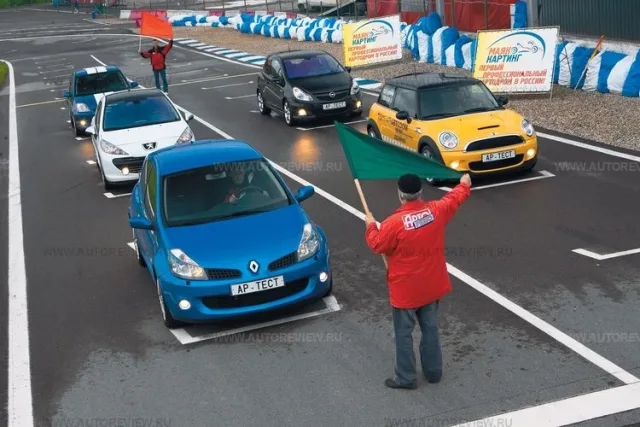
When Kirill Ladygin was preparing for the final run at the track in Myachkovo, it started drizzling again. Would he make it in time? After all, the famous racer still had to complete his laps in the last of our "hot" hatches — the charming Mini Cooper S.
Kirill made it before the bad weather. But getting out of the Mini, he said he would only give it second place. And in first place... Ladygin had a rich choice: Ford Fiesta ST, Opel Corsa OPC, Renault Clio RS. We gathered in one place almost all the "hot" B-class hatches sold in Russia! Only the Peugeot 207 RC was missing in Myachkovo. But the next day, for tests at the Dmitrov test site, we found the Peugeot too!
And despite the rain, we found out who was the fastest.
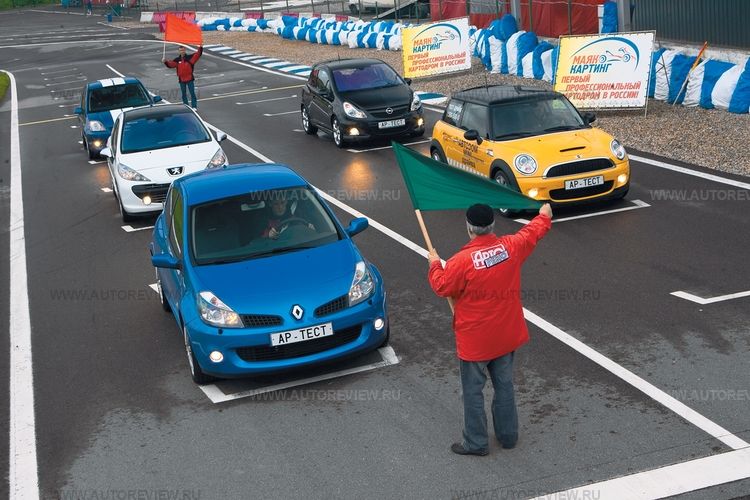
Rain is rain: nothing to be done. We can't cancel the performance measurements! Especially since all five cars are in the same conditions: all front-wheel drive, "free" differentials (none have locks) and fresh "original" tires. True, the Renault is the most powerful — 197 hp from two liters of naturally aspirated displacement. For comparison, the Fiesta ST also has a two-liter "atmospheric" engine, but it produces only 150 hp, like the regular "civilian" versions.
The Opel Corsa, refined by the OPC studio, is also not simple — 192 hp from a 1600-cc turbo engine. And the Mini Cooper S and Peugeot 207 RC make do with 175 turbo horses — they have the same 1.6 engines.
Moreover, in terms of power-to-weight ratio, that is, the ratio of power to mass, the order is the same — the Clio RS leads (197 hp divided by the curb weight we measured at 1286 kg gives 153.2 "specific" horsepower per ton). Almost close is the Corsa OPC (151.4), the Mini Cooper S lags slightly (143.0), the Peugeot 207 RC is heavier (135.9). And the Fiesta ST, although the lightest (1142 kg), closes the list with a result of 131.3 horsepower per ton.
Will this lineup be confirmed on the dynamometer road?
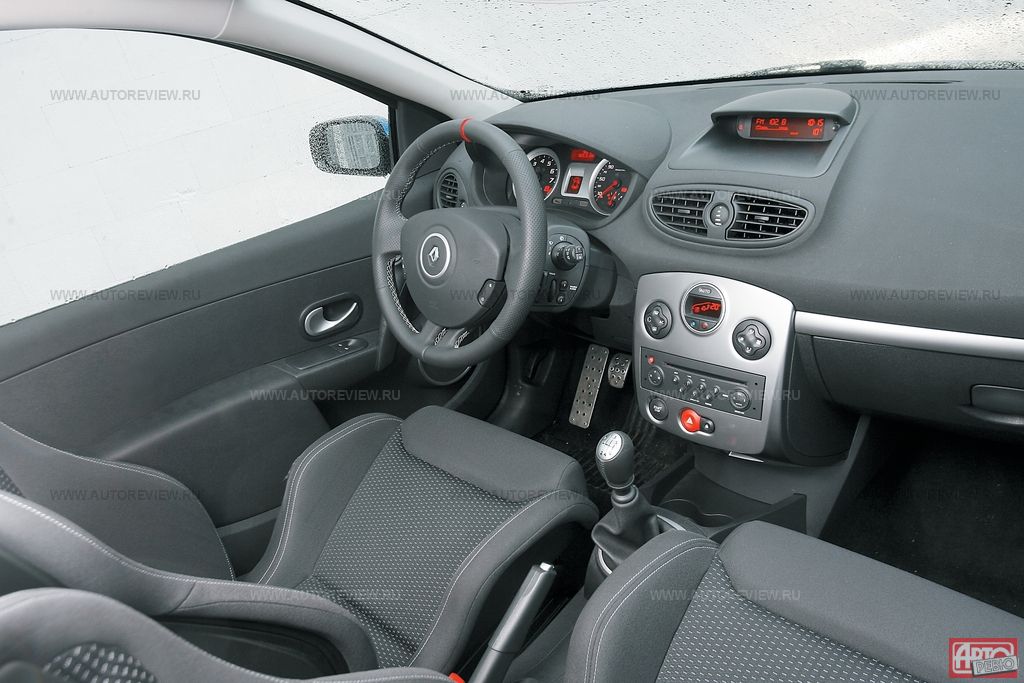 |  |
| Renault Clio RS: sport here is in the details — steering wheel and pedals |
Andrei Mokhov, together with Ivan Ivanovich Shadrichev (also known to everyone as Uncle Vanya), took the Peugeot 207 RC and went to the "dyno". And I, with expert Yaroslav Tsyplenkov, settled into the Opel: let's see what kind of beast it is.
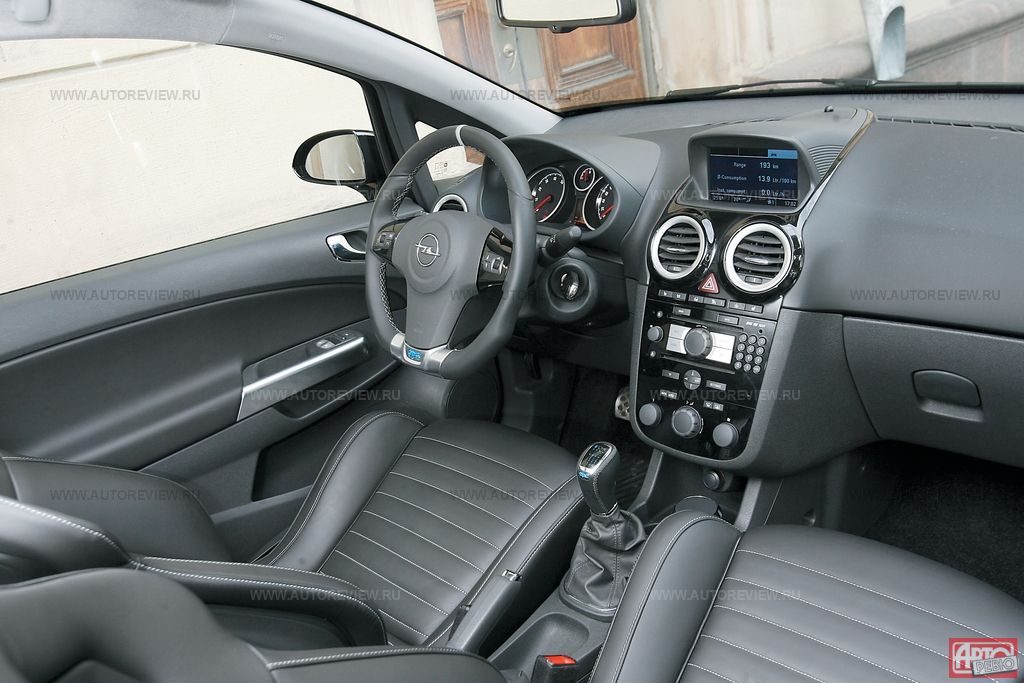
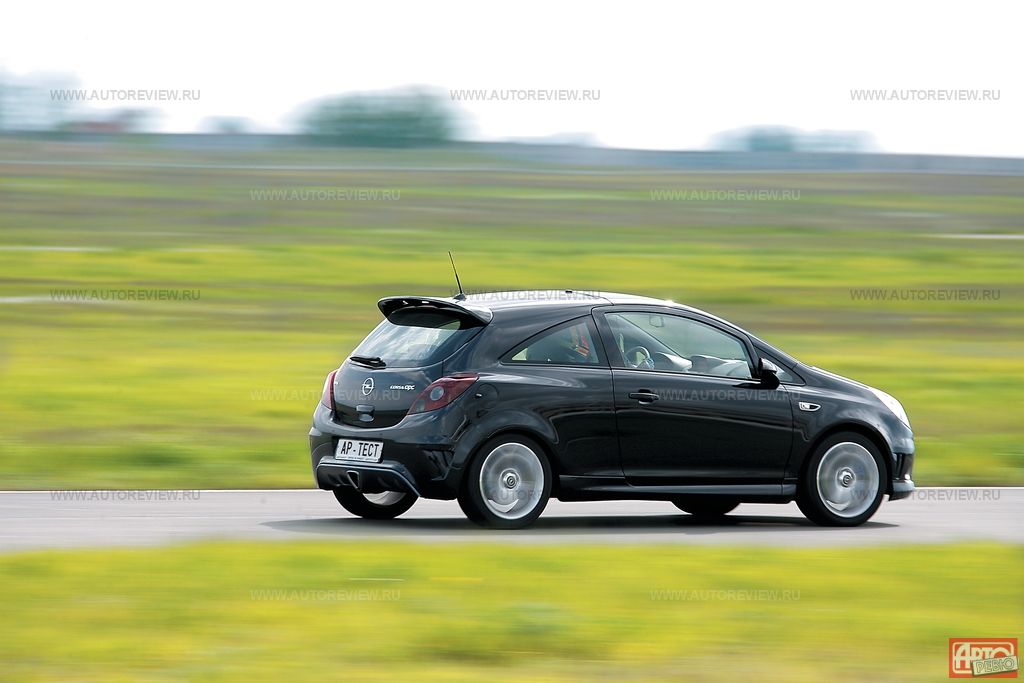
In terms of the number of "racing" gadgets, the Corsa OPC is unrivaled. Gills in the bumpers, non-folding mirrors on legs. And at the back, both a diffuser and a spoiler, and tinted lights... Only a "street racing" sticker is missing.
| Ford Fiesta ST | Mini Cooper S | Opel Corsa OPC |
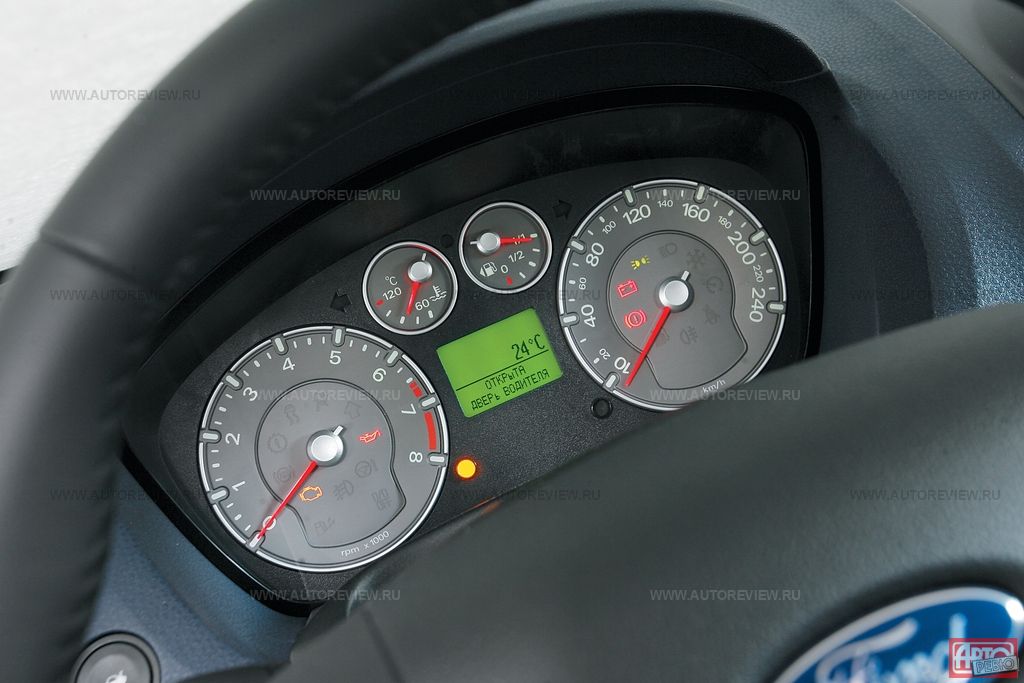 | 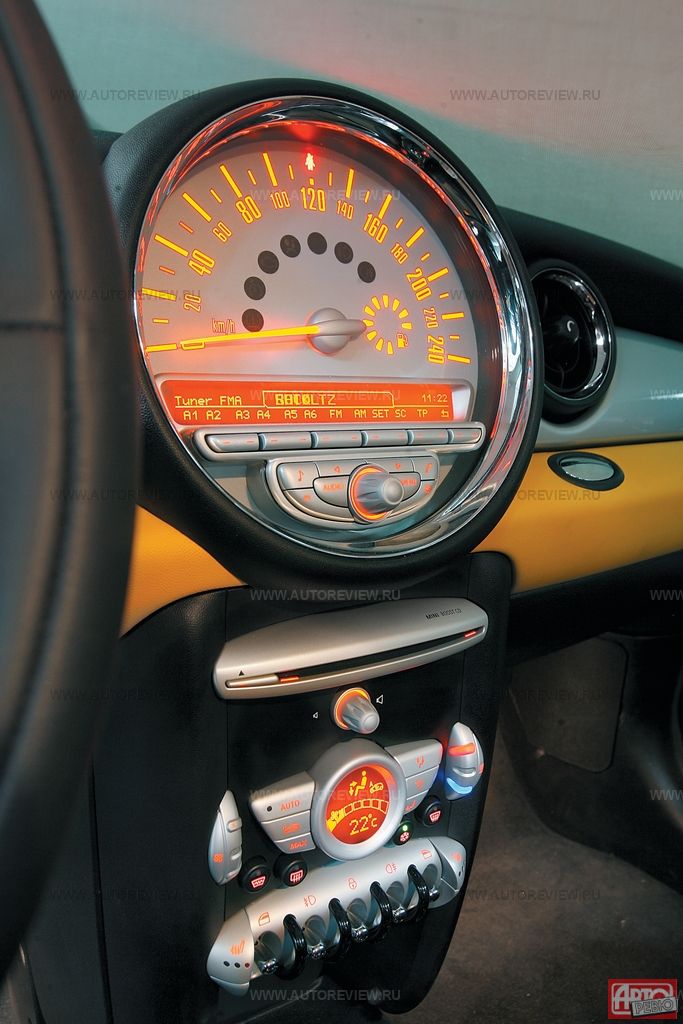 | 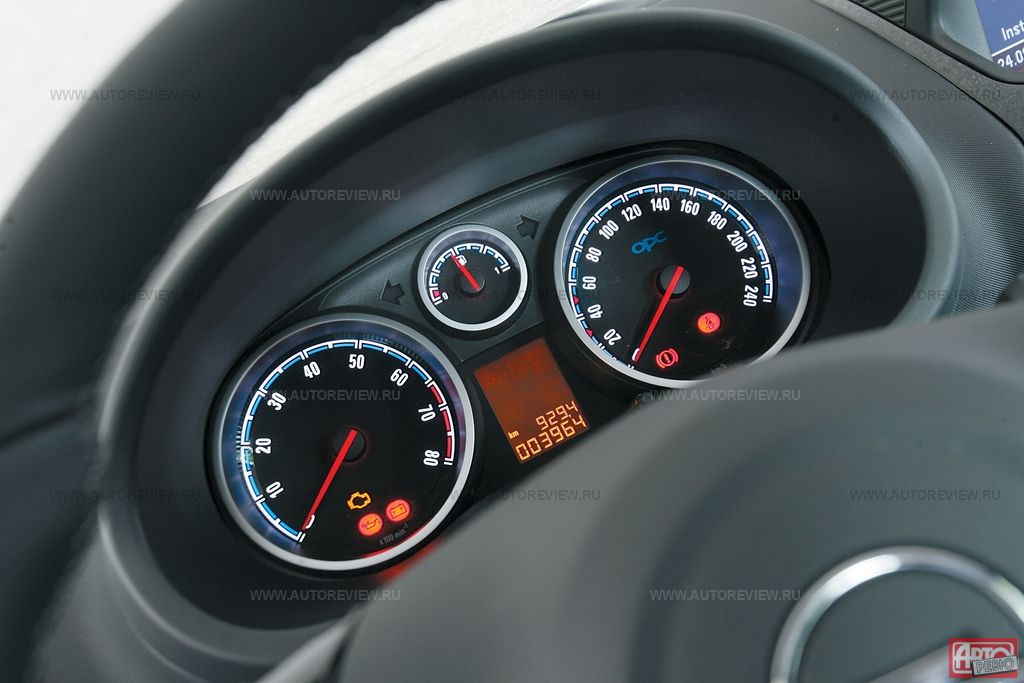 |
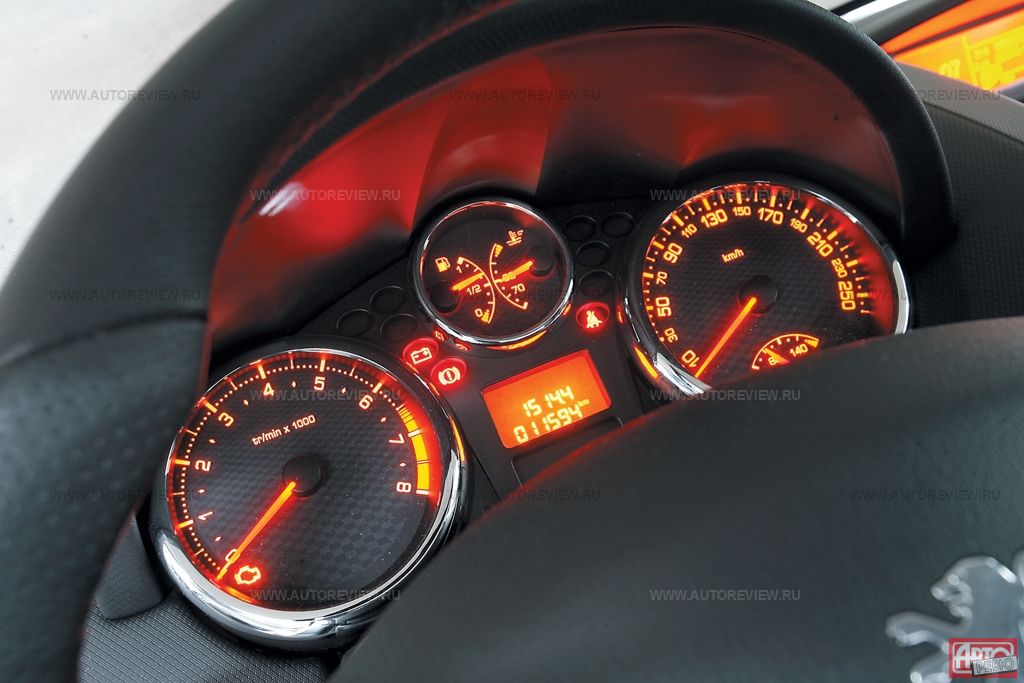
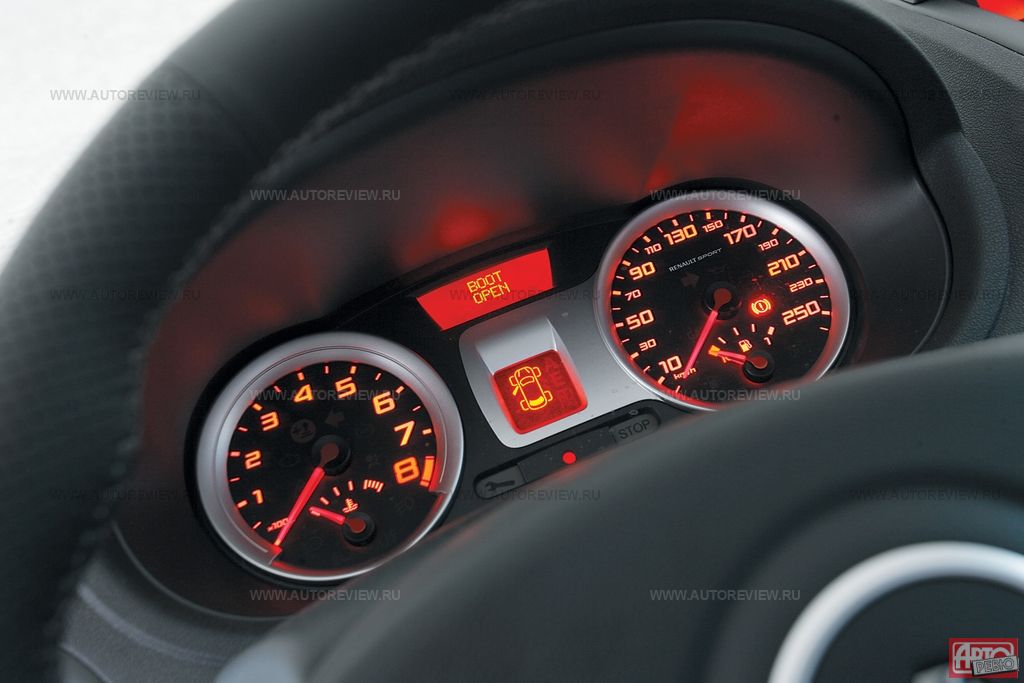
| Peugeot 207 RC | Renault Clio RS | The most understandable instruments are in the Renault. The Peugeot dials are more richly styled, but their small "radial" numbers are harder to read. The Opel's instruments suffer from the same drawback, and the Ford also let down by its color scheme: white numbers get lost on a gray background. The Mini's speedometer is easier to spot from a neighboring car than from the driver's seat: here the pilot's main tool is the tachometer, which hangs on the steering column |
 |  |
Getting behind the wheel is hindered by the rigid side bolster of the leather Recaro seat. But here it's a pleasure: I'm puffing like a real racer! And the "zero" mark on the steering wheel looms right in front of my nose.
The engine rumbles bassily at idle. Let's go!
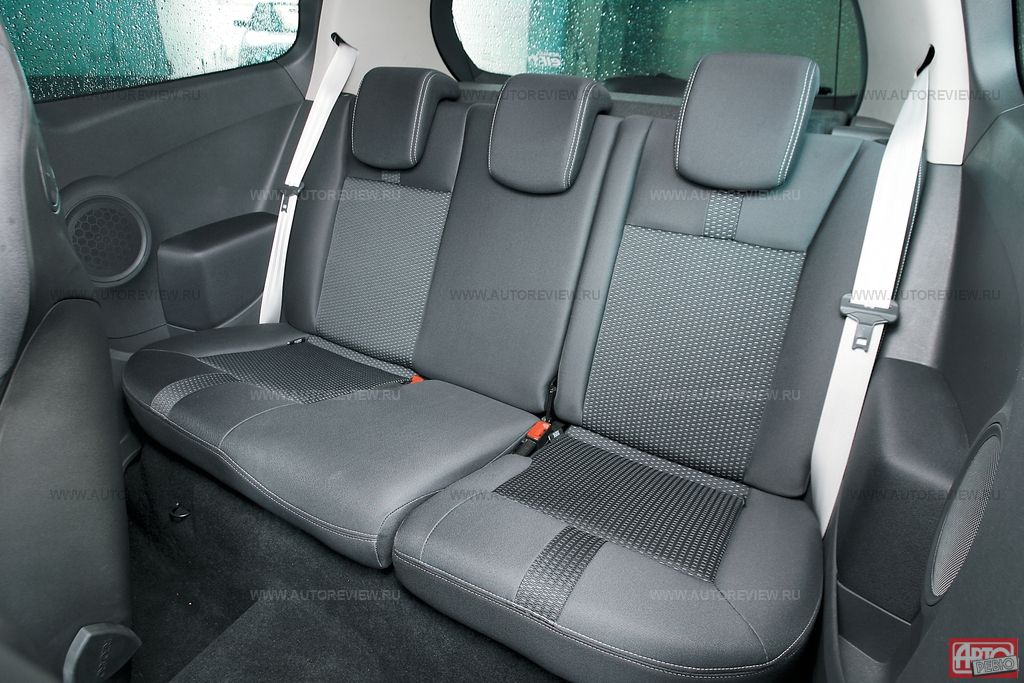 | 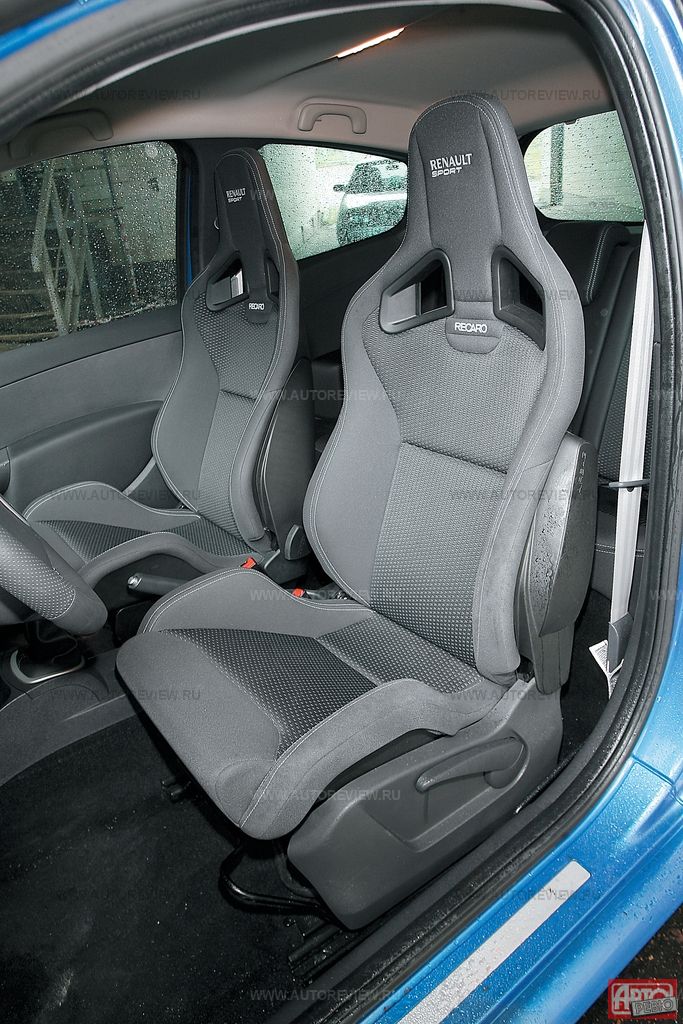 |
| The rear seats of the Clio RS are quite suitable for three brave passengers with a strong vestibular system | The fabric Recaro "buckets" for 35 thousand rubles in the Clio RS are the best in the five, but the slightly less contoured standard seats are more practical |
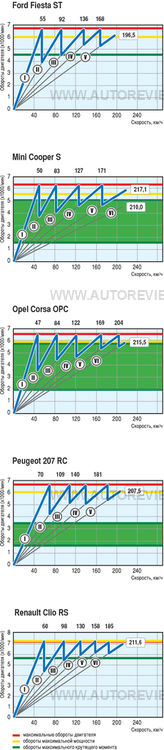
Getting moving is hindered by the "rubbery" gas pedal and thoughtless clutch. But the turbo engine is good — it pleasantly wakes up after 2000 rpm and... Hits the limiter already at 6500 rpm. First gear spun out instantly! Shifting to second — with a strong jerk. Powerful acceleration, but only up to 84 km/h: very "short" gears! Third — again a jerk. What's going on — the gas and clutch are so uninformative that smoothly shifting "up" is simply impossible!
Moreover, the Corsa's steering is too sharp: from lock to lock — less than two and a half turns. This could be pleasing if it weren't for that torque steering — parasitic steering under load, typical of powerful front-wheel-drive cars: on acceleration, the wheel constantly tears out of your hands! The brakes are also "angry" — the pedal is sensitive, and during hard braking, the "thoughtful" ABS allows long wheel locking.
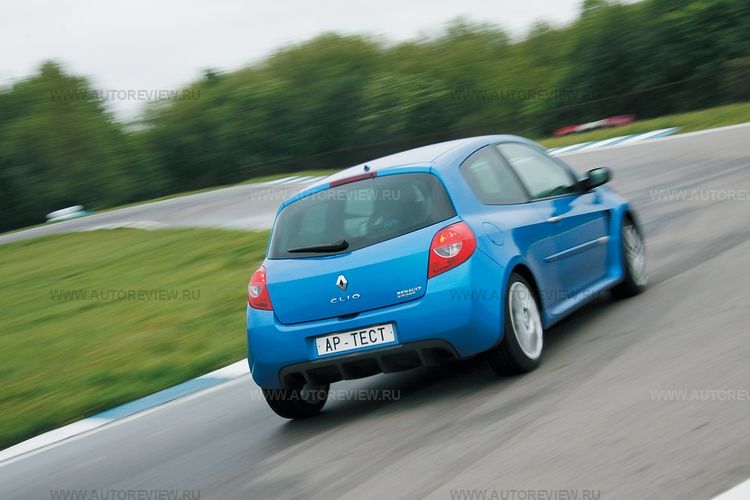
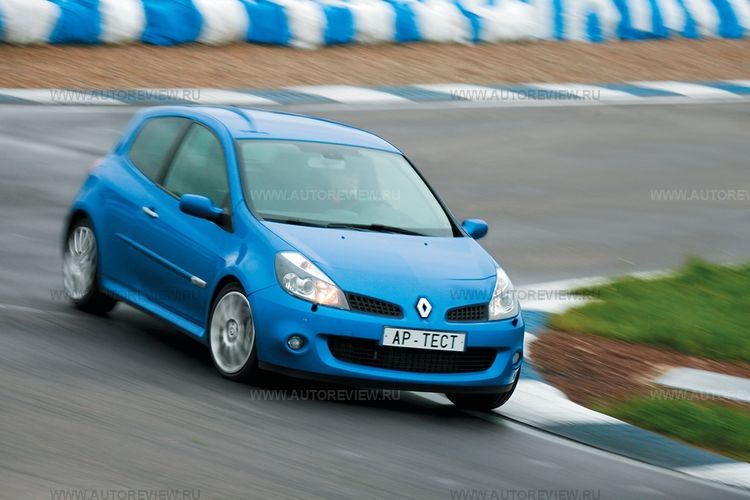
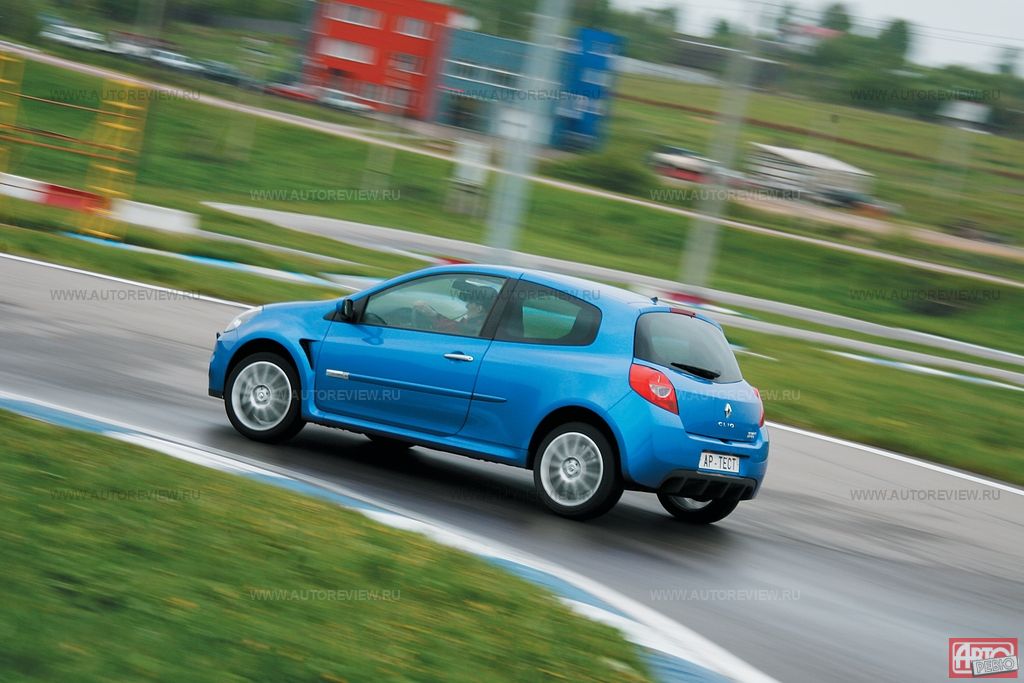
The Clio Renault Sport stands out for its simple, understandable, but exciting handling: "aiming" before a tight turn at the Mayak kart track is a piece of cake
And the handling is ambiguous. On bumps, the Corsa OPC darts sideways, the steering wheel "empties" — and the worse the road, the stronger it is. The "Opel" turns with delays — first it rolls, then softly settles into the arc. At corner entry, the rear axle slides smoothly, at exit, under load — the front. But the stability system is on guard. Although a couple of times after active correction, the electronics "went crazy" and turned off, requiring a "restart".
And, of course, comfort is not about the Corsa OPC. The Corsa doesn't notice asphalt joints and cracks, but larger bumps respond with impacts and make the car sharply roll from side to side. Good that sound insulation is decent: the rumbling exhaust note, pleasant on acceleration, presses on the ears only at constant speed.
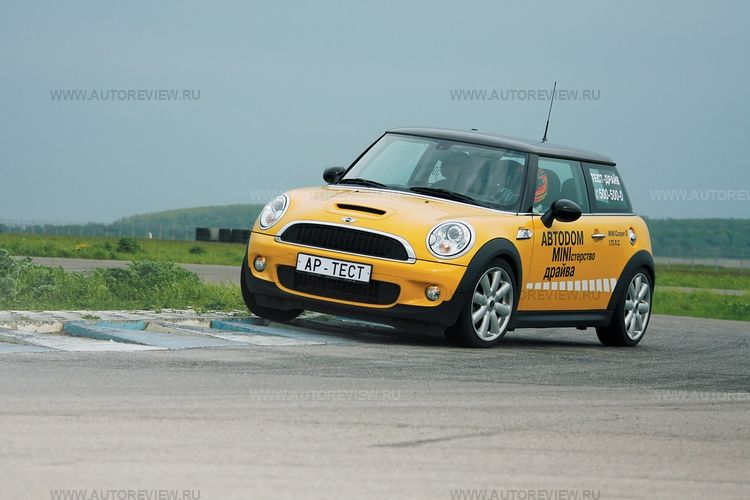
Even with the "automatic", the Mini Cooper S is the fastest car on the race track. But on bad roads it is too nervous and shaky
The Corsa tired me out. Take it to the "dyno" — let it put on its performances there! And we'll take the Peugeot 207 RC, which just returned from measurements.
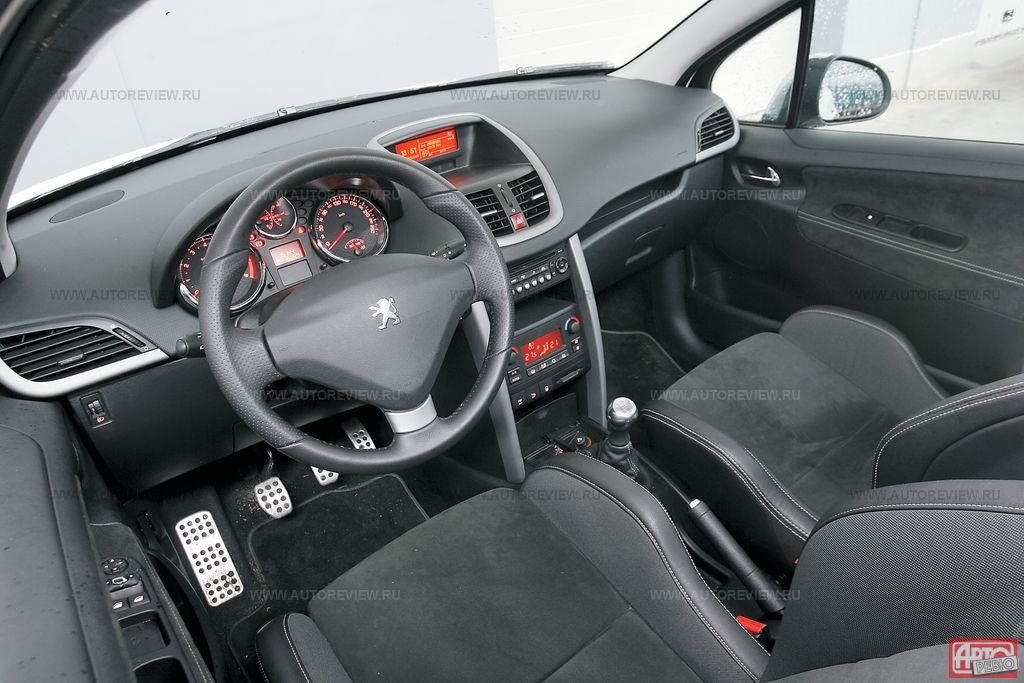
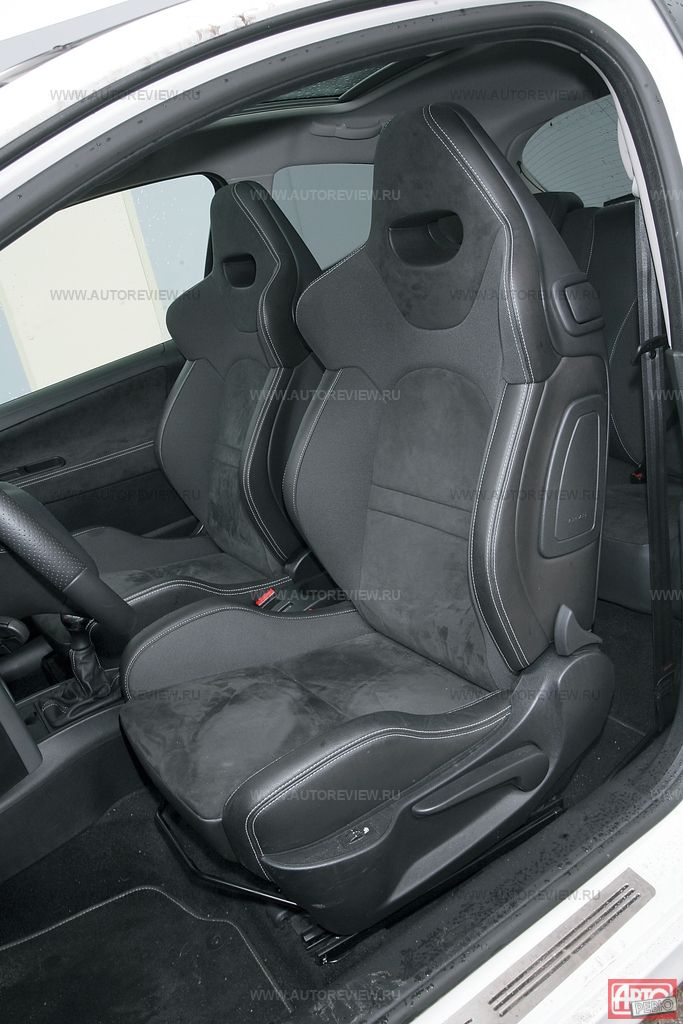
The snow-white "lion cub" doesn't look angry at all externally — only the large wheels, "rear wing" and twin exhaust tips stand out. Getting behind the wheel is more comfortable than in the Corsa — the seat's side bolsters are set wider and easily yield under load. The mood is relaxed: chrome instrument rings, optional glass roof. You want to look not at the road, but at the sky.
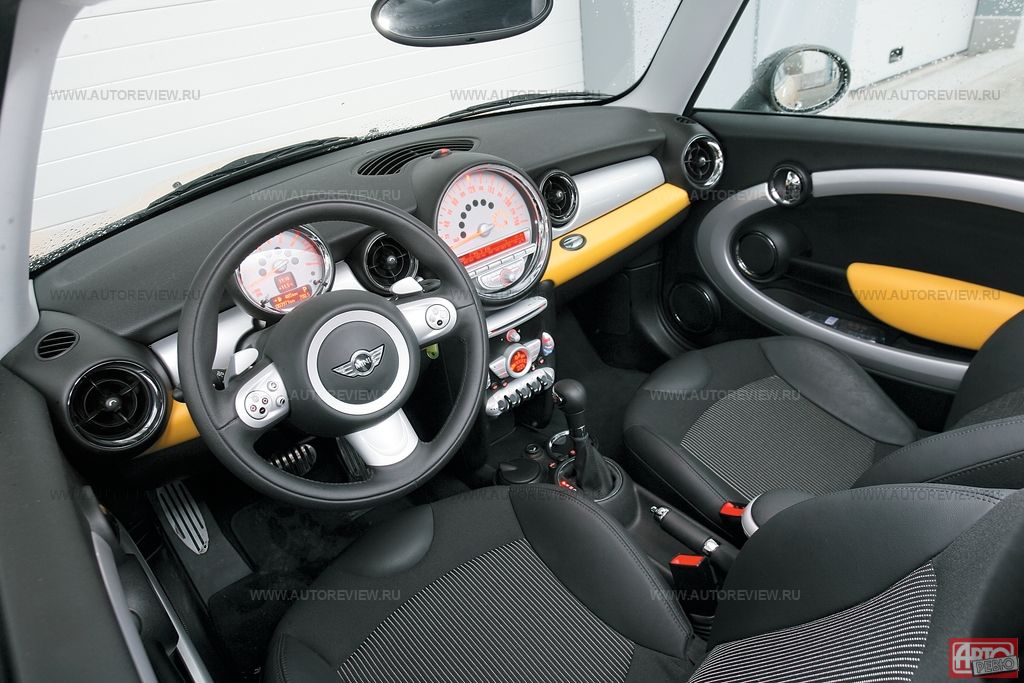 | 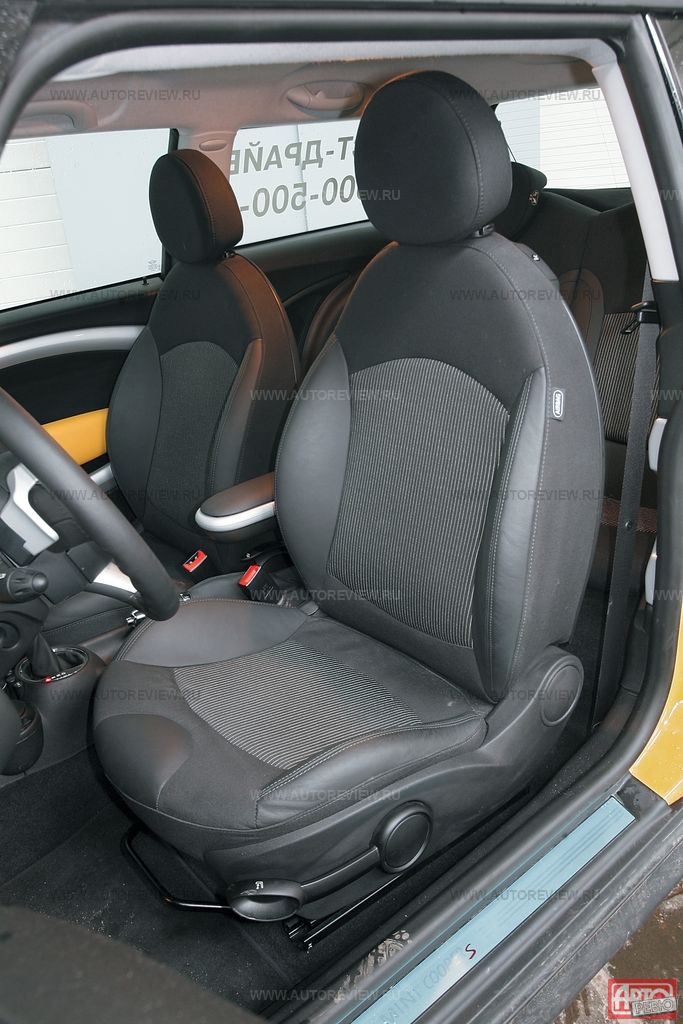 |
| Mini interior: great ergonomics — and a showcase of stylish accessories | The Mini has the lowest seating position, and the seat pleases even against the background of competitors' "buckets" |
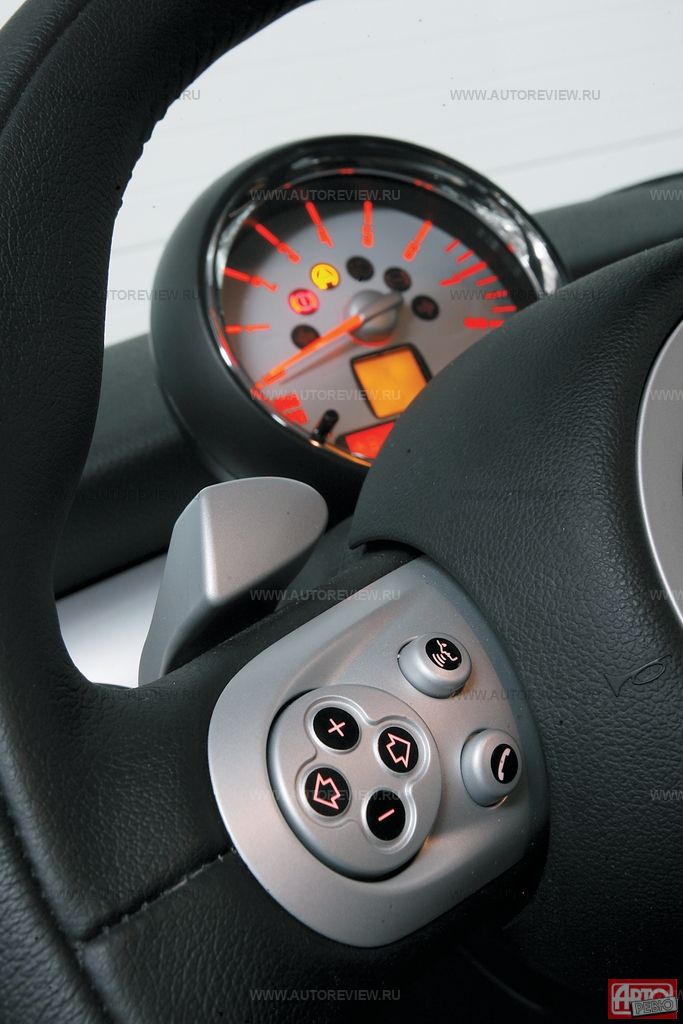 | 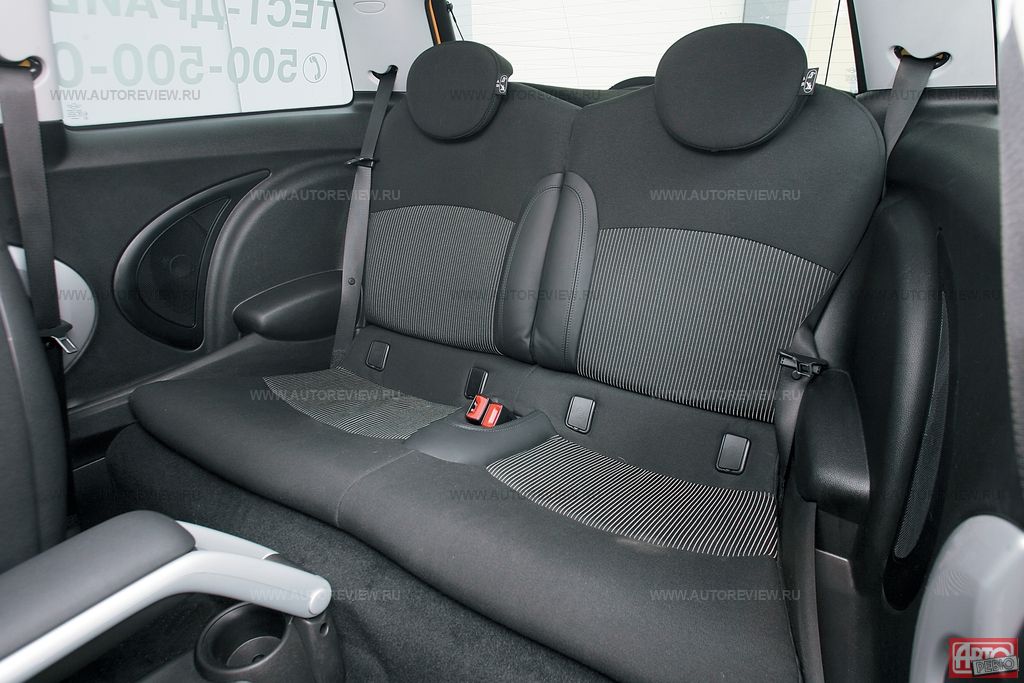 |
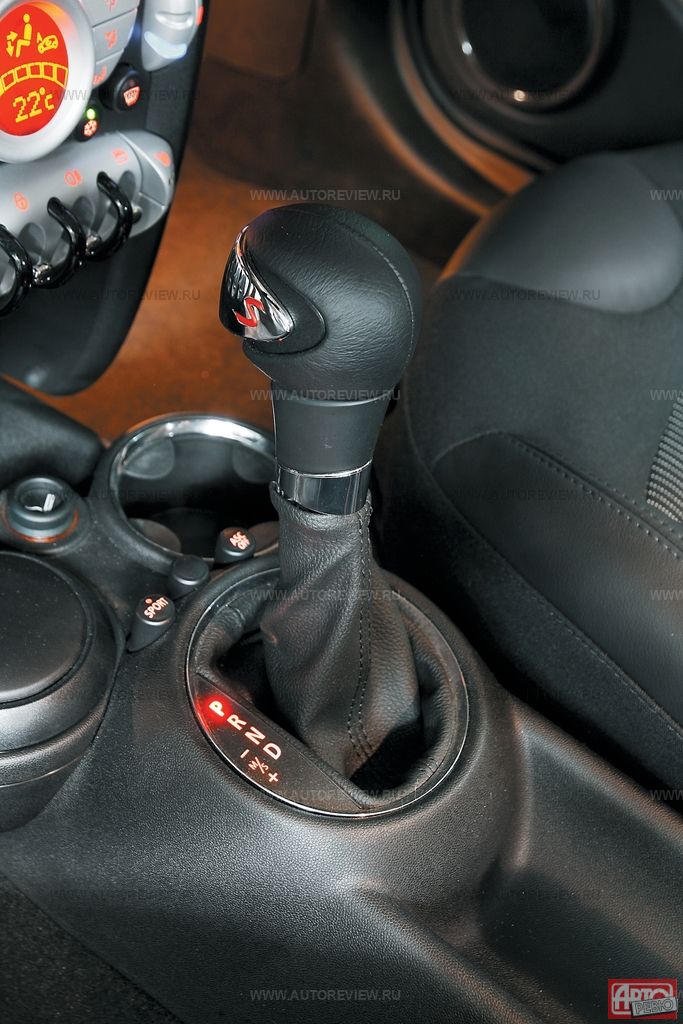
| From the Mini's "automatic", you can shoot without taking your hands off the steering wheel | In the back of the Mini, two "mini-people" fit |
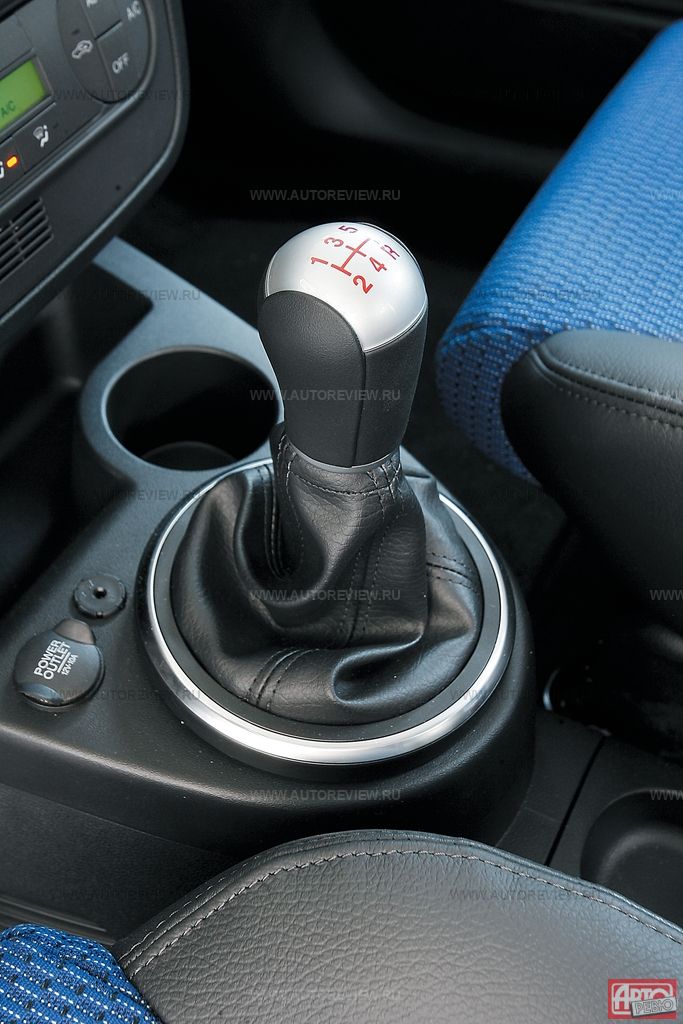
Starting off and shifting gears here is noticeably easier than in the Opel — the only thing that slightly gets in the way is the long throws of the five-speed gearbox lever, although the gears themselves engage crisply. The turbo engine pulls smoothly and confidently across the entire range, only livening up slightly after three thousand rpm. The gears are long: second stretches all the way to 109 km/h. For everyday driving this is good, but it naturally affects acceleration dynamics.
| Ford Fiesta ST | Mini Cooper S | Opel Corsa OPC |
 |
 |
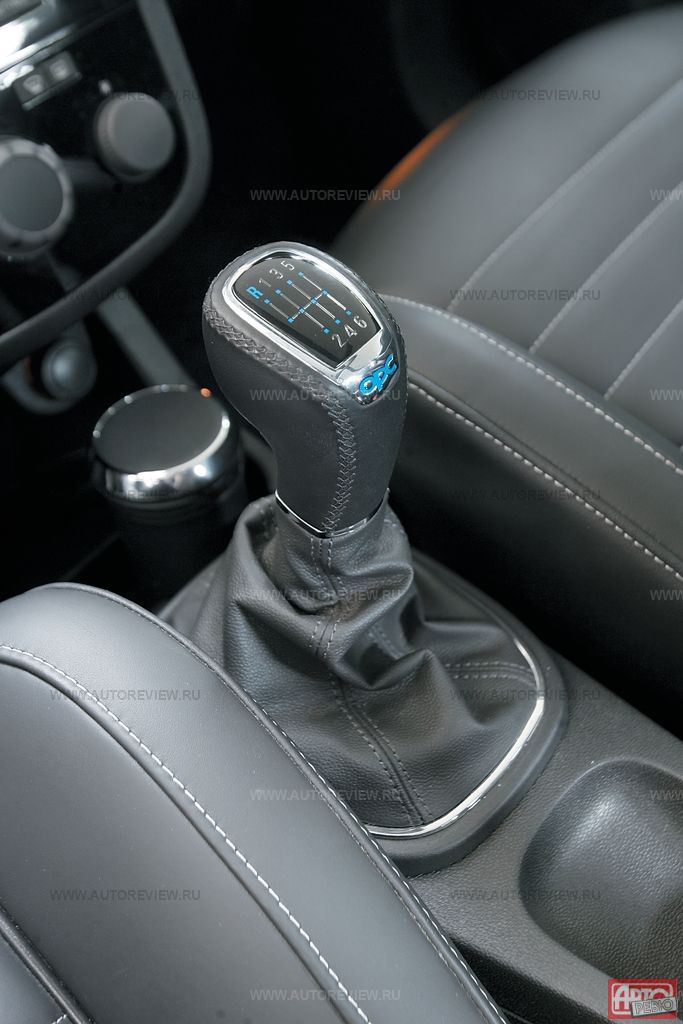 |
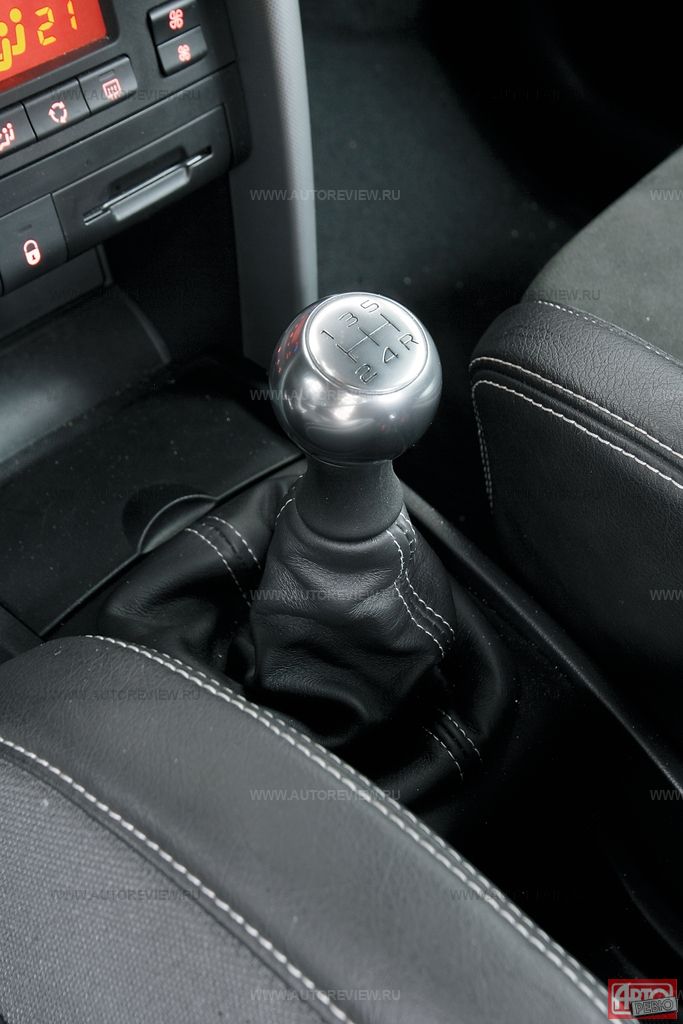
| Peugeot 207 RC | Renault Clio RS | The Mini's "automatic" shifts quickly and transparently. But the best "manual" is in the Renault: here the gear ratios are well chosen, and the engagements are crisp. The Ford's gearbox is slightly inferior in both aspects. The Opel's gears disappoint with excessive "shortness," and the Peugeot's with long lever throws |
 |
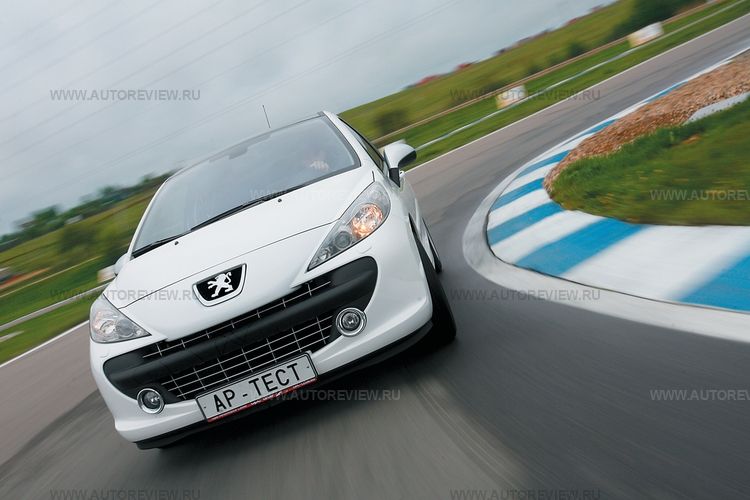
On perfectly smooth asphalt, the Peugeot flies confidently, only slightly widening its dynamic corridor. But as soon as the road deteriorates, the "lion cub" loses its composure: like the Opel, it starts to wander off the trajectory and tug at the steering wheel. However, the driver here is less stressed: excellent self-centering action and low steering sensitivity come to the rescue.
In corners, the "Peugeot" holds up excellently: reactions are soft and unambiguous, with no deviations from the trajectory. On lift-off, there's a slight oversteer of the rear axle, which even a novice can manage. And in terms of ride smoothness, the Peugeot 207 RC surpasses the Corsa OPC: impacts from large bumps are felt just as strongly, but the "Frenchman" is far less tied to the road surface profile. It can't be called noisy, but it's not quiet either: tires hum, pebbles tap against the arches. However, the engine could sing louder — its contented purr is only heard under acceleration.
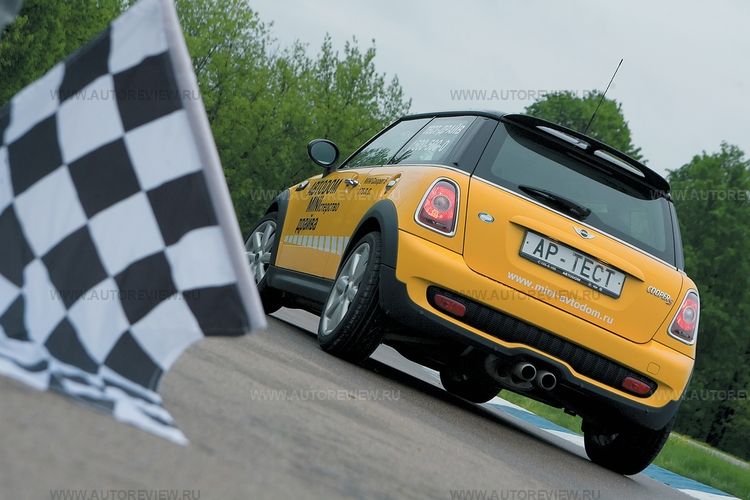
The Peugeot doesn't ignite! But the Mini Cooper S with the same 175-horsepower turbo engine is a completely different story!
Here you sit lower than in any of the other cars. Growling deeply, the turbo engine pulls confidently from the very bottom, and at 2500–3000 rpm there's a pleasant push in the back — the related Peugeot engine has a much smoother character. The "automatic" is just a song! Yes, yes, "our" Mini turned out to have an automatic gearbox. And we don't regret it one bit — shifts are fast, smooth, and predictable. Additionally, there's a Sport mode, manual mode, and paddle shifters.
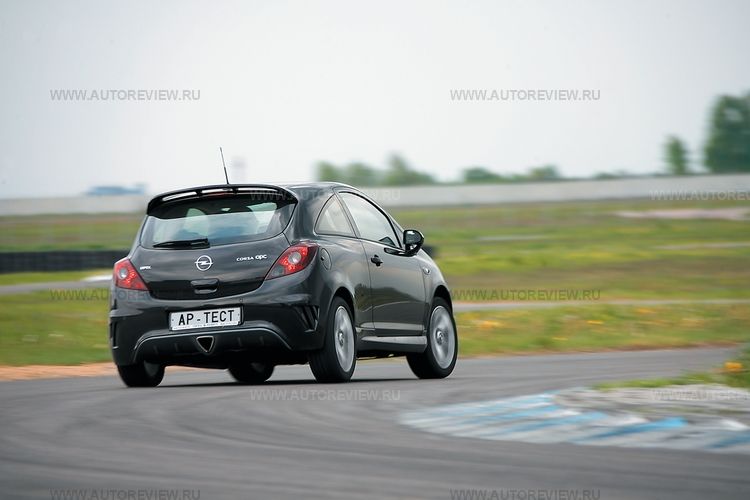
On smooth asphalt, the Mini delivers a lot of pleasure: instant reactions, a steering wheel filled with effort, excellent brakes, and a death grip on the trajectory. But on broken roads, the Cooper S starts darting from side to side on potholes and ruts, "shuffling" on road waves. And ride smoothness... It simply doesn't exist! The "Mini" counts every seam and crack, falters before harsh bumps, and bucks unpleasantly on short waves. Surely part of the blame lies with the "run-flat" tires with stiff sidewalls that the Cooper S comes standard with. And they're also noisy.
In short, the Mini is good, but not for our roads.
And what about the Clio Renault Sport?
 |
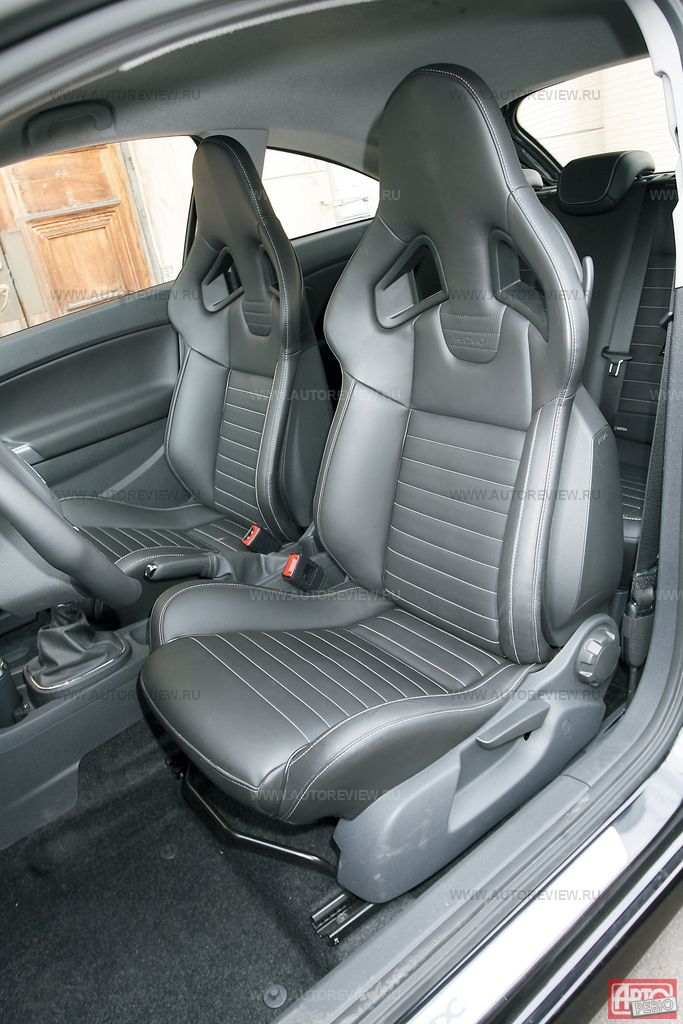 |
| The steering wheel and gear lever knob scream the Corsa's uniqueness with extravagant shapes | Great seats are standard equipment: you'll only have to pay extra for leather upholstery (30 thousand rubles) |
 |
 |
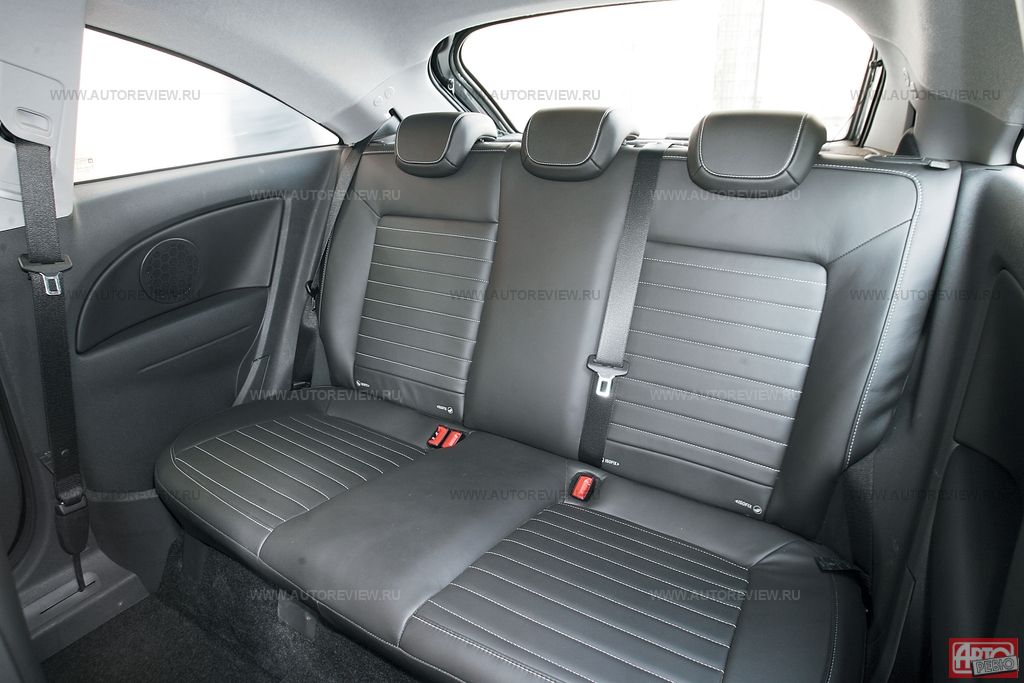
| In the back, the Corsa OPC is slightly less spacious than the Clio RS |
Remember its modest predecessor? There you couldn't find not just a flashy rear wing, but even an exhaust pipe! The new Clio RS has shed its mask: a wide mouth of the front air intake, flared fenders — and a dashing diffuser, as if from Formula cars.
The seating position in the optional Recaro "bucket" is higher than in the previous cars, but it's also tighter. The stiff clutch engages at the very end of the pedal travel, but that doesn't bother us. Acceleration is combative! From the bottom, the two-liter naturally aspirated engine revs reluctantly, but after 2000–2500 rpm it wakes up and, with a high "Formula" roar, delivers excellent thrust — all the way up to the limit of 7500 rpm. Gears engage crisply, brakes are class-leading, and the ABS and stability control work effectively and smoothly. At the same time, during acceleration and at high speed, the Clio RS doesn't dart in ruts or get knocked off course in corners. The Renault responds to steering inputs quickly, but not sharply like the Mini or Opel. And in corners on lift-off, the Clio RS breaks into oversteer without hesitation, allowing you to "set up" before sharp bends.
| Ford Fiesta ST | Mini Cooper S | Opel Corsa OPC |
 |
|
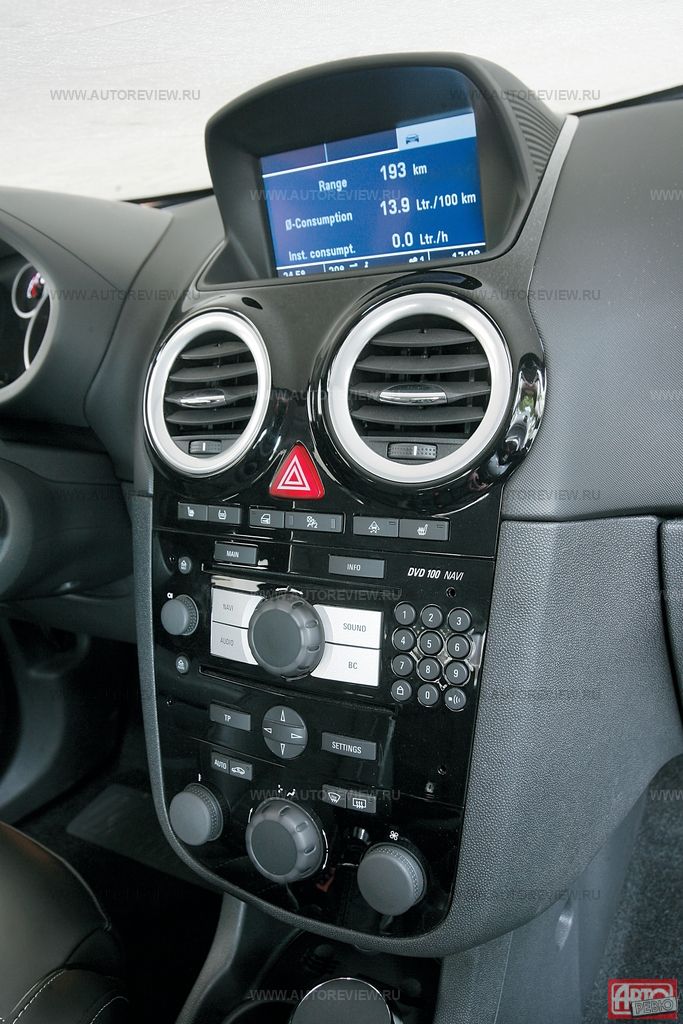 |
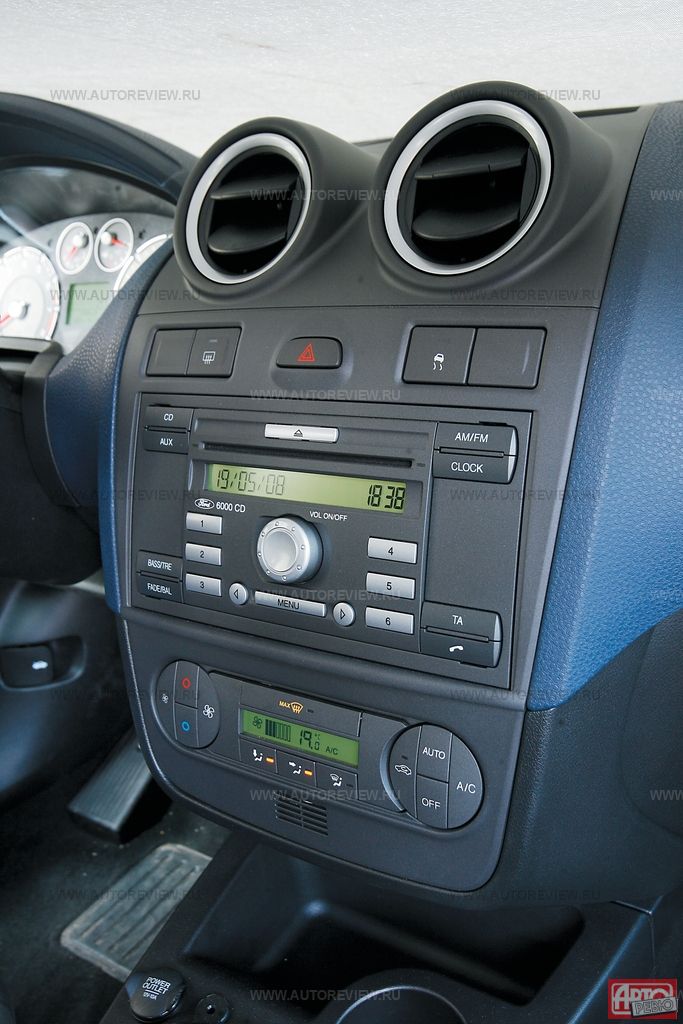
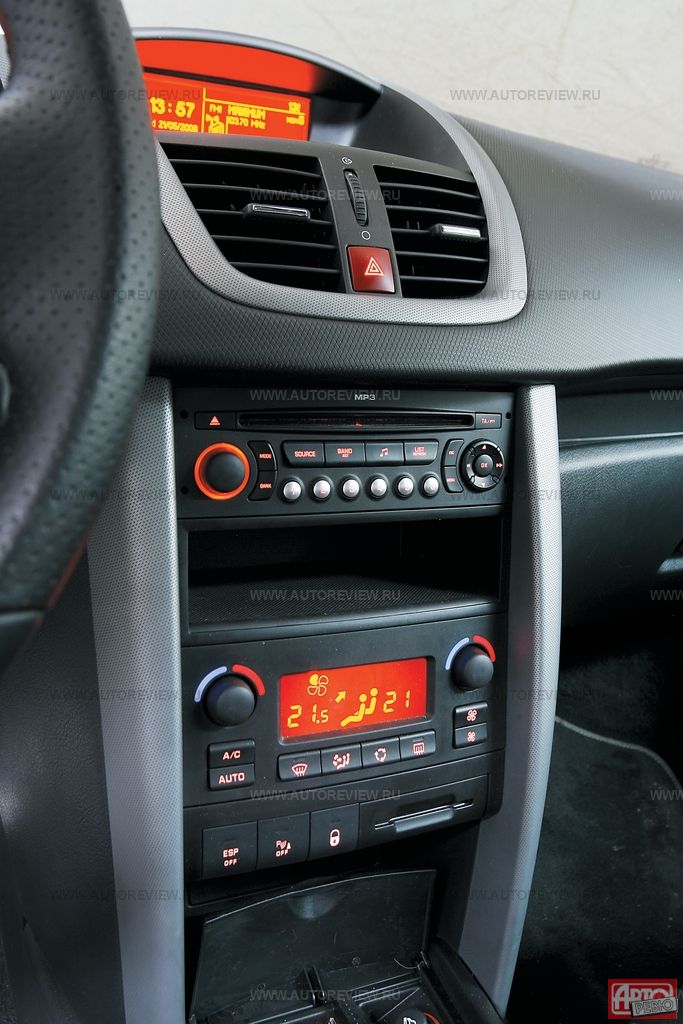
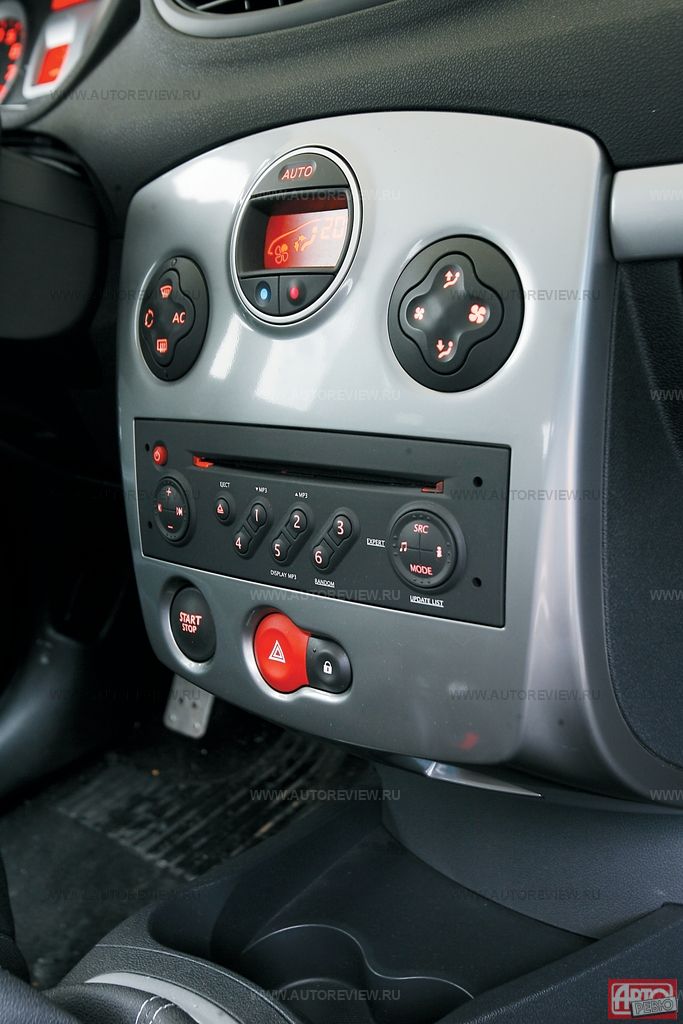
| Peugeot 207 RC | Renault Clio RS | Only the Peugeot 207 RC can boast dual-zone climate control. But controlling the microclimate in the Ford and Mini is more convenient: each airflow direction has its own button here — while in the other cars you need to repeatedly press the same button or, in the case of the Opel, rotate a non-latching knob |
 |
 |
And comfort is top-notch! The Renault barely notices road "small stuff," transmits harsh bumps into the cabin in a rounded form, and follows waves actively but, unlike the Peugeot 207 RC, without "sighs" and lateral rocking. It's also quiet inside — the engine howls only at "cruising" speeds, since our Clio RS, brought into Russia a year ago as a showroom sample, has "short" top gears. On new cars, to reduce noise, fifth and sixth gears were made "longer."
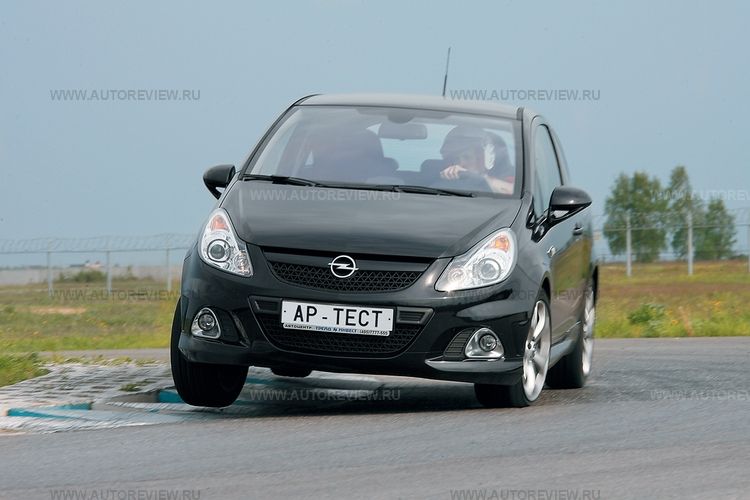
On the race track, the Opel Corsa OPC pleases with its engine and handling, but its suspension is poorly suited for aggressive driving
Meanwhile, Uncle Vanya and Mokhov were "measuring" almost all the cars. Yaroslav and I gave them our beloved Clio, and we ourselves moved to the last of the five hatches — the Ford Fiesta ST.
There's too little sportiness... The seating position is as high as in the Clio RS, but the seats are soft. The little engine hums peacefully at idle and easily gets the Fiesta moving. The accelerator here is no less damped than in the Opel, and acceleration, though brisk, is even. Additionally, the short transverse throws of the gear lever and "mushy" gear engagements get in the way. The brake pedal is also a bit stiff.
At high speed, the Fiesta ST is as stable as the Clio RS — it flies straight, ignoring potholes and ruts. The steering wheel makes only 2.3 turns from lock to lock, but the Fiesta enters an arc softly. The little car holds the trajectory firmly even on broken roads, and in response to lift-off, it immediately, though not as actively as the Renault, starts sliding with the rear axle. Only the vibrations on the steering wheel caused by road irregularities disappoint. And also the fact that the effort on the Ford's "sharp" steering wheel "lags" behind the steering angle.
The smoothness with which this car moves is reminiscent of the "207": the Fiesta responds more actively to small joints, but handles serious bumps more confidently and "rocks" on road waves just the same. However, acoustic comfort lets it down: the engine runs too loudly, and stones hitting the underbody are clearly audible.
 |
 |
| Peugeot interior: style — yes, sport — no |
Peugeot's "buckets" are the most spacious and soft in their class |
 |
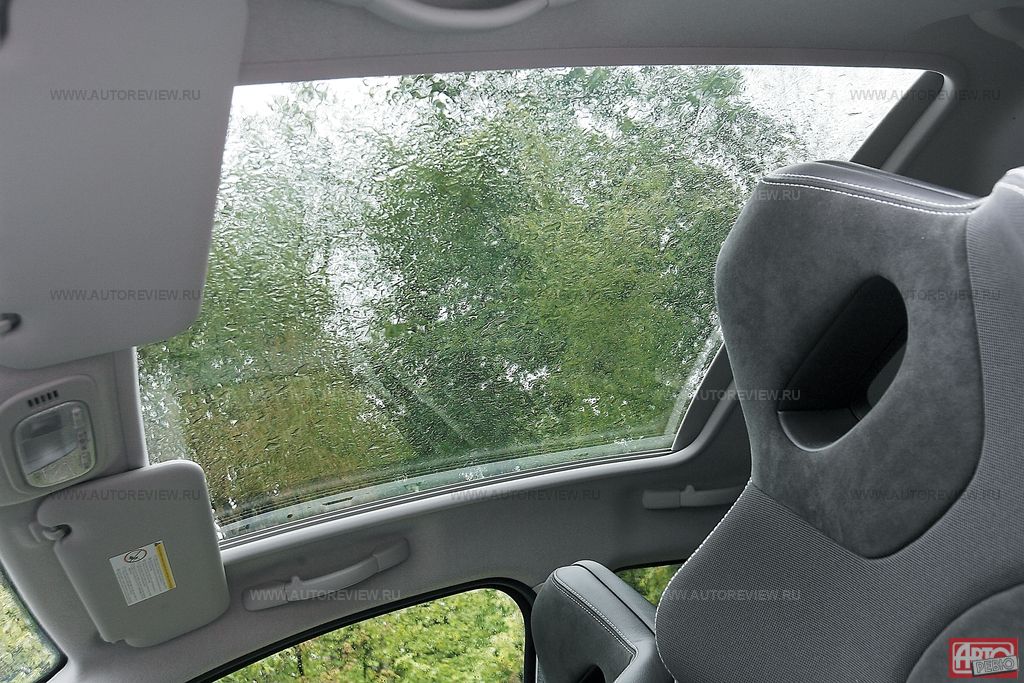 |
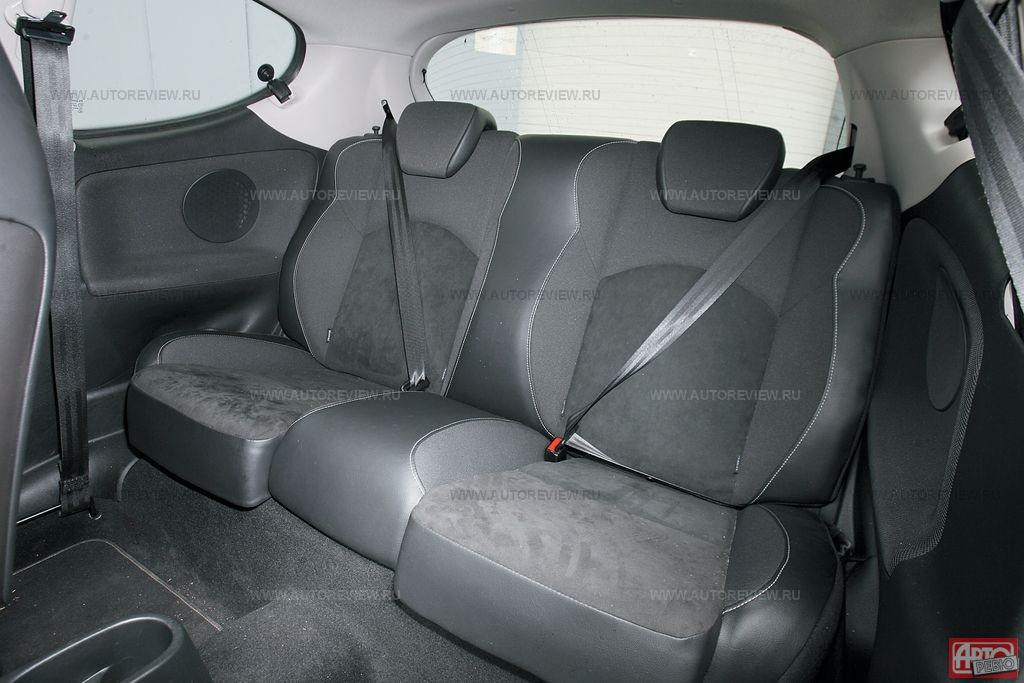
| In the back, the Peugeot, like the Mini, is a two-seater, but there's noticeably more room here. Plus opening quarter windows | The glass roof is an option available only for the Peugeot (pictured) and the Mini. And for the Cooper, it's not just a window to the sky, but a sunroof |
 So what did the measurements show?
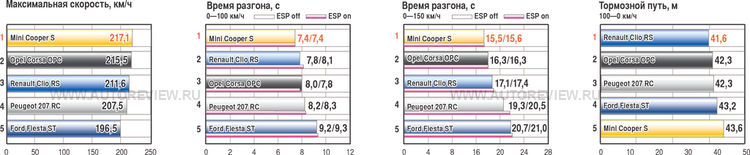
We look at the protocol printed out by Mokhov — and can't believe our eyes. The fastest to 100 km/h was the Mini Cooper S with the "automatic" — 7.4 seconds! That's three-tenths faster than last year's result of the Mini with the "manual" (see AR No. 12, 2007). The reason is likely the engine's weather dependence: it likes cold (and therefore denser) air more than hot — last time it was 34-degree heat, and now it's only plus seven. Second place in the sprint was shared by Opel and Renault: 7.8 seconds. Moreover, on the Clio RS the best result was achieved with the stability control system off, and on the Corsa OPC — with it on.
Interestingly, the Peugeot 207 RC with the "manual" is noticeably slower than the Cooper S with the same turbo engine and "automatic" — 8.2 seconds. After all, the Peugeot is not only heavier than the Mini, but also suffers from "long" gear ratios. And in last place is the Ford Fiesta ST with a result of 9.2 seconds.
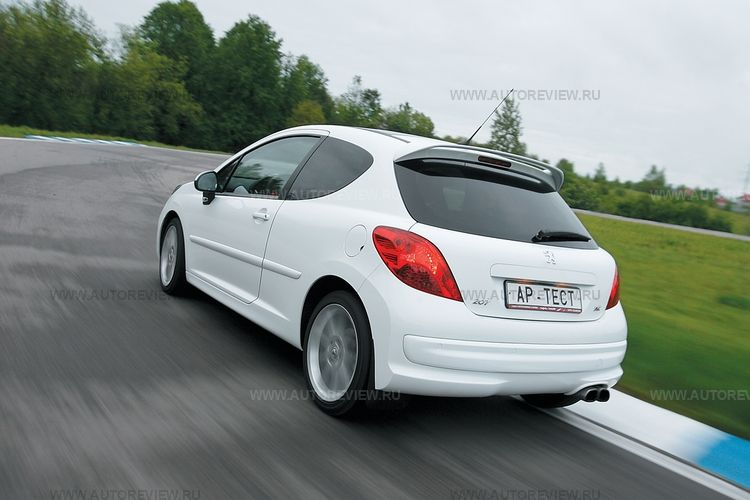
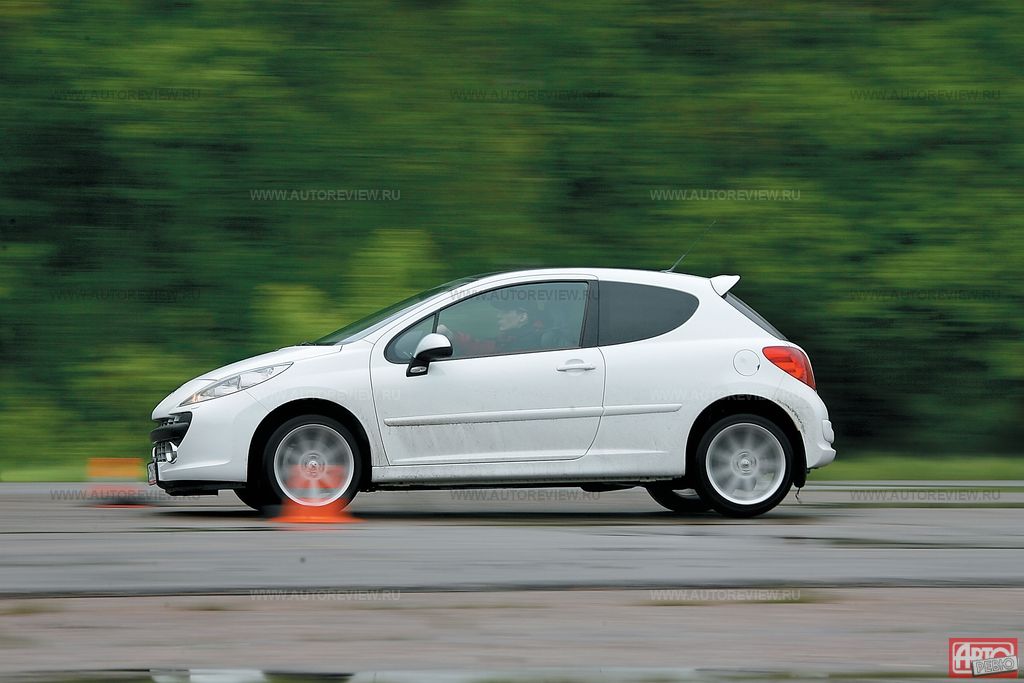
Peugeot 207 RC is fast and understandable, but not "hot"
By the way, note that we made all measurements on wet asphalt — and yet the cars showed very good results!
And in Myachkovo we raced on dry pavement. But the layout is still similar. The fastest on the track is the Mini Cooper S, even though it has an "automatic". Maximum lateral G-forces — 1.25 g, braking deceleration — up to 1.3 g! A real fighter.
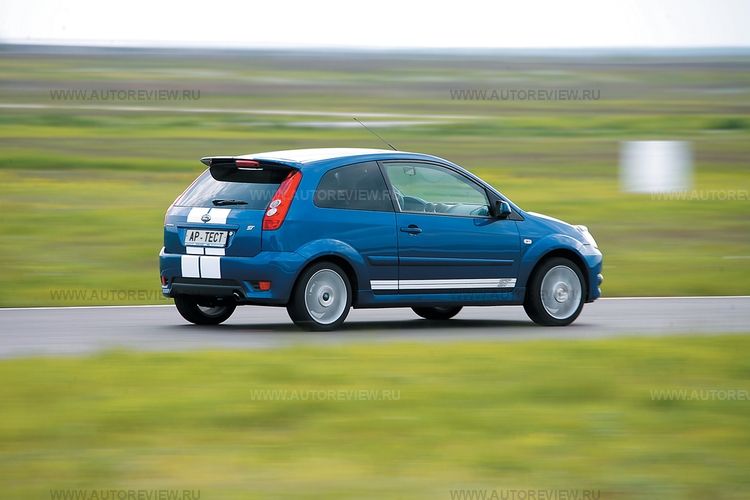
Next comes the Clio RS, which Kirill Ladygin rated even higher than the Mini in terms of handling. And the Corsa OPC and especially the Fiesta ST lag behind on the race track.
So, is the best hot hatch the Mini Cooper S?
Yes, it's the fastest. And the most stylish. But it's also the most cramped, bumpy, and jerky on our roads. That's why the Cooper S scored the fewest expert points in the final table. So the Mini is for those who don't think about comfort at all and are ready to constantly "tame the shrew".
 |
 |
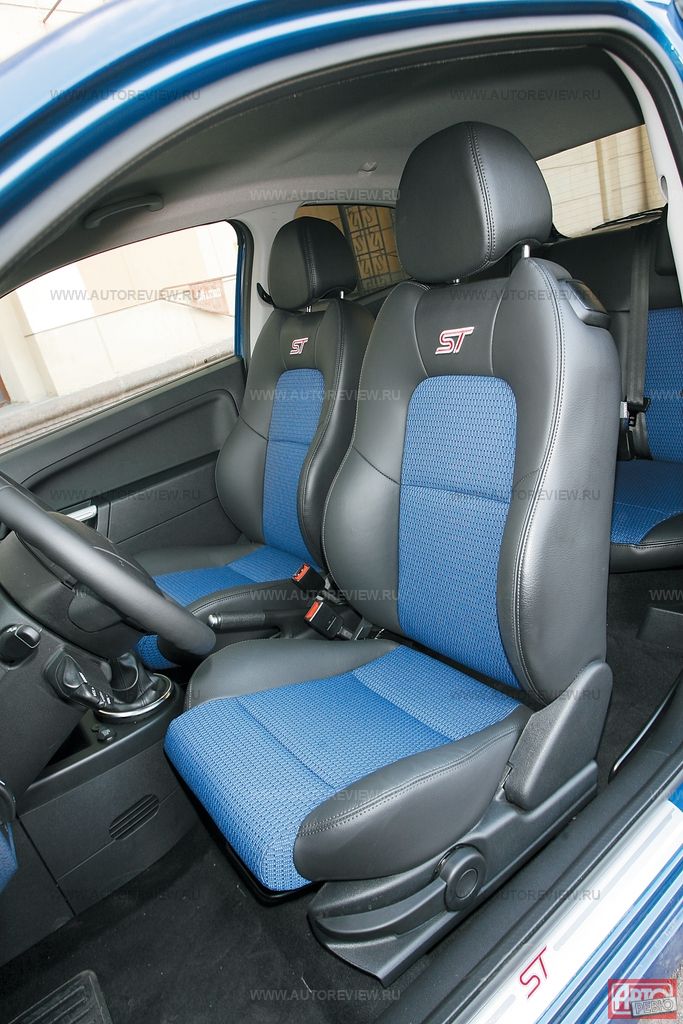 |
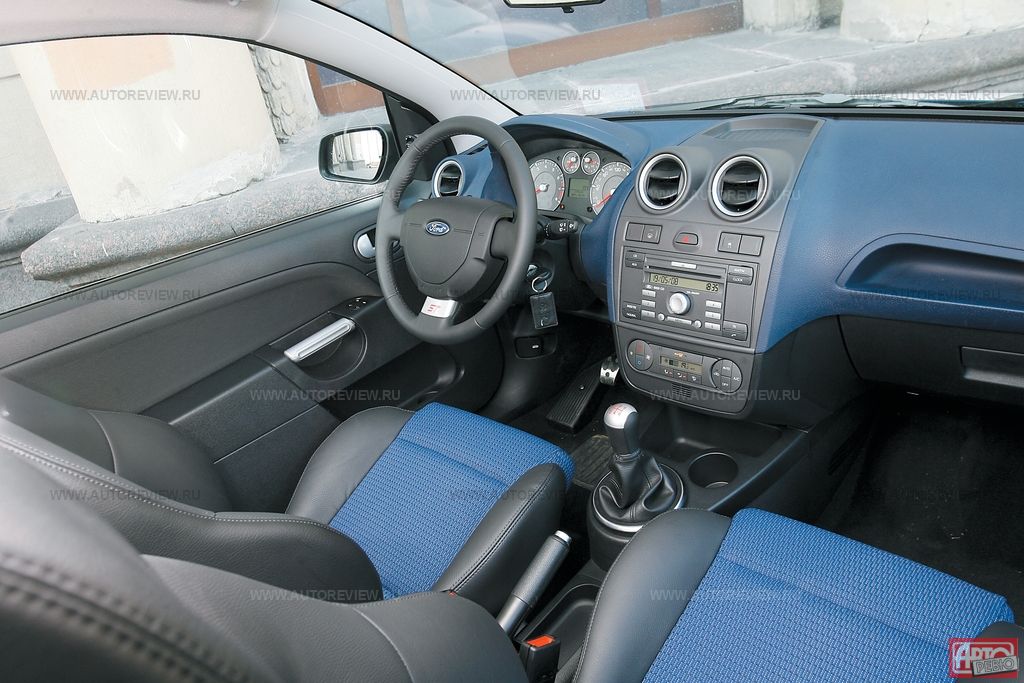
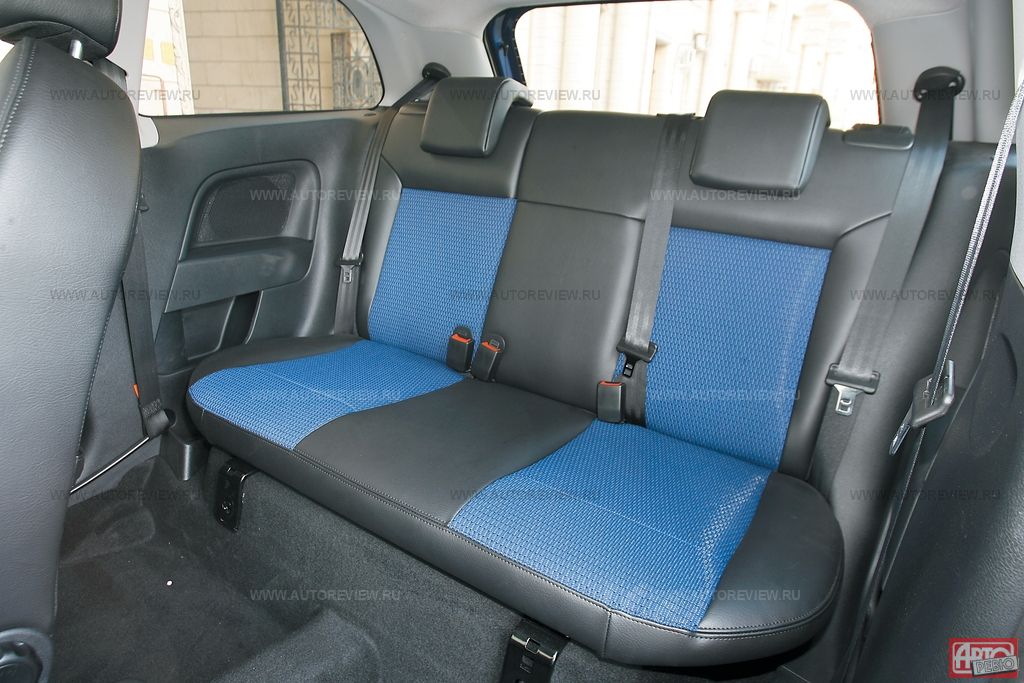
| Inside, the Fiesta ST is just a Fiesta | In terms of comfort, the Fiesta's rear seat is on par with the Opel's | Soft seats — with a hint of sportiness |
Ford Fiesta ST is a "warmed-up" hatchback. For beginner pilots. Never mind that it has the most modest engine — refine your racing line! The handling allows it. In addition, the Fiesta ST leads in the "price-to-power" criterion — 3,600 rubles per horsepower! For comparison: for the Renault Clio RS and Corsa OPC, this figure reaches 4,000 rubles/hp.
That's why Fiestas are often bought for conversion into a real race car: look at how many "STs" are racing in Russian rally. But if you're thinking of buying, hurry: a new Fiesta is coming soon, which will be larger, heavier, more expensive — and you'll have to wait at least a year for the next ST version.
Opel Corsa OPC is the choice for lovers of external attributes. It's a fast and flashy machine, but with the nervous handling typical of all "hot" Opels and mediocre ride smoothness.
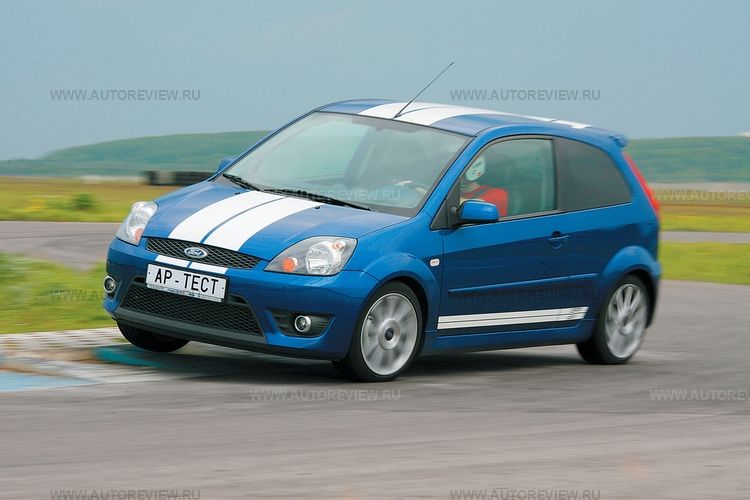
Ford Fiesta ST — the best choice for your first track day ever
The Peugeot 207 RC is no "hotter" than the Fiesta. But it's beautiful, fast, handles well, comfortable, and well-equipped... A well-deserved second place overall.
And in first place...
| Ford Fiesta ST | Mini Cooper S | Opel Corsa OPC |
 |
 |
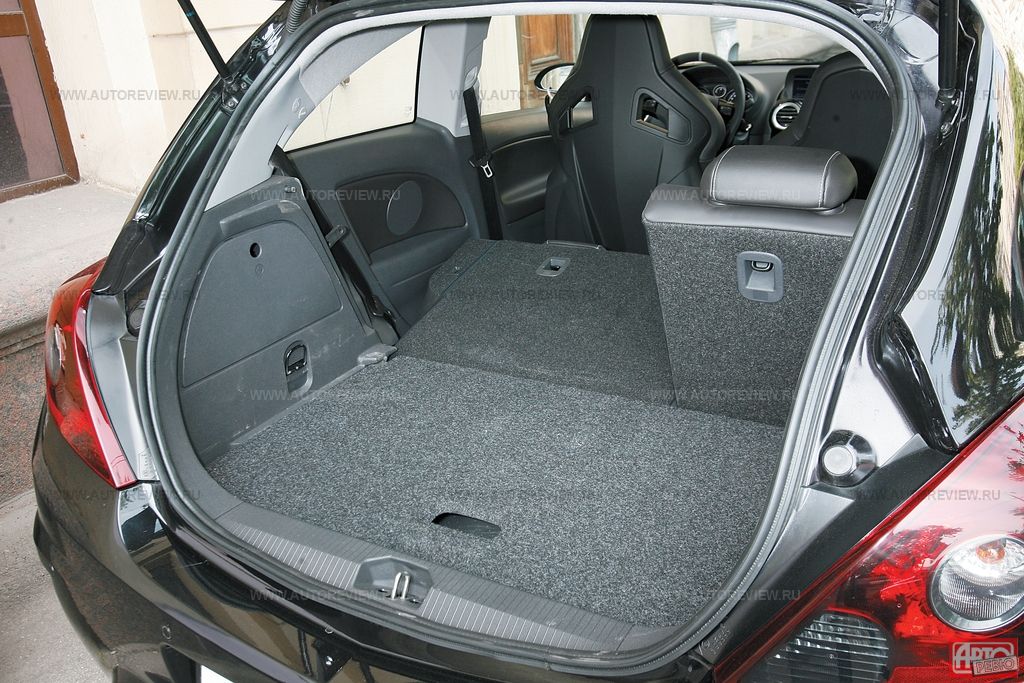 |
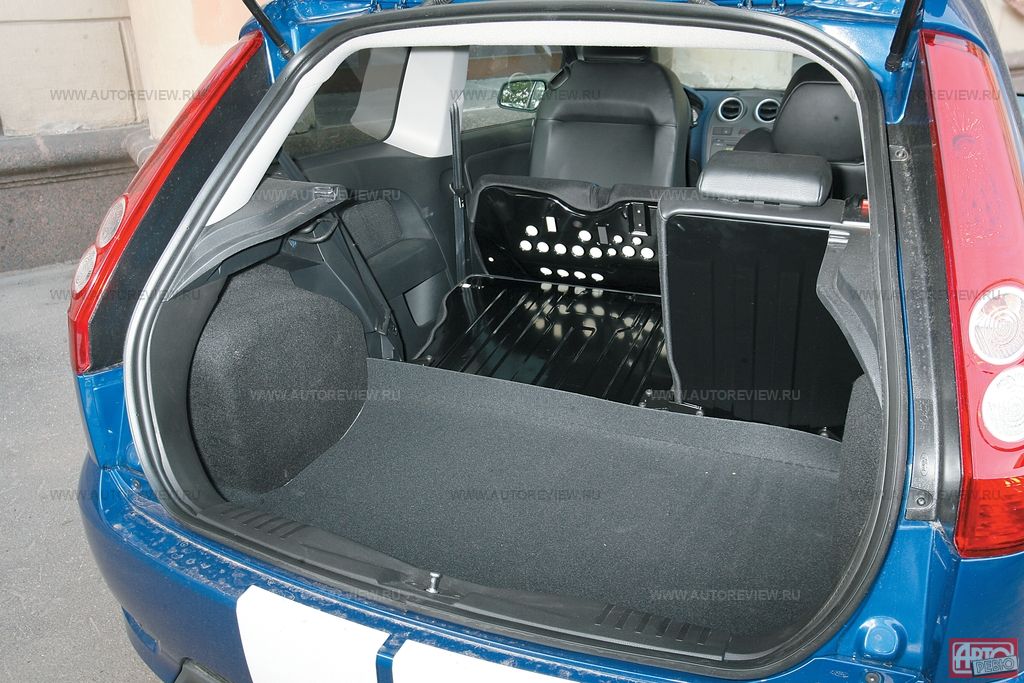
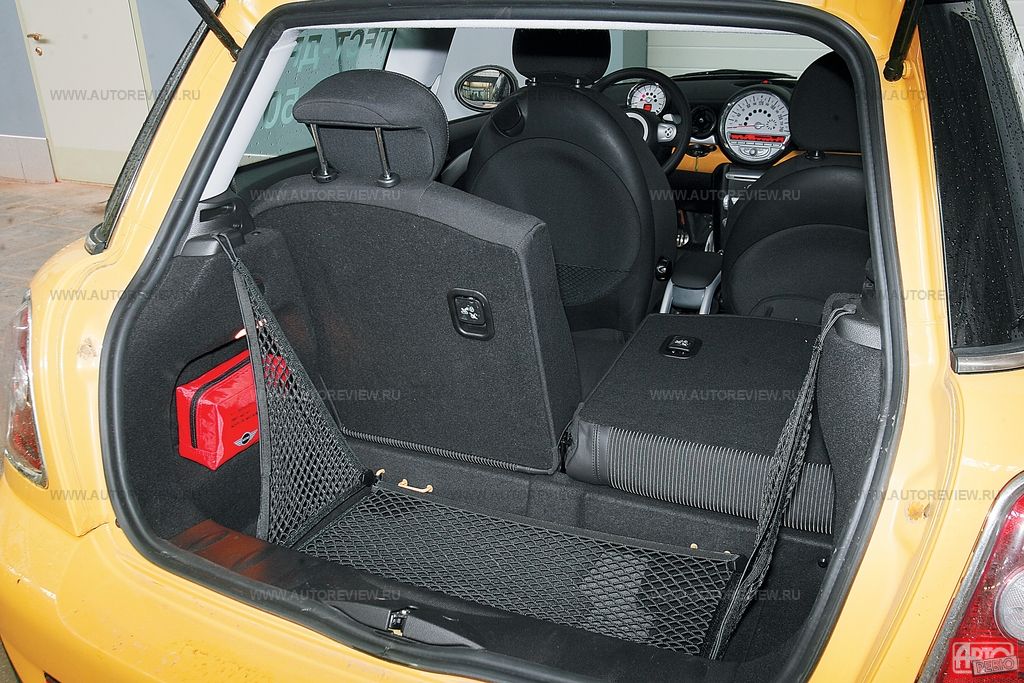
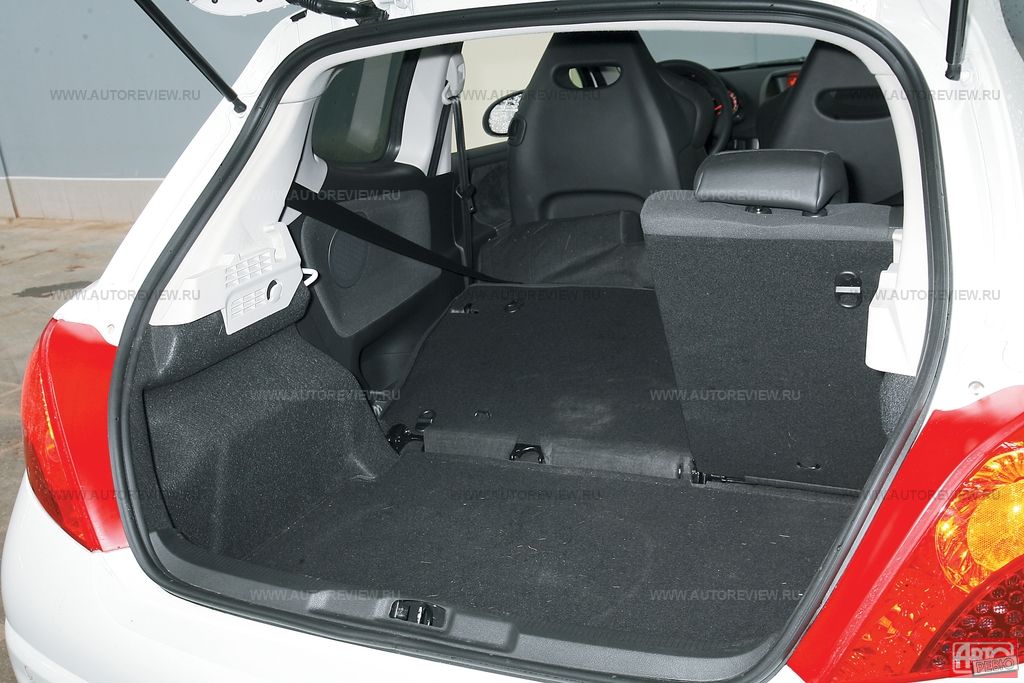
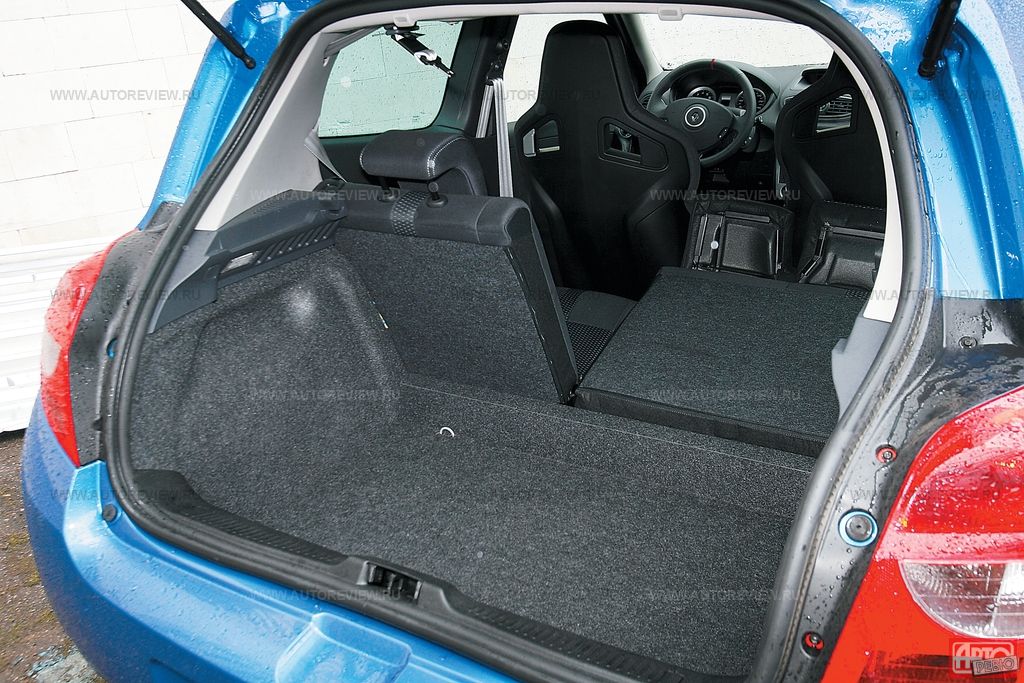
| Peugeot 207 RC | Renault Clio RS | All trunks cope with their main purpose — accommodating a helmet and other racing gear. And in everyday use, the Opel, Peugeot, and Renault compartments are more convenient — as the most spacious and transformable. Alas, none of the hatches has a full-size spare: the Ford and Peugeot have space-saver spares, while the others have only repair kits with sealant |
 |
 |
I confess: I love the Renault Clio Sport. For about a year I had my own Clio RS of the second, previous generation — I sold it only because the "little beast" had no place in Moscow traffic jams. During this test, I held on as best I could, trying not to give free rein to "subjectivism" — but when both Ladygin and Uncle Vanya with Yaroslav unanimously put the Renault in first place in their reports... Long live the Clio, the muse of speed!
So now, when race tracks are being built near Smolensk and in Kazan, when more than a hundred participants gather at track days in Myachkovo, I again dream of the Renault Clio RS. After all, it's on this car that you can quite comfortably drive around on your daily business, and on the weekend come to the race track, line up at the start alongside powerful and expensive BMWs, Mitsubishis, Subarus, Hondas... And almost not yield to them in lap time. And even surpass some.
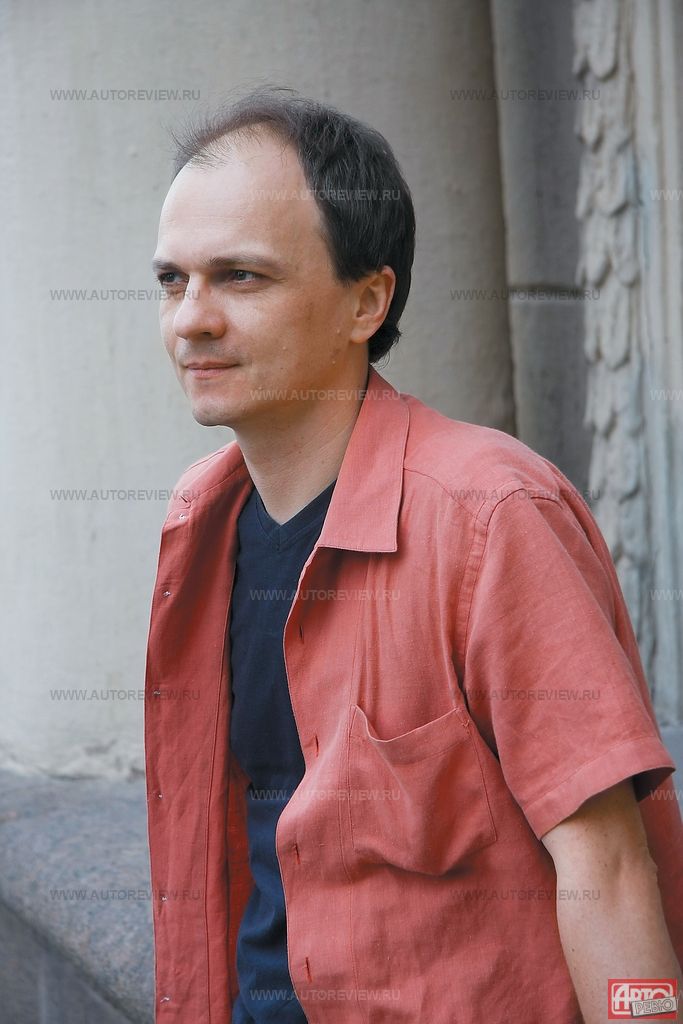 Alexey, entrepreneur
Drives a Renault Clio RS
I got "hooked" on Renault Sport division cars after reading rave reviews in the British press — the English know their stuff when it comes to "pocket rockets". Now I have my second Clio Sport of the second generation, and I've ordered a new "RS" and am waiting for it in July.
A short drive in the "third" Clio RS was enough for me not to consider alternative options. As before, the car "sticks" to the road even on uneven surfaces. Compared to the previous model, the quality of materials and assembly has clearly improved, sound insulation has improved, and useful options like the key card and cornering lights have appeared. I also like the rich, noble sound of the exhaust, but I feel I'll have to get used to the six-speed gearbox. The only thing I regret is the lack of a spare tire. I'm also concerned about service: ordered parts sometimes have to be waited for more than a month, and sometimes I have to tighten the nuts myself.
On the new Clio RS, as now, I'll drive daily — without any modifications. And for experiments, I have a 220-horsepower Renault 19 with a turbo engine in reserve.
I am the CEO of a construction company. We have two cars in the family, but in the morning there is a real battle for the Mini: my wife also wants to drive it to work. This is already our second Mini — previously we had a regular Cooper with an automatic transmission. I am one of the founders of the Russian MINIpeople club, so when I bought the 'S', I didn't even consider other options — I took it without a test drive. And I haven't regretted it. The new Mini, in my opinion, has become more comfortable and smoother, but at the same time it holds the road excellently. After we replaced the standard Run Flat tires with softer Dunlop Sport Maxx ones, it became even more comfortable, and the wheels no longer suffer. We usually don't use the Mini for cargo, but when we went on a two-week trip to Europe, it turned out that it can fit a lot of things.
There are no difficulties with Mini maintenance. The only breakdown was the sunroof, which stopped opening due to dirt, but it was replaced under warranty.
I thought about equipping the Mini with the factory John Cooper Works package, but it turned out that the most powerful package is only installed at the factory. So we are waiting for spring, when the warranty ends, and ordering a 218-horsepower Mini Cooper S JCW GP.
I am a sales manager, and I chose my 'hot' hatchback based on four parameters: power, appearance, compactness, and novelty. I reviewed all cars up to $35,000, but none evoked the same emotions as the Opel Corsa OPC. A very bright car! The powerful 192-horsepower turbo engine more than covers all its shortcomings, including non-folding mirrors and a finicky clutch: it is very difficult to match the pedals and shift without jerks.
The Corsa OPC is my daily car; I don't plan to race. But still, I want more, so I plan to do chip tuning of the engine, replace the alloy wheels with lighter forged ones, and possibly install a self-locking differential. But even without this, I have never regretted the purchase, especially since there are no maintenance problems.
I am a journalist, and when I was looking for a 'hot' hatchback, Peugeot was the last thing on my mind. I went through many options: the Seat Ibiza Cupra was old, the Mini Cooper S was expensive, and the Renault Clio RS had to be waited for until summer. In the end, I chose the three-door Opel Corsa OPC. But soon at the Peugeot dealer I saw the 207 RC — and fell in love with its interior, rich standard equipment, and, of course, the white color. I bought it — and overall I am satisfied.
Over 12 thousand kilometers of active driving, including several amateur competitions, I found only three drawbacks in the car: a loose suspension, a slightly 'sluggish' steering wheel, and weak sound insulation. But the 'lion' pleases with an elastic and economical engine (average consumption — 10.8 l/100 km), a sonorous exhaust, comfortable seats, decent comfort, and excellent brakes. Moreover, maintenance is inexpensive, spare parts are affordable, and the service interval is 20 thousand kilometers.
But now, after I have driven all the cars in this test, I would choose the Clio RS — it surpasses my 'lion' in almost all parameters. I need to find out the terms of the Renault trade-in system…
I am a heating systems designer. I bought the 'hot' Fiesta right after its official premiere in Russia. The interior here is almost the same as in my previous Fiesta with the 1600cc engine, but the suspension is noticeably stiffer: seeing the '20' sign before a speed bump, it's better to brake even harder, otherwise you'll get a noticeable jolt. The brakes pleased me, as did the powerful engine. The Fiesta accelerates easily; the slight lack of directional stability at speed is compensated by the reliable grip of the steering wheel, and excellent visibility gives a feeling of full control over the road. The only inconvenience is the too large turning radius. But the Fiesta ST is very practical: with active driving, it consumes only about 9 l/100 km and is covered by the same warranty as regular Fords.
Tuning? Official!
European manufacturers traditionally offer special kits ('kits') for their 'hot' models, which increase engine power and improve driving characteristics. Moreover, they can be installed at authorized service centers — with the factory warranty preserved.
Unfortunately, in Russia, of our quintet, only the Mini Cooper S can be officially modified. The first step is a self-locking differential, the factory installation of which (only on cars with a manual transmission) will cost only 7,700 rubles. The John Cooper Works kit of a sport air filter, muffler, and engine controller increases the turbo engine's power to 192 hp — for 95 thousand rubles. In addition, for 1 million 265 thousand rubles, you can order the Mini John Cooper Works hatchback with a 218-horsepower 'turbo-four' from the Mini Challenge club racing series. This engine has reinforced pistons, cylinder head, and valve mechanism, different intake and exhaust systems, plus increased boost pressure from 0.9 atm to 1.6 atm. The Mini JCW comes standard with racing brakes and standard suspension, which can be replaced with a sport or racing one (plus 70 thousand rubles).
For the Clio Renault RS, some Russian dealers offer a set of a front spoiler, rear wing, and side skirts for 75 thousand rubles. And by the end of summer, more serious 'kits' are promised, including a self-locking differential. In Europe, a lightweight version of the Clio RS 197 Cup is also available — with lowered suspension. Moreover, the 'Cup' Clio costs Europeans even slightly less than the standard one.
Official tuning programs for the Ford Fiesta ST hatchback were developed by the Ford Team RS and Mountune Racing racing teams. The initial kit for 1,800 euros is designed to raise engine power from 150 hp to 165 hp and includes a sport muffler, air filter, and modified engine control program. Other camshafts and valves will add another 20 horsepower and cost an additional 2,300 euros, and for a stiff KW sport suspension you will have to pay 770 euros.
The three-door Opel Corsa OPC in continental Europe is not subject to official modifications, but its British twin, the Vauxhall Corsa VXR, can be equipped with a straight-through muffler and a new engine control unit from Triple Eight, which prepares racing Vauxhalls for the BTCC championship. Such a kit for 1,300 euros increases engine power from 192 hp to 225 hp. A suspension lowered by 20 mm — plus 280 euros.
But for the Peugeot 207 RC, even in Europe, official 'kits' are not yet offered, although third-party tuners are waiting for enthusiasts with open arms.
Autoreview Readers' Forecast
On the eve of this test, we asked visitors of the website www.autoreview.ru to answer the question: 'Which of the cars participating in the next Autoreview test would you prefer?'
Here is how the votes were distributed:
Mini Cooper S 40.86%
Peugeot 207 RC 20.09%
Opel Corsa OPC 16.68%
Ford Fiesta ST 13.76%
Renault Clio RS 8.61%
15,363 people voted
Autoreview Expert Ratings
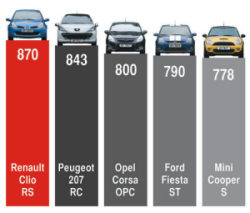
| Expert ratings from Autoreview | |||||||
| Parameters assessed | Max. score | Cars | Why? | ||||
| Ford Fiesta ST | Mini Cooper S | Opel Corsa OPC | Peugeot 207 RC | Renault Clio RS | |||
| Ergonomics | 220 | 185 | 185 | 185 | 190 | 200 | All cars have decent seating geometry. However, the Fiesta's is the most "civilian," while the Clio RS's is the most sporty: the snug "bucket" seat with grippy upholstery helps. |
| Driver's workplace | 110 | 90 | 95 | 100 | 100 | 105 | |
| Visibility | 110 | 95 | 90 | 85 | 90 | 95 | |
| Dynamics | 360 | 290 | 310 | 290 | 305 | 325 | The Clio RS accelerates slower and is slightly less emotional than the Cooper S, but it holds the road confidently on any surface and brakes excellently. The Mini, like the Opel, gets on the driver's nerves on bad roads. The Fiesta handles well, though it lags behind rivals in terms of engine. The Peugeot is consistently good but lacks vivid emotions. |
| Acceleration dynamics | 120 | 95 | 110 | 100 | 100 | 105 | |
| Braking dynamics | 120 | 100 | 105 | 100 | 105 | 110 | |
| Handling | 120 | 95 | 95 | 90 | 100 | 110 | |
| Ride comfort | 240 | 175 | 170 | 170 | 185 | 185 | In terms of suspension, the Clio RS is unrivaled. The Ford is the noisiest. And the most "advanced" climate control is in the Peugeot. |
| Ride smoothness, vibration protection | 90 | 70 | 60 | 60 | 70 | 75 | |
| Acoustic comfort | 80 | 50 | 55 | 60 | 55 | 60 | |
| Climate control | 70 | 55 | 55 | 50 | 60 | 50 | |
| Interior comfort | 180 | 140 | 113 | 155 | 163 | 160 | The Mini is cramped — even the Fiesta is more spacious! And among the other three cars, it's a tie. |
| Passenger seats | 70 | 57 | 41 | 61 | 63 | 62 | |
| Trunk | 60 | 44 | 40 | 53 | 55 | 53 | |
| Interior transformation | 50 | 39 | 32 | 41 | 45 | 45 | |
| Total score | 1000 | 790 | 778 | 800 | 843 | 870 | |
Moose in the rain
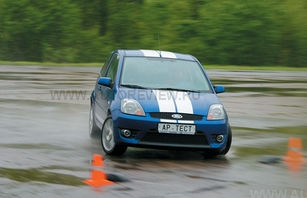
A light rain didn't prevent our traditional "moose test" — an exercise that simulates a sharp swerve around an unexpected obstacle. First, five drivers, already familiar with the cars in normal mode, attempted to dodge the imaginary moose in a single run at 65 km/h. Then an expert, through a series of runs, determined the maximum speed at which this maneuver was still possible. As always, the test was conducted with stability control systems activated.

Behind the wheel of the Ford Fiesta ST, the tester dodged the "moose" at a speed that many cars wouldn't even dream of on dry asphalt — 80.5 km/h! The striped hatchback went into a slide early, but the stability control yanked it back onto the correct trajectory as if by the scruff of the neck. And if the Fiesta did end up sideways, its modest dimensions saved it from the cones. Among the "one-time" drivers, only one missed, complaining about weak steering feedback.
The second result was achieved by the Opel Corsa OPC — 79.0 km/h. The picture was the same as with the Fiesta, but the electronics intervened even more harshly. Steering wheel effort jerks, which the Ford didn't have, didn't affect the outcome. Among the "random" drivers, one was "hit" by the moose: he attributed it to sudden oversteer and overly active electronic assistance.
In the Renault Clio RS, the expert almost repeated the Opel's result — 78.9 km/h. Achieving more was hindered by the "spirited" stability control tuning: it allowed slides to develop and only then began to suppress them. However, the system worked so softly and smoothly that the driver felt as if he himself was sensing and catching the car. Only one of the five volunteers failed with the Clio.
To dodge the "moose" at 78.4 km/h in the Peugeot 207 RC, the tester had to work hard. The stability control activated late and inaccurately, so the low-sensitivity steering wheel had to be turned at excessively large angles, and ultimately it was oversteer that limited the speed. Three unsuccessful drivers cited a lack of steering sensitivity.
The Mini's modest result (76.9 km/h) was largely due to a stability control failure: after driving through another puddle, all the "brake" warning lights came on the dashboard, and electronic support disappeared. But even without it, the Cooper S pleased with excellent directional stability and lively responses — the expert almost always had time to correct a mistake. However, "at the limit," it too couldn't handle sharp slides. And among the volunteers, one made a mistake by underestimating the sharpness of the responses.
| Maximum speed in the "moose test," km/h | |
| Car | Speed |
| Ford Fiesta ST | 80.5 |
| Mini Cooper S | 76.9 |
| Opel Corsa OPC | 79.0 |
| Peugeot 207 RC | 78.4 |
| Renault Clio RS | 78.9 |
| "Moose test" on the first attempt at 65 km/h | |
| Car | Maneuver completed by |
| Ford Fiesta ST | 4 out of 5 drivers |
| Mini Cooper S | 4 out of 5 drivers |
| Opel Corsa OPC | 4 out of 5 drivers |
| Peugeot 207 RC | 2 out of 5 drivers |
| Renault Clio RS | 4 out of 5 drivers |
A racer's word
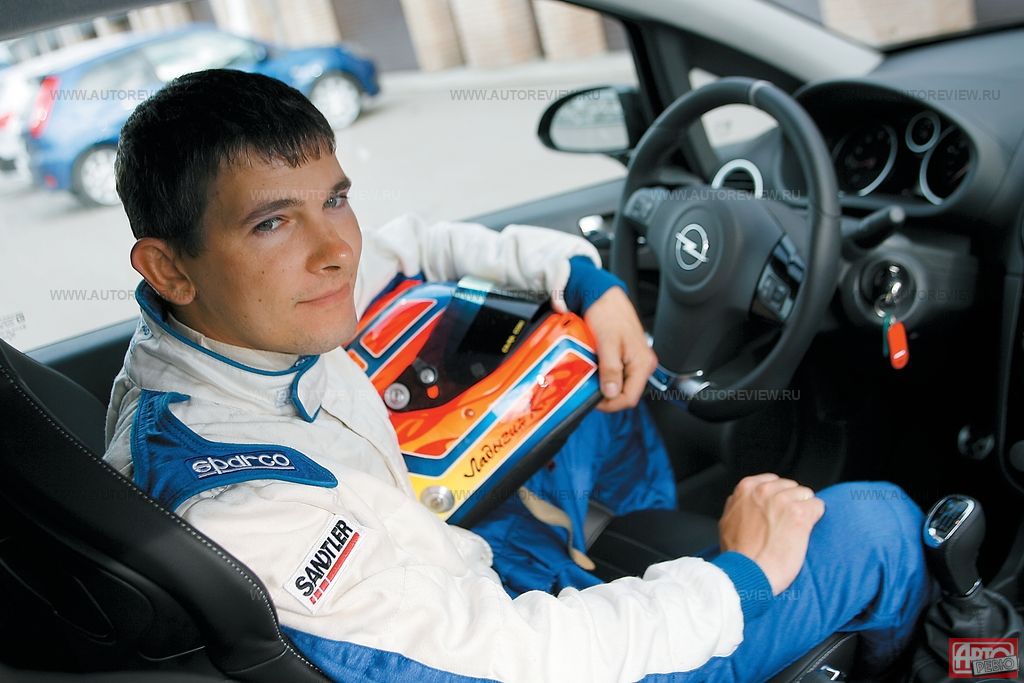 Kirill Ladygin
Lada Sport team driver, 11-time Russian karting champion, two-time Russian champion in the Lada Revolution class
I would choose the Clio Renault Sport. This car won me over with its handling: in a corner, I can do whatever I want with it! The Renault follows the steering wheel more precisely than the others and responds better to throttle. Pilot errors are easy to correct — usually just turning the wheel a bit more is enough. The engine's character is like a formula car's: all the torque is "up top." 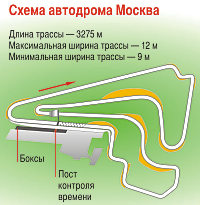 But the gears are well chosen, and the synchronizers allow for race-fast shifts. Plus, it has the best brakes and an excellent suspension: you can bounce over the curbs at the Myachkovo track without worry.
Mini Cooper S is an overly nervous car. At times it's even fun: you sharply turn the steering wheel — and the rear end starts sliding before a corner. But the slightest mistake — and the car begins to oversteer. For fast laps, you want more precise settings, like in the Renault: on slow corners, the Mini confidently outpaces the Clio RS, but on high-speed arcs, everything changes exactly the opposite. The robot gearbox in the Mini works well, but on corner exits I had to be careful with the accelerator so the gearbox wouldn't click through extra gears, and the paddle shifters are poorly placed — in a corner, you simply can't reach them.
The Opel Corsa OPC's main trump card is the engine, which pulls from low revs and allows for brisk acceleration after a corner. True, the gearbox ratios are too short. And heel-and-toe downshifting is hindered by slippery pedals — your foot keeps slipping off the brake. The throttle response delays are also annoying: you release the gas — revs hang, you press — they don't rise. But the brakes are excellent, and the handling pleased: just lift off the gas — and the Corsa willingly tucks into the corner, precisely following the line. However, the suspension isn't designed for extreme driving: once it takes a set, the car starts to bounce.
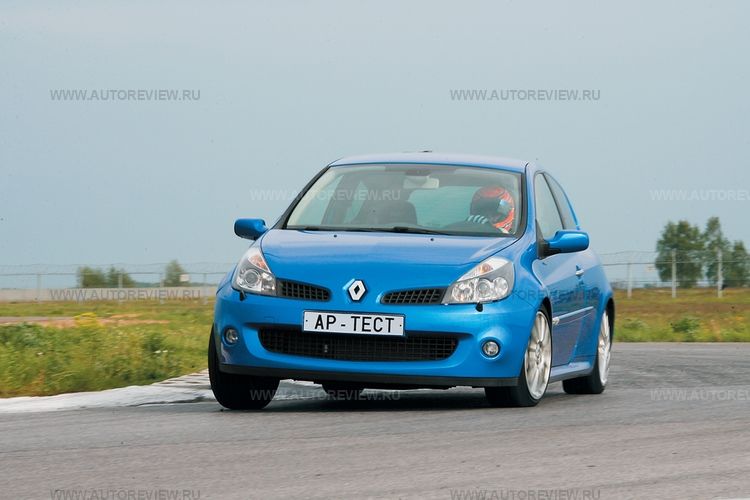
Ladigin noted two main advantages of the Clio RS — handling and brakes
But the Ford Fiesta ST shines where chassis matters more than power. The stiff suspension allows you to attack curbs boldly, and under braking, the car is planted. An excellent option for the money.
| Kirill Ladigin's "Telemetry" | ||||
| Parameters | Cars | |||
| Ford Fiesta ST | Mini Cooper S | Opel Corsa OPC | Renault Clio RS | |
| Best lap time | 2:06.30 | 2:02.70 | 2:05.47 | 2:03.60 |
| Maximum speed on lap, km/h | 146.9 | 156.7 | 153.3 | 153.0 |
| Minimum speed on lap, km/h | 40.8 | 41.5 | 38.5 | 40.1 |
| Maximum lateral acceleration, g | 1.22 | 1.25 | 1.14 | 1.2 |
| Maximum deceleration, g | 1.01 | 1.30 | 1.06 | 1.04 |
Crash tests
Among the five "hot" hatches, the Ford Fiesta ST has the most modest set of active and passive safety systems: front and side airbags, pretensioners and load limiters, ABS and electronic brake-force distribution EBD. There are no curtain airbags, although the other four cars have them as standard, and the Renault Clio RS additionally features "knee" airbags for front passengers.
All five cars underwent EuroNCAP crash tests — of course, in their base "civilian" versions. Four hatches received the maximum five stars, and only the aging Fiesta had to settle for four. The Fiesta was tested with two airbags: in both frontal and side impacts, the front occupants' chests experienced high loads. Additionally, the ignition lock and steering column adjustment lever could injure the driver's knees.
The Mini Cooper, Opel Corsa, Peugeot 207, and Renault Clio were tested with six airbags and showed a high level of protection, but of these four, only the Corsa can boast a fully injury-safe dashboard. True, in the frontal impact, the "driver's" head of the Corsa touched the steering wheel hub through the airbag, but this did not affect the loads.
The Ford Fiesta was crashed back in 2002, when child passenger safety ratings were not yet given, but even then EuroNCAP experts noted weak protection in frontal impacts — increased loads on the chest and neck vertebrae of "children" in Britax Romer Baby Safe and Britax Renaissance seats. Moreover, in Russia, Isofix mounts cannot be ordered for the Fiesta. The Mini Cooper protects children with a "three" — in the side crash test, the Fair BimboFix Type II seats rotated toward the impact, causing the 1.5-year-old "child" to hit their head on the interior trim panel. The Opel Corsa with Britax Romer Duo Plus seats also earned three stars, while the Peugeot 207 and Renault Clio protect young passengers in Britax Romer Baby Safe and Duo Plus seats best of all — four out of five stars.
Finally, the lowest "pedestrian" rating was earned by the Renault Clio — one star out of four. The Ford Fiesta and Mini Cooper are "twos," while the Opel Corsa and Peugeot 207 protect pedestrians with a "three."
| Ford Fiesta* | ????? | 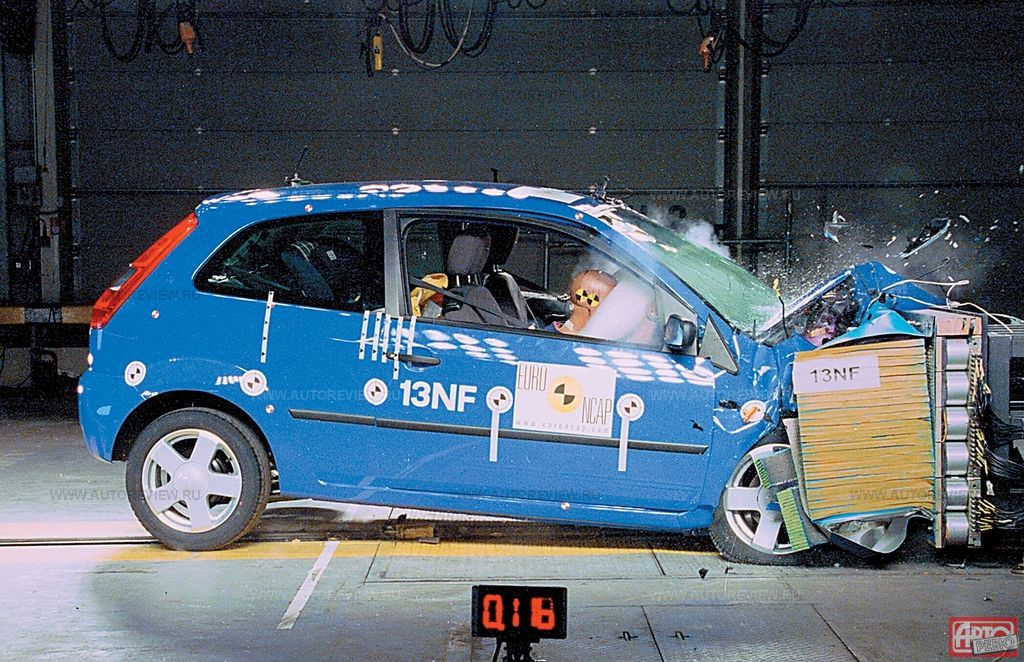 |
| Overall rating | 25 points | |
| Frontal crash test | 11 points (69%) | |
| Side crash test | 14 points (78%) | |
| SBR** | 0 points | |
| Child passenger protection | — | |
| Pedestrian protection | 14 points (39%) | |
| Curb weight | 1165 kg | |
| * Tests conducted according to EuroNCAP methodology | ||
| ** Seat belt reminder availability | ||
| Mini Cooper* | ????? | 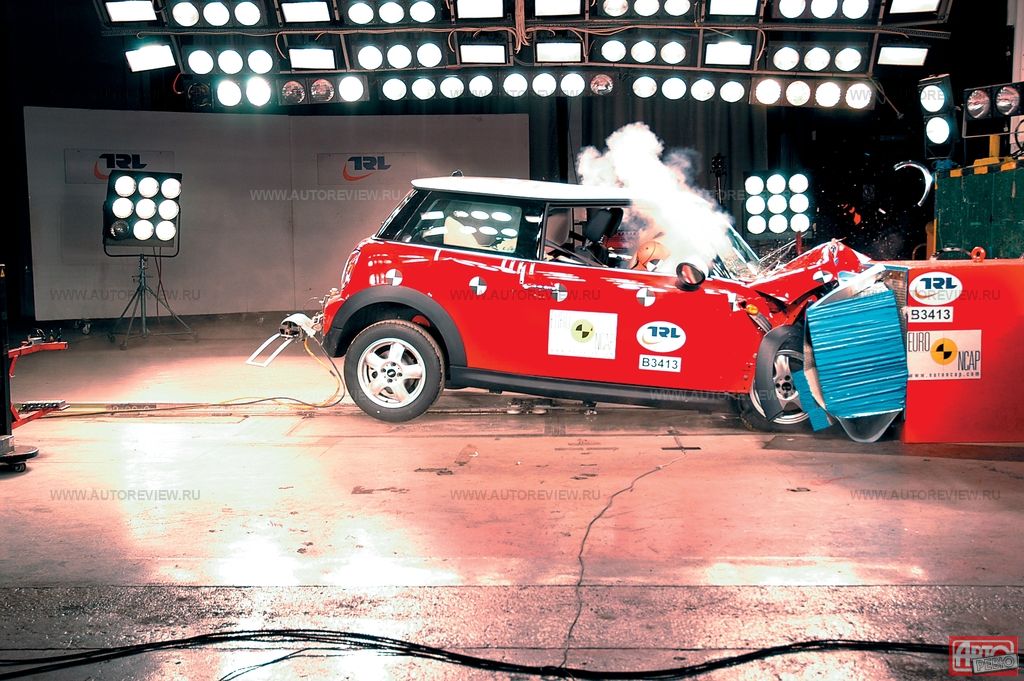 |
| Overall rating | 33 points | |
| Frontal crash test | 13 points (81%) | |
| Side crash tests | 16 points (89%) | |
| SBR** | 3 points | |
| Child passenger protection | 29 points (59%) | |
| Pedestrian protection | 14 points (39%) | |
| Curb weight | 1140 kg | |
| * Tests conducted according to EuroNCAP methodology | ||
| ** Seat belt reminder availability | ||
| Opel Corsa* | ????? | 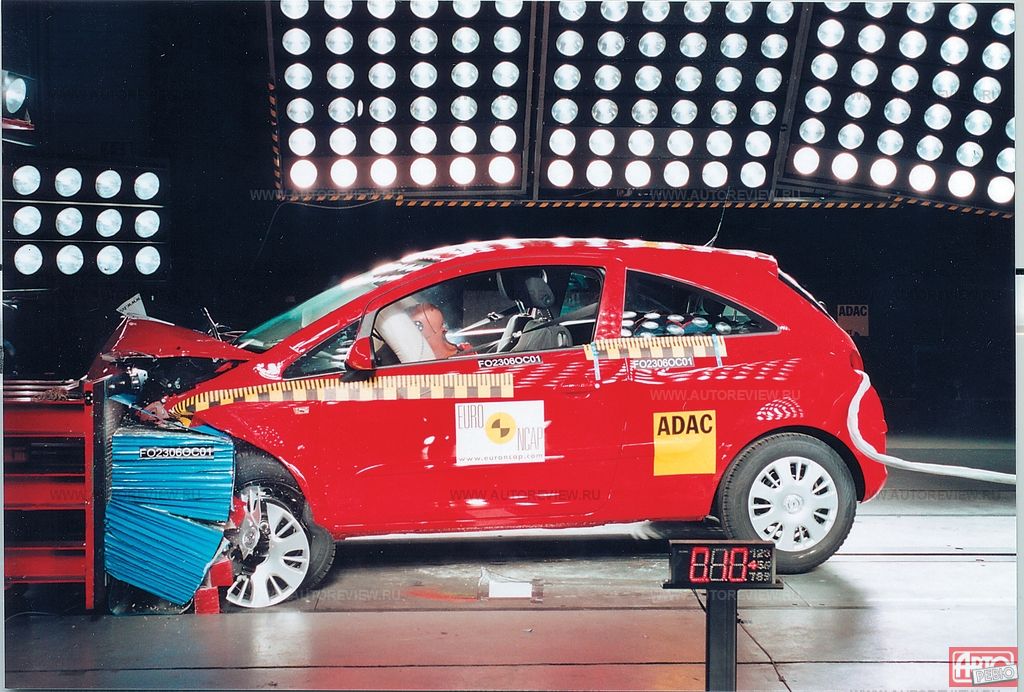 |
| Overall rating | 34 points | |
| Frontal crash test | 15 points (94%) | |
| Side crash tests | 18 points (100%) | |
| SBR** | 1 point | |
| Child passenger protection | 32 points (65%) | |
| Pedestrian protection | 19 points (53%) | |
| Curb weight | 1075 kg | |
| * Tests conducted according to EuroNCAP methodology | ||
| ** Seat belt reminder availability | ||
| Peugeot 207* | ????? | 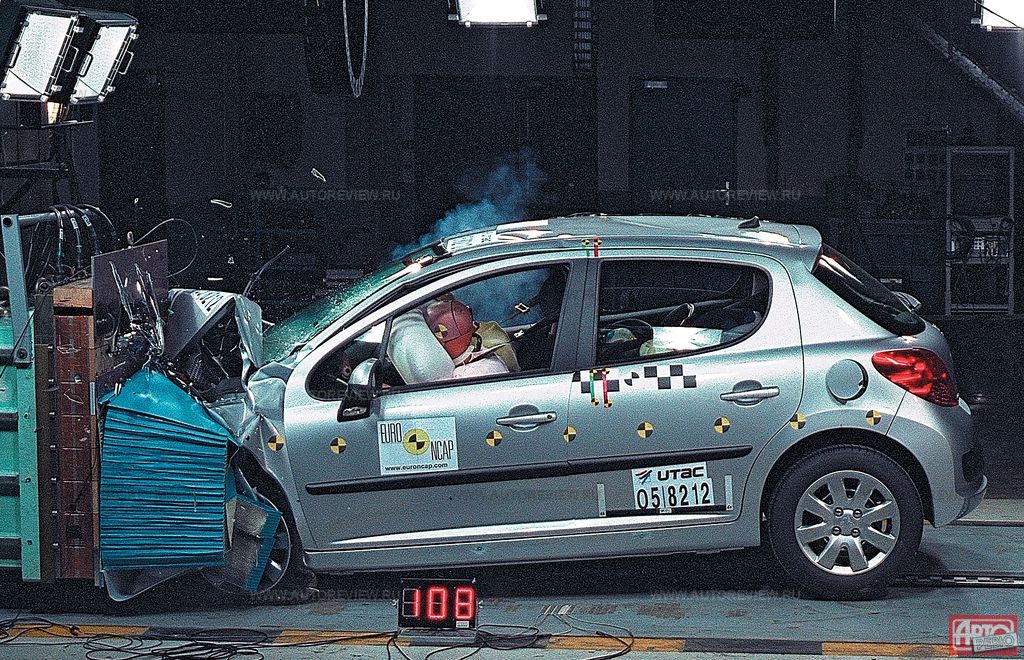 |
| Overall rating | 35 points | |
| Frontal crash test | 15 points (94%) | |
| Side crash tests | 17 points (94%) | |
| SBR** | 3 points | |
| Child passenger protection | 37 points (76%) | |
| Pedestrian protection | 19 points (53%) | |
| Curb weight | 1163 kg | |
| * Tests conducted according to EuroNCAP methodology | ||
| ** Seat belt reminder availability | ||
| Renault Clio* | 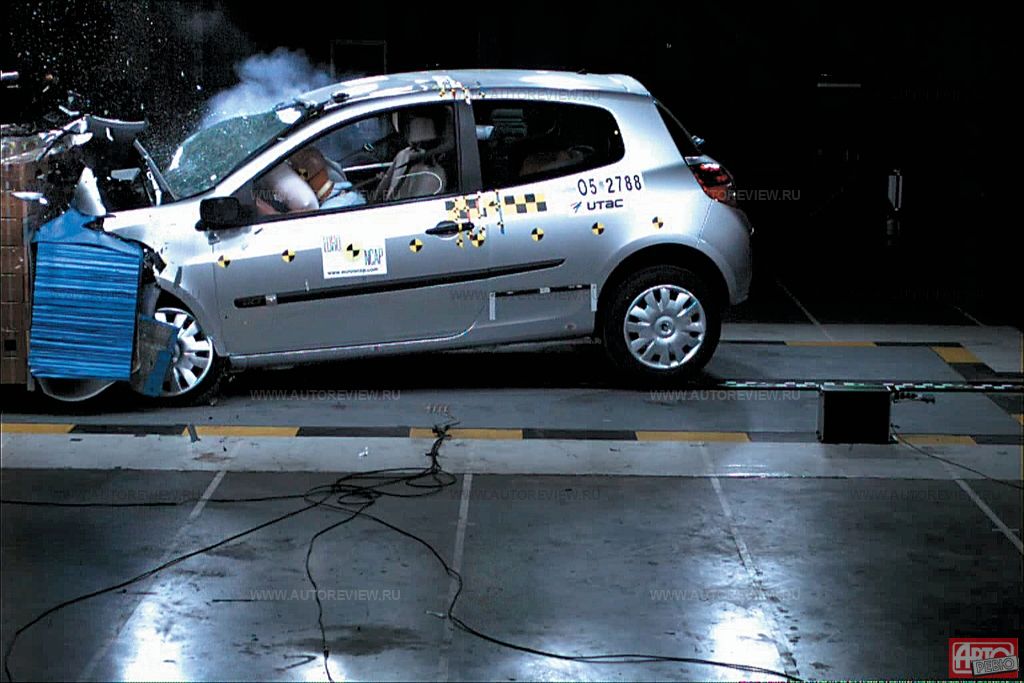 |
|
| Overall rating | 33 points | |
| Frontal crash test | 14 points (88%) | |
| Side crash tests | 18 points (100%) | |
| SBR** | 1 point | |
| Child passenger protection | 39 points (80%) | |
| Pedestrian protection | 9 points (25%) | |
| Curb weight | 1165 kg | |
| * Tests conducted according to EuroNCAP methodology | ||
| ** Presence of seatbelt reminder | ||
| Specifications | |||||
| Parameters | Vehicles | ||||
| Ford Fiesta ST | Mini Cooper S | Opel Corsa OPC | Peugeot 207 RC | Renault Clio RS | |
| Body type | 3-door hatchback | 3-door hatchback | 3-door hatchback | 3-door hatchback | 3-door hatchback |
| Number of seats | 5 | 4 | 5 | 4 | 5 |
| Trunk volume, l | 268—945* | 160—680* | 285—1050* | 270—1195* | 288—1038* |
| Curb weight, kg | 1137 | 1155 | 1203 | 1250 | 1240 |
| Gross weight, kg | 1590 | 1605 | 1715 | 1600 | 1690 |
| Engine | petrol, with port injection | petrol, with direct injection and turbocharging | petrol, with port injection and turbocharging | petrol, with direct injection and turbocharging | petrol, with port injection |
| Location | front, transverse | front, transverse | front, transverse | front, transverse | front, transverse |
| Number and arrangement of cylinders | 4, in-line | 4, in-line | 4, in-line | 4, in-line | 4, in-line |
| Displacement, cm³ | 1999 | 1598 | 1598 | 1598 | 1998 |
| Cylinder bore/piston stroke, mm | 87.5/83.1 | 77.0/85.8 | 79.0/81.5 | 77.0/85.8 | 82.7/93.0 |
| Compression ratio | 10.8:1 | 10.5:1 | 8.8:1 | 10.5:1 | 11.5:1 |
| Number of valves | 16 | 16 | 16 | 16 | 16 |
| Max. power, hp/kW/rpm | 150/110/6000 | 175/128/5500 | 192/141/5850 | 175/128/6000 | 197/145/7250 |
| Max. torque, Nm/rpm | 190/4500 | 240 (260)**/1600—5000 | 230 (266)**/1980—5850 | 240 (260)**/1600—3500 | 215/5550 |
| Gearbox | manual, 5-speed | automatic, 6-speed | manual, 6-speed | manual, 5-speed | manual, 6-speed |
| Gear ratios | |||||
| I | 3.58 | 4.04 | 3.82 | 2.92 | 3.18 |
| II | 2.04 | 2.37 | 2.16 | 1.87 | 1.95 |
| III | 1.41 | 1.56 | 1.48 | 1.37 | 1.48 |
| IV | 1.11 | 1.16 | 1.07 | 1.05 | 1.21 |
| V | 0.88 | 0.85 | 0.88 | 0.86 | 1.03/0.97 *** |
| VI | — | 0.67 | 0.74 | — | 0.87/0.81 *** |
| Reverse | 3.62 | 3.19 | 3.65 | 3.33 | 2.55 |
| Final drive | 3.82 | 3.68 | 4.18 | 3.95 | 4.31 |
| Drive | front | front | front | front | front |
| Front suspension | independent, coil spring, McPherson | independent, coil spring, McPherson | independent, coil spring, McPherson | independent, coil spring, McPherson | independent, coil spring, McPherson |
| Rear suspension | semi-independent, coil spring | independent, coil spring, multi-link | semi-independent, coil spring | semi-independent, coil spring | semi-independent, coil spring |
| Front brakes | disc, ventilated | disc, ventilated | disc, ventilated | disc, ventilated | disc, ventilated |
| Rear brakes | disc | disc | disc | disc | disc |
| Tires | 195/45 R16 | 195/55 R16 | 215/45 R17 | 205/45 R17 | 215/45 R17 |
| Maximum speed, km/h | 208 | 220 | 225 | 220 | 215/223 *** |
| Acceleration time 0—100 km/h, s | 8.4 | 7.3 | 7.2 | 7.1 | 6.9 |
| Fuel consumption, l/100 km | |||||
| Urban cycle | 10.4 | 9.7 | 10.5 | 9.9 | 12.2 |
| Extra-urban cycle | 5.7 | 5.3 | 6.4 | 5.7 | 7.1 |
| Combined cycle | 7.4 | 6.9 | 7.9 | 7.2 | 8.9 |
| CO? emissions, g/km, combined cycle | 179 | 165 | 190 | 171 | 209 |
| Fuel tank capacity, l | 40 | 50 | 45 | 50 | 55 |
| Fuel | petrol AI-95 | petrol AI-91—95 | petrol AI-95—98 | petrol AI-95—98 | petrol AI-95 |
| * With rear seats folded | |||||
| ** In Overboost mode | |||||
| *** On the car tested/on models produced after October 2007 | |||||
| Equipment of cars participating in the comparative test | |||||
| Options | Models | ||||
| Ford Fiesta ST | Mini Cooper S | Opel Corsa OPC | Peugeot 207 RC | Renault Clio RS | |
| Price of standard version, RUB | 548000 | 925200 | 766500 | 724000 | 799000 |
| Front airbags | + | + | + | + | + |
| Side airbags | + | + | + | + | + |
| Curtain airbags | – | + | + | + | + |
| ABS | + | + | + | + | + |
| Stability control | O | + | + | + | + |
| Power steering | + | + | + | + | + |
| Automatic transmission | – | O | – | – | – |
| Paddle shifters on steering wheel | – | O | – | – | – |
| Audio controls on steering wheel | – | O | + | – | + |
| Tilt steering wheel adjustment | + | + | + | + | + |
| Telescopic steering wheel adjustment | – | + | + | + | + |
| Leather steering wheel | + | + | + | + | + |
| Heated windshield | – | P | – | – | – |
| Heated front seats | – | P | + | + | – |
| Auto-dimming rearview mirror | – | P | + | + | – |
| Central locking with remote | + | + | + | + | + |
| Keyless entry | – | – | – | – | P |
| Alarm | – | P | – | – | – |
| Air conditioning | + | P | + | – | – |
| Climate control | O | P | O | – | + |
| Dual-zone climate | – | – | – | + | – |
| Power mirrors with heating | + | + | + | + | + |
| Folding mirrors | – | – | – | + | P |
| Power windows | + | + | + | + | + |
| Sport front seats | + | + | + | + | O |
| Driver seat height adjustment | + | + | + | + | + |
| Folding rear seat | + | + | + | + | + |
| Rear seat backrest angle adjustment | – | + | + | – | – |
| CD player | + | + | + | + | + |
| CD changer | – | – | O | – | – |
| Engine start button | – | + | – | – | + |
| Light sensor | – | + | + | + | – |
| Rain sensor | – | P | O | + | + |
| Tire pressure monitoring | – | + | + | + | – |
| On-board computer | + | P | P | + | + |
| Navigation system | – | – | O | – | – |
| Cruise control | – | O | P | + | + |
| Panoramic roof | – | – | – | O | – |
| Rear parking sensors | – | O | O | + | – |
| Leather interior | +* | +* | O | +** | – |
| Remote trunk release | + | – | – | – | – |
| Xenon low beam | – | P | – | – | + |
| Bi-xenon | – | P | – | – | – |
| Adaptive low beam | – | – | O | + | + |
| Fog lights | + | P | + | + | + |
| Headlight washers | – | + | – | + | + |
| Alloy wheels | + | P | + | + | + |
| Full-size spare tire | – | –*** | –*** | – | –*** |
| Metallic paint | O | – | O | – | O |
| Tires | Pirelli Pzero Nero 195/45 ZR 16 | Dunlop SP sport 01205/45 R 17 | Continental Contisport contact 3 215/45 R 17 | Bridgestone Potenza RE 050 A 205/45 R 17 | Continental Contisport contact 3 215/45 R 17 |
| Price of test car, RUB | 578100 | 1123000 | 941800 | 743000 | 880000 |
| * Leather with fabric | |||||
| ** Suede with fabric | |||||
| *** Tire repair kit | |||||
| (+) Included in base version | |||||
| (–) Not available in base | |||||
| (O) Installed as an option on test cars | |||||
| (P) Included in package options of tested cars | |||||
| Some measurement results from Autoreview | ||||||
| Parameters | Cars | |||||
| Ford Fiesta ST | Mini Cooper S | Opel Corsa OPC | Peugeot 207 RC | Renault Clio RS | ||
| Max speed, km/h | 196.5 | 217.1 | 215.5 | 207.5 | 211.6 | |
| Acceleration time, s* | 0-50 km/h | 3.1/3.4 | 3.0/3.0 | 3.4/2.9 | 3.1/3.0 | 2.9/3.2 |
| 0-100 km/h | 9.2/9.3 | 7.4/7.4 | 8.0/7.8 | 8.2/8.3 | 7.8/8.1 | |
| 0-150 km/h | 20.7/21.0 | 15.5/15.6 | 16.3/16.3 | 19.3/20.5 | 17.1/17.4 | |
| 0-200 km/h | —/— | 37.9/37.9 | 38.6/38.8 | 48.7/49.7 | 45.0/44.7 | |
| over 400 m | 16.6/16.8 | 15.4/15.5 | 15.9/15.7 | 16.1/16.1 | 15.8/16.1 | |
| over 1000 m | 30.4/30.6 | 28.0/28.1 | 28.6/28.4 | 29.5/29.7 | 28.9/29.1 | |
| 60-100 km/h (III) | 5.7 | — | 4.2 | 4.9 | 5.1 | |
| 60-100 km/h (IV) | 8.6 | — | 5.6 | 6.7 | 6.5 | |
| 80-120 km/h (V) | 12.8 | — | 7.7 | 8.5 | 8.7 | |
| 80-120 km/h (VI) | — | — | 9.5 | — | 11.4 | |
| 60-100 km/h (D) | — | 3.9 | — | — | — | |
| 80-120 km/h (D) | — | 4.9 | — | — | — | |
| Coast-down, m | from 50 km/h | 555 | 516 | 538 | 491 | 560 |
| 130-80 km/h | 840 | 858 | 798 | 831 | 837 | |
| 160-80 km/h | 1224 | 1287 | 1186 | 1214 | 1245 | |
| Braking from 100 km/h | distance, m | 43.2 | 43.6 | 42.3 | 42.3 | 41.6 |
| deceleration, m/s² | 8.9 | 8.9 | 9.1 | 9.1 | 9.3 | |
| * With stability control off/on | ||||||
| Speedometer accuracy | |||||||||
| Cars | Speedometer reading, km/h | ||||||||
| 40 | 60 | 80 | 100 | 120 | 140 | 160 | 180 | 200 | |
| True speed, km/h | |||||||||
| Ford Fiesta ST | 38 | 57 | 75 | 95 | 115 | 135 | 155 | 174 | 194 |
| Mini Cooper S | 37 | 57 | 76 | 96 | 116 | 136 | 155 | 175 | 194 |
| Opel Corsa OPC | 39 | 57 | 77 | 96 | 116 | 135 | 155 | 174 | 194 |
| Peugeot 207 RC | 38 | 57 | 77 | 97 | 116 | 136 | 155 | 175 | 195 |
| Renault Clio RS | 39 | 59 | 77 | 97 | 117 | 136 | 154 | 174 | 193 |
| Turning circle of cars | ||||
| Car | By track of outer front wheel, m | By outer front overhang, m | Number of steering wheel turns from lock to lock | |
| Ford Fiesta ST | 11.50 | 12.00 | 2.3 | |
| Mini Cooper S | 10.61 | 11.08 | 2.4 | |
| Opel Corsa OPC | 10.78 | 11.28 | 2.4 | |
| Peugeot 207 RC | 10.59 | 11.19 | 3.0 | |
| Renault Clio RS | 11.06 | 11.58 | 2.8 | |

Visibility
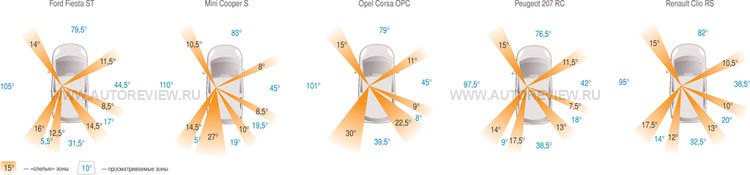
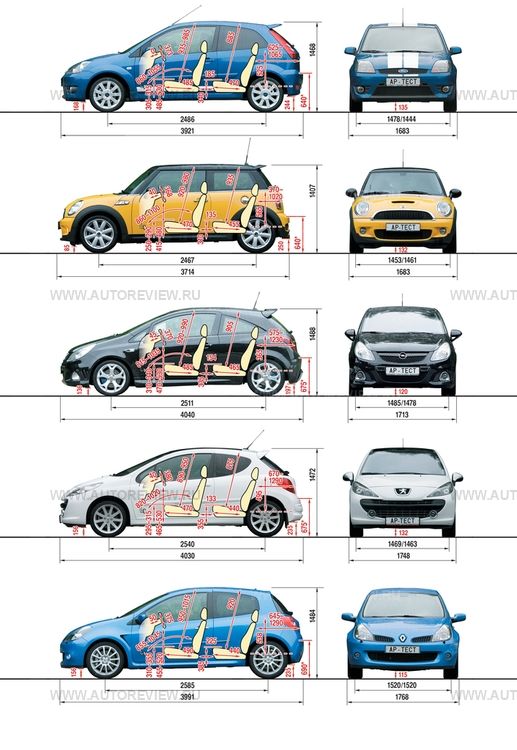
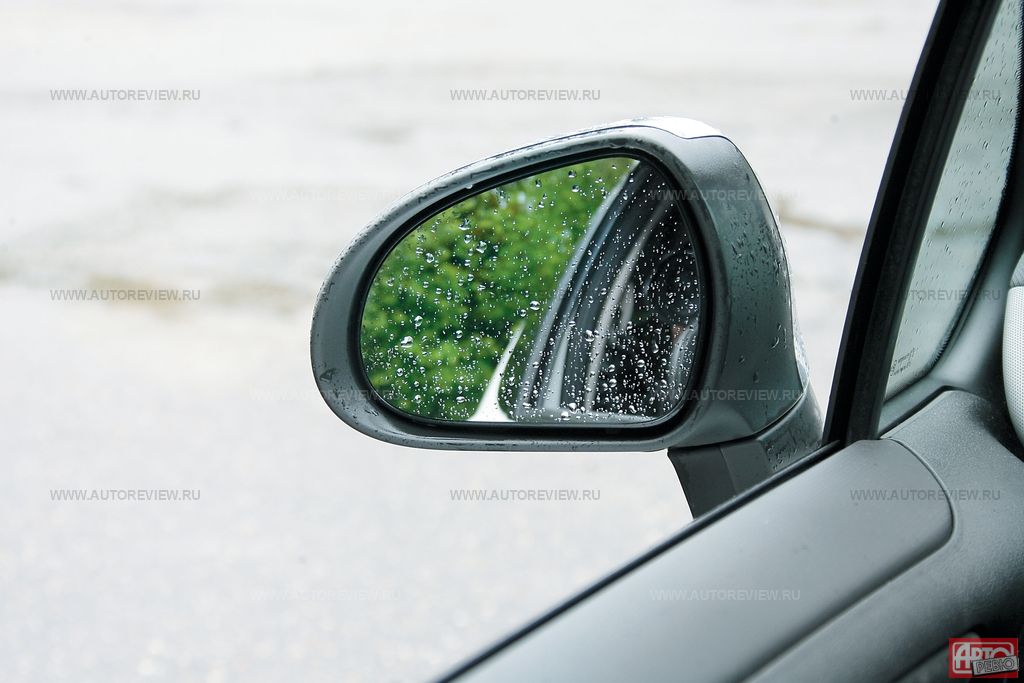
The best visibility is in the Fiesta: the hood is perfectly visible, the front pillars hardly obstruct, and the mirrors give a full picture of what's behind and to the sides. The Renault is slightly worse - you don't feel the front overhang. The Mini loses points due to the low windshield opening and the mirror that constantly hangs in front of your eyes. The Peugeot is spoiled by the triangular windows in the doors and the mirrors: they are narrow but tall, and also shifted back - you have to turn your head. And in the Opel, visibility is frankly disappointing: thick pillars, a huge dashboard, and small side mirrors that are located too far back.
| Ford Fiesta ST | Opel Corsa OPC | Renault Clio RS |
| Mini Cooper S | Peugeot 207 RC | |
 |
| Car | Total viewing angle, deg. | Total blind spot angle, deg. |
| Ford Fiesta ST | 283.0 | 77.0 |
| Mini Cooper S | 281.5 | 78.5 |
| Opel Corsa OPC | 272.5 | 87.5 |
| Peugeot 207 RC | 281.5 | 78.5 |
| Renault Clio RS | 282.0 | 78.0 |
What's the price?
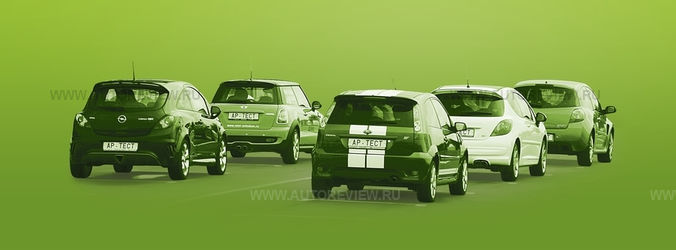
Ford Fiesta ST (2.0 L, 150 hp) is the cheapest in this group: the starting price is 548 thousand rubles. Even the base version includes four airbags, ABS, air conditioning, and a CD player. For an extra charge, you can get climate control, stability control, and decorative stripes on the body - like on our test car. The hot hatch from Ford can be found at dealers in stock, but if you order individually, you'll have to wait four to five months.
Warranty - two years or 100,000 km. Ford's network in Russia has 143 dealers in 90 cities.
Peugeot 207 RC (1.6 L, 175 hp) will cost at least 724 thousand rubles. The equipment is generous: six airbags, stability control, dual-zone climate control, light and rain sensors, CD/MP3 stereo and rear parking sensors. Optionally, you can order a JBL audio system, panoramic roof and Bluetooth. Cars are only brought to order — from two weeks to four months.
Warranty — two years without mileage limit. Peugeot is sold by 52 dealers in 34 Russian cities.
Prices for "hot" hatchbacks vary quite significantly. Opel Corsa OPC with a 1.6-liter turbo engine (192 hp) costs from 766,500 rubles. True, for this money the car only has a regular air conditioner, and parking sensors, light and rain sensors are absent. But there is heated front seats. Later this year, a more subdued Corsa GSi modification with a 150-horsepower engine should also appear. In the meantime, you'll have to wait for the OPC: delivery to order will take up to six months.
Warranty on Opel — two years without mileage limit. In Russia, the brand is represented by 111 dealers in 62 cities.
Renault Clio RS (2.0 L, 197 hp) costs 799 thousand rubles. Standard equipment includes eight airbags, stability control, climate control, heated front seats and a CD stereo. Options — Recaro sports seats, xenon headlights and a key card. Ordering the car will take about four months.
Warranty — two years without mileage limit. Renault has 109 dealers in 70 cities in Russia.
Mini Cooper S (1.6 L, 175 hp) is the most expensive in the group: from 925,200 rubles. Standard includes six airbags, stability control, power accessories, CD stereo and light and rain sensors. For the Starter package (air conditioning, heated seats, fog lights) you'll have to pay an extra 61,200 rubles, and for a six-speed automatic — 64,800 rubles. A regular Mini Cooper with a 120-horsepower naturally aspirated engine costs 727,200 rubles. Cars are available at dealers; an order will arrive in four months.
Warranty — two years without mileage limit. Mini is sold by 11 dealers in 8 Russian cities.
| Cost of scheduled maintenance with consumables and parts, RUB | ||||||
| Scheduled service | Cars | |||||
| Ford Fiesta ST | Mini Cooper S | Opel Corsa OPC | Peugeot 207 RC | Renault Clio RS | ||
| Labor rate per hour | 1400 | 2700 | 1300 | 1300 | 1350 | |
| Mileage, km | 10000 | — | 5500 | — | — | — |
| 15000 | — | — | 4900 | — | 6000 | |
| 20000 | 6000 | 9900 | — | 4100 | — | |
| 30000 | — | 7300 | 6000 | — | 9000 | |
| 40000 | 15000 | 10200 | — | 9000 | — | |
| 45000 | — | — | 4900 | — | 6000 | |
| 50000 | — | 7300 | — | — | — | |
| 60000 | 12000 | 8400 | 16500 | 7800 | 20000 | |
| 70000 | — | 5500 | — | — | — | |
| 75000 | — | — | 4900 | — | 6000 | |
| 80000 | 6000 | 9600 | — | 12000 | — | |
| 90000 | — | 7300 | 6000 | — | 9000 | |
| Total | 39000 | 71000 | 43200 | 32900 | 56000 | |
| Approximate prices for original parts at dealers in Moscow, RUB | |||||
| Parts | Cars | ||||
| Ford Fiesta ST | Mini Cooper S | Opel Corsa OPC | Peugeot 207 RC | Renault Clio RS | |
| Oil filter | 345 | 510 | 390 | 550 | 270 |
| Fuel filter | 520 | 2400 | 12600* | 10050* | 12000* |
| Air filter | 1120 | 920 | 990 | 500 | 1160 |
| Cabin filter | 1100 | 1760 | 640 | 1140 | 850 |
| Spark plug | 380 | 850 | 300 | 380 | 870 |
| Front brake pads | 3140 | 6180 | 4180 | 2790 | 5210 |
| Rear brake pads | 3480 | 4630 | 4400 | 2750 | 5070 |
| Front shock absorber | 4650 | 6550 | 5300 | 2670 | n/a** |
| Rear shock absorber | 3040 | 4700 | 4800 | 3400 | n/a** |
| Front stabilizer link | 3470 | 970 | 1130 | 400 | 2570 |
| Clutch disc | 4970 | 5820*** | 4770 | 4960 | 8030 |
| Front headlight | 4630 | 17560 | 9500 | 7000 | 6230 |
| Rear taillight | 2765 | 4660 | 4700 | 2700 | 3130 |
| Front fender | 6330 | 4820 | 5890 | 3000 | 4170 |
| Front bumper | 16820 | 11230 | 20300 | 22890 | 22420 |
| Hood | 14040 | 15950 | 18590 | 11170 | 11830 |
| Windshield | 11940 | 11100 | 12150 | 21290 | 20086 |
| * Complete with fuel pump | |||||
| ** N/a — no data | |||||
| *** For version with manual transmission | |||||
| After calling dealers, we found that there are no particular problems with delivery times for parts for the five "hot" hatchbacks: the longest wait is for shock absorbers and clutch for the Corsa — one and a half months | |||||
Alternative
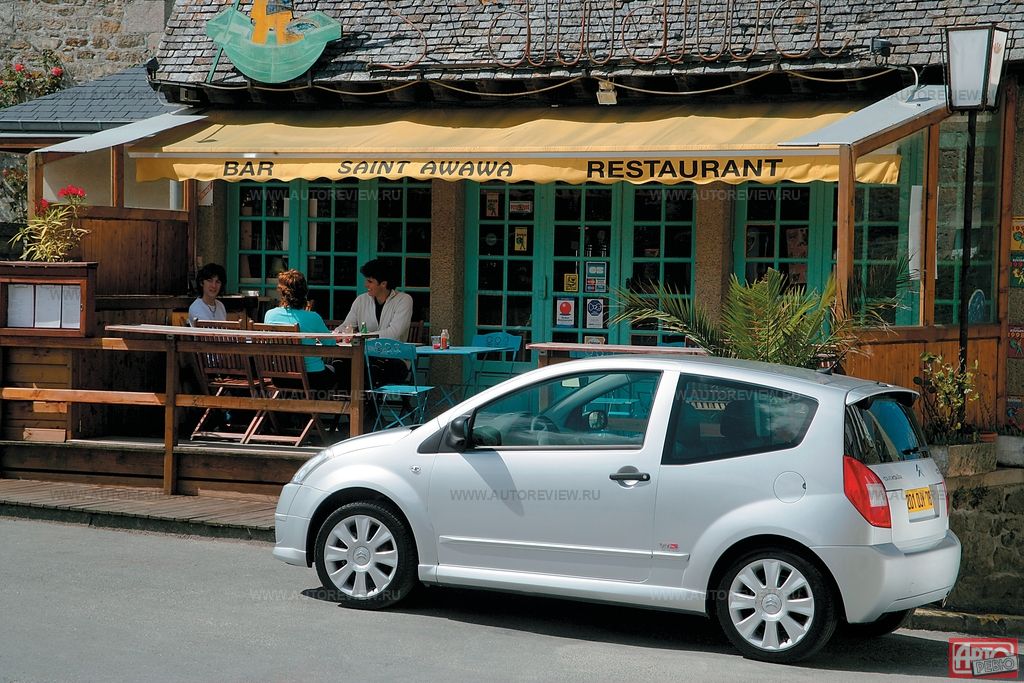
We included in our test all officially sold in Russia "hot" hatchbacks of the B+ class. There are also smaller cars with more modest engines, but, say, Citroen C2 VTS with a 1600-cc engine producing 125 hp will cost 545 thousand rubles — almost like the Ford Fiesta ST.
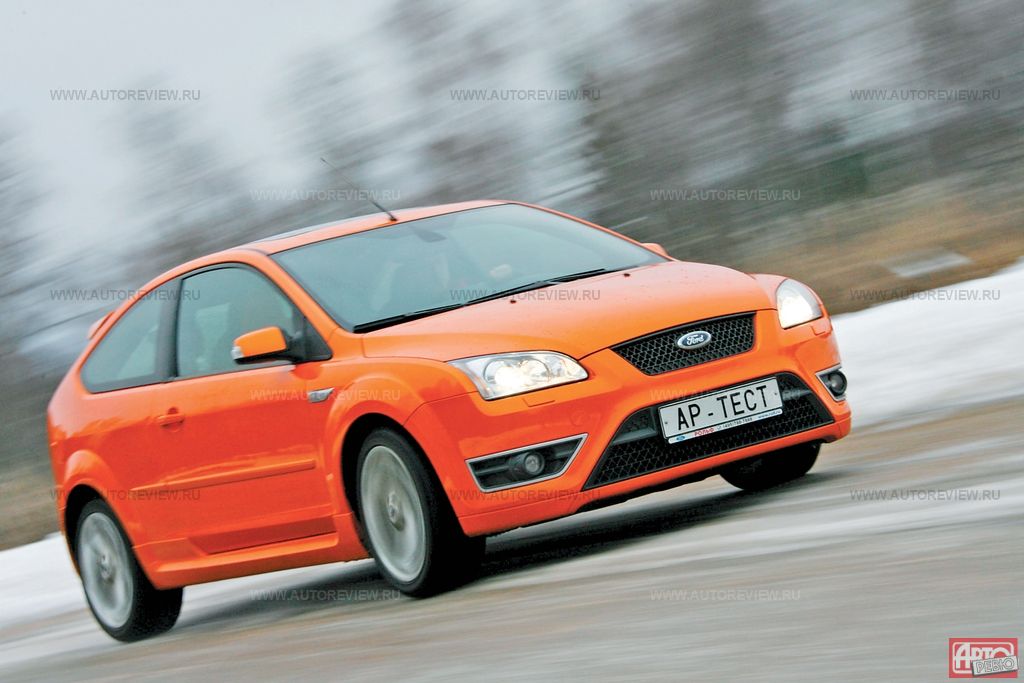
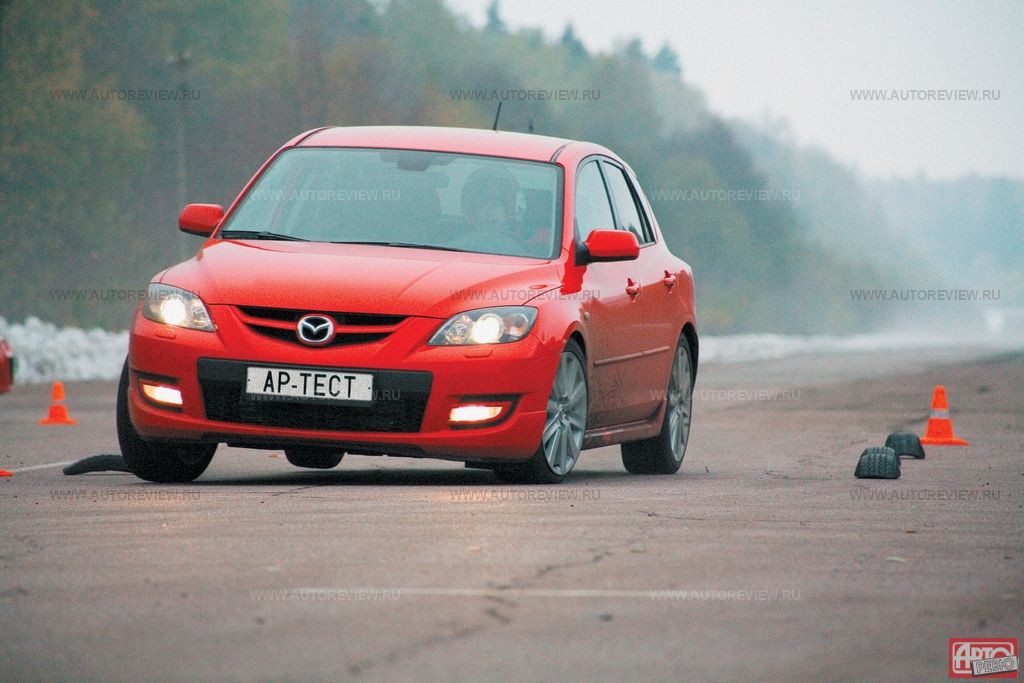
And what if you look at "hot" hatchbacks of the golf class? Prices there are quite comparable! For example, the updated Ford Focus ST (2.5 L, 225 hp), which perfectly combines comfort and drive, costs only 19 thousand rubles more than the Renault Clio RS — from 818 thousand rubles for the three-door. More about the Focus — in AR No. 10, 2006 and AR No. 23, 2006. For 829 thousand rubles you can get the fastest car in the class — the five-door Mazda 3 MPS with a 260-horsepower 2.3 DISI turbo engine and a self-locking differential (details — in AR No. 23, 2006 and AR No. 23, 2007). According to our measurements, the Focus ST is faster than the Clio RS only in top speed (it wins by 20 km/h), and accelerates to 100 km/h in the same 7.8 seconds. The Mazda 3 MPS reaches 240 km/h and hits 100 km/h in 6.8 seconds! Here and below — results of Autoreview's own measurements, not official data.
| Opel Astra OPC | Volkswagen Golf GTI |
 |
 |
| Skoda Octavia RS | Seat Leon FR |
 |
 |
| Honda Civic Type R | Dodge Caliber SRT4 |
 |
 |
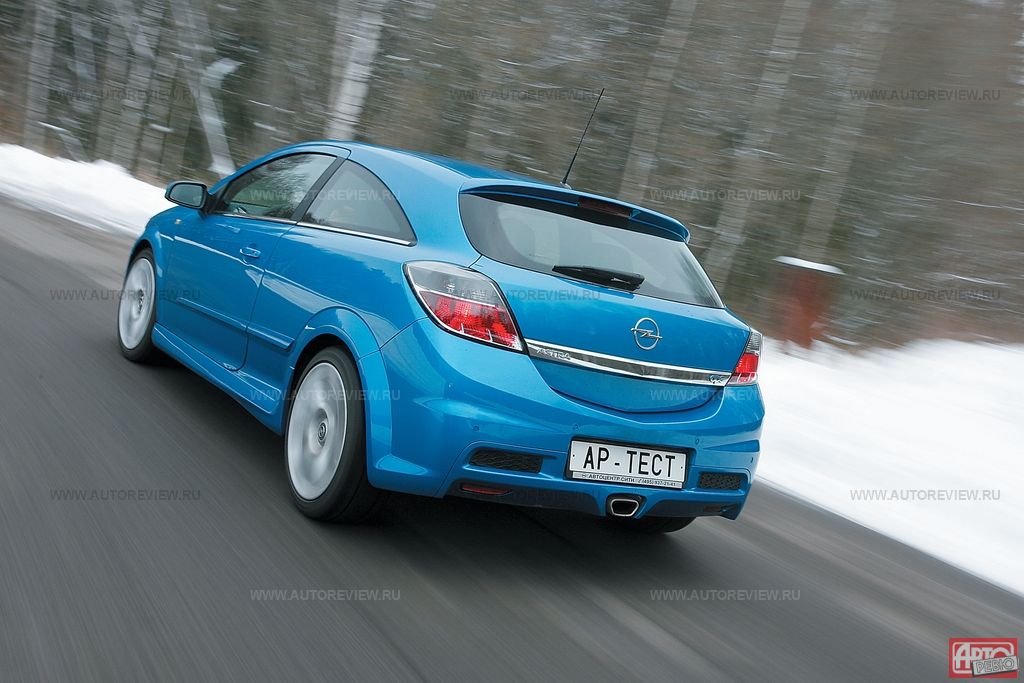
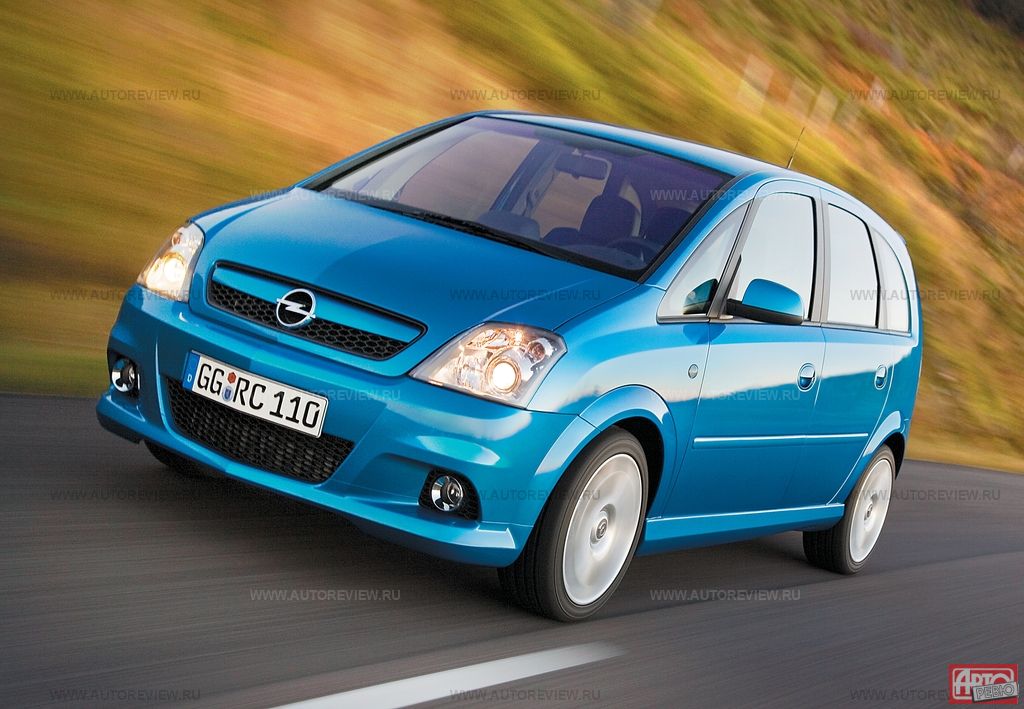
There are plenty of other contenders in the golf class. For instance, the three-door Opel Astra OPC is a real projectile: the suspension is ruthless, the character is jerky, but under the hood there is a two-liter turbo engine producing 240 hp. It shoots to 100 km/h in 7.4 seconds, with a top speed of 230 km/h. They ask from 839 thousand rubles for such a car. If you are not interested in racing for tenths, you can take a more modest 200-horsepower Astra GTC for 711 thousand. And for those who want something unusual, Opel's OPC division even has a minivan Meriva OPC: the engine is the same as the Corsa OPC, but detuned to 180 hp, and it costs from 749 thousand — 16 thousand less than the Corsa.
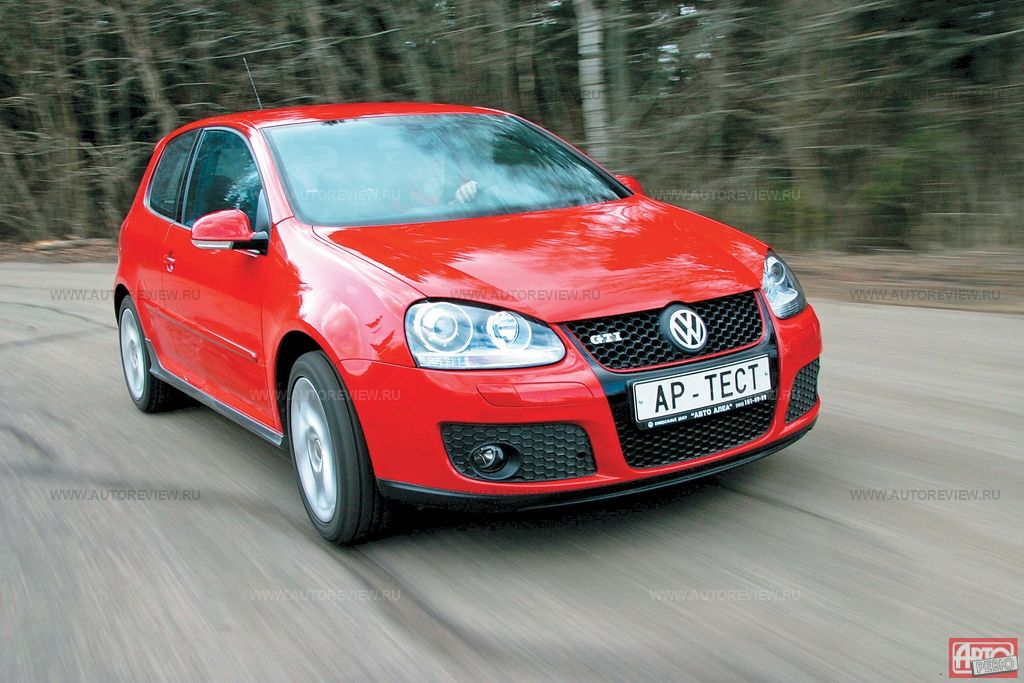
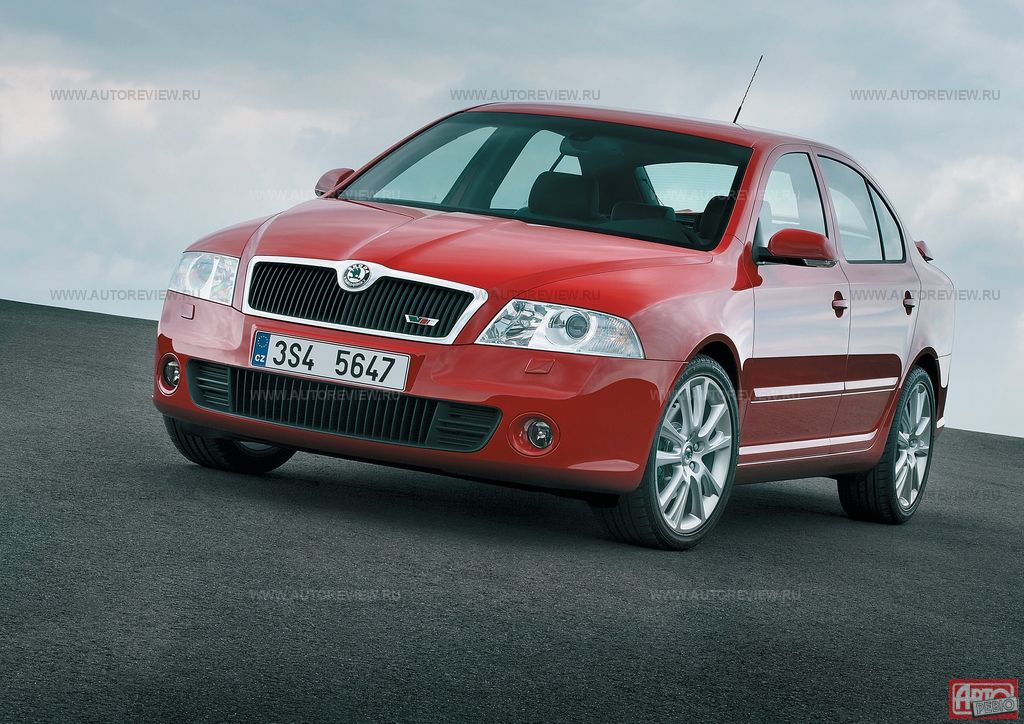
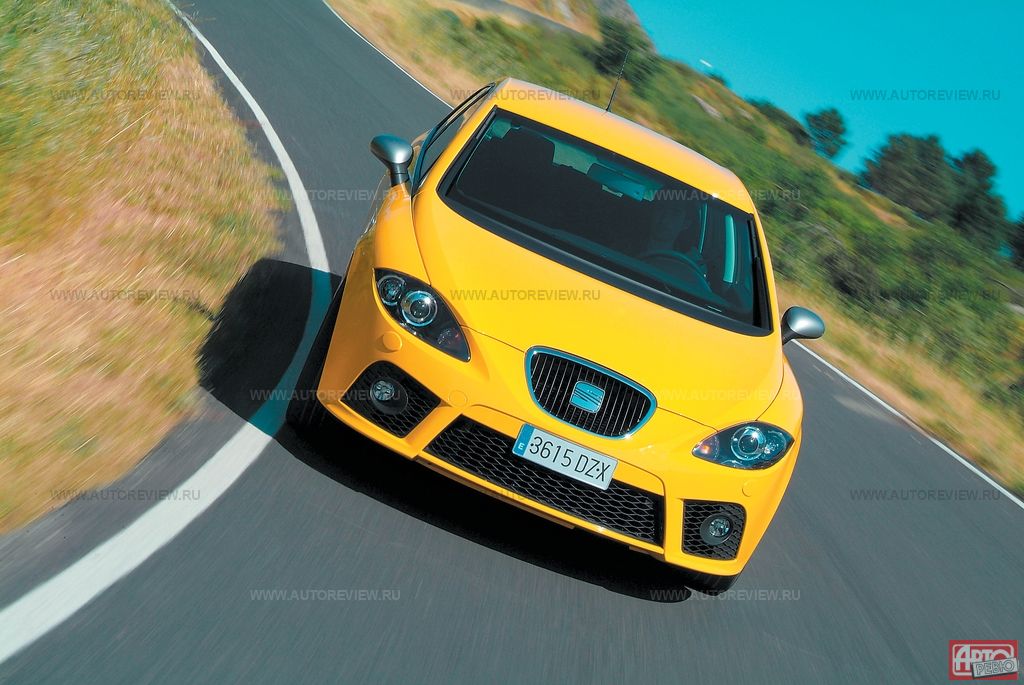
The benchmark of the genre remains the Volkswagen Golf GTI. Its two-liter turbo engine develops 200 hp, acceleration to 100 km/h takes 7.6 seconds, and the maximum is 220 km/h. The price starts from 906,780 rubles. The five-door Skoda Octavia RS is built on the same platform: it has 7.9 seconds to 100 km/h and 235 km/h on the speedometer. The hatchback is priced at 915 thousand rubles, the estate is 30 thousand more. We do not forget about the Spaniards: the Seat Leon FR will cost at least 946,900 rubles, but the Leon Cupra with the same two-liter turbo engine, but boosted to 240 hp, costs from 1 million 65 thousand.
| Citroen C2 VTS | Opel Meriva OPC |
 |
 |
| Volvo C30 T5 | Subaru Impreza WRX |
 |
 |
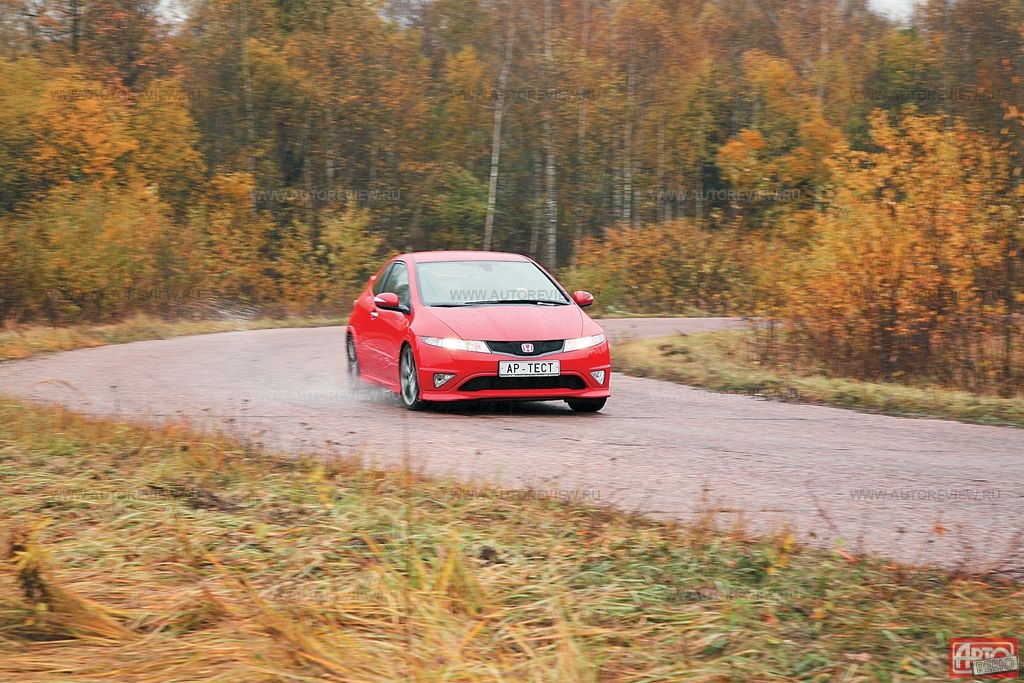
The Honda three-door Civic Type R stands out from the crowd: under the hood it has a two-liter naturally aspirated engine with 200 hp, but in dynamics it is inferior to turbocharged rivals — 8.6 seconds to 100 km/h and 224 km/h of "top speed". The price is 913 thousand rubles. I talked about this car in more detail in AR No. 12, 2007 and AR No. 23, 2007.
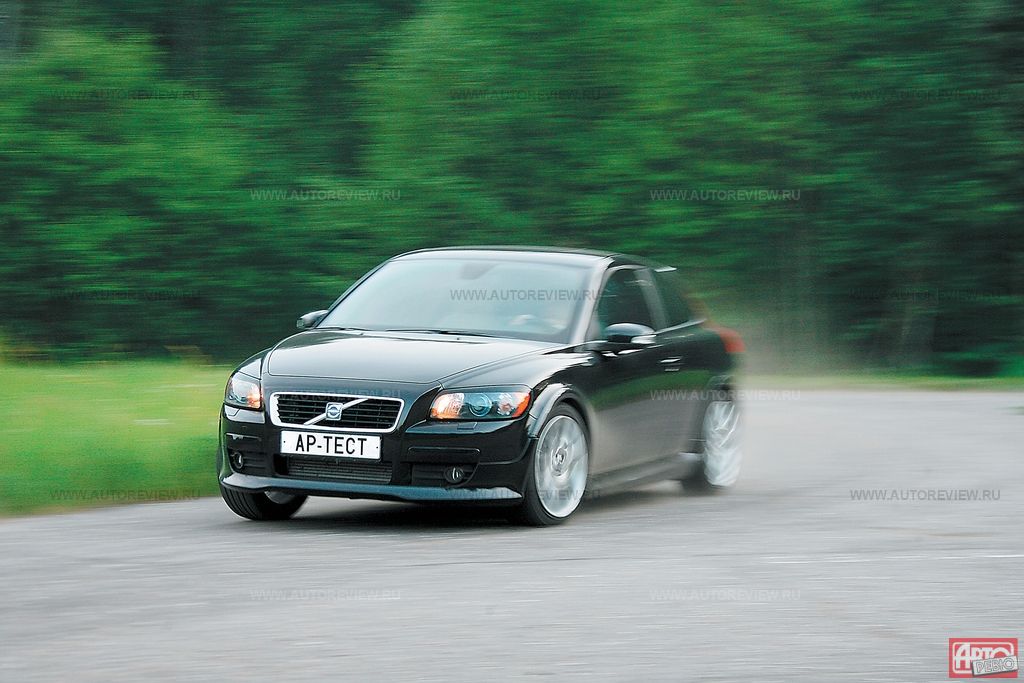
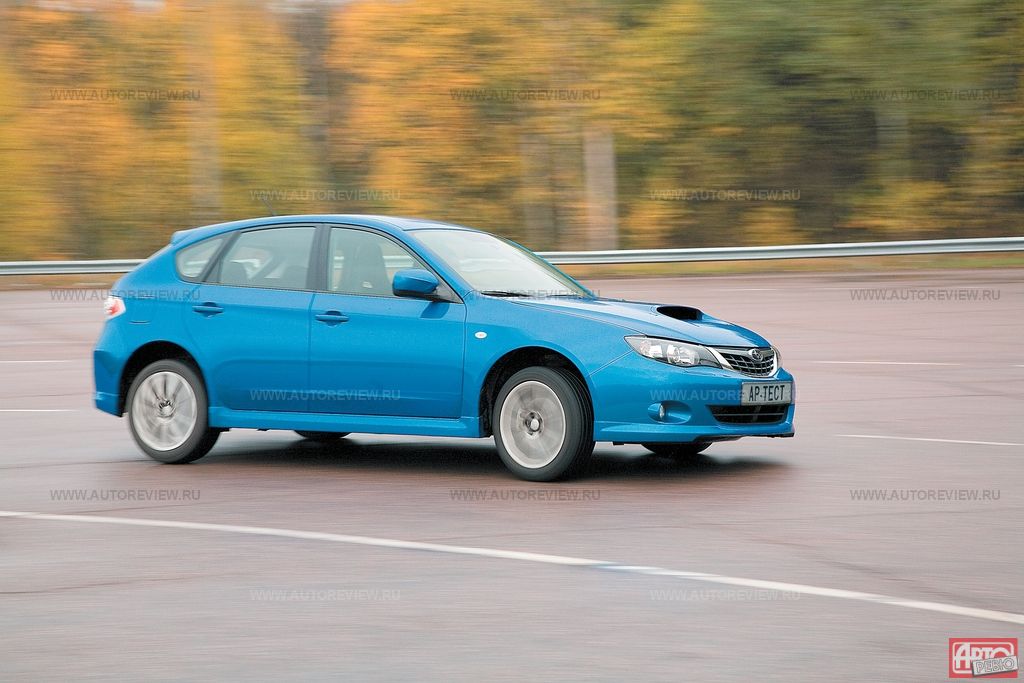
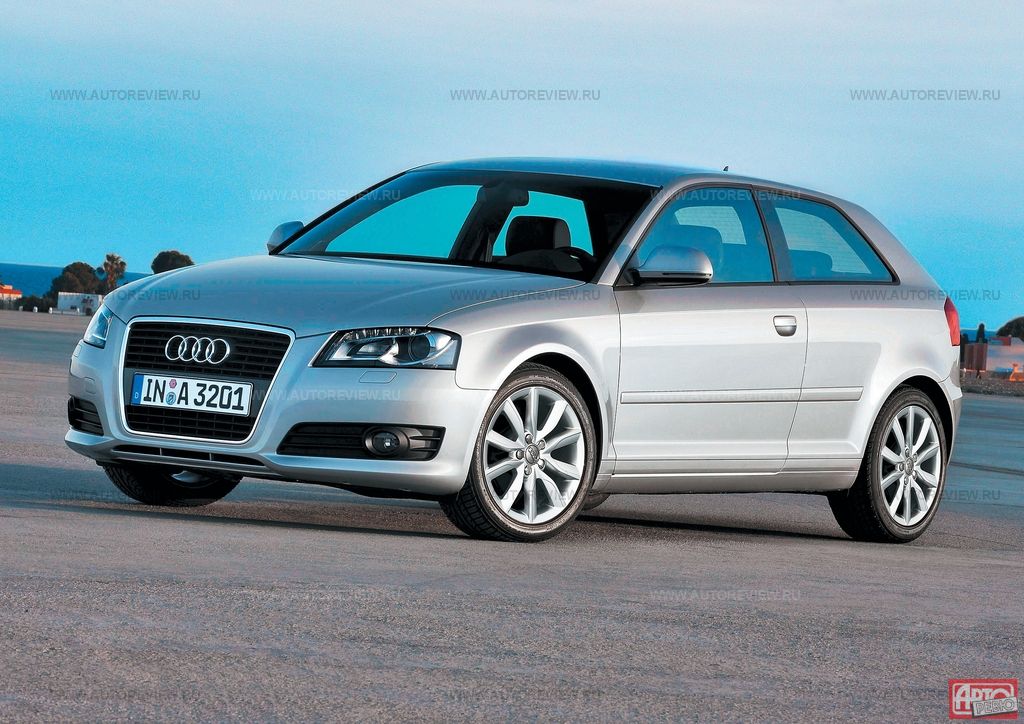
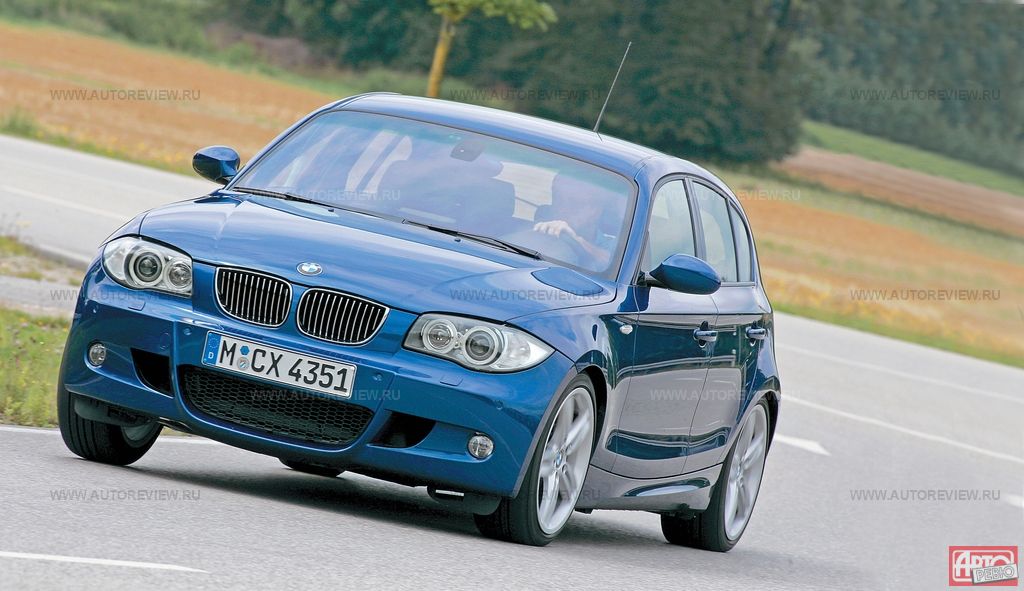
Crossing the million mark, we find more serious machines. For example, all-wheel drive Mitsubishi Lancer Evolution X — from 1,468,800 rubles — or Subaru Impreza WRX with a 2.5-liter engine with 230 hp, for which they ask from 1 million 166 thousand. There are also "premium" alternatives to Mini: Volvo, Audi, BMW and Mercedes-Benz. So, the stylish three-door Volvo C30 T5 (220 hp, 7.8 seconds to 100 km/h, 230 km/h) costs from 1,019,100 rubles — I wrote about this in AR No. 12, 2007. The front-wheel drive Audi A3 2.0 TFSI (200 hp) cannot be found cheaper than 1 million 140 thousand. For the BMW 130i with an inline "six" with 265 hp, they ask from 1,162,800 rubles. And the Mercedes-Benz A 200 Turbo (2.0 l, 193 hp) is estimated at a minimum of 913,900 rubles — that is 11,300 less than the Mini Cooper S.
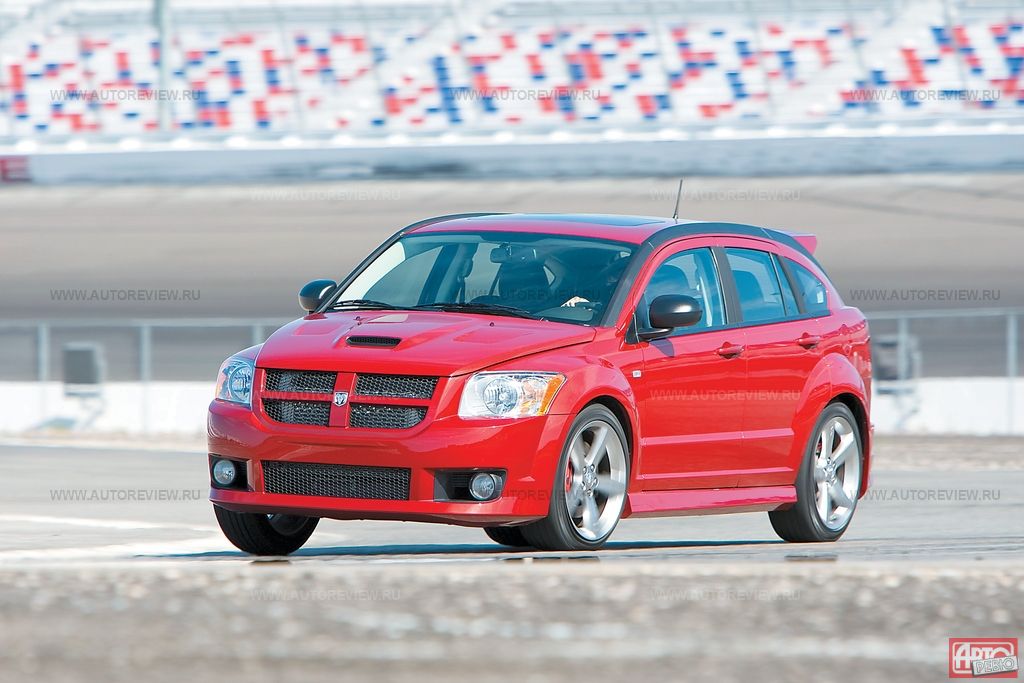
And the last hero is the Dodge Caliber SRT4. This front-wheel drive "charged" hatchback-crossover is equipped with a 2.4-liter turbo engine with 295 hp. In Russia, its sales started at a price of 940,500 rubles.
| Ford Focus ST | Mazda 3 MPS |
 |
 |
| Audi A3 2.0 TFSI | BMW 130i |
 |
 |