
 Comments (5)
 Purchasing the flagship Mercedes S-Class is not a difficult task – almost any driver will confidently state that, in the absence of financial constraints, the Stuttgart masterpiece is beyond competition. But if you dig into the biographies of such advisors, an interesting detail emerges: most of them have never even sat behind the wheel, let alone in the passenger seat, of this car. So what is Mercedes' superiority – a well-established myth or a real reputation that passes from one generation to the next? To find out, we went on a test drive of the Mercedes S500 4Matic – the optimal choice for Russian roads among all modifications.
We got a black glossy S-Class with an interior matching the body color. Tinting on such cars is usually done immediately and without options, but our example had regular windows. However, electric blinds save from prying eyes, hiding even the tiny triangular windows.
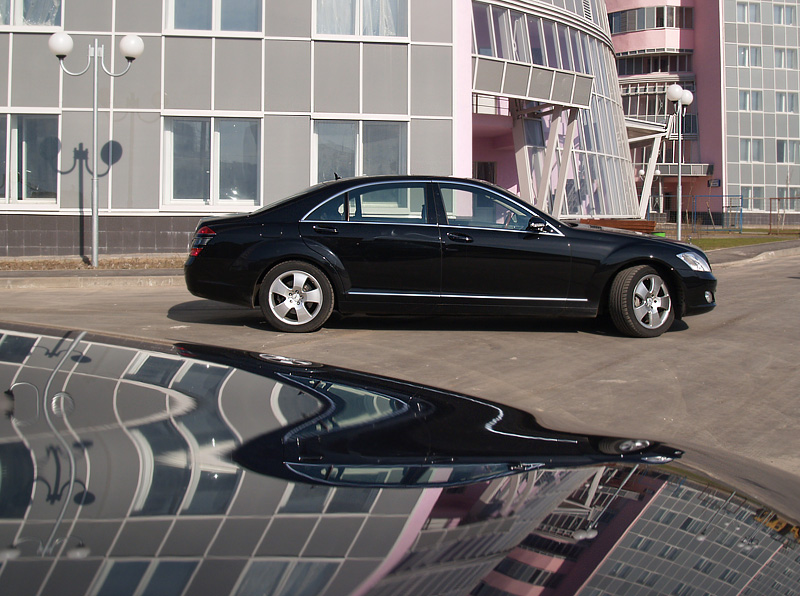
The W221 marked the beginning of a new design era for Mercedes. By abandoning rounded headlights, the sedan gained a strict and confident look that is hard to resist. Moving in the fast lane, you don't even need to flash your high beams – just approach, and the car ahead obediently moves to the right. The trunk lid, which overlaps the rear fenders, evokes associations with Maybach, although there are skeptics who see a resemblance to the Bavarian "seven." But accusing the designers of plagiarism is hard – rather, it's appropriate to talk about borrowing successful solutions. The silhouette of the S-Class is speed in its purest form. It seems that the air behind the sedan's stern closes without a single vortex. And this is not an illusion: the car's aerodynamic drag is only Cx = 0.266.
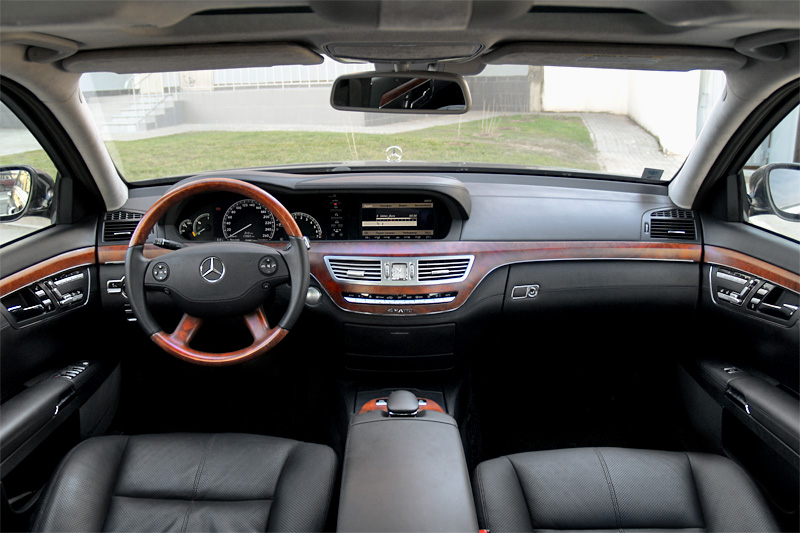
The interior is a separate celebration of technology. And again, hints of Bavarian motifs are heard. Indeed, the Comand system and the steering column gear selector remind us of what we saw in competitors. But there is a nuance: when similar solutions appeared on the BMW 6 years ago, they caused a storm of criticism. Mercedes engineers did not rush, but calmly refined the ideas and made them much more user-friendly. Figuring out Comand is much easier than i-Drive, and basic functions are read intuitively. True, some auxiliary services require concentration – for example, to get to the fine seat adjustments, you need to press a separate key next to the automatic transmission mode switch. Miss it – and instead of adjusting the seat, you'll start clicking through gears.
 Evaluating the S-Class with conventional standards is a thankless task. An unprepared driver feels overwhelmed by the abundance of electronics and options – the effect of a boa constrictor on a rabbit. What doesn't it have: heating and ventilation for all seats, including the rear, a rearview camera with parktronic, adaptive cruise control, a powerful engine with all-wheel drive, and a night vision system that none of the competitors have. Perhaps just the electronic functions alone would be enough for all three days of the test to simply study them.
But we still tore ourselves away from the screens and paid attention to the road. However, the first impression turned out to be related to the car, not the road. On the first turn, leaving the underground parking, I felt a push in my left side – as if the rear wheel had hit an obstacle and the suspension had harshly absorbed it. The situation repeated several times. The explanation turned out to be simple: it was the multicontour seats changing lateral support depending on the trajectory. At first, such activity frightens and irritates, but over time you get used to it: you can sit relaxed in the wide seat and not worry about being thrown out of it in a turn. The seat itself adjusts in the widest ranges – up to a racing "bucket." All that's left is to add a steering wheel with an adjustable diameter – and you'd have a real transformer, transforming from a sports car into a limousine.
Surprisingly, even Mercedes had flaws. Despite the thoughtfulness of the interior, the power window buttons look strange. Instead of the usual "hooks" that work up and down, there are flat "rockers", and all four buttons are grouped very tightly. To hit the right one, you have to aim – otherwise you risk opening the wrong window. You get used to the overloaded steering column stalk faster than to these buttons. The climate control unit also requires attention: the row of levers looks impressive, but using them is not very convenient.
 Okay, enough lyricism – time is pressing. Getting the S-Class out of balance or throwing it into a drift is practically an impossible task. In everyday life, this doesn't happen. A BMW owner can still afford to turn off stability control and hooligan around, but the S-Class in a controlled drift is the lot of either crazy journalists or specially trained drivers from courses that Mercedes regularly conducts around the world, including in Russia.
But despite all its mass and comfortable air suspension, the S-Class turned out to be surprisingly tenacious and nimble. In a calm rhythm, it seems like a clumsy lump. But as soon as you press the gas harder, the car transforms. The roar of the "V8" carries the heavy sedan forward with persistent acceleration. All-wheel drive allows you to forget that under the wheels, dry asphalt changes to wet without the slightest hint of wheelspin, and electronics strictly monitor traction. It's clear that the S-Class is not for the track: the huge steering wheel is not informative enough, and you have to either act blindly or rely on electronics. With active ESP, it's enough to just indicate the direction – and the system itself will steer the car into the corner. With stability control off, the car does not lose its integrity but allows for mischief, remaining predictable: if you overdo the speed, first there will be a slight understeer outward, then a four-wheel slide, which by adding gas turns into a spectacular drift and allows you to fly out of the corner. The main thing is not to overdo it: ESP can strangle the engine at the most inopportune moment. The question remains: will rear passengers appreciate such driving, will it interfere with their work or conversation?
My wardrobe does not yet have a suit matching the status of the S-Class, but that did not stop me from moving to the luxurious rear sofa and telling my colleague behind the wheel: "let's go...".
 In calm mode, when the speed does not exceed a hundred and the revs do not reach two thousand, the moment of gear shifting can be caught only by the instruments – it's impossible by ear. If you raise the pace and rev the engine to 3000-4000 rpm, the gear change is revealed by a change in the engine sound. The hum is clearly audible only at high revs – then it becomes clear that the engine is working at full capacity.
The suspension has one mode – comfortable. Except for parking or on a broken road, the body can be raised a couple of centimeters, but this does not affect smoothness. Huge wheels and air springs easily digest any irregularities, completely isolating passengers from road bustle. And the driver gets a feeling of permissiveness – you can race over any potholes, and the boss in the back won't feel a thing.
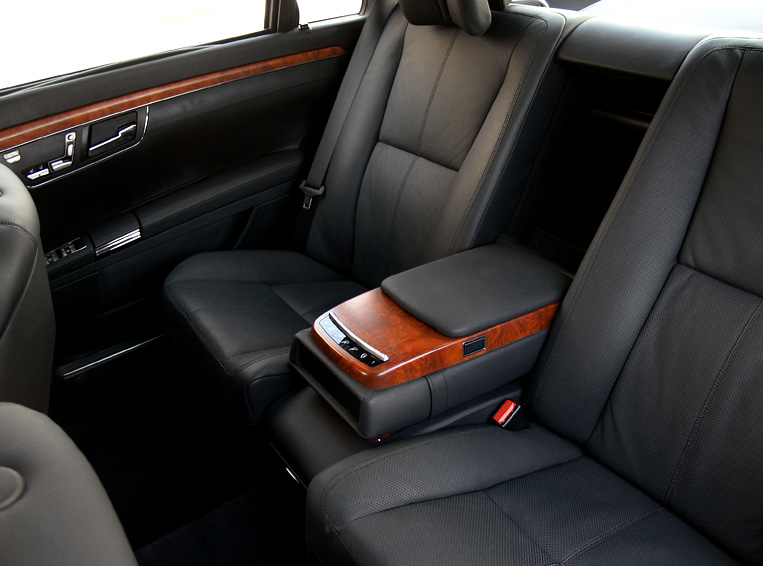
When you first get into the S-Class, it seems that there are more than enough functions even for the most important person. But after you figure out the separate climate control for rear passengers, adjust the personal reclining seat to your liking, draw all the electrically operated blinds, and take a cold drink from the spacious refrigerator hidden in the central armrest, in a traffic jam you begin to catch yourself thinking that for complete happiness, all that's missing is a partition between the cabin and the driver, a retractable footrest, and instead of a delicate massager, it would be nice to have a real masseuse. It seems that there is always room for improvement for the good, and to be more precise – the excellent always wants to become even better...
After all, one step above Mercedes are such tempting brands as Bentley, Maybach, and Rolls-Royce. What general doesn't dream of rising to the rank of marshal?