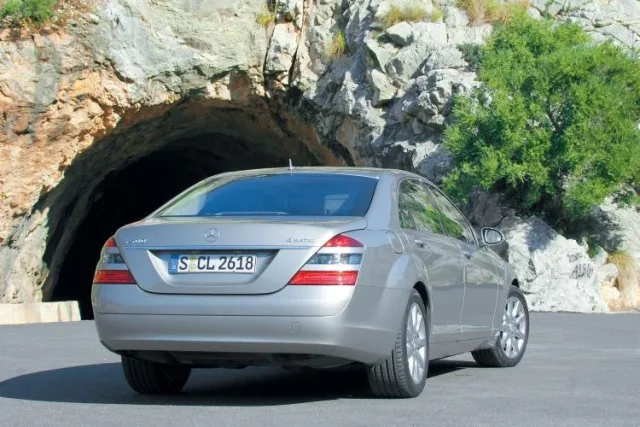
The debut of the new Mercedes CL coupe almost stole the show from the main star — the all-wheel-drive S-Class sedan. I had the chance to drive along the serpentines of Mallorca in the flagship S 500 4Matic version (known colloquially as "firmatic"), and then talk with Mercedes engineers. Previously, all-wheel drive for Mercedes was handled by the Austrian company Steyr-Daimler-Puch, but now the Germans have developed their own transmission. And they assure it turned out better.
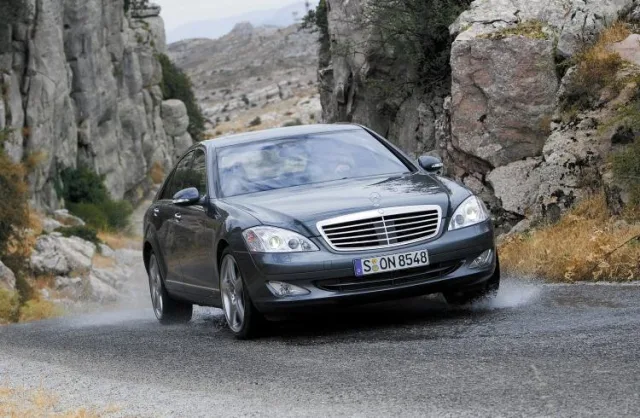
Demand for all-wheel-drive cars in Europe is steadily growing, and the executive sedan segment is no exception: over the past three years, the share of such cars here has risen from 6 to 9 percent. Over the same period, 29,000 all-wheel-drive S-Class cars were sold worldwide. The new S-Class got 4Matic just a year after its premiere — the predecessor in the W220 body had to wait four times longer.
What has changed?
 |  |
| In the new transfer case, the front-wheel drive shaft is connected directly to the drive shaft, without an intermediate gear. Inside the driven gear is a universal joint, the planetary gear satellites have become helical (quieter operation), and a two-disc locking clutch is placed on the carrier | Now 45% of the torque goes to the front, and the differentials are free, both front and rear |
The concept remains the same: permanent drive, asymmetric planetary center differential, torque to the front axle is taken off by gears. But the transfer case is no longer a separate unit bolted to the gearbox — it is integrated into it and uses a common lubrication system. The front wheel shaft is now connected directly to the drive shaft of the 7G-Tronic automatic, without that intermediate gear that previously increased the size of the unit and, accordingly, made the floor tunnel wider. The result is a saving of about 40 kg of mass and less fuel. Previously, the transfer case gears rotated in an oil bath, uselessly stirring the fluid; now lubrication is supplied pointwise to the engagement zone and drains into a common sump with the gearbox. The numbers speak for themselves: the old "firmatic" added an extra liter to the S 500 in the combined cycle (from 11.9 to 12.9 l), while the new one adds only 0.4 l (to 12.3 l).
Unfortunately, on the winding mountain roads I never encountered a gravel section — and that's where the new 4Matic should show itself in all its glory! The Germans redistributed torque in favor of the front axle: it was 40:60, now it's 45:55. According to them, on slippery surfaces this added stability — "the car stopped wiggling like a snake." Plus, to facilitate starting on ice or snow, the center differential has learned to partially lock — until the torque difference between the axles reaches 50 Nm. This is handled by a two-disc friction clutch with constant friction torque, which also dampens torsional vibrations from parasitic torques. In the Austrian version of the "firmatic," there was also a damper, but single-disc, and it wasn't suitable for locking, even "starting" locking.
Interestingly, it is precisely the vibrations from parasitic torques that competitors from BMW, who bet on electronically controlled xDrive, call the main drawback of permanent all-wheel drive. Mercedes, however, is convinced: only permanence gives predictability, and therefore safety.
 | |
| The compact drive shaft, close to the automatic, allowed not to rework the floor tunnel. For the "firmatic" installation, the front suspension was slightly modified and the steering rack was moved. Curb weight increased by 66 kg | The previous generation 4Matic system: an extra gear in the transfer case (indicated by the arrow), straight-tooth planetary differential satellites (40:60), and a weight increase of 100 kg |
— A car with "floating" torque distribution goes through the same corner differently each time, — explains Günter Fischer, head of development of the new "firmatic." — The electronics don't know that the corner is the same, so it calculates the torque balance anew each time. Competitors say it happens in fractions of a second, but even one "tenth" at 100 km/h is 2.8 meters, more than half the length of the car!
Snow will judge them — we'll check in winter.
In Russia, all-wheel-drive S-Class will be offered with two engines: S 450 (340 hp) and S 500 (388 hp), in standard and long-wheelbase versions. A sedan with "firmatic" is five thousand euros more expensive than the rear-wheel-drive one: for example, the S 500 4Matic with a "short" wheelbase is priced at 110 thousand euros (the same as the Audi A8 4.2 L quattro with a long wheelbase). In the middle of next year, the S 350 4Matic will also appear. And in spring, the updated all-wheel-drive system will also be available on the new generation C-Class. What about an all-wheel-drive CL coupe?
— We're thinking about it, — Fischer replies, — never say "never."
| Specifications | ||
| Vehicle | Mercedes-Benz S-Class | |
| Modification | S 450 4Matic | S 500 4Matic |
| Body type | 4-door sedan | 4-door sedan |
| Number of seats | 5 | 5 |
| Trunk volume, l | 560 | 560 |
| Curb weight, kg | 2010 (2055) | 2010 (2055) |
| Gross weight, kg | 2620 (2640) | 2620 (2640) |
| Engine | gasoline, with distributed injection | |
| Location | front, longitudinal | front, longitudinal |
| Number and arrangement of cylinders | 8, V-shaped | 8, V-shaped |
| Displacement, cm³ | 4663 | 5461 |
| Cylinder bore/piston stroke, mm | 92.9/86.0 | 98.0/90.5 |
| Compression ratio | 10.5:1 | 10.5:1 |
| Number of valves | 32 | 32 |
| Max power, hp/kW/rpm | 340/250/6000 | 388/285/6000 |
| Max torque, Nm/rpm | 460/2700—5000 | 530/2800—4800 |
| Gearbox | automatic, 7-speed, ZG-Tronic | |
| Drive | permanent all-wheel | permanent all-wheel |
| Front suspension | independent, air, on double wishbones | |
| Rear suspension | independent, air, multi-link | |
| Front brakes | disc, ventilated | |
| Rear brakes | disc, ventilated | |
| Tires | 235/55 R17 | 235/55 R17 |
| Maximum speed, km/h | 250 | 250 |
| Acceleration time 0—100 km/h, s | 5.9 | 5.4 |
| Fuel consumption, l/100 km | ||
| urban cycle | 17.0 (17.1) | 18.0 (18.1) |
| extra-urban cycle | 8.6 (8.7) | 8.8 (8.9) |
| combined cycle | 11.7 (11.8) | 12.1 (12.2) |
| Fuel tank capacity, l | 90 | 90 |
| Fuel | gasoline AI-98 | gasoline AI-98 |
| * In parentheses — data for the long-wheelbase modification | ||