
Is it possible to combine the advantages of a minivan, an off-road vehicle, and a business sedan in one car? The task is not easy, but it was precisely this that Mercedes engineers tried to solve when creating their unusual series under the letter R. A new class of cars, which loudly announced itself at the New York auto show a year earlier, has also reached Russia. It clearly demonstrates that loyalty to traditions can coexist with advanced technologies, and comfort with excellent handling. The authors embedded this idea in the name as well — GST (Grand Sports Tourer), which translates as a big sports traveler.
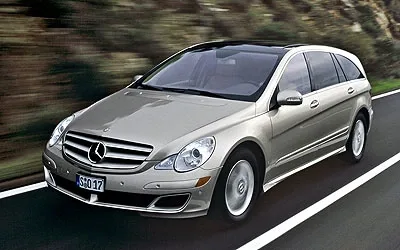
By launching the R-Class, Mercedes aimed to form its own market segment where the model would become the benchmark. How successful this step will be, time will tell. In the meantime, we decided to personally get acquainted with the GST and took it for a test.
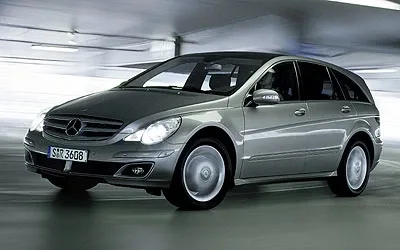
From the outside, the R-Class most resembles a large minivan Chrysler Voyager, although the differences are immediately noticeable. The Mercedes is lower, and its wheels are large, revealing off-road roots. And this is not accidental: it is based on the platform of the all-wheel-drive Mercedes ML of the current generation with asymmetric torque distribution between the axles. True, the wheelbase was stretched by 300 mm, and the body was made single-volume: the hood and windshield almost merge into one line.
Because of the front headlights, unusual for the German brand, you don't immediately recognize a classic Mercedes in the R-Class. But if externally the designers allowed themselves to deviate from the canons, then inside everything is done in a thoroughly Mercedes-like manner. The front panel has almost entirely moved here from the ML — including the automatic transmission selector, which moved from the tunnel to the steering column. At first, this seems strange and seemingly capable of confusing the driver. However, in practice, by the second day of the test, I had completely gotten used to it, and even in parking lots, where gears have to be clicked frequently, no inconvenience arose. Moreover, it seemed to me that such a steering column lever is even more convenient and quicker than the traditional "stick."
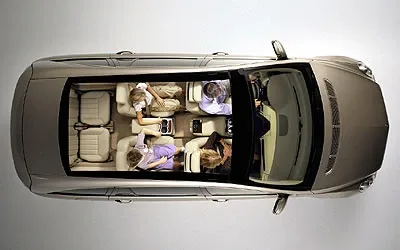
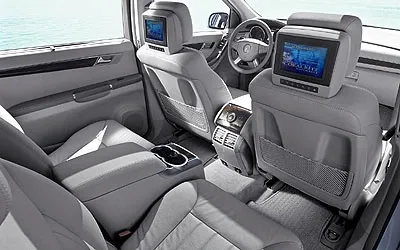
The seats in the R-Class are surprisingly practical and comfortable. Electric drives allow you to adjust the seating position for both a miniature housewife of one and a half meters tall and a two-meter basketball player. Overall, Mercedes, as usual, provides comfort. Thanks to the extended base, on the rear, or rather middle, seats (there are three rows here), you feel quite at ease. The wide doors simplify entry, and each seat is individually adjustable in length and backrest angle. If you slide the middle row all the way back, passengers will be more spacious than in a luxury sedan. There is also more headroom, not to mention the absence of a central tunnel. True, electric adjustments and massage for the second and third rows are not provided, but monitors are built into the backs of the front seats, and the rear of the cabin has its own climate control.
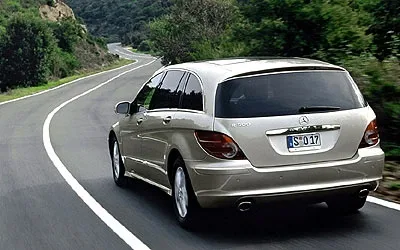
The two seats in the very rear, of course, are not as spacious: legs are tighter, the head almost touches the ceiling, and the massive body pillar hinders visibility. But if you remember the purpose of the R-Class, everything falls into place. On long trips, these places are reserved for children. They will surely like having their own corner in a huge car, especially since there is a large sunroof (optional) above their heads, which kids love so much. Parents will also be calmer: children do not have direct access to the doors.
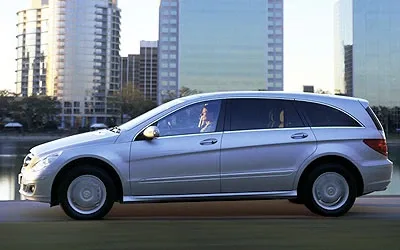
The trunk with a spacious six-seat cabin turned out to be modest — only 433 liters. But if you fold down at least one row of seats, the volume grows to 1195 liters, and if you leave only two seats, the "traveler" turns into a small van of 2.4 cubic meters.
For the test, we got a GST with the most modest gasoline engine of 3.5 liters and 272 hp (the range also includes diesels and more powerful engines) and, of course, with an automatic transmission — a manual is not offered at all. Despite the impressive weight of 2205 kg, which is 300 kg more than the ML, the R-Class turned out to be quite lively in the city. If desired, the huge body takes off surprisingly briskly and reaches a hundred in 8.3 seconds. It accelerates to 140 km/h at a very lively pace, but then aerodynamics make themselves known, and the speed gain becomes calmer, although it remains acceptable.
In any mode, whether acceleration or braking, amazing silence reigns in the cabin. On rough asphalt, the tires hum barely noticeably, and on smooth surfaces, almost absolute silence sets in — the driver can talk to passengers in the last row almost in a whisper. The engine is also perfectly isolated: when the tachometer needle approaches the red zone, it is heard just enough to understand that the engine is running at full capacity.
The multifunctional steering wheel is studded with buttons for controlling the phone, audio system, and on-board computer screen, and on the reverse side are hidden keys for selecting gears of the 7G TRONIC automatic transmission with the "DIRECT SELECT" function. The steering wheel, as befits a Mercedes, is comfortable and equipped with power steering.
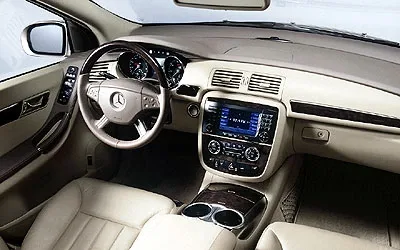
The seven-speed transmission 7G-Tronic works clearly — by the way, this is the only seven-range automatic gearbox in the world; competitors do not have one.
Sometimes you want a more sporty algorithm, but if desired, you can switch to manual mode.
Additionally, the test vehicle was equipped with air suspension with adjustable ground clearance and a shock absorber stiffness switch. Given that the car is often planned to be used off-road and considering the condition of our roads, such options turned out to be not superfluous at all.
In comfort mode, the car seemed excessively rolly and leaned in corners, but as soon as you chose sport, the car tightened up, becoming more composed and precise in its responses to the steering wheel. However, you can't fool almost two tons of mass and high-profile tires: the R-Class is not designed for aggressive cornering, and in sport suspension mode, road irregularities are felt more distinctly in the cabin. As a result, although the car remains obedient and predictable in critical situations, you want to slow down and enjoy smoothness rather than speed. If desired, the R-Class can "light up," but the atmosphere in the cabin encourages calmness. Therefore, the comfort mode of the air suspension seems more appropriate: in it, the huge car seems not to notice small surface defects. Even tram tracks and speed bumps are passed almost imperceptibly.
Despite all-wheel drive, the R-Class is poorly suited for serious off-roading: low bumpers and impressive overhangs limit it on slopes, and the ground clearance even at the maximum of the air suspension is small. But it easily climbs most curbs, where minivans are forbidden, and in winter, all-wheel drive will surely be the key to confident movement.
Throughout the test, I pondered: who would become the buyer of the R-Class? On the one hand, the car has many advantages, but each of them separately and in a more perfect form is available in other Mercedes models. Then why is this hybrid needed? Maybe it's not worth harnessing a horse and a tender doe to one cart? But in the end, I concluded that a buyer will be found. Probably, this is a person who cannot afford to keep several cars in the garage, but lives in such a way that family and work tasks do not conflict, but peacefully coexist. These are exactly those whom in the West it is customary to call the middle class.
The prices that Russian dealers ask for the "big traveler" are a bit confusing. The most affordable R-Class with a short wheelbase costs €63,500, the long-wheelbase version is €2,300 more expensive. And the tested example with a rich set of options is estimated at almost €100,000. If the R-Class were sold in Russia at American prices (and it is assembled in the USA) — from €49,000, then, I am sure, there would be fewer doubts, and those willing would be many times more.
Leonid Pavlov