
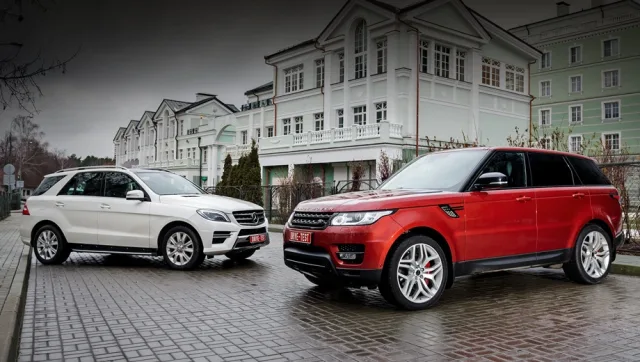
They say that whatever you name a boat, that's how it will sail. Wasn't that what the British were thinking in 2005 when they gave the heavy frame-based off-roader built on the Discovery platform the name Range Rover Sport? On the road, it didn't behave very sportily, but it floated quite successfully. The new Sport has changed radically: it's more technologically advanced, lighter, and, yes, sportier. But its opponent is also a tough one — the Mercedes ML, the leader in the segment of large premium crossovers. True, today their conversation is in raised tones: both cars come with serious off-road packages and supercharged V8 engines.
Don't you see yourself as a conqueror of off-road terrain, and your habitat is the city? Then you can skip ordering the On & Offroad package, which the test ML 500 is equipped with. In that case, you'll get permanent all-wheel drive with a free center differential, and the maximum ground clearance won't exceed 255 mm (instead of 285).
Running boards with powerful illumination in the style of Brabus tuning studio are a factory option. The rear-view camera always stays clean because it automatically retracts under a plastic cover.
The British SUV has gained an aluminum unibody, shedding 420 kg at once, and stiffer suspension elements compared to the regular Range. But the first inconsistency with the Sport prefix is felt in the driver's seat — you sit so high behind the wheel that you feel like you're in a long-haul truck. The excellent contoured seat is mounted 20 mm lower than in the older 'brother,' but even in the lowest position, you see the entire hood and look over the roofs of various Focuses, Solarises, and other Octavias. A side effect is the inconvenience of getting in and out due to the high floor. However, visibility is exemplary thanks to thin front pillars, large side mirrors, and a large glass area!
The car turns into a serious off-roader for an additional fee (exception — this Supercharged version, which initially comes with advanced off-road transmission), and in base trims, the five-door is content with an asymmetric self-locking Torsen differential that sends up to 62% of torque forward and up to 78% rearward. By default, it splits the moment in a 48:52 ratio. No low-range gear, no wheel locks.
Regardless of the air suspension mode, without retractable side steps (option), getting into the cabin is difficult — the floor is too high. But thanks to the developed plastic side trim at the bottom of the doors, the threshold is always clean.
After the Range Rover, you sit in the Mercedes as if in a coupe. You sit low in the ML 500, the front edge of the hood is no longer visible to your eyes, and the seating process causes no inconvenience — the floor is lower, and the thresholds are complemented by a branded step. The front multicontour seats have a less strict profile, but they are comfortable and, besides all conceivable adjustments, can pamper the owner and front passenger with four types of massage (the Range doesn't have this). But you look at the surrounding world from the driver's seat of the Mercedes — and you feel the sense of security created by the British model dissolving. And visibility in the German car is not all smooth: although the thickness of the pillars doesn't exceed reasonable limits, after the Range's big mirrors, the small side mirrors of the Mercedes are disheartening.
Expensive trim, high build quality, homey comfort, and thoughtful ergonomics — it seems you've just entered the cabin, but it feels like you've spent years here. The steering column-mounted gear selector (on the right side) is a very convenient thing!
The interior design is modern, there's noticeably more front width, and in terms of trim materials and the precision of button and controller effort, the Range Rover Sport even surpasses the Mercedes. But the interior is assembled worse (the lower edge of the central horizontal panel creaks and flexes when pressed with fingers), and using the equipment is not as convenient.
In the cabin — a kingdom of natural leather, real aluminum, and wood, and under the hood — the territory of eight cylinders. The English five-door is armed to the teeth — a V-shaped five-liter engine with a supercharger. Its output is 510 hp and 625 N•m, allowing the 2310 kg car to catapult to 100 km/h in 5.3 seconds and reach 250 km/h. The Mercedes ML 500 weighs less — 2235 kg. But its engine is also weaker — a 4.7 V8 with two turbochargers produces 408 hp and 600 N•m. And even though in terms of power-to-weight ratio the Mercedes yields to its opponent (183 hp per ton versus 221), the ML 500 accelerates to 100 km/h in 5.6 seconds from a standstill, and the top speed is also electronically limited to 250 km/h. However, these figures should not mislead you — in driving disciplines, there's a chasm between the British and German cars.
Control buttons for the most sought-after functions in the Mercedes are always at hand and don't require lengthy manipulations. And things like extended settings for the front multicontour seats (adjusting cushion length, side support bolsters, massage) are only available through the colorful and intuitive menu of the Comand Online system. Using it is a pleasure. And the navigation works more promptly than in the Range.
The Range's virtual instrument cluster is more visual than the classic Mercedes instrumentation. Moreover, this solution allows displaying more useful information, including large and clear navigation prompts and alarming messages about various malfunctions (the Mercedes also had plenty of such notifications). But the central touchscreen kills everything alive in us. It's larger than the Mercedes display, but the graphics send greetings from the last century, and the sluggish response to button presses would infuriate even a boa constrictor. The fact that to control some climate functions and seat heating/ventilation you need to dive into the multimedia menu is also displeasing. Only the stereo imaging function slightly sweetens the pill.
Both off-roaders are covered with cameras around the body — they are not only in the tailgate but also in the side mirror housings and the front bumper. But only the Mercedes can render a 'bird's-eye view' picture, while the Range Rover Sport displays images from all cameras in several virtual windows.
The Range Rover Sport Supercharged loudly declares its character even when standing still — during engine start after an overnight stop. Your neighbors will hate you! For the first couple of minutes, the SUV emits such a wild roar that a shiver runs down your spine. Then from the exhaust pipes comes only a pulsating thump, and after about five more minutes, warm air flows from the cabin vents. The Mercedes also quickly starts warming the driver and passengers, but the engine start is more prosaic. Outside, you hear an unremarkable sound of a multi-liter gasoline engine, and inside — a barely audible rustle. It's not fitting for a solid Mercedes to scare others with animal sounds.
The Mercedes' headlights seem borrowed from two different cars, which introduces dissonance into the design. Alloy wheels with 255/50 R19 tires and perforated brake discs on both axles are standard equipment for the V8 version.
From whichever side you look, the Range Rover Sport is executed in a single memorable style. Stunning 22-inch alloy wheels are additional equipment ('in base' — 21-inch wheels). Six-piston Brembo calipers on the front axle are available for V8 cars by default.
So the ML 500 starts moving — emphatically smoothly, with a sense of self-worth. The gas pedal responds detachedly, but if you sharply stomp the accelerator, the seven-speed 'automatic' will downshift one or several gears, and the Mercedes will make a powerful lunge under the quiet growl of the supercharged V8. The thrust becomes unbridled already from 1600 rpm, and the peak torque extends to 4750 rpm. In other words, there wasn't a single situation where I lacked the capabilities of the 'eight.' There's no separate sport mode for the gearbox, but you can switch the entire powertrain from Auto to Sport mode. The SUV will become more responsive to the accelerator, and the 'automatic' will gain enthusiasm. A very fast all-wheel-drive by any standards, but this impression doesn't change — the ML 500 is perceived as a car for a judicious, calm driver.
The German SUV doesn't look big, but there's enough free space in the cabin for everyone. The seats with many adjustments are friendly to front and rear occupants, but in our Mercedes, second-row passengers will be bored — the only amenities are an armrest with two cupholders and seatback angle adjustment. Although any whim is possible for your money — on request, the car can be equipped with an entertainment system with monitors in the front seat headrests and a separate climate control unit.
The Range's front seats are no less technologically advanced. While they lack a built-in massage function, they hold the body better, and the three-stage heating or ventilation can be activated separately for the cushion and backrest. The luxurious front headrests, which gently embrace the head, are also worth noting. The rear bench is also heated and ventilated, and its backrest angle is adjustable. One thing that puzzles is why, with a wheelbase of nearly three meters, the second row offers cramped legroom.
The cabin of the test Range is a multimedia kingdom! There are two screens in the headrests, wireless headphones in the door pockets, and a remote control for the DVD player and Meridian audio system with 23 speakers and 1700 watts in the center armrest, priced at 228,500 rubles (the Mercedes has a Harman Kardon with 14 speakers and 830 watts). However, it's hard for rear passengers to watch movies on the move—the shaking can cause motion sickness.
The English SUV offers a properly shaped trunk and a full-size spare wheel with a diameter of 22 inches (you might pass out while pulling it out). But the cargo volume is a modest 784–1761 liters. Despite being shorter, narrower, and having a smaller wheelbase, the Mercedes offers from 690 to 2010 liters. The German also has a lower loading height and a slightly wider opening. Both vehicles have a power tailgate.
The chassis settings also induce melancholy. The steering wheel offers almost no resistance when turned—it seems it would turn if you just blew on it. At speed, the rim becomes heavier, allowing you to iron out straights without paying much attention to the trajectory. The Mercedes also has good feedback at low speeds. But the confidence you gain in yourself and the car dissipates as soon as you enter a corner faster. The low steering sensitivity is compounded by body roll, diagonal rocking, and overall softness of the chassis. Even Sport mode only changes nuances: the air suspension becomes slightly firmer, and the steering becomes more viscous. But even in Sport, the Mercedes remains true to itself without any 'buts' or 'ifs'.
Like the Range Rover Sport, the Mercedes ML 500 is equipped with adaptive cruise control with stop & go function. Both systems work imperfectly, but the Mercedes one makes you more nervous due to late and harsh braking.
And all for unprecedented comfort. The air suspension protects the driver and passengers like professional bodyguards protect their employers. In automatic mode, there's no trace of bumps. The ML 500 smooths out rough and uneven surfaces to the state of smooth ice, and small, medium, and large potholes, as well as transverse cracks in the asphalt, remain somewhere out there, between you and the road. In Sport, the car pays more attention to small imperfections, better indicating bumps, but still remains velvety on the move. Honestly, you only need to slow down for significantly protruding bumps—only they can hurt passengers. And acoustic comfort is absolutely perfect—neither the studs of winter tires nor the oncoming air at even the most immodest speeds disturb the atmosphere of tranquility. King of comfort!
The Mercedes holds the high-speed straight better due to less sensitive steering, soft suspension, and indifference to worn ruts in the asphalt. Perhaps the ML would be more composed if the chassis were supplemented with optional Active Curve stabilizers for 222,000 rubles.
And the Range Rover Sport—king of what? Sport? At first, it seems so. Especially when you shamelessly press the gas pedal. In an instant, the giant, squatting on the rear axle, with a deafening, heart-rending roar, makes a lightning-fast journey to the horizon. Passengers pressed into the seatbacks experience shock at that moment, but after a short breather, beaming with smiles, they ask for more. And they still can't comprehend how this huge SUV, weighing almost as much as a Crusader tank, can move its 22-inch wheels so quickly. And I understand them! After all, every energetic acceleration in the Range is a loud event that cannot go unnoticed—neither by people in the cabin, nor by drivers of neighboring cars, nor by pedestrians on the street.
The British SUV is more eager to tackle winding roads than its opponent, and the weight distribution is almost ideal (the ML 500 has nearly 60% of its mass on the front axle).
After the Mercedes, driving the 'sporty' Range Rover makes you feel 20 years younger. The English all-wheel-drive vehicle tries to match, proving to be more solid on the move. It responds quickly to steering inputs, requires turning the rim to smaller angles, doesn't deprive the driver of valuable information, and thanks to active anti-roll bars, leans less than the ML 500. The Range's throttle response is also more honest, though it raises questions. You can activate Dynamic mode (where the suspension becomes slightly stiffer) and also switch the eight-speed automatic to a sportier algorithm. Sacrificing shift smoothness, the gearbox becomes rapid-fire.
Under throttle, the Range Rover Sport, without wasting much time on understeer, quickly transitions to carving into the corner, and if you let emotions run wild, it can even slide (and not always smoothly). In the same conditions, the Mercedes behaves more restrained—it understeers with a larger radius in a four-wheel drift.
It seems to have everything—a magnificent engine, a perfectly tuned automatic, and a smartly calibrated chassis. But the Range Rover has enough rough edges that prevent it from being called the king of sport among such vehicles. If you forget about the Mercedes for a while, the Range Rover Sport no longer seems so flawless. The English engine's output is higher, but it's harder to manage due to the coarse and unpredictable throttle response. The brakes could be more resistant to overheating. The red six-piston Brembo calipers on the front axle promise great things, but in reality, the Range behaves uncertainly after just a few prolonged high-speed braking events. The pedal's free travel increases significantly, although initially it's less than on the German SUV.
Both SUVs have similar base ground clearance—200 mm for the Range and 202 mm for the Mercedes. But the German model has more forced air suspension modes, including a sport mode available at any speed that lowers the clearance to 180 mm. The English car, however, has an access mode (clearance of 150 mm), lowers or raises the body faster, and off-road with electronics, the ground clearance can be increased to 300 or even 335 mm (the Mercedes ML 500 with the On & Offroad package has a maximum of 285 mm).
The British claim that the Range Rover Sport has suspensions with the most impressive travel. The German lifted the rear wheel quickly, but with the 'Brit' we had to fiddle longer. However, both handle diagonal wheel articulation perfectly using only the stability control system. The approach and departure angles for the Mercedes and Range are 31 and 29 degrees versus 33 and 31 degrees, respectively.
A paradise for beginners! You select the off-road system mode and calmly set off to conquer nature—the car does everything for you. And the Mercedes is even more convenient in this regard—it offers fewer settings to choose from. You can display clear images on the screen showing the wheels, air suspension operation, and differential locks.
But the Range Rover will take its toll on the driver and passengers to the fullest—for every letter in the word sport. The presence of air suspension on the move manifests as almost imperceptible body oscillations when driving straight. But in any mode, the five-door Land Rover's chassis meticulously collects all the small stuff from the road and, without scattering it along the way, delivers it to the cabin. It's not scary. Nor is the fact that small bumps respond with slaps from the wide tires. But then... The suspension is stressed even by medium-sized potholes, and large ones terrify it. Protruding rails, expansion joints—the Range Rover Sport can't come to terms with them. The sound insulation of such an expensive car could also be better: up to 100 km/h everything is fine, but after that, tire roar and aerodynamic whistling appear around the side mirrors and the top edge of the windshield.
During the tests, both cars didn't complain about poor appetite: in normal driving modes with a predominance of city use, the Range Rover Sport consumed 20.4 liters of gasoline per 100 km, while the Mercedes ML 500 consumed 17.9 liters. Those who like to frequently press the gas pedal are to be pitied—fuel disappears from the tank almost as quickly as it enters.
The only thing that unites the Range Rover Sport and the Mercedes ML 500 is their supreme off-road capability. Both vehicles are equipped with a multi-mode transmission with permanent all-wheel drive, a low-range gear, a central differential lock, and air suspension, while the Range Rover Sport additionally features a rear differential lock (with torque vectoring) and water level sensors. With suitable tires, these vehicles can conquer many tough challenges. And yet, the "Briton" seemed preferable to us over the "German." The former has greater suspension travel, the maximum ground clearance that the air suspension can provide is 335 mm for the Range versus 285 mm for the Mercedes, and the wading depth is 850 mm versus 600 mm, respectively.
Over the past year, Russians bought 5,427 Mercedes ML SUVs (of which 132 were the "500" models). Sales of the Range Rover Sport began in late August 2013, and by the end of the year, 1,448 vehicles were sold, including 511 five-door versions with the 510-horsepower engine. And we are not surprised by the popularity of the most powerful modification.
If we were awarding points, the Mercedes would win. An excellent car that is worth its money. It will not disappoint with build quality and cabin comfort, will captivate you with its refined character, and conquer you with comfort. And the V8 is not needed — replace it with a "six," and harmony will only increase. A bestseller, in a word: the M-Class is more than twice as popular in the market. And the Range Rover Sport… A controversial ideology, a bunch of contradictions. The suspension is stiff, but it does not deliver sporty on-road behavior. The accelerator calibration lacks precision, and the cabin lacks space. But we cannot help ourselves — impeccable style, charisma, and a barrel of recklessness from the Supercharged version robbed us of our composure. We even awarded the Sport the title of "Large All-Wheel-Drive Vehicle of the Year."
Specifications
| Model | Mercedes ML 500 | Range Rover Sport Supercharged |
|---|---|---|
| Body | ||
| Body type | wagon | wagon |
| Number of doors/seats | 5/5 | 5/5 |
| Length, mm | 4804 | 4850 |
| Width, mm | 1926 | 1983 |
| Height, mm | 1796 | 1780 |
| Wheelbase, mm | 1648/1663 | 2923 |
| Track front/rear, mm | 1648/1663 | 1690/1685 |
| Curb weight, kg | 2235 | 2402 |
| Gross weight, kg | 2950 | 3050 |
| Trunk volume, l | 690–2010 | 784–1761 |
| Engine | ||
| Type | petrol with direct fuel injection and bi-turbocharging | petrol with direct fuel injection and supercharger |
| Location | front, longitudinal | front, longitudinal |
| Number and arrangement of cylinders | 8, V-shaped | 8, V-shaped |
| Number of valves | 32 | 32 |
| Displacement, cm³ | 4663 | 4999 |
| Max power, hp/rpm | 408/5000–5750 | 510/6000–6500 |
| Max torque, N•m/rpm | 600/1600–4750 | 625/2500–5500 |
| Transmission | ||
| Gearbox | automatic seven-speed | automatic eight-speed |
| Drive | permanent all-wheel | permanent all-wheel |
| Chassis | ||
| Front suspension | independent, air, double wishbone | independent, air, double wishbone |
| Rear suspension | independent, air, multi-link | independent, air, multi-link |
| Front brakes | ventilated disc | ventilated disc |
| Rear brakes | ventilated disc | ventilated disc |
| Tires | 255/50 R19 | 275/40 R22 |
| Ground clearance, mm | 202–285 | 200–335 |
| Performance characteristics | ||
| Maximum speed, km/h | 250 | 250 |
| Acceleration time from 0 to 100 km/h, s | 5.6 | 5.3 |
| Fuel consumption, l/100 km | ||
| — urban cycle | 15.2 | 20.5 |
| — suburban cycle | 9.5 | 10.0 |
| — combined cycle | 11.5 | 13.8 |
| Emission standard | Euro-5 | Euro-5 |
| Fuel tank capacity, l | 93 | 105 |
| Fuel | AI-95 | AI-95 |
The Money Question
| Standard equipment | Mercedes ML 500 | Range Rover Sport Supercharged |
|---|---|---|
| Front airbags | + | + |
| Side airbags | + | + |
| Inflatable "curtains" | + | + |
| Isofix child seat anchors | + | + |
| Electronic stability control | + | + |
| Bi-xenon headlights | + | + |
| Adaptive suspension | – | + |
| Ground clearance adjustment | + | + |
| Active steering | + | + |
| Air suspension | + | + |
| Transmission with low-range gear and differential locks | – | + |
| Fog lights | + | + |
| Tire pressure monitoring | – | + |
| Rain sensor | + | + |
| Light sensor | + | + |
| Heated windshield | – | + |
| Front and rear parking sensors | + | + |
| Soft-close doors | – | + |
| Cruise control | + | + |
| Dual-zone climate control | + | + |
| Immobilizer | + | + |
| Anti-theft alarm | + | + |
| Keyless entry | – | + |
| Multifunction steering wheel | + | + |
| Electrically adjustable steering column (rake and reach) | – | + |
| Electrochromic rearview mirror | + | + |
| Heated and power-adjustable exterior mirrors | – | + |
| Electrochromic, heated, and power-adjustable exterior mirrors | + | – |
| Leather upholstery | + | + |
| Wood trim | + | – |
| Aluminum trim | – | + |
| Power-adjustable front seats | + | + |
| Memory for front seats and mirrors | – | + |
| CD player with MP3 support | + | + |
| Navigation system | – | + |
| Integrated Bluetooth hands-free system | + | + |
| Heated front seats | + | + |
| Power tailgate | + | + |
| Alloy wheels | + | + |
| Metallic paint | + | – |
| Base price, rubles | 3,990,000 | 4,460,000 |
Autobiography package
| 276,000 | |
Exterior package
| 190,000 | |
Interior package
| 150,000 | |
Multimedia package
| 160,000 | |
Driver Assistance Plus package
| 158 662 | |
| Additional equipment of the test vehicle | ||
| On&Offroad package | 100 000 | |
| AMG styling kit | 151 600 | |
| Front seats with heating and ventilation | 77 579 | |
| Multicontour front seats | 77 579 | |
| Tire pressure sensors | 21 505 | |
| Multimedia interface | 15 558 | |
| Harman Kardon audio system | 59 259 | |
| 22-inch alloy wheels instead of 21-inch | 66 000 | |
| Metallic paint | 54 900 | |
| Black fabric headliner | 22 300 | |
| Rear seat with ski hatch | 7200 | |
| Automatic parking system | 37 800 | |
| Surround-view cameras | 44 400 | |
| Electrochromic exterior mirrors with heating and power adjustment | 19 500 | |
| Adaptive cruise control | 80 000 | |
| Steering column paddle shifters | 2000 | |
| Refrigerator | 20 000 | |
| Four-zone climate control | 77 800 | |
| Front and rear seats with heating and ventilation | 38 000 | |
| Trunk rails | 13 100 | |
| Rear-seat multimedia system | 106 000 | |
| Touchscreen with dual-view function | 47 000 | |
| Meridian Signature Reference audio system | 228 500 | |
| Virtual instrument cluster | 38 900 | |
| Automatic high beam control | 8000 | |
| Window tinting | 22 600 | |
| Price of the tested vehicle, rubles | 5 151 742 | 5 947 088* |
| * The amount also includes additional equipment installed by the official dealer. | ||
| Maintenance prices at the official dealer, including cost of materials and labor in rubles | ||
|---|---|---|
| Mileage, km | Mercedes ML 500 | Range Rover Sport |
| 13 000 | — | 22 943 |
| 15 000 | 20 000 | — |
| 26 000 | — | 24 623 |
| 30 000 | 25 000 | 6733 |
| 39 000 | — | 22 943 |
| 45 000 | 25 000 | — |
| 52 000 | — | 30 874 |
| 60 000 | 25 000 | |
| 65 000 | — | 22 943 |
| 75 000 | 25 000 | — |
| 78 000 | — | 24 623 |
| 90 000 | 25 000 | 6733 |
| 91 000 | 22 943 | |
| Total | 145 000 | 171 892 |
Range Rover Sport SUV technology
The British laugh: lightening a car is the cheapest kind of tuning. Not when you spend hundreds of millions of pounds sterling on developing an innovative aluminum platform. And you build a new factory for the lightweight cars of the new generation. The body is 25% stiffer in torsion and 30% lighter than the steel structure of the previous Sport. The stiffness values for both modern Ranges are the same, although only the floor is identical, not counting the overhangs, which are shorter on the Sport. By the way, I admit that the new Discovery will also be built on the same base. Unification is the motto of the Jaguar Land Rover concern these days.
Adapting the common Range Rover platform for the needs of the Sport, the developers were guided by the principle "more Range Rover, more sport." As a result, the Sport turned out to be 75% different from the big Range. Most of the parts for the Sport have their own identification code. The chassis is full of unique parts: front suspension arms and steering knuckles, rear arms and silent blocks, stabilizers, shock absorbers, and air springs... Everything marked in green on the demonstration units.
Even the steering mechanism with progressive rack teeth is different, with a 10% increased gear ratio. The damping elements on the Sport are 10% stiffer than on the big Range, passive stabilizers are 15% stiffer, active ones (in highway mode) are all 30%. All electronic active safety systems are configured in a new way.
The five-liter gasoline engine LR-V8 is familiar from the previous generation model, where it first appeared in 2009. The unit is produced in two versions — naturally aspirated and supercharged. Design features: compact aluminum cylinder block, variable valve timing on intake and exhaust, direct fuel injection, and on the naturally aspirated version also a variable-length intake manifold. Interestingly, this engine is a variation of the AJ133 engine found on several modern Jaguars. Only for the SUV did engineers make the oil pan deeper to ensure oil supply at large tilt angles, and also improved waterproof insulation of a number of important components such as the alternator or air conditioning pump.
The base transmission of the Sport uses an asymmetric self-locking Torsen differential. It can transfer up to 62% of traction forward and up to 78% backward, and by default splits torque in a 48:52 ratio in favor of the rear axle. The transmission, devoid of a low range and center lock, is 18 kg lighter. A more advanced scheme with a symmetric electronically controlled center differential and a two-speed transfer case (low gear ratio — 2.93:1) is standard only on the five-liter "supercharged" version. Others — for an extra charge. The rear active differential (also standard equipment for V8 SC) uses a stepper motor to control locking for faster operation along with ABS, simulating a torque vectoring system by braking the inner wheels in corners.
Mercedes ML SUV technology
The body of the latest generation Mercedes ML has become stiffer where needed, more pliable in other places, and overall safer. The share of high-strength steels has increased. To save weight, the hood and front fenders are made of aluminum, and the cross member installed between the front pillars is die-cast from a magnesium alloy.
The Germans did a lot of work to ensure acoustic comfort of the body, using a variety of tricks. From active hydraulic engine mounts (top left) to soundproofing spray in the area of the bulkhead or trunk floor. In critical places, like wheel arches, among other things, "patches" are used that are applied by robots to a carefully calculated position. Although it looks as if the place for the sticker was chosen randomly.
The chassis architecture has not changed: double wishbones at the front and multi-link at the rear. However, all arms, steering knuckles, and hubs are now aluminum. The base suspension is still spring-based, but now it is equipped by default with passive shock absorbers with variable damping characteristics. The front air struts offered for an extra charge (in the illustration) have been changed: their design includes a new load-bearing joint that reduces the load on the air chamber housing. Adaptive shock absorbers ADS II with four-position stiffness adjustment are equipped with more reliable seals. All elements of the air system are better protected.
The main chassis innovations of the M-Class are the ZF electric power steering, almost like on the CLS sedan (shown by the red arrow) and active stabilizers with hydraulic locks (front shown by the green arrow), powered by a hydraulic system with pressure up to 180 bar. The ESP unit adjusts the angular stiffness of the suspensions to minimize understeer or prevent skidding at an early stage, before the brakes come into play.
The V8 4.7 engine (M278) with two turbochargers and third-generation direct fuel injection weighs 220 kg and resembles in architecture the naturally aspirated engine with index M273 KE46, which was previously installed, in particular, on the (340 hp): the cylinder bank angle is 90°, the cylinder pitch (distance between axes) is 109 mm with a cylinder diameter of 92.9 mm and a piston stroke of 86 mm. The compression ratio is 10.5:1. The block is cast from an aluminum alloy, and the liners are made of silicon-aluminum. The valvetrain is driven by three silent chains. Phase shifters are on both intake and exhaust.
The upgraded seven-speed "hydromechanics" 7G-Tronic Plus is adapted for the start/stop system and is equipped with a new torsional vibration damper with a centrifugal pendulum to reduce vibrations at low speeds of diesel engines. The all-wheel drive transmission features a free center differential and low-inertia drives that distribute torque to the axles in equal proportions. A more advanced version with the On & Offroad package is equipped with a two-speed transfer case with a low range (2.93:1) and center locking via an electronically controlled multi-disc clutch. However, the imitation of inter-wheel locks is the responsibility of the stability control system and brake mechanisms.
History of the Range Rover Sport model
The Range Rover Sport SUV is a younger model than the Mercedes ML. The first generation of the British five-door was released in 2005, and it was based on a platform with a body-integrated frame and independent suspensions from the Land Rover Discovery 3 (McPherson at the front and double wishbone at the rear). The length of the then-new model reached 4737 mm, and the wheelbase was 2745 mm. The body was steel, but due to less metal, the curb weight was reduced by 100 kg compared to the regular Range Rover. But still, the Range Rover Sport turned out to be heavy — depending on the version, the weight varied from 2480 to 2798 kg. And there were enough modifications: before the restyling, the SUV was equipped with a naturally aspirated V8 4.4 (300 hp) and a supercharged V8 4.2 (390), as well as turbo diesels V6 2.7 (190) and V8 3.6 (272). All engines were paired with the only available six-speed automatics, and the fastest versions could accelerate to 100 km/h in 7.6 seconds and reach up to 225 km/h (the slowest — 12.3 seconds and 193 km/h). The SUV also received permanent all-wheel drive with locking center and rear differentials, a low range, and the Terrain Response system, which allowed selecting one of several off-road driving algorithms. As options, customers were offered air suspension, increasing ground clearance to 227 mm.
In April 2009, the updated Range Rover Sport was shown at the New York Auto Show. Designers retouched the exterior, and the interior finally matched the model's status. But even more changes were made to the technical side. The engine lineup was completely revised. The outdated gasoline V8s gave way to the newest V8 5.0, which developed from 375 to 510 hp. A new diesel also appeared, replacing the previous ones at once: it was a three-liter V6, available with one or two turbochargers and producing 211, 245, or 256 horsepower. The six-speed automatic was also removed from the range, replaced by an eight-speed one. Of course, the Range Rover Sport became more dynamic — acceleration time depending on the engine ranged from 10.3 to 6.2 seconds. Production of the first-generation car at the Solihull plant ceased in early 2013.
History of the Mercedes ML model (Anastasia Korolkova)
The Mercedes ML crossover (W163) was first presented in 1997 as the Germans' response to the successful Lexus RX. The car was developed primarily for the North American market and was produced at the DaimlerChrysler plant in Alabama. The crossover was offered by default in a five-seat version, and a third row of seats could be ordered for an additional fee. The base ML 230 was equipped with a four-cylinder engine with a displacement of 2.3 liters, developing 150 hp. The six-cylinder ML 320 was equipped with the corporate 3.2 engine with three valves per cylinder and a power of 218 hp. In 1998, the ML SUV received the North American Truck of the Year award. Since spring 1999, a version with a V8 with a power of 272 hp was supplied to Europe. The engines were paired with five-speed manual or automatic transmissions. A year later, the model range was supplemented with two new variants — the economical ML 270 CDI and the "charged" ML 55 AMG. In 2001, the car underwent a restyling: the optics changed, the number of airbags increased to eight, turn signal repeaters appeared in the side mirrors, and the interior slightly freshened up.
The second generation of the ML crossover (W164) was presented in 2005 at the Detroit Motor Show. The car grew in size: compared to its predecessor, it became 15 cm longer and seven centimeters wider. The exterior became more aggressive. The new model was offered in two different variants. The base was a crossover with spring suspension, permanent all-wheel drive, and an upgraded electronic traction control system 4-ETS. The advanced off-road variant Pro Off-Road was considered with Airmatic air suspension (four fixed body positions, maximum ground clearance 291 mm), an additional transfer case with a low range, and locking of the center and rear differentials. The engine lineup also expanded: it included a new V6 3.5 with a power of 272 hp and two V6 turbo diesels for the ML 280 CDI (190 hp, 440 N•m) and ML 320 CDI (224 hp, 510 N•m) versions. All engines were paired with the new 7G-Tronic automatic. In 2006, the "charged" modification ML 63 AMG appeared: the V8 6.2 engine developed 510 hp, accelerating the car from standstill to 100 km/h in just five seconds. The 2009 restyling was minor, but at the same time, a hybrid modification of the crossover with a gasoline V6 3.5 and an electric motor appeared.
Behind the scenes
Part of the test was a trip to the cultural and educational center "Ethnomir", located about 100 km from Moscow. During the trip, there were no complaints about the cars, except for one — the front side windows get dirty too quickly and heavily, which interferes with the view in the mirrors. But the place where we spent a couple of hours evoked mixed feelings. The idea is excellent, but the implementation still needs work. And also, while in "Ethnomir", one cannot shake the feeling that the quality of services does not match the price tags.