
It would seem, why does the DaimlerChrysler (DC) concern need another SUV built on the basis of the ML and R classes? Who needs this seven-seater and by no means cheap Mercedes GL?
But have you remembered the Siberian oil workers? Those who have as much money as oil in our subsoil? What should they drive on harsh winter roads, spring thaw, and summer potholes? Let them also have their own flagship Mercedes — the largest passenger SUV from Stuttgart.
Iceland amazes the imagination.
It all starts in the sky when the plane approaches for landing over a landscape resembling the lunar or Martian: below stretches a hilly plain of an unusual pale green hue, cut by ancient cracks and craters. As soon as you step out of the small Keflavik airport, you realize that around the neat narrow highway there are only piles of boulders covered with a dense layer of green moss. There is no road there: such terrain is only suitable for a tank. And you cannot walk there — Icelandic laws prohibit it for environmental reasons, because damaged lichens recover extremely slowly.
But will prohibitions stop us? When I, jumping from stone to stone, step onto this elastic green carpet, I seem to touch eternity. It has been growing here for years, decades, centuries… Perhaps before me, only the red-bearded Viking Leif Erikson roamed these rocks — before his legendary voyage to the shores of America about a thousand years ago?
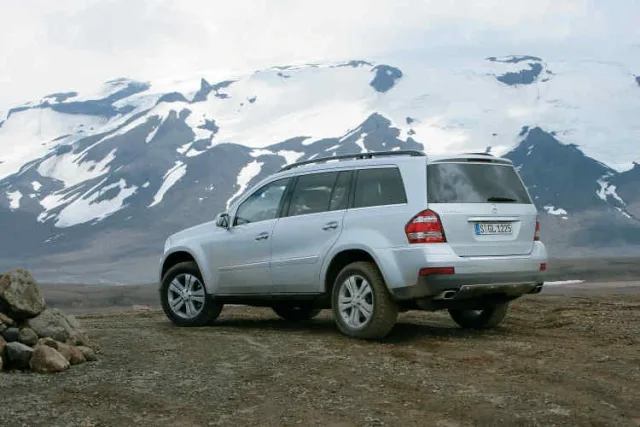
The only thing that seems alien here is the Mercedes GL.
| Insufficient suspension travel is compensated by two lockers | Leather trim on the panel and wooden inserts make the interior, familiar from the ML and R classes, more noble | Front seats are a model of comfort. On the back of the steering wheel are gear shift paddles |
It is too fussy, momentary. The old G-class with its simple, "brick" aesthetics would look quite organic among the Icelandic stones. But the GL… Longitudinal stampings on the hood, like on the SLK roadsters. Sculpted sides designed to emphasize the "waist" (but why should a seven-seater SUV dream of "90-60-90" proportions?). The contrived kink of the rear window line. Pretentious shapes of the front and rear lights. Chrome moldings. And the pinnacle of decorative excess — shiny rings around the front fog lights when the function of their automatic activation when turning the steering wheel for cornering light is enabled.
However, why did I expect from the GL the same simple and honest "military prose" as from the G-wagen? Only because of the letter "G" in the name — from the German "Gelaendewagen", that is, "off-road vehicle"? Or because journalists have already dubbed the GL the heir to the G-class?
| The lower left handle is responsible for the body height, the right one for the transmission modes. Between them are buttons for descent assist and hill start assist | In the "gallery" it is a bit cramped, but cozy | The third-row seats fold silently — at the touch of a button |
But this is not at all the case. Not at all.
— No, the Mercedes GL is by no means a replacement for the G-class, — explain Mercedes representatives. — The "Gelaendewagen" is a real off-road vehicle for those who need endurance. A car created by professionals for professionals…
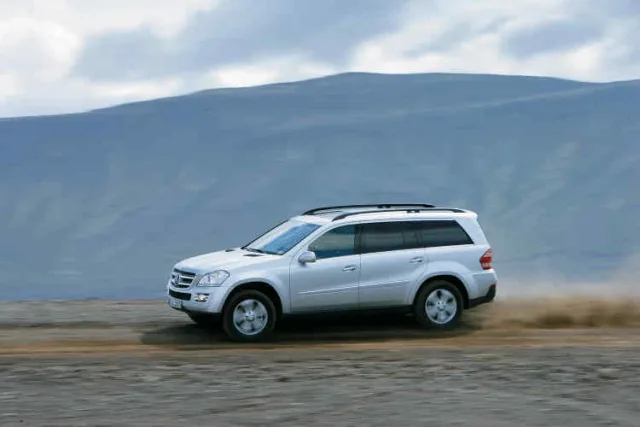
Golden words. They will certainly flatter those Russians from criminal and law enforcement circles for whom the G-class has long become a business card on wheels.
And the Mercedes GL — by whom and for whom is it created?
By whom — it is clear: also by professionals. But if the "real" G-wagen was developed more than 30 years ago mainly by the Austrians from the company Steyr, known for its military all-terrain vehicles (we wrote about this in AR No. 11, 2004), then the GL is flesh and blood of the Stuttgart land, a native brother of the ML and R. No frames and solid axles: a unibody, independent suspension of all wheels and rack-and-pinion steering, as it should be in the 21st century. Moreover, structurally both the body, and the power units, and the chassis are common for all three cars. The ML, R, and GL are assembled at the same American plant in Tuscaloosa, Alabama.
By the way, in interviews with American journalists, interesting figures were mentioned: about $100 million invested in expanding the plant in Tuscaloosa and only $300–400 million for the development of all three models. Unification! A great force.
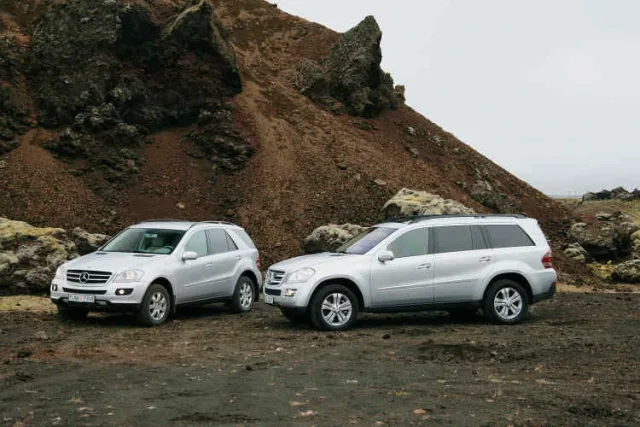
In a sense, the GL is a combination of the ML and R. A seven-seat interior with a third row of seats — like the R-class. The body is according to common patterns with the ML, but the wheelbase is 160 mm longer, and the body itself is 308 mm longer. To achieve the required rigidity of the bulky steel structure, engineers had to resort to tricks — for example, in the rear part there appeared an X-shaped floor reinforcement and a so-called D-ring, resembling sections of an aircraft fuselage and connecting the roof bases, sidewalls, and side members in the trunk area.
The interior differs from the ML and R cabins mainly in trim: the "too plastic" front panel is finally upholstered in noble black leather and decorated with natural wood inserts. True, the "sporty" instrument pods surrounded by pompous wood and leather look a bit strange, especially in a heavy SUV over five meters long.
For whom is the GL created? For example, for a very wealthy head of a large family living on a remote ranch among dirt roads — say, in the same Alabama. The "purely asphalt" R-class is not suitable for such a person, the ML is too small. But the GL… The trunk is huge: in the five-seat configuration, its volume "under the curtain" is 750 liters, and with the middle seats folded, you get a huge flat area — more than two square meters. Need to seat seven? You order the seven-seat version, press the buttons in the trunk or on the arches on the sides of the middle-row sofa — and from under the trunk floor, silently like ghosts, two comfortable leather seats rise. There is almost no space left for luggage behind them (only 200 liters), and getting to the "gallery" by folding the side seat of the middle row is not very convenient. But you can sit in the "trunk" at ease, and above the heads of the third-row passengers of the seven-seat versions, a glass roof is even provided. All the best for children!
In general, the "Gel" is cozy, like in all current Mercedes. Smooth contours of the panels, soft embraces of the seats — with ventilation, like in the S-class! Without taking the massive keyless access fob out of your pocket, you press the Start button, start the silent V8 — and comfortably set off to conquer the vast expanses of Alabama.
More precisely, Iceland. After all, now we are not in America, but somewhere between the New World and old Europe. Like the GL itself — designed in Germany, but for America…
The air suspension with adaptive dampers "swallows" the impacts from Icelandic boulders with surprising appetite. The ride is excellent, the cabin is quiet — the side windows (4.1 mm thick) are almost as good as the five-millimeter laminated windshield… Combined with the powerful and quiet 388-horsepower V8 5.5 of the GL 500 version, this completely disorients: you instantly forget that on Icelandic dirt roads you cannot accelerate above 80 km/h. No way… The speedometer needle has long crossed 120 and is flying somewhere between 140 and 160. The 7G-Tronic automatic, only slightly "thinking" during sharp presses of the gas pedal, tirelessly and quickly juggles the higher gears. If you believe the passport, this 2.5-ton colossus accelerates to a hundred in 6.6 seconds! That is, the GL 500 is 0.3 seconds faster than the ML 500, which is 270 kg lighter, but is still equipped with an archaic five-liter engine with three valves per cylinder and a power of "only" 308 hp.
The brakes, of course, are also excellent — with huge front ventilated discs with a diameter of as much as 375 mm. Interestingly, if the driver panics and hits the pedal at speeds above 70 km/h, the emergency braking assist BAS not only "brakes" to the maximum itself, but also turns on the hazard lights — and leaves them working together with the brake lights until the car reaches 10 km/h. Here the Mercedes people followed the path of the French: as we remember, this solution was first applied by the PSA concern on the Peugeot 607 model.
Now I do not want to brake before gravel turns at all. Instead, I am tempted to press the button, switch the automatic to manual mode, fix the third gear with the paddles on the back of the steering wheel — and attack the corners in a rally style. A slight slide of the front, then the beginning of a drift, a counter-steer with the elegant wooden rim of the steering wheel… But then the stability control electronics wakes up. The crunch of brakes — and the GL, having lost speed, itself stops the hooligan attempts to "play rally driver". As usual with cars with the three-pointed star, ESP is non-switchable here — it intervenes even with the Off button pressed. Safety!
And it is a pity. How beautifully one could race across this dead volcanic plain…
The landscapes here are simply incredible. Against the background of the coal-black wasteland, mountains with dazzling white peaks rise, in which clouds are tangled. The plain is crossed here and there by small streams. And if you are lucky, you can stumble upon a geothermal source equipped for tourists — a place where underground waters, heated by the proximity of red-hot magma, break out to the surface. A spectacle, frankly, not of the beautiful: just a hole in the ground where gray mud boils, exuding a hellish smell of hydrogen sulfide. But the realization that this is the breath of the Earth itself changes all perception.
The black plain unexpectedly breaks off, giving way to a snow-white surface — this is where the glacier begins. It's better not to go there: it's no wonder that a huge American van with a lifted suspension and huge low-pressure tires is helplessly spinning its wheels right at the edge of the snow. Such vehicles are found at every turn in Iceland — they are used to carry tourists and are driven by locals.
Where to test the "extreme off-road" capabilities of the Mercedes GL? Maybe go lower, into a green valley somewhat reminiscent of Scotland, to where melting glaciers give rise to streams of crystal-clear water?
In the States, the Mercedes GL will be offered both with a simplified transmission (regular permanent all-wheel drive without locks, like the R-Class or the "crossover" ML) and with the Off-Road Pro package — again, like the ML. But for European "GLs," the Off-Road Pro package was decided to be made standard equipment. This means that the air suspension can raise the body to off-road heights, the transfer case has a low range, and the center and rear differentials are equipped with locks — multi-disc clutches with electric drive. Simply put, if in America the GL can be either a seven-seat crossover (in the spirit of the Audi Q7) or a seven-seat off-roader, then in Europe it is exclusively an all-terrain vehicle.
A real one!
Of course, the Mercedes ML with the same Off-Road Pro package has a shorter wheelbase — where it will pass calmly, the GL, all else being equal, may catch its belly on the ground. But if the ML's air suspension raises the body to 293 mm from the ground, the GL goes further — its ground clearance reaches a fantastic 307 mm.
| Front suspension — double wishbone | Rear suspension — multi-link | All-wheel drive — permanent, with a symmetrical center differential that distributes torque equally between the axles. For Europe, the Mercedes GL in base trim is equipped with the Off-Road Pro package — with a reduction gear in the transfer case and multi-disc locks in the rear and center differentials |
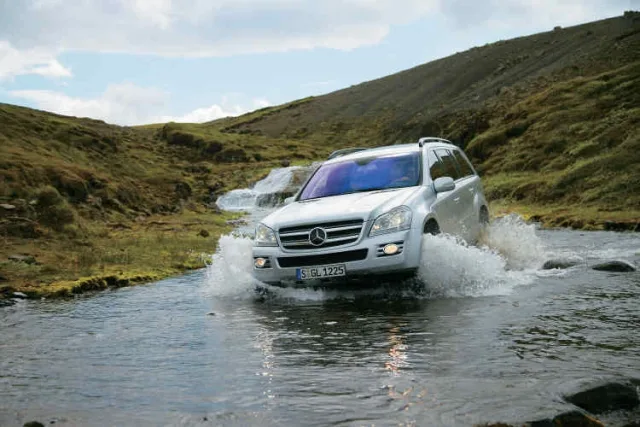
Clicks of the left lever on the center console — and the Mercedes slowly "gains altitude." In the third, highest position of the air suspension, fording an Icelandic river turns into an easy stroll: the depth here is much less than the 60 cm allowed for crossing in the GL and ML with the Off-Road Pro package. But as soon as you start storming the steep and rocky bank, the wheels quickly hang up and begin to spin — the suspension travel is small. Since the transmission lever is in Auto mode, the electronics monitor wheelspin and first brake the spinning wheels, then lock the differentials. The car crawls, but with jerks, crackling, and knocking — unpleasant sensations. However, in such a situation, it's enough to turn the right ring one click to forcibly lock the "center" and engage low range. Or better yet, immediately move the lever to the third position — then the electric motors will rigidly lock the friction packs not only in the center but also in the rear inter-wheel differential.
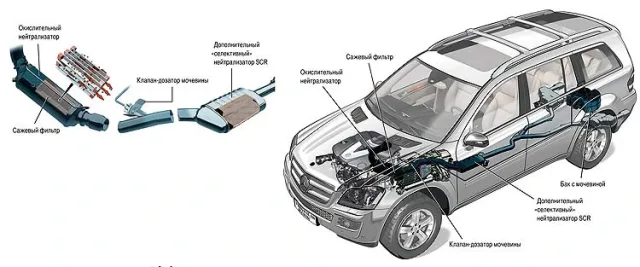
DaimlerChrysler continues to promote diesels in the American market: one of the trial steps will be the Mercedes GL 320 CDI, which has already received praise from the overseas press. However, in some states, including California, the standards for nitrogen oxide NOx content in exhaust are stricter than Euro 4 and roughly correspond to the Euro 5 level. For these states, Mercedes is preparing passenger sedans and station wagons E 320 CDI Bluetec, whose exhaust gases undergo four-stage (!) cleaning — in three catalytic converters (two of which combat exclusively nitrogen oxides) and in a diesel particulate filter.
The "super-clean" Mercedes E 320 CDI Bluetec will go on sale in the US this fall. And for the Mercedes GL, Stuttgart is preparing a different option — with injection of synthetic urea AdBlue into the exhaust tract, which, through chemical reactions in a special "selective" SCR (Selected Catalytic Reduction) converter, breaks down NOx into harmless nitrogen and water vapor. Since urea consumption is low (about 0.1 l/100 km), the fluid supply can be placed in a tank in the trunk — a 20-liter capacity will last for a service interval of 20,000 km. This technology is already used on 20,000 Mercedes-Benz trucks and, apparently, will be adopted by other major automakers
Now it's almost a G-Wagen! True, that one also has a front differential lock — with full deactivation of ESP and even ABS. But the "GL" has an off-road mode for the electronics — for example, ABS works according to a different algorithm, allowing the wheel locking so necessary on dirt or snow.
In short, in off-road exercises, the "European" Mercedes GL is a real good guy.
And how is it on asphalt?
In Iceland, believe me, there is asphalt. Fishing (two-thirds of GDP) and aluminum production on cheap energy from hydro- and geothermal power plants allow the island nation to build good roads. And taxes on Bjork's songs probably help too…
But why does the Mercedes GL on smooth Icelandic asphalt "float" across the lane at speeds up to 100 km/h, as if it had archaic leaf-spring axles? Maybe the shock absorbers are "killed" over the 6,000 test kilometers of the journalist presentation in Iceland? But on the dirt road, everything is fine! And switching the shock absorbers to sport mode is felt: the electronically controlled valves "tighten up," and ride comfort becomes slightly worse.
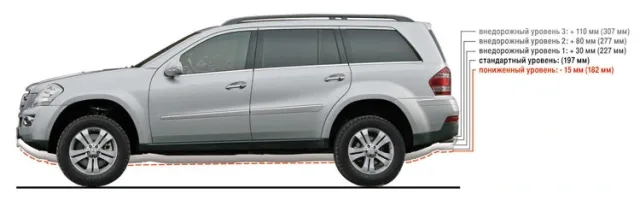
The Mercedes GL is equipped exclusively with air suspension — structurally exactly the same as on the ML and R-Class. At high speed, the Mercedes GL "squats" by 15 mm. And for cars with the Off-Road Pro package, three off-road body positions are provided — with lifts of 30, 80, and 110 mm. Shock absorbers with built-in auxiliary springs and remote electronically controlled valves have four levels of resistance force, switched by computer command
Probably, it's the tires — the off-road Dunlop Grandtrek AT2 is excellent on dirt, but forces the Mercedes to "wander" on asphalt.
However, a detailed analysis of behavior on asphalt will be left for Russian tests of production cars — fortunately, sales have already started. In Russia, only two gasoline versions will be available — the GL 450 and GL 500 with modern 32-valve "V8s" of 4.6 L (340 hp) and 5.5 L (388 hp). In Europe, two more diesel vehicles are presented — the GL 320 CDI (V6 3.0, 224 hp) and GL 420 CDI (biturbo diesel V8 4.0, 306 hp). The transmission for all cars is only the seven-speed automatic 7G-Tronic. In America, there will be no "senior" turbo diesel GL 420 CDI, and the GL 500 will be sold with a more "honest" index GL 550.
Russian prices — from 92,400 euros for the GL 450 and from 105,900 euros for the GL 500. So, the "GL" has no direct competitors! Who else among real off-roaders is expensive, seven-seat, and equally richly equipped?
In America — both the Cadillac Escalade, the Infiniti QX 56, and the Lincoln Navigator. And here, only the Lexus LX 470…
But there are plenty of "indirect" competitors. There's the Range Rover — never mind that it's five-seat. And the Audi Q7 — never mind that it's a crossover with "slightly increased" off-road capability. And the Porsche Cayenne, the Volkswagen Touareg W12, and the new BMW X5, which is about to appear on the horizon. And the Lexus LX will soon be updated.
If the Mercedes GL were as stern and convincing in appearance as the G-Wagen, its success in Russia would be resounding. Everyone would switch to the GL. Both former and current bandits, the police, businessmen, their wives and mistresses… But the Mercedes GL is not only an elongated "ML" with a leather-trimmed panel and new engines — it also looks like an elongated ML.
However, let's see. After all, the Mercedes GL is the "most-most." The largest of the off-road Mercedes and the most expensive. True, the ML 63 AMG and G 55 AMG Kompressor are more expensive. And a GL 63 AMG version, according to Mercedes people, is not planned.
But size matters — especially for buyers of expensive cars. And don't forget the industrialists of Siberia. The oil workers, the gas workers. Surely we have enough oil for the Russian quota for 2006 to be instantly sold out?
There's plenty of oil in Russia — as much as you want. And gas — enough to choke on.
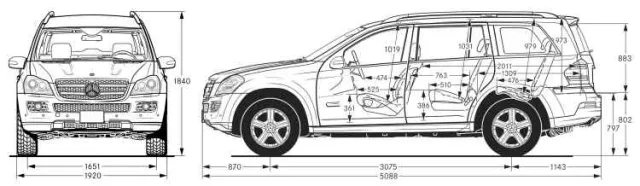
| Mercedes-Benz GL (factory specifications) | ||||
| GL 320 CDI | GL 420 CDI | GL 450 | GL 500 | |
| Body type | 5-door wagon | |||
| Number of seats | 7 | |||
| Length, mm | 5088 | |||
| Width, mm | 1920 | |||
| Height, mm* | 1840 | |||
| Wheelbase, mm | 3075 | |||
| Track front/rear, mm | 1651/1654 | 1645/1648 | 1645/1648 | 1645/1648 |
| Trunk volume, l | 300—2300 | |||
| Curb weight, kg | 2450 | 2550 | 2430 | 2445 |
| Gross weight, kg | 3250 | |||
| Engine | diesel, turbocharged | petrol, with multipoint injection | ||
| Location | front, longitudinal | |||
| Number and arrangement of cylinders | 6, V-shaped | 8, V-shaped | 8, V-shaped | 8, V-shaped |
| Displacement, cm³ | 2987 | 3996 | 4663 | 5461 |
| Cylinder bore / stroke, mm | 83.0/92.0 | 86.0/86.0 | 92.9/86.0 | 98.0/90.5 |
| Compression ratio | 17.7:1 | 17.0:1 | 10.7:1 | 10.7:1 |
| Number of valves | 24 | 32 | 32 | 32 |
| Max power, hp/kW/rpm | 224/165/3800 | 306/225/3600 | 340/250/6000 | 388/285/6000 |
| Max torque, Nm/rpm | 510/1600 | 700/2200 | 460/2700 | 530/2800 |
| Transmission | automatic, 7-speed, 7G-Tronic | |||
| Final drive ratio | 3.45 | 3.09 | 3.7 | 3.7 |
| Drive | permanent all-wheel drive | |||
| Front suspension | independent, air, double wishbone, with stabilizer | |||
| Rear suspension | independent, air, multi-link, with stabilizer | |||
| Front brakes | disc, ventilated | |||
| Rear brakes | disc, ventilated | |||
| Tires | 265/60 R18 | 275/55 R19 | 275/55 R19 | 275/55 R19 |
| Maximum speed, km/h | 210 | 230 | 235 | 240 |
| Acceleration time 0–100 km/h, s | 9.5 | 7.6 | 7.2 | 6.5 |
| Fuel consumption, l/100 km | ||||
| Urban cycle | 12.5 | 15.6 | 18.2 | 19.1 |
| Extra-urban cycle | 8 | 9.2 | 10.4 | 10.9 |
| Combined cycle | 9.8 | 11.6 | 13.3 | 13.9 |
| Fuel tank capacity, l | 100 | |||
| Fuel | diesel | petrol AI-95 | ||
| * In standard air suspension mode | ||||