
 Comments (3)
I first got acquainted with the E-Class in the W211 body back in 2002, when this model had just appeared on the European market. It happened in the Slovenian border area with Italy, at a taxi stand. Being obsessed with cars since childhood, even on vacation I couldn't resist the temptation to take a ride in the fresh "E-class". I had to work hard, explaining to my companion why we were skipping the first two cars and getting into the third one. Settling into the cabin, we started talking with the driver, and the conversation about Mercedes novelties so captivated us that we didn't notice how the speedometer needle passed 220 km/h — and that was the most modest diesel version E220 CDI with only 136 horsepower. Perhaps the taxi driver just wanted to show off the capabilities of his car, especially since the sound insulation allowed us to talk without raising our voices.
But what's even more interesting is something else. That conversation with the taxi driver made me look at the E-Class differently, whose angular body lines previously seemed overly ornate to me, especially in the neighborhood of the laconic three-pointed star. To my question whether the new "E-class" had become better than the previous one, the driver with hot Italian blood energetically nodded, waved his hands, and began to jump incoherently from English to his native Italian. The essence of his speech boiled down to the fact that the E-Class had finally acquired emotionality and sporting fervor, but at the same time became even more spacious and cozy. It was the combination of these qualities with legendary German reliability that prompted the taxi driver to betray his principles and switch to a Mercedes from his beloved Alfa Romeo — beautiful and drivey, but, alas, too capricious for daily work.
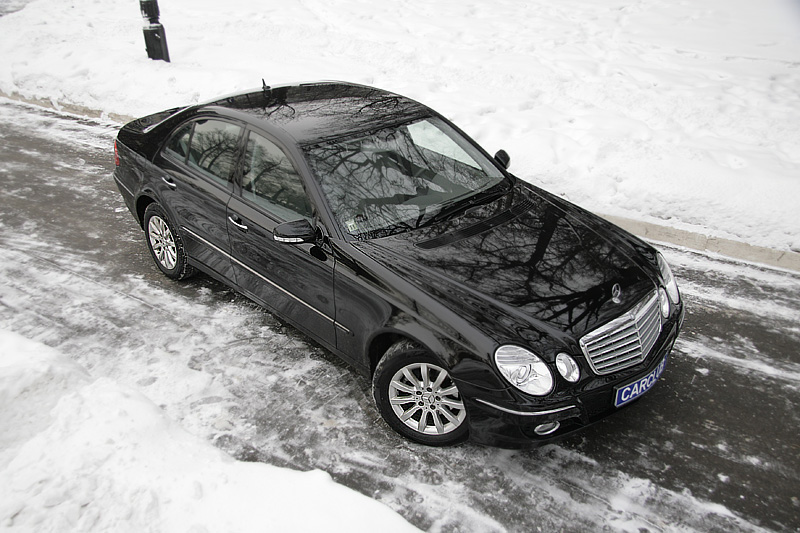
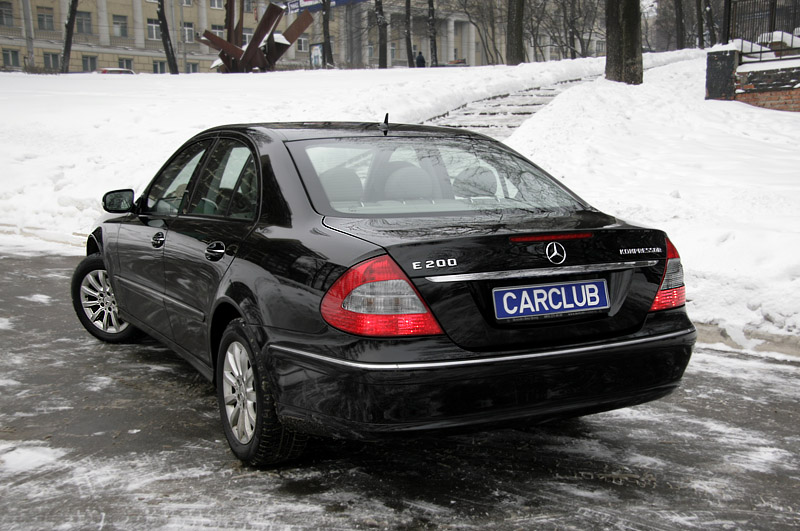
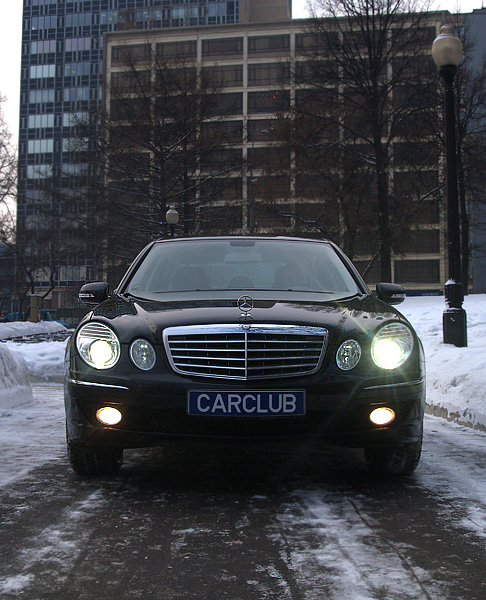 When I got the opportunity to test the updated E-Class in the most affordable version E200 Kompressor in the "Special Series" trim, I also tried to find that very sporting note in its appearance, but it turned out to be not easy. At the end of 2004, the new BMW "five" with Bangle design and the respectable Audi A6 hit the market. If you mentally place the Mercedes between them, it is perceived as something average: not as assertive and aggressive as the Bavarian, but noticeably more emotional than the cold representative from Ingolstadt. At the same time, the expressive oval headlights and the star on the hood leave no doubt about the car's origin. After the facelift, the E-Class received a new wedge-shaped radiator grille, which, combined with the faceted front bumper, gave the car a resemblance to an icebreaker. This doesn't harmonize very well with the rounded sides and rear, but it refreshes the appearance and adds solidity to it.
Recently, the boundaries of the business class have become so blurred that even Korean sedans costing from 23 thousand dollars are classified as such. Against their background, buying a Mercedes — formally a car of the same class, but several times more expensive — seems unjustified: ideally, both perform the same function, carrying top managers while the head of the company rides in an S-Class. Moreover, the status of the "E-class" allows it to be used both with a chauffeur and independently behind the wheel.
However, all the mythical similarity between the Hyundai NF and the Mercedes E-Class evaporates as soon as you approach the German sedan. Despite its respectable age, the current "E-class" — the largest in the business class — looks quite presentable. The predatory gaze of the xenon headlights can strike down anyone who dares to doubt this or draw parallels with Korean or Japanese models. When the E-Class W210 with its split oval headlights appeared, Mercedes was accused of deviating from conservative traditions and losing its own face. However, the nickname "big-eyed," which quickly stuck to the "E-class," even spawned imitators: remember the Kia Shuma and Kia Opirus.
 Getting into the E-Class cabin, you don't immediately realize the car's status. Cheap wood imitations have become so tiresome that you don't instantly recognize real veneer. At first, the steering column stalk on the lower left, responsible for both the wipers and turn signals, is annoying. Nearby is the cruise control lever, which keeps getting in the way instead of the "turn signal." But after half an hour you get used to it, and difficulties arise only in non-standard situations — say, when a couple of buckets of water splash onto the windshield from under an oncoming car: your right hand instinctively reaches for the stalk, and only after a second you catch yourself and press the right end with your left. And with constant use, after 2-3 days there comes complete fusion with the car — apart from the mentioned trifles, the ergonomics are thought out to the smallest detail.
The range of adjustments of the driver's seat, as usual, amazes the imagination — with the seat pushed all the way back, your legs barely reach the pedals. And at the same time, there remains enough space in the back for passengers. Three on the rear sofa, however, is a bit cramped due to the massive central tunnel, but two sit with complete comfort — it is, in fact, molded for two.
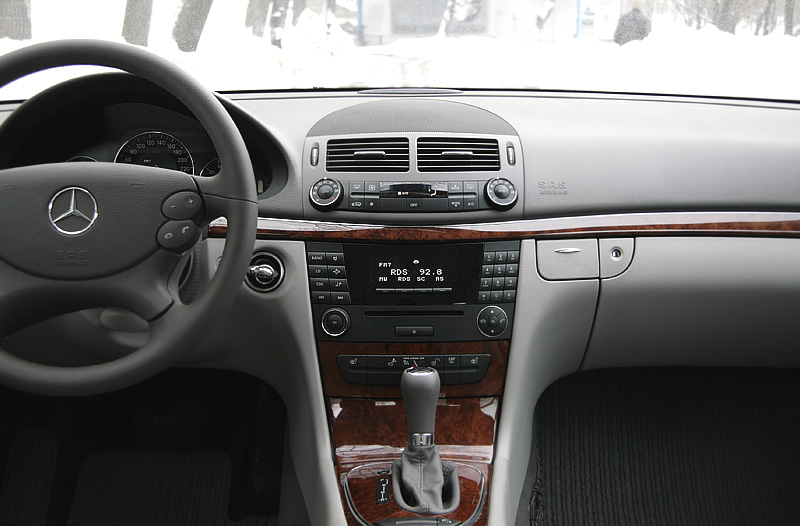 The base 1.8-liter supercharged engine initially seemed not solid enough for a business sedan, especially with an "automatic." But in reality, its power is enough for calm and even moderately active driving. This is largely due to excellent sound insulation — even at maximum rpm, the engine is heard in the cabin muffled, and the dynamics are quite convincing. The 5-speed automatic transmission, of course, is tuned for smoothness, and you shouldn't expect the briskness of BMW gearboxes from it. But with measured driving, there's a feeling that you're moving on electric traction — shifts are absolutely imperceptible if you don't glance at the tachometer. You can also indulge in manual mode, but it won't add agility, and the pauses between the command and the shift itself are quite annoying. So don't expect sporting feats from the E-Class — and then it won't disappoint. When accelerating "to the floor," the first wave of acceleration is felt after 140 km/h, and then the "E-class" without much zeal, but quite confidently reaches 200 km/h — more than enough for a comfortable business sedan.
The suspension settings are certainly shifted towards comfort, and at first the E-Class even seems slightly rolly. But it — a true German — knows how to pull itself together, and on the highway the sedan flies like an arrow shot from a bow: the steering wheel is filled with reactive effort, and the suspension doesn't allow even a hint of pitching. In the city, the large "steering wheel" and the number of turns you have to make from lock to lock when parking are initially annoying, but the result of diligent rotation is a turning radius minimal for such a large car. Some Golf-class cars can't turn around as easily as the "E-class." Special thanks to the parking sensors, tuned according to a peculiar philosophy. The sensors in the front and rear bumpers inform the driver of approaching an obstacle via a display on the dashboard and above the rear window. 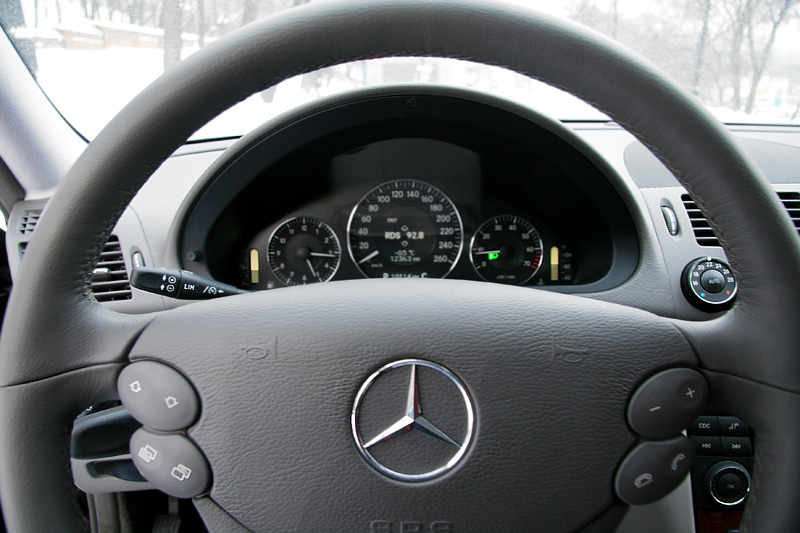 Until the distance is reduced to critical, the sensors are silent — why disturb passengers if the driver can see everything himself? A warning signal sounds only when less than 20 cm remains to the wall. This fully reflects the essence of the E-Class — it is a true friend and assistant to the owner. At the same time, it never offers unsolicited advice or interferes in other people's affairs. But if the driver is in danger, the car will do everything possible to help.
The main result of our test is the victory of conservatism. Five years ago, when the E-Class just appeared, it was a model of modernity, now it has moved into the category of classics. And it has become, as befits any Mercedes, a conservative — in the good sense — car with a three-pointed star on the hood. Yes, it is more expensive than classmates from BMW and Audi, and against the background of Japanese competitors, choosing the "E-class" looks like the height of extravagance. This once again confirms the signature phrase of Mercedes salespeople: "If you are still worried about the price of our car, then you clearly don't have enough money to buy it"... And that's true: if you go to a car dealership with a calculator in your pocket, it's better to visit another dealer. Mercedes is bought not with the mind and, interestingly, not with the heart — the "star" takes something else, probably the soul, and maybe the whole person entirely. And only by becoming the owner of the "star" can you stop worrying about your image and about how others look at you — your car will say everything itself.
Leonid Pavlov