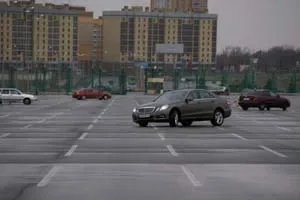
Mercedes E300
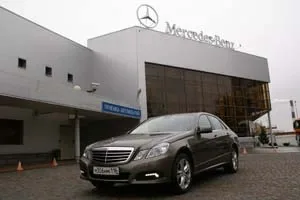
Life is good!
Engine — 3.0 L
Max power -
231 hp/6000 rpm
Max torque - 300/2,500-5,000
Max speed (km/h) — 247
Acceleration to 100 km/h — 7.5 sec
Fuel consumption:
combined — 9.3
city — 13.1
highway - 7
Automatic transmission - 7 G-Tronic,
Rear-wheel drive
Curb weight - 1735 kg
Length - 4868
Width - 1854
Height - 1471
Ground clearance - 160 mm
Tires 225/55 R16
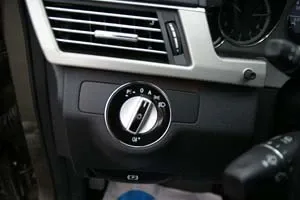
Equipment: front, side, window and knee airbags, driver fatigue monitoring system Attention assist, oil and water level indicator, Audio 20 CD with color display, dual tuner, ISOFIX, 2-zone climate control THERMATIC, ADAPTIVE BRAKE braking system with HOLD function, ABS+BAS, ESP+ASR, Bi-xenon headlights with auto light and auto range adjustment with additional cornering light, DIRECT CONTROL suspension, PARKTRONIC parking assistance system, tire pressure sensor.
Price $75,601 (604,800 UAH) base $56,026 (448,201 UAH)
Service interval:
15,000 km
Warranty - 2 years without mileage limit or 3 years/150,000 km under service contract
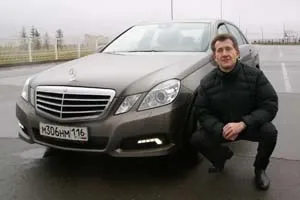
Marat Makhmutov, «Kazan School of Advanced Driving»
When Alfred showed up at our office on the day of the test of the new Mercedes E-Class (W212 body) and asked for coffee, I didn't think much of it — we're not a café. But I poured him a cup. I only understood his joke after I found myself behind the wheel of this solid car, which has long been considered a symbol of success. On the display built into the speedometer, I saw an icon of a steaming cup. It turned out the new model has a driver fatigue monitoring system «Attention assist». The electronics, collecting data from about seventy sensors, monitors driving style — how the driver turns the wheel, presses pedals, uses turn signals, and also takes into account speed and acceleration. When it detects signs of fatigue, the system gives a signal and shows that very cup on the screen. So Alfred's coffee joke wasn't accidental: the car itself told him he was tired. But let's take it in order — I'll start with the exterior.
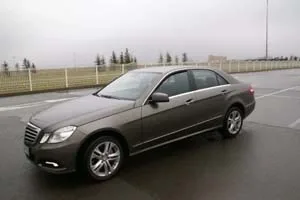
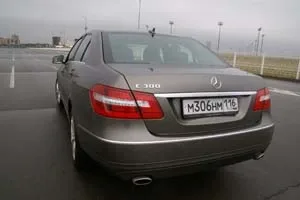
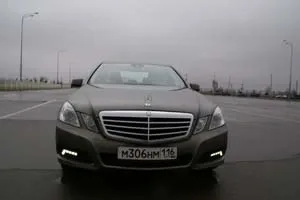
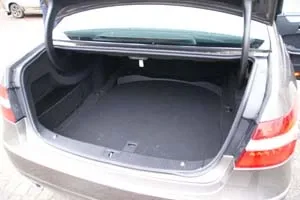
From the front, it's still a «four-eyed» Mercedes, but the eyes are no longer round like those of its predecessors W210 (1995-2002) and W211 (2002-2008). For an extra charge, the Intelligent Light System is available, which automatically adapts the light to the road situation: the range of low beam changes from 65 to 300 meters. If the highway is empty at night, it automatically turns on high beam, and when an oncoming car appears, it switches back. At first, I mistook the L-shaped LED daytime running lights in the front bumper for fog lights — those turned out to be in the headlight sections closer to the radiator grille. The body has become more angular and brutal, although it previously featured smooth contours. Especially memorable are the ribs on the doors that rise toward the rear — they make the large sedan look sportier. And this is not only visual: the drag coefficient has dropped to 0.25 versus 0.26 for the previous model, despite the noticeable rear arches. An excellent figure for such a car! The rear lights look simple, but they are adorned with four strips of LEDs in the parking lights and brake lights. The trunk has hardly changed — 540 liters, normal for a business class. As for getting into the cabin, of course, everything is fine. The E-Class has always been not just a driver's car, but also a car for important persons, and in this regard, the new model has not disappointed. Moreover, in Europe, such cars are actively used as taxis. The new Mercedes has become 16 mm longer, 32 mm wider, and the wheelbase has grown by 20 mm. Honestly, I personally didn't feel this difference — it was already spacious in the back. But the engineers from Stuttgart clearly knew what they were doing.
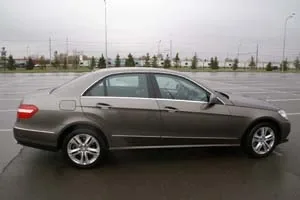
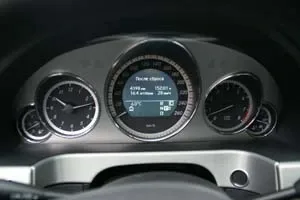
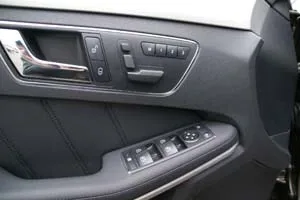
We were given a car in the «Avantgarde» trim with the E300 badge. The index traditionally indicates the displacement: here there's a three-liter engine with 231 hp. This version differs from the «Classic» and «Elegance» in the interior — instead of wooden inserts, there's metal here, and also the suspension springs are 15 mm shorter and the shock absorbers are stiffer. But more on the chassis later, for now about the interior. The same «cubism»: the dashboard and center console seem cut with a ruler. The front seats, although not multicontour like in the E500, are very comfortable, with a bunch of electric adjustments and memory for three drivers. The seat control panel, as befits a Mercedes, is placed on the door in the form of a schematic drawing — everything is intuitive. The instruments are round, and in the center there are analog clocks, already classic for the E-Class.
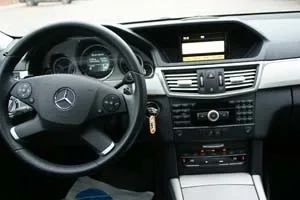
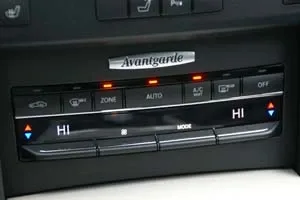
Everything is stylish, traditional, in a Mercedes way. The familiar seat heating buttons, parktronic, phone dialing keys — everything is in place. But new original rocker switches have appeared for controlling the four-zone climate control, which have moved here from the S-Class. They are so pleasant to the touch that you want to press them just for fun, even when nothing is needed. The selector of the seven-speed automatic transmission has moved from the tunnel to under the steering wheel, freeing up space for the controller knob and buttons of the Comand APS multimedia system. The steering wheel is four-spoke, with buttons for controlling the onboard computer and audio system. On the left, there's a single steering column stalk that controls both turn signals and wipers. For a beginner, this is unusual, but for those who have already driven a Mercedes, this is the norm — and they won't want to change their usual way. And the front armrest opens like shell flaps. Of course, all trim materials are of high quality, all handles and compartments have micro-lifts, and the glove box and armrest are lined with velvet on the inside.
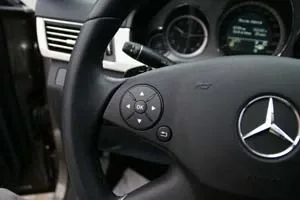
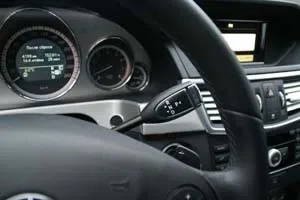
While I was enjoying describing the interior, which pleased the eye and gave pleasant tactile sensations, I almost missed the main thing — evaluating the engine and how the car drives. I've already mentioned the 3-liter engine and the 7-speed «automatic» G-Tronic, as well as the lowered suspension. Now let's figure out how it all works in practice. The gearbox shifts very smoothly, I'd even say overly delicately. With a sharp press on the gas, it seems to consult with the driver: «Are you sure you need to start that fast?» There's no sharp pickup typical of powerful cars, but this is only an illusion — the claimed 7.5 seconds to 100 km/h are quite real. It's just that the dynamics here are perceived differently: the acceleration is so swift and smooth that the vestibular system doesn't have time to realize how quickly you're gaining speed.
The ride smoothness of this car cannot be called exemplary, but that's only if you compare it with the flagship S-Class on hydropneumatics or the E500 with air suspension, which literally float over broken asphalt. But if you compare it with most classmates, including competitors in the business class, then the suspension works excellently, skillfully smoothing out all irregularities. I'd call it «worthy of the brand». On a flat highway, the car performed magnificently: at a speed of 140 km/h, I let go of the steering wheel (yes, I know, a violation), and the car didn't even think of deviating from its course. In addition — precise, tenacious, and predictable brakes, plus clear handling for such a large sedan, which, in general, was not designed as a driver's toy. For those craving drive, there are versions from AMG and Brabus, and for the average owner — if one can say that about the owner of a «classic of success» — the capabilities of the production version are more than enough. In the end, if you look at the new E-Class through the eyes of its future owner, you can confidently say: «Life is good!»
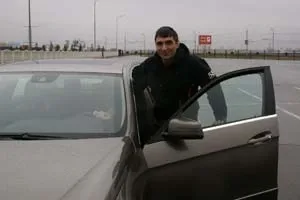
Tigran Ivanov, Director of LLC «NHP-Piston»
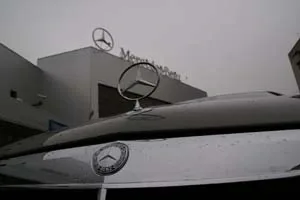
When I first saw photos of the new E-Class, I was immediately struck by its exterior changes, especially the unusual rectangular headlights that replaced the familiar ovals. The generational continuity is felt, but now instead of smooth lines — a chiseled body, brutal shapes, and a tech style. It's worth noting that the global trend toward larger sizes is gaining momentum, and the new Mercedes E-Class clearly demonstrated this: the body length is impressive, and the width and spaciousness suggest that the fashion for big cars is returning. This car has become even more attractive for the business class. The lighting has retained its recognizable style: two-section headlights, now angular instead of rounded, and at the rear — signature taillights with LED running lights. It seems the Germans decided to equip this car with everything new. LED lights are the latest trend in automotive fashion, but I can't wait to move on to telling you about getting acquainted with this elegant and brutal Mercedes. Since childhood, Mercedes cars have attracted me with their standout appearance among other brands and always evoked delight. Thanks to the newspaper "Autoclub," I got the opportunity to test-drive the new generation E-Class. Arriving at the Mercedes center on Gagarin Street, we completed the paperwork, and they rolled out the new E-Class in the W212 body. My first thought: there's a picture of exactly this model hanging above my desk. It dawned on me — today another dream will come true.
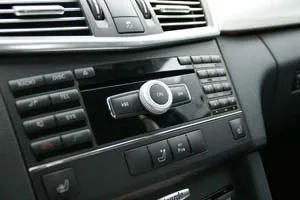
Before I knew it, Alfred offered me to get behind the wheel. Inside, I was a bit lost: the car was in top trim, and the dashboard was literally overloaded with buttons and toggles, which takes getting used to. But with the help of Arthur, a Mercedes center representative who accompanied us on the trip, we smoothly set off. Driving out onto the road in such a big "ship," you immediately understand who's in charge here. Our route was as follows: first, we had to get to the track at the new hippodrome, conduct a test drive there, then hit the highway and see how the car behaves on our roads. While we drove to the hippodrome, I tried to examine all the interior details. Let me start with the fact that everything here is controlled electronically. For the driver, there are 3 memory settings that automatically adjust the seats and steering wheel. Then the round clock caught my eye — already a Mercedes classic and an essential attribute. Behind the wheel, I immediately noted the smooth ride and long gears, which created a sense of comfortable travel. Sound insulation is excellent — no extraneous sounds penetrated the cabin, adding coziness. Getting behind the wheel, I decided to switch from automatic to manual mode to feel all the dynamics and power of this car.
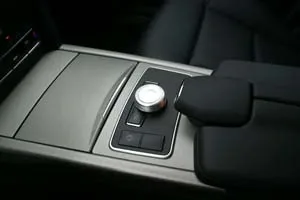
Stopping at a traffic light, I switched the car to manual mode and turned on sport mode. By the way, the shift paddles are located behind the steering wheel — levers on the left and right, making it easy to control the car during fast driving. As soon as I started, I immediately felt all the power of the 3-liter engine. Unlike class competitors, the car accelerates quickly and smoothly, without tire squeal. I was impressed by the handling and smoothness of gear changes, which you simply don't notice in city mode. The "7G-Tronic" gearbox allows you to enjoy comfortable driving, quickly gaining speed without jerks or fluctuations. Also worth noting is the front MacPherson suspension and rear multi-link, which are tuned so that the car doesn't lean during driving. They come standard from the factory on all cars of this class. Overall, it seemed to me that the Germans put more than enough effort into this class. Take, for example, the "assistant" system, which has 60 sensors constantly monitoring the driver's condition. If he suddenly deviates from the usual pattern, for example, spends too much time behind the wheel, a large coffee cup appears on the dashboard with a reminder that it's time to rest. And, of course, one can't miss another German detail — the "parking assistant," which makes parking very convenient, and women would especially like it.
The onboard sensors themselves tell the driver when to turn, and the parking process between other cars happens almost without human intervention. Arriving at the hippodrome, where the respected Marat was already waiting for us, we headed to a separate fenced area. I'll admit right away: my expectations for the test drive were completely different — I thought an instructor would sit next to me and explain technical details in detail, but reality turned out to be quite different. That day the sky was overcast and it was drizzling, so I couldn't even imagine that we'd decide to fully unleash the Mercedes's potential in such weather.
When we buckled up, Alfred began to accelerate aggressively, and I thought a brake system test would follow. However, instead, he unexpectedly turned the steering wheel sharply to the left at high speed — the car immediately went into a slide, and I was mentally preparing for a collision with the barrier. A thought flashed through my mind that instead of a test drive, we'd now have a crash test with live dummies inside. But the electronic ESP system instantly intervened, bringing the car back under the driver's control. The system worked flawlessly, not allowing the car to break into an uncontrollable slide and maintaining full control over the road. Even on wet asphalt, despite the rain, traction remained confident. The most complex trajectories that Alfred set, the car handled playfully, remaining absolutely predictable — the sensors instantly detected the slightest hints of a slide and applied braking. Honestly, I'd never done such maneuvers before, and Alfred made me quite nervous — with every sharp maneuver, I instinctively pressed myself into the floor.
After several sharp turns, I decided to test the new car's character myself. Turning the steering wheel at speed in different directions, I realized that the car simply doesn't let the driver break into a slide — the suspension and ESP sensors lock the wheels, and the car stops obeying when you try to go into a skid. Though why be surprised — this is a business class, not some supercar. At the same time, the car turned out to be very fast and dynamic: it accelerates briskly, but you don't feel it at all; it seems you're driving smoothly and steadily, even though the speedometer needle has already passed 140. Brakes in Mercedes are traditionally among the best in the class — here are ventilated two-piece discs, high-efficiency pads, and reinforced hoses developed specifically for this model, providing maximum deceleration and "optimal braking balance."
Behind the wheel, I also noticed that during a slide, the seat belts pressed me harder into the seat, fully fixing the body and protecting against injuries. Overall, this car pleasantly surprised me with many details. Even if the driver manually disables the ESP system to do a little drifting, the Germans still provided their "collars" that prevent the car from going into a full slide. After the adrenaline rush on the track, where we tested the new "E-class," we headed to the M7 highway to evaluate the car's behavior on the open road. While driving, I caught myself thinking that I definitely want such a car and wouldn't trade it for anything else. Along the way, the weather worsened — the rain intensified, and fog appeared in places, as if we were in German Stuttgart, where these cars are assembled.
One feature deserves special mention: if the driver is driving with high beams and forgets to switch before an oncoming car, the sensor automatically switches the headlights to low beams, detecting the light of the oncoming vehicle. Plus, you can install a night vision camera that allows driving in the dark even without headlights — the screen clearly shows the road and all its participants. On the highway, the car held confidently and precisely, with no extraneous noises or rocking from passing trucks, and the set trajectories were handled easily, being completely "readable." The transmission shifts and ride remained smooth and imperceptible to everyone in the cabin. And another detail that will be especially useful on the highway — the "distronic" sensors that control the distance to the car ahead: when it brakes or slows down, the car will automatically reduce speed or maintain the distance you've selected, preventing an accident.
Overall, the test drive left exclusively positive impressions and turned out to be very informative. Mercedes is a smart, comfortable, and safe car. Choosing it, you get a reliable and faithful companion, which many lack these days.
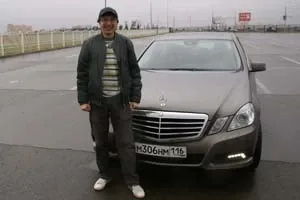
Alfred Mardanov, "Autoclub-Kazan"
As soon as they called me from the dealership to confirm, I immediately dialed Tigran and shared the good news. He had long dreamed of test-driving a Mercedes, being a devoted fan of the brand. So, the test drive of the new E-Class is scheduled, and the wait won't be long. True, I always get lost on how to properly evaluate cars of this level. It's much easier for me to analyze some C-Class from European or Japanese manufacturers. No, of course, we regularly drive such cars, but usually it all comes down to one question: does the execution match the original idea of the car. Discussing the quality of materials or assembly is simply ridiculous. Can you imagine the phrase: "The plastic on the dashboard is too hard, and the gaps are uneven"? I'd laugh my head off if I heard that about a Mercedes. Obviously, this car should be evaluated not just as a vehicle, but as what it gives the owner—comfort and respect from others. It's not just a car, but a kind of pass into a closed club of people who have no need to rush and who, as Marat aptly noted, "Life is good!"
I met Tigran at the dealership and gave him the right of first go, yielding the driver's seat. Our route, as usual, led to the hippodrome. I settled into the front passenger seat and had a great opportunity to look around and get comfortable.
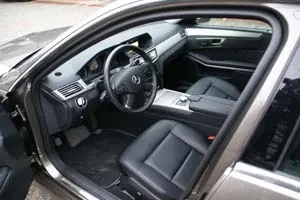
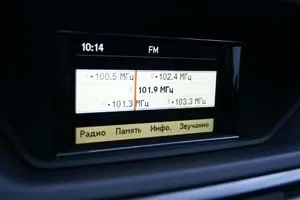
The atmosphere in the cabin literally invites sleep. Seriously, the environment is so soothing and relaxing, and with Tigran's cautious driving style, I started to doze off. Coffee is definitely a must, especially since the car itself subtly reminds you of it with a cup icon on the instrument panel. When we reached the site, I finally got a good look at the car from the outside. There was more space to appreciate it from a distance. After all, there's something in its appearance that hints at Lexus or someone else. Up front, only the radiator grille and dual headlights remain unchanged, but now they've taken on an aggressive trapezoidal shape, with LED "boomerangs" in place of the fog lights. The car looks both dynamic and solid, the design has become bold. Conservatism has given way to aggression—that's outside, but inside, the Germans didn't dare to start a revolution, keeping everything quite strict. The signature control layout under the left hand is designed so you can steer effortlessly with one hand. Electronic systems help in every way. We eventually tested one of them to the fullest, but more on that later.
This time there were no cones on the site—it would be awkward to train such a solid car on a "slalom," but just trying it out was intriguing. It's immediately clear that the car's settings are sporty and it knows how to show character—it dives into corners with such zest. But will this affect comfort on bumps, especially small ones? The electronic "leash" strictly monitors the driver's actions, but once you turn it off, you can have some fun. The Mercedes readily accepted the challenge and, as befits a rear-wheel-drive car, gracefully went into a drift.
Delight! How great that the asphalt is wet—you can allow yourself a beautiful and spectacular "waltz" on the site. Mercedes engineers are rightly proud of the impressive turning radius: the front wheels turn almost 90 degrees, which once played a trick on me—I over-rotated the steering wheel, and the car spun 180 degrees. But otherwise, the car is pure obedience and responds instantly to the slightest pedal movements.
An interesting detail: in manual mode, the gearbox doesn't downshift even when braking. If you're driving in fourth, you'll stop in fourth, and the dash will still show fourth. Moreover, if the driver doesn't intervene, the car will calmly pull away from that gear without any strain.
After playing around on the site, we head to the highway, and I move to the rear seat—the very place for which such a car is bought. To say it's good there is an understatement. It's pure bliss, everything is thought out to the smallest detail. However, the feeling that the car bounces on small bumps like a rubber ball was quite distinct. Marat, who was driving at that moment, fully confirmed my impressions. It seems this is a suspension tuning feature: on a certain type of road, it seems to work "against" obstacles. Hence, excellent handling and incredible comfort, but on a "washboard" road, there's a slight uncertainty.
I've already mentioned the gearbox, but I'll repeat the main point: power is delivered to the wheels surprisingly smoothly and assertively. Acceleration is calm but confident—both in "Sport" and "Comfort" modes. When you watch the speedometer needle rapidly devouring the dial, you realize: the dynamics aren't slow at all, but the key is that they're completely linear.
The instruments in a white-lunar palette, among which the signature clock modestly hides (to my shame, I didn't recognize it at first), create a feeling of airiness and lightness. They look far more noble than the "colorful" panels of competitors. I especially appreciated the climate control: clear digital indicators and pleasant-to-touch buttons. When you use these little things, you're finally convinced: in cars of this level, there are no insignificant details.