
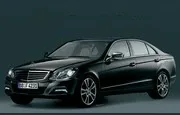
RETURN TO THE ROOTS
The new E-Class challenges its own past: instead of the familiar round headlights — angular blocks, and the body lines hint at a decisiveness that was replaced by smoothness two generations ago. At the same time, the car looks quite modern and even daring.
Dieter Zetsche, head of Daimler, invariably radiates optimism in public — his smile, hidden behind his signature mustache, seems to say that 2009, when the new generation of the E-Class debuts, will go smoothly for the brand. However, the crisis spares no one. Just look at the financial figures to understand: behind the facade of eternal youth and confidence, cracks are hidden in the solid edifice of the concern.
Profit for the last reporting period turned out to be significantly more modest than in 2007. Moreover, the main failure is in the passenger car segment: sales fell by 6%. Smart, however, added 20%, while Mercedes-Benz lost as much as 8%. The financial cushion of Mercedes-Benz is certainly still reliable, but the market situation is not conducive to risk right now. That is why the launch of the new E-Class is an extremely responsible mission. It is the flagship model of the Stuttgart lineup, and any mistake could have serious consequences.
Nevertheless, judging by available information, the new model, which will be shown in Geneva in March, has every chance of success. Engines will become more powerful by an average of 15%, while fuel consumption will decrease by the same 15%. The options list will include systems that the previous "E" did not have: one warns of obstacles in blind corners, another monitors the driver's condition and will not let them fall asleep at the wheel, a third makes the night road almost as clear as day. This is just the tip of the iceberg — a wealthy customer will be able to choose from many other innovations.
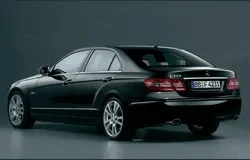 | 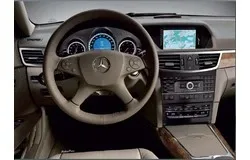 |
INSTEAD OF CLK THERE WILL BE E COUPE
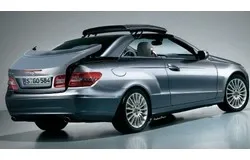
The styling of the model changes radically. The public reaction may vary, but one thing is clear: the designers deliberately turned the page and are looking for fresh solutions. The round headlights that appeared in 1995 and survived two generations are a thing of the past. Now the optics are diamond-shaped, and between them and the radiator grille are small quadrangular sections. The elongated hood, laconic front end, and expressive sides echo the Fascination concept shown in Paris. This design language will be applied to the entire E-Class family: both the sedan and the estate, which is expected by autumn, and the sporty modifications. A coupe will appear in spring, and a convertible with a folding hardtop in autumn. Both models will be visually closer to the sedan than the current CLK. This change of image will even be reflected in the name: the new generation coupe will be called E Coupe. The main task of the Stuttgart designers is to make the lines of the E-Class more distinct and expressive, roughly as they managed to do with the C-Class.
The dimensions will hardly change compared to the current generation. The suspension will also remain the same in design — double wishbone at the front and multi-link at the rear. It will have to be recalibrated for the new dynamics. Those who wish can order adaptive dampers, the stiffness of which will vary depending on the surface and driving style. The main changes, however, are under the hood. Environmental requirements are tightening, especially regarding CO2 emissions, and the key word becomes downsizing — reducing engine displacement. Among the new units are two ultra-economical ones: petrol and diesel. The four-cylinder petrol engine has already debuted on the C-Class.
The diesel range for the E-Class will include 200 CDI (136 hp), 220 (170 or 185 hp — exact data not yet confirmed), and 250 CDI with two-stage turbocharging, producing 204 hp. The flagship diesel is a V-shaped "six" with 224 hp.
In 2010, a 300 Bluetec hybrid will appear: a three-liter internal combustion engine will work in tandem with an electric motor of 15 kW.
In the petrol lineup — a new six-cylinder version 250 CGI with direct injection. The familiar 1.8-liter turbo engine will remain, as on the E 200 Kompressor. V-shaped engines (six and eight cylinders) have become more powerful, and in addition, a completely new turbocharged V6 with an output of 350 hp is expected.
Of course, new engines alone will not help achieve the goal — reducing CO2 emissions to 140 g/km by 2012. After all, just a year ago, the average figure for the brand exceeded 180 g/km. Therefore, in parallel with the plans to release several versions of the E-Class, a seemingly secondary program will be underway: next year, an electric Smart will hit the market, and an electric B-Class is planned for 2010.
EXPANSION OF THE FAMILY: FROM ESTATE TO COUPE-CABRIOLET
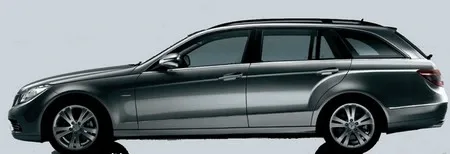
The illustration shows a computer reconstruction of the estate: a low roofline sloping towards the rear, a rounded tail. It will be shown in September in Frankfurt. The coupe-cabriolet will also be presented there, which, despite the hardtop, will not replace the E Coupe.
 |  |
CALENDAR
|
2009 S-Class — facelift
R-Class — facelift
Electric vehicle based on Smart |
2010 S-Class — diesel hybrid
Electric vehicles based on A- and B-Class SLS "gullwing" GL — facelift
| ||||||
|
2011 SLK — new
CLS — new
A-Class and B-Class — new |
2012 S-Class — new
M-Class — new
SL — new | ||||||