
On the day of the presentation, out of the 18 models currently produced by Mercedes AMG, we managed to test five. Almost all of them — I only missed out on the CLK 63 AMG coupe, settling for the cabriolet. But the main discovery was not it, nor even the newest S 65 AMG. It was the ML 63 AMG crossover, under the hood of which is a fresh naturally aspirated V8 with 510 hp.
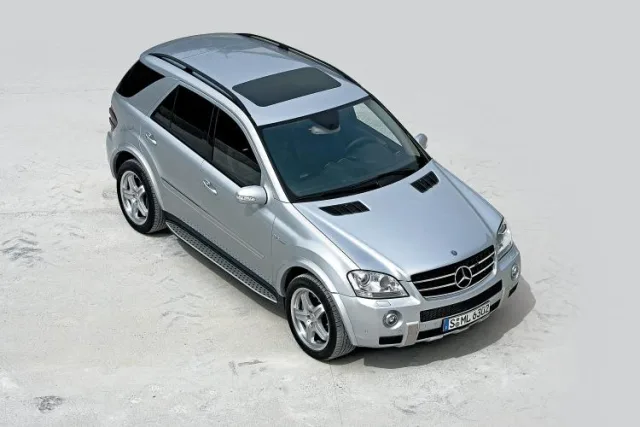
 Navigation is a brilliant thing! With it, it's impossible to get lost. And if you have a Mercedes ML 63 AMG at your disposal and an extra quarter of an hour in a foreign country, you can interrupt the voice prompts leading to your destination — and set off on a free voyage. Wherever your eyes may lead.
And meanwhile, the eyes are looking for a dirt road. After all, the ML is an off-roader... Well, no, the newest "hot" modification ML 63 AMG is devoid of off-road arsenal: no low-range, no lockers, and the air suspension is tuned for asphalt. But with all-wheel drive and decent ground clearance, it would be a sin not to check what the car can do on a country road!
 And so the Spanish road narrows, becoming more and more winding. Into the village, into the wilderness, to Granada! A lonely donkey sadly watches the silver Mercedes go by — it rarely gets to see a car with 510 "horses" here. And I rarely get to sit behind the wheel of such a pleasant-to-drive machine as the ML 63 AMG.
The previous ML 55 AMG with its 347-horsepower engine was also good — I recall my colleague Maxim Kadakov speaking of it in the most enthusiastic terms (see AR No. 16, 2001). But the second-generation ML made a giant leap in terms of suspension, and the wizards from AMG, who work in Affalterbach, turned the SUV into... almost a sports car!
Everything turned out to be simple! Whether you enter slow corners after braking from a straight or hold a sweeping arc at the limit of grip of the wide tires — you don't feel even half of those 2,300 kilograms that this stylish silver body carries. True, the ML 63 AMG's behavior lacks the ostentatious sportiness and "track" stiffness of the Porsche Cayenne. Nor does it have the refined aristocratic quality that the Range Rover Sport is famous for — intelligent, gentlemanly precise in every steering movement. One could say the Mercedes is simpler than the Cayenne or RRS. But it's a noble simplicity. It's the demeanor of a self-assured person who doesn't need to put on a racing suit or an expensive jacket to prove their status and ability to drive fast. Jeans, suede shoes, and a light shirt are enough...
 |  |  |
| The interior of the new ML is modern and pleasant, but for the AMG version costing 125 thousand euros, it is, to put it mildly, a bit modest. All the differences are a silver insert in the instrument cluster, pedal covers, and shiny plastic on the console | The "automatic" gears are conveniently shifted with paddles on the back of the steering wheel | The seats are good. If only the interior matched... |
 |  | |
| The speedometer is marked up to 320 km/h, but the electronics limit the maximum to 250 km/h. The tachometer redlines at 7,200 rpm | Mercedes ML 63 AMG: the chassis is superbly tuned! Minimal body roll, quick and precise responses, excellent ride comfort... |
The steering requires just over three turns from lock to lock — the usual "car-like" sharpness. The effort on the wheel is neither low nor high — just right. You don't overexert, but you feel everything. There's no delay in responses. Body roll is minimal, and you only notice it when exiting a fast corner — when the gas pedal is already floored for powerful acceleration. And the ride comfort is simply magnificent! You fly over a broken country road, boldly cut corners along shoulders with potholes, barely braking before sloppy repair patches — and the ML merely gives you a slight shake in the spacious leather seats.
 |  | |
| The volume of engine tests in Affalterbach exceeds factory Mercedes standards | Each AMG engine has a nameplate of the assembler: a master builds two engines per day | |
 |  | |
| External speed characteristics of the AMG 6.2 engine | ||
The electronically controlled air suspension dampers (in the AMG version, it is seriously refined: not only the bushings, but even the air springs themselves are different) can operate in two special modes — "comfort" and "sport." Switching to "comfort" I barely felt, and in "sport" the ML 63 becomes a bit stiffer. But this doesn't add speed on bad roads — rather, "sport" is needed to do a couple of laps on the Nürburgring Nordschleife.
And I am now far from the Nordschleife — huge 295/45 R19 wheels are rolling over the gravel of a country road near Granada. In the mirrors, a white dust cloud instantly boils up; every press of the gas becomes an immediate invitation to oversteer — following Mercedes tradition, the center differential is asymmetric and sends 60% of the torque to the rear. But as soon as it starts, the slide is immediately cut off by the electronics — even with the ESP off button pressed, the stability system does not doze off. Oh, what a pity! Right now, I'd love to take this corner in rally style...
 |  |
| The CLK cabriolet is good for long trips: a comfortable cabin, excellent ride comfort — even in the most powerful AMG version | If you enthusiastically click the "paddles" for manual gear shifting, you can overheat the transmission |
 |  |
| Tobias Moers at AMG is responsible for shaping the driving "character" of new cars. He is literally in love with the new ML 63 AMG | Mercedes CLK 63 AMG Cabriolet: the engine power is limited |
And maybe it's for the best. The 6.2-liter engine has so much torque at the "top" that it's easy to overdo the gas. Along the roadsides, there are either rocks or trees... And the center differential is "open," without self-locking. So a short, electronics-cut-off burst toward a slide on every gravel corner is just a reminder that the Mercedes ML 63 AMG is not made for rally stages.
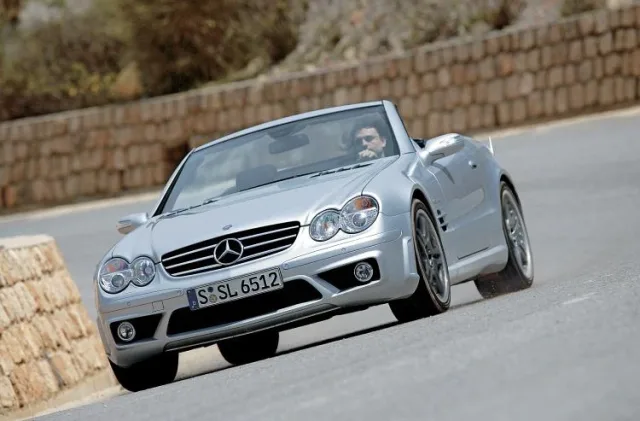
In a tight corner, the Mercedes SL 65 AMG practically doesn't lean — the active hydropneumatic ABC suspension works brilliantly
But for Spanish highways — it is made! When the dirt road ends, the revived "navigation" instantly finds the way to the main road — a wide and free two-lane highway, on which there is almost no one right now. Including traffic police. Not good, of course, but... Here goes nothing! Gas to the floor, the hum of the revving V8, quick shifts of the seven-speed "automatic" — and the speedometer needle instantly hits the mark with the number 260 km/h. Considering the error, that's the very 250 km/h "maximum" limited by the electronics.
The sensation of speed is completely absent! This heavy and tall car behaves so confidently on the high-speed highway that you quickly lose caution and don't lift off the gas even on fairly sharp bends. A bit more, a little more... But stop — everything has its limit. The most powerful brakes slow the Mercedes, transitioning life from a gallop to a walk. The speedometer shows a hundred, but it feels like you're driving in first gear.
It is curious that the phenomenal dynamics (5.0 seconds to 100 km/h) are not felt here at all. And you involuntarily recall the Mercedes G 55 AMG Kompressor — less powerful (476 hp vs. 510 hp) and heavier (2550 kg vs. 2310 kg) than the ML 63 AMG. But during acceleration, it is far more spectacular. After all, the supercharged engine delivers its 700 newton-meters already at 2650 rpm. You press the pedal — something gurgles under the floor, the mechanical supercharger howls under the square hood — and your vision darkens from the surging acceleration.
But the new AMG 6.2 engine is naturally aspirated, without supercharging. At around 3000 rpm, it produces "only" 550 Nm of torque, reaching its peak thrust only in the zone of 4000—5200 rpm. This is also a Niagara of thrust. But a domestic, civilized, tamed Niagara. As if a dam was built in its path, subduing the elements and directing them toward good purposes.
Well, we get used to the new philosophy of AMG power units. Previously, it was a torquey "supercharger" with a five-speed gearbox — with such thrust, more gears are not needed. Now, these are naturally aspirated "eights" paired with the newest seven-speed automatic 7G-Tronic — lively, responsive, quite "rev-happy".
Why are they abandoning supercharged engines in Affalterbach?
— Do you know how much power is required to drive the spiral supercharger at high rpm? About a hundred! — explain the AMG engine specialists. — In fact, the 55 AMG Kompressor engine produces about 600 hp, but 100 of them go to "self-service" of the supercharger. Moreover, engines with driven superchargers are inert in their reactions. Therefore, we will develop two other directions — naturally aspirated engines, like in the 63 AMG versions, and turbocharging…
The transition to the naturally aspirated concept was largely simplified by the appearance of the seven-speed automatic 7G-Tronic — known for its ability to instantly "dive" four gears down. You drive calmly in top gear, press the gas pedal to the floor, activating kick-down — and the "automatic", after thinking for just a fraction of a second, jumps in one go from seventh to third! Of course, this greatly facilitates the engine's work: it immediately finds itself at the rpm of maximum thrust.
In short, the 63 AMG power unit is made in the... traditions of BMW M. A relatively high-revving naturally aspirated engine (the "eight" revs up to 7200 rpm) and a "rapid-fire" gearbox controlled by paddles on the steering wheel — almost like on the BMW M5/M6! Almost, because the M5/M6 power unit is a truly high-revving V10 engine of only 5 liters, revving up to 8200 rpm, and an ultra-fast robotic manual SMG III — almost racing technology. But the V8 6.2 with an "automatic" on AMG is "civilian" technology.
 |  |  |
| Mercedes S 65 AMG — the most powerful production sedan in the world for 246 thousand euros. And that says it all | Front brakes — with dual floating calipers |
True, the AMG Speedshift gearboxes, in addition to reinforced friction discs, also have adjustable shift speed — in "sport" mode S, they occur a third faster than in "comfort" mode. And if the letter "M" is lit on the display, gears can be shifted manually using the paddles on the back of the steering wheel — the shift speed in manual mode increases by one and a half times. The "automatic" does not shift "up" in this case, forcing the engine to hit the rev limiter.
And, clicking through gears on a winding road, you feel like... Of course, not a racer. But you drive fast.
If it weren't for the non-switchable ESP…
— This is a necessity, — as if apologizing to me, explains Tobias Moers, one of the AMG managers responsible for choosing the concept of new models. — Without ESP, such a tall car as the ML will not pass the "moose test". But the electronics do not prevent the car from driving fast. In our tests at the Nordschleife, the Mercedes ML 63 AMG was faster than the 500-horsepower Porsche Cayenne Turbo Power Kit!
Oh, it's hard to believe... If only because the Mercedes ML 63 AMG is much softer and more comfortable. However, why would Moers be deceitful? Moreover, surely both the Mercedes ML and the Cayenne Turbo (most likely in the 520-horsepower Turbo S version) will undergo journalist tests at the Nordschleife.
And as for the non-switchable ESP... This is now the case for all cars with the three-pointed star, and AMG cars are no exception here.
— Not at all! — Moers seems slightly offended. — Yes, it was like that before. But on new AMG passenger cars, we are changing the ideology of ESP application. For example, on the CLK 63 AMG coupe and cabriolet, the stability system is completely switched off!
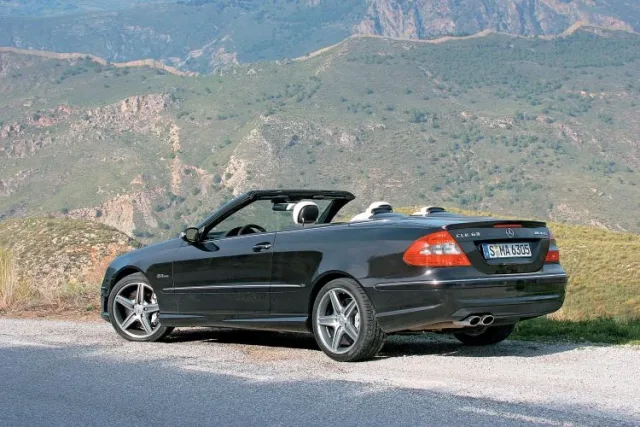
I tried the cabriolet. It's crazy, of course — a forced six-liter engine on an open car weighing less than two tons... True, the V8 6.2 engine on the CLK develops 30 hp less than on the ML crossover — only because there is not enough space under the floor for sufficiently thick exhaust system pipes. Therefore, the power of the naturally aspirated engine on the CLK is limited by backpressure in the exhaust. Surely, the next-generation coupe, which is not far off, is being designed with the "breathing" of more powerful engines in mind.
In general, the age in the CLK is felt. The rounded design from the 20th century, the soft suspension masks the feeling of crazy dynamics (less than five seconds of acceleration time to 100 km/h). And after ten minutes of active driving on a mountain road, the gearbox overheated — and completely refused to work in the "rapid-fire" manual mode. It was possible to return the letter "M" to the display only by rebooting the electronics, turning the ignition off and on again.
— Yes, that happens, — admitted Moers. — Were you driving in manual mode? Were you hitting the rev limiter? Under such conditions, overheating is possible. In general, "thermal management" will become a stumbling block for all automakers: it is the capabilities for dissipating excess heat that will limit the growth of power in the future. At what level? I think 600—650 horsepower. In fact, this is the limit. You have no idea how difficult it is to implant a biturbo V12 engine with 612 hp into the relatively compact SL 65 AMG roadster…
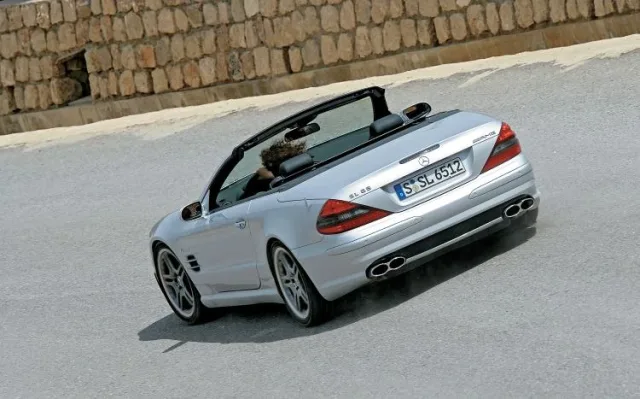
On the SL 65 AMG roadster with a folding hardtop, I took a ride along the same mountain road as on the CLK 63 AMG cabriolet. What dissimilar cars they are! As if from different eras. And the active suspension ABC, Active Body Control, is to blame: on SL roadsters, it is now in its second generation, and on AMG versions, it is additionally tuned for more sporty behavior. There are no rolls at all! The car moves along the road left-right plane-parallel, like a racing car, instantly darting to the side following the deviation of the steering wheel filled with heaviness. Except that in slides, strong vibrations are transmitted to the steering wheel — according to Moers, this is due to the family features of the SL front suspension geometry.
And there is so much thrust…
The stated acceleration time to 100 km/h is 4.2 seconds. The rear wheels break into a skid constantly, even on dry asphalt. Of course — 1000 newton-meters! The six-liter biturbo engine could develop even more (just look at the torque "shelf" limited by dumping excess boost pressure), but the transmission will not digest that much. Even so, on the SL 65 AMG version, compared to the less powerful supercharged SL 55 AMG variant (517 hp), it was necessary to make virtually a new rear suspension with a different final drive. And numerous radiators: coolant, engine oil, in the "automatic", in the final drive... As a result, the SL 65 AMG is 160 kg heavier than the "supercharged" variant! Therefore, according to Moers, on the North Loop, it is not the biturbo 12-cylinder roadster that turns out to be faster, but the less powerful "supercharged" one.
— On the Nordschleife, power is not the main thing, — smiles Moers. — But the Mercedes SL 65 AMG with the "maximum speed" limiter removed is faster on the straight: I personally accelerated it on the test oval of the proving ground in Papenburg to 338 km/h. This is more than the Mercedes McLaren SLR supercar! Why? It's very simple: the SL has better aerodynamics…
Of course, I could not help but ask about the brakes. Why does the Mercedes-Benz brand, which about twenty years ago served as the standard of braking efficiency, now have a reputation for problems? Why, in the test of the Mercedes CLS 55 AMG sedan a year and a half ago (see AR No. 21, 2004), did the warning inscription "Brake overheated!" appear after 15 minutes of far from the most aggressive driving?
Moers winced as if from a toothache.
— Yes, the brakes... On cars with the electro-hydraulic drive Sensotronic Brake Control, we are forced to insure against overheating. After all, there the brake pedal is not connected to the hydraulic drive. And if on ordinary cars, as the brake fluid temperature rises, the pedal will begin to become "soft" and you will feel it, then on cars with SBC, a decrease in braking efficiency can be a dangerous surprise for the driver. Therefore, the electronics light up the warning indicator very early — at the slightest suspicion of overheating! After all, we are not some tuners; we bear exactly the same responsibility for our cars as the entire Mercedes-Benz brand. But on new cars, this problem is solved. Did you appreciate our composite brakes?
With the brakes, everything was indeed in order — even on the serpentine, where frequent and sharp deceleration was required, they did not let us down. However, calling the new AMG brake mechanisms "composite" would be an exaggeration. In fact, these are simply composite structures: a cast-iron ventilated disc is bolted to an aluminum hub, roughly like on the BMW M5/M6.
Why don't they put ceramics on AMG?
— Oh no, there's too much hassle with them, — Tobias waves it off. — First, ceramic brakes are only effective when heated to 1000°C. Second, they need larger pads and discs, which means we'd have to increase the diameter of the brakes and wheels. But we deliberately don't want to put 21- or 22-inch wheels on our cars: that would worsen ride comfort. And for Mercedes-Benz, that's unacceptable. We're looking for other ways to increase braking power. For example, on the front brakes of the S 65 AMG sedan, the advantages of floating calipers and fixed calipers are combined…
By the way, the S 65 AMG with the same 612-horsepower biturbo engine as the SL 65 AMG roadster is the most powerful production sedan in the world. It accelerates to 100 km/h in just 4.4 seconds! True, I only got to sit behind the wheel of this monster for a short time, and it didn't make much of an impression. On the road, it noticeably "floated," and in D mode it accelerated only after a second's pause — the old five-speed automatic needed time to shift down. If you switch the gearbox to manual mode in advance and press the downshift paddle on the steering wheel, then hit the gas, acceleration comes instantly. But it seemed to me that the power delivery here is softened. And perhaps that's right. After all, the owner of a long-wheelbase S 65 AMG is unlikely to drive it himself — he'd rather entrust the driving of this five-meter monster to a chauffeur. And he himself would sit in the back seat. And are those fractions of a second of acceleration really that important to him?
However, what goes on in the minds of millionaires and billionaires, what guides them when choosing a car — is a mystery to us mere mortals. But if I had to choose AMG cars for my imaginary millionaire's garage, I'd settle on three models.
First, the Mercedes ML 63 AMG for 125 thousand euros — an excellent choice for daily use when you drive yourself. The only thing that might annoy me is the abundance of plastic in the cabin. But that's not a problem: I'd find craftsmen to upholster the interior in leather. And I'd certainly replace the standard audio system with something more "sonorous."
Second, the majestic Mercedes G 55 AMG Kompressor for 140 thousand euros. This time I didn't get to ride in it, which I regret: it gives incredible sensations. By the way, if I were a millionaire, I wouldn't hesitate — after 2008, the G-Class might be discontinued. Although Russia has already become one of the main sales markets for "tuned" G-Wagens. But what share they occupy among all 143 officially sold AMG cars in our country is a "company secret."
And third, I'd choose the SL 55 AMG. Not the biturbo SL 65 AMG for 262 thousand euros, but specifically the "fifty-fifth" for just 170 thousand — to occasionally drive out of town with the roof down, enjoying the indescribable sound of the supercharged engine, which will soon go down in history...
| Mercedes-Benz ML 63 AMG, S 65 AMG, SL 65 AMG, CLK 63 AMG (manufacturer's data) | ||||
| ML 63 AMG | S 65 AMG | SL 65 AMG | CLK 63 AMG | |
| Body type | wagon | sedan | roadster | coupe/convertible |
| Number of seats | 5 | 5 | 2+2 | 4 |
| Trunk volume, l | 551/2050* | 560 | 339 | 435/276—390 |
| Curb weight, kg | 2310 (2100)** | 2270 | 2120 | 1755/1875 |
| Gross weight, kg | 2880 (2830) | 2705 | 2385 | 2175/2260 |
| Engine | petrol, with distributed fuel injection | |||
| Supercharging | — | two turbochargers | two turbochargers | — |
| Location | front, longitudinal | front, longitudinal | front, longitudinal | front, longitudinal |
| Number and arrangement of cylinders | 8, V-shaped | 12, V-shaped | 12, V-shaped | 8, V-shaped |
| Number of valves | 32 (24) | 36 | 36 | 32 |
| Cylinder bore/piston stroke, mm | 102.2/94.6 (97.0/84.0) | 82.6/93.0 | 82.6/93.0 | 102.2/94.6 |
| Displacement, cm3 | 6208 (4966) | 5980 | 5980 | 6208 |
| Compression ratio | 11.3:1(10.0:1) | 9.0:1 | 9.0:1 | 11.3:1 |
| Max. power, hp/kW/rpm | 510/375/6800 (306/225/5600) | 612/450/4800—5100 | 612/450/4800—5100 | 481/354/6800 |
| Max. torque, Nm/rpm | 630/5200 (460/2700—4750) | 1000/2000—4000*** | 1000/2000—4000*** | 630/5000 |
| Drive | permanent all-wheel | rear-wheel | rear-wheel | rear-wheel |
| Gearbox**** | 7A | 5A | 5A | 7A |
| Gear ratios | ||||
| I | 4.38 | 3.60 | 3.60 | 4.38 |
| II | 2.86 | 2.19 | 2.19 | 2.86 |
| III | 1.92 | 1.41 | 1.41 | 1.92 |
| IV | 1.37 | 1.00 | 1.00 | 1.37 |
| V | 1.00 | 0.83 | 0.83 | 1.00 |
| VI | 0.82 | — | — | 0.82 |
| VII | 0.73 | — | — | 0.73 |
| reverse | 3.42/2.23 | 3.17/1.93 | 3.17/1.93 | 3.42/2.23 |
| final drive | 3.45 (3.70) | 2.65 | 2.65 | 2.65 |
| Front suspension | independent, air, | independent, air, | independent, air, | independent, air, |
| double wishbone, | multi-link, | multi-link, | McPherson | |
| with stabilizer | with stabilizer | with stabilizer | with stabilizer | |
| Rear suspension | independent, | independent, | independent, | independent, |
| air, | air, | spring, | spring, | |
| multi-link, | multi-link, | multi-link, | multi-link, | |
| with stabilizer | with stabilizer | with stabilizer | with stabilizer | |
| Front brakes | disc, ventilated | disc, ventilated | disc, ventilated | disc, ventilated |
| Rear brakes | disc, ventilated | disc, ventilated | disc, ventilated | disc, ventilated |
| Tires | ||||
| Front | 295/45 R19 (255/55 R18) | 255/40 ZR19 | 255/35 R19 | 225/40 R18 |
| Rear | 295/45 R19 (255/55 R18) | 275/40 ZR19 | 285/30 R19 | 255/35 R18 |
| Maximum speed, km/h | 250*** (235) | 250*** | 250*** | 250*** |
| Acceleration time 0—100 km/h, s | 5.0 (6.9) | 4.4 | 4.2 | 4.6/4.7 |
| Fuel consumption, l/100 km | ||||
| combined cycle | 16.5 (13.1) | 14.8 | 15.1 | 14.2/14.4 |
| Fuel tank capacity, l | 95 | 90 | 80 | 62 |
| * With rear seats folded | ||||
| ** Data in parentheses for Mercedes-Benz ML 500 | ||||
| *** Electronically limited | ||||
| **** 5A — 5-speed automatic; 7A — 7-speed automatic | ||||
| Dimensions, mm | ML 63 AMG | S 65 AMG | SL 65 AMG | CLK 63 AMG |
| length | 4820 | 5206 | 4535 | 4562 |
| width | 1951 | 1871 | 1827 | 1740 |
| height | 1863 | 1473 | 1295 | 1400 |
| wheelbase | 2915 | 3165 | 2560 | 2715 |
| track, front/rear | 1665/1669 | 1604/1605 | 1569/1551 | 1493/1474 |