
Pavel KARIN, photos by DaimlerChrysler
Of the seventeen models currently produced by AMG, seven carry the index “63”. And although the actual engine displacement is 6.2 liters, not 6.3, this small inaccuracy is easy to forgive. It's not about marketing cunning, but respect for tradition: the first Mercedes AMG with such a number in its name appeared back in 1971 — it was the 280-horsepower 300 SEL 6.3 AMG sedan (W109).
I had the chance to ride in the newest representatives of the “sixty-third” series: the Mercedes CL 63 AMG coupe and the Mercedes S 63 AMG sedan.
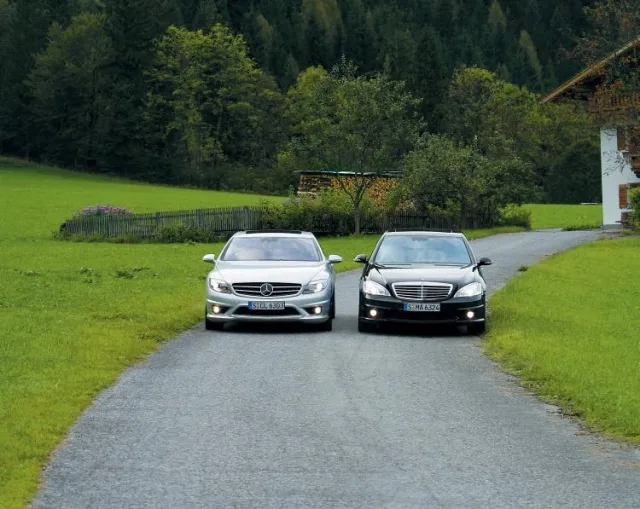
A couple of months ago, at the presentation of the standard Mercedes CL coupe, I immediately jumped behind the wheel of the top version — the CL 600 (see AR No. 19, 2006) with a 517-horsepower twin-turbo V12. Now I need to find out what distinguishes the luxurious coupe in the “regular” and “tuned” versions.
First, I visually assessed the work of the AMG masters from Affalterbach. The front bumper received a predatory “shark” bite, “gills” of air intakes appeared on the sides, and at the rear — two twin exhaust pipes. Then I moved on to tactile sensations: the leather steering wheel lost its wooden inserts. And finally, I heard the main thing: the exhaust sound is a mixture of thunder and the roar of a gas burner. Moreover, the most aggressive roar occurs when releasing the gas pedal, not when pressing it.
Five years ago, cars with the 63 AMG index were equipped with a 6.3 V12 engine producing 444 hp. Today, under the hood of the new CL 63 AMG coupe is a naturally aspirated “eight” with a displacement of 6.2 liters. This engine is not only more powerful — 525 hp versus previous figures — but also more torquey: 630 Nm versus 620 Nm for its predecessor.
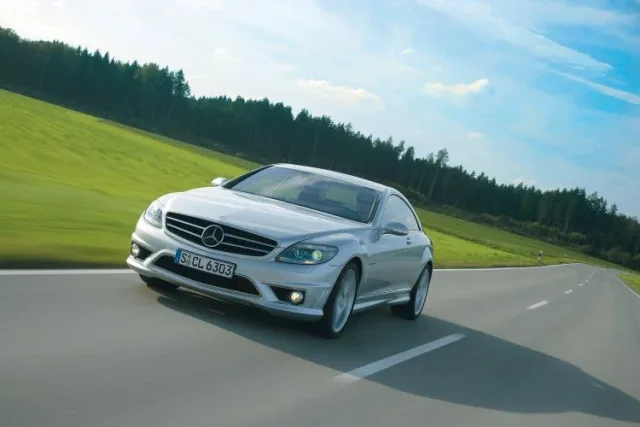
For AMG engineers, this is the first truly “native” engine — it was fully developed in Affalterbach according to a new concept. The essence is that AMG is abandoning superchargers due to too high energy costs, focusing on naturally aspirated engines and turbocharged units. The basis of the new V8 is a specially designed block with an increased distance between cylinders (cylinder diameter — 102.2 mm!).
Acceleration, of course, is impressive! But for this “atmospheric” engine to truly open up, it needs to be revved to at least 4000 rpm. Up to this mark, it seems that the CL 63 AMG accelerates even more lazily than the “civilian” CL 600 — after all, its twin-turbo V12 delivers 830 Nm already at 1900 rpm. At the same time, according to the spec sheet, there is complete parity: both cars reach 100 km/h in 4.6 seconds.
However, it's worth pressing the “C-S-M” button on the center tunnel — and the impression of acceleration becomes completely different. The AMG Speedshift automatic (compared to the standard 7G-Tronic, bearings and friction discs are reinforced here) switches from “comfort” mode to “sport” mode: gears change a third faster, the suspension tightens slightly. True, changes in suspension operation are hard to feel — except that road imperfections become slightly more noticeable. But manual mode M is a completely different matter! The suspension retains sporty stiffness, but in response to manipulations of the large paddle shifters, gears change twice as fast as in “comfort”. The gearbox holds the selected gear even at maximum revs, and error protection is limited to the fact that when the revs approach idle, the gearbox automatically downshifts.
 |  | |
| AMG instruments: red needles, speedometer scale marked up to 320 km/h, and a racing stopwatch in the center | Inside, the Mercedes CL 63 AMG features a leather steering wheel without wooden inserts, large paddle shifters, and aluminum pedal covers | After winning the 24-hour marathon at Spa-Francorchamps in 1971, this Mercedes 300 SEL 6.8 AMG (V8, 420 hp) brought fame to AMG. And soon a “civilian” version of the “tuned” sedan was released — 300 SEL 6.3 AMG (V8, 280 hp) |
But the most vivid impression is the “backing vocal” of the exhaust when lifting off the gas. It is so mesmerizing that you have to drive in a jerky rhythm: either adding gas, then releasing...
Handling is a game of nuances. It seemed to me that the CL 63 AMG reacts slightly more lively to steering input than the CL 600. And the steering wheel itself has more natural feedback.
— Exactly! — confirmed Tobias Moers, responsible for the driving character of new AMG models. — We installed “stiffer” shock absorbers so that the computer's control signals have less influence on the active suspension. Plus, we increased the diameter of the power steering torsion bar — this made the feedback more natural.
In addition, AMG specialists, together with colleagues from Conti Teves, refined the brakes. Compared to the “civilian” CL 600, the disc diameter increased from 360 to 390 mm at the front and from 330 to 365 mm at the rear. And the six-piston monoblock front calipers gave way to two-piston ones with a pair of floating brackets. So how much did the braking distance shorten?
— That's not the point! — Moers objects. — Much more important is thermal stability: the confidence that even after the twentieth lap on a race track, the car will slow down as effectively as after the first.
A race track is, of course, interesting. It's not for nothing that the AMG coupe's dashboard can display a “racing” stopwatch that allows you to measure the best lap time, average and maximum speed, distance... True, unlike the “younger” E 63 AMG sedan, the stability control system here is not completely disabled, but only expands the limits of what is allowed. God protects the cautious. That's why they didn't let us onto the race track...
And what about the S-class, more precisely the Mercedes S 63 AMG?
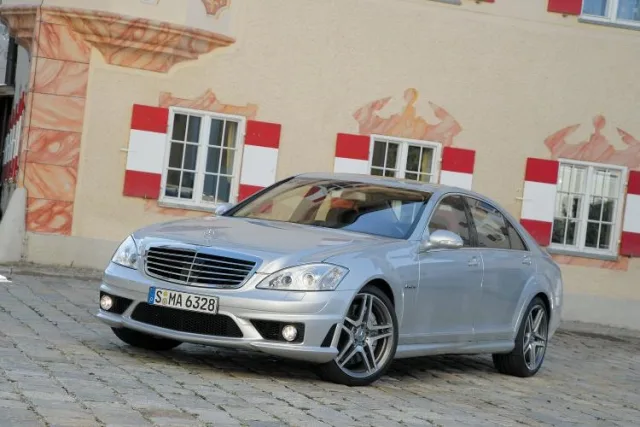
The refinements of the executive sedan completely repeat the CL coupe: the same power unit, the same steering, the same suspension. As a result, the S-class sedan has turned into almost a race car. But why? After all, sitting in the back seat of such a car, you want to sprawl out, read a newspaper, take a nap... Why a more “transparent” steering? Why a manual transmission mode? And finally, why a racing stopwatch? How can you doze off when every time you lift off the gas, there are thunderous roars behind your back? And in general, you have to really love your hired driver to pay such a price for his driving pleasure. Especially to the detriment of yourself, beloved... Maybe the executive sedan in the AMG version is an attempt to establish a new dress code?
 |  |
| Front brakes — with two floating brackets | The backing vocal of the exhaust is unforgettable |
But people from AMG prefer to talk about origins. After all, in 1971, the 300 SEL 6.8 AMG sedan (W109) won the “24 Hours of Spa-Francorchamps” race, which, in fact, brought fame to the small tuning company. Hence, they say, the love for “tuned” sedans.
The Mercedes CL 63 AMG coupe and S 63 AMG sedan will go on sale in January, with the sedan offered in two versions: with a standard and a 130 mm extended wheelbase. Prices will be announced in winter. Judging by the CLS and E-class models, the 63 AMG versions in Russia are on average 40 thousand euros more expensive than the regular “five-hundreds”. But surely the markups on the “executive” coupe and sedan will be higher: the CL 63 AMG coupe should be more expensive than the “regular” CL 600 (185 thousand euros), and the S 63 AMG sedan — more expensive than the S 600 version (166 thousand euros).
| Specifications | ||
| Vehicle | Mercedes-Benz | Mercedes-Benz |
| Model | CL 63 AMG | S 63 AMG |
| Body type | coupe | sedan |
| Number of seats | 4 | 5 |
| Length, mm | 5065 | 5142 (5262)* |
| Width, mm | 1871 | 1871 |
| Height, mm | 1418 | 1473 |
| Wheelbase, mm | 2955 | 3035 (3165) |
| Track front/rear, mm | 1601/1607 | 1600/1606 |
| Trunk volume, l | 490 | 560 |
| Curb weight, kg | 2085 | 2070 (2115) |
| Gross weight, kg | 2585 | 2670 (2615) |
| Engine | petrol, with distributed fuel injection | |
| Location | front, longitudinal | front, longitudinal |
| Number and arrangement of cylinders | 8, V-shaped | 8, V-shaped |
| Number of valves | 32 | 32 |
| Cylinder bore/piston stroke, mm | 102.2/94.6 | 102.2/94.6 |
| Displacement, cm³ | 6208 | 6208 |
| Compression ratio | 11.3:1 | 11.3:1 |
| Max power, hp/kW/rpm | 525/386/6800 | 525/386/6800 |
| Max torque, Nm/rpm | 630/5200 | 630/5200 |
| Drive | rear-wheel drive | rear-wheel drive |
| Transmission | automatic, 7-speed | automatic, 7-speed |
| Front suspension | independent, coil spring, with hydraulic correction, double wishbone | |
| Rear suspension | independent, coil spring, with hydraulic correction, multi-link | |
| Front brakes | disc, ventilated | disc, ventilated |
| Rear brakes | disc, ventilated | disc, ventilated |
| Tires | ||
| front | 255/40 ZR19 | 255/40 ZR19 |
| rear | 275/40 ZR19 | 275/40 ZR19 |
| Maximum speed, km/h** | 250 | 250 |
| Acceleration time 0-100 km/h, s | 4.6 | 4.6 |
| Fuel consumption, l/100 km, | ||
| combined cycle | 14.9 | 14.9 |
| Fuel tank capacity, l | 90 | 90 |
| * Data in parentheses — for long-wheelbase version | ||
| ** Electronically limited | ||