
I am the king! Because everything is under my control. Accelerating faster than everyone, taking a turn at insane speed, or stopping dead in my tracks — no problem. And all this with maximum comfort! Seven built-in pneumatic chambers in the seat massage my back, six fans blow air through the leather upholstery, and the side support bolsters inflate in sync with the steering wheel turns. And I am already starting to believe that all 517 "horses" are completely under my command... I am the king!
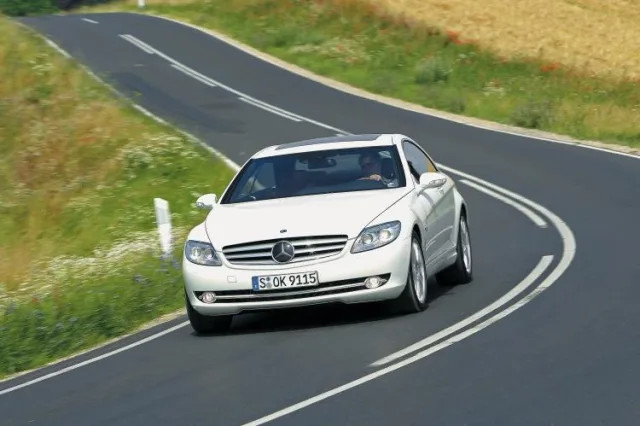
For more than half a century, Mercedes has adhered to the tradition of building coupes based on flagship sedans. In 1951, on the platform of the flagship 300 Adenauer (W186), the first large two-door 300 S Coupe with body index W188 appeared. The current CL coupe (body C216) is based on the platform of the S-Class series W221, which debuted a year earlier.
 Together with designer Steffen Koehl, we walk around the coupe. He strokes the silver sides with admiration and explains:
— To convey the commanding character, we set the radiator grille almost vertically and divided it with wide chrome slats. The car looks more muscular than before, but retains the brand's signature details — for example, the panoramic rear window...
The new coupe indeed has its own character, and now it can never be confused with the E-Class sedan. Although in the rear there are hints of the Bentley Continental GT — but is that comparison insulting? The side stampings, which smoothly transition into the rear lights, add special charm. Large Mercedes coupes have never had B-pillars, so with the windows down and the sunroof open, the CL almost turns into a convertible — swift and elegant.
 |  |  |
| The armrest between the front seats is two-tier | Multi-contour seats massage, ventilate, and "actively" support the body in turns | Contoured rear seats are separated by an armrest, and behind it — a hatch to the trunk |
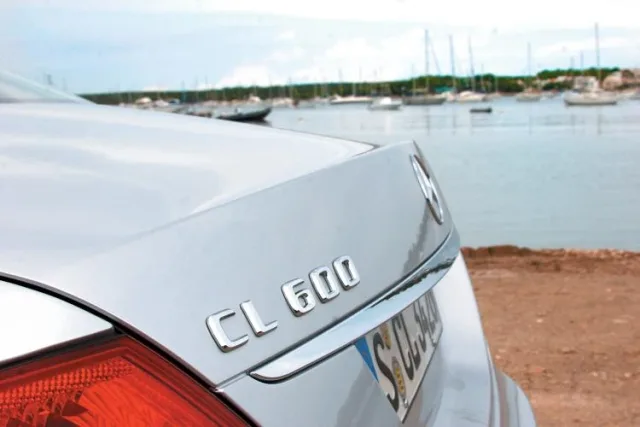
What to choose — CL 500 or CL 600? Well, for us Russians, it's not our style to skimp! I get into the "six hundred": miracle seats with massage, ventilation, and active side support — already standard, and most importantly — 517 "horses" versus 388 for the "five hundred"! Why such excess? But on Mallorca, I've already gotten used to the role of a millionaire: 388 is good, but 517 is better!
 |  | |
| The engine is started with a button: the Keyless-Go contactless access system is standard equipment for the CL 600 | For rear passengers — their own air vents. Climate control, like on the S-Class, is four-zone | Up front in the CL coupe — like in a Mercedes S-Class |
The engines and transmissions (five-speed automatic for the CL 600 and 7G-Tronic for the "five hundred") also came from the S-Class. And the interior is like in the S-Class. The arched front panel, the absent console like in old flagship Mercedes, rectangular analog clock, and the metal washer of the Comand controller. I'll start with it — I'll set a route in navigation to the opposite shore of the island, then adjust the seat to myself. An engaging activity, by the way — wider in the shoulders, narrower in the waist... Done.
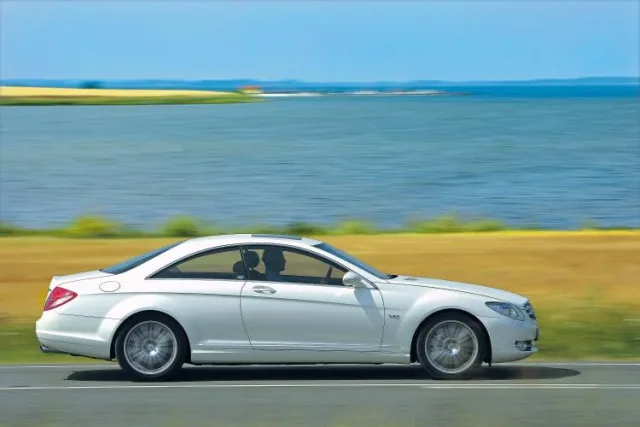
You can only guess that the road is uneven from the muffled slaps of the tires — the ride smoothness and noise insulation are simply amazing. Like the S-Class sedans, the coupe received a modernized active suspension ABC (Active Body Control), whose support hydraulic cylinders constantly change height and dampen body roll. The system components have become more compact, and the "software" has changed. While maintaining operating pressure up to 200 atm and vibration suppression frequency up to 5 Hz, the new CL rolls almost half as much as its predecessor. If the C215 coupe leans 2.2 degrees in a test turn, the new one — only 1.2. One could say it doesn't roll at all. On one hand, this is a plus: the suspension works more precisely, and the tires are used more efficiently. On the other hand, there is a danger: no matter what speed I entered a turn, the Mercedes traced it as if by a template, dulling the sense of self-preservation. And if even faster? Please! And more? Easily. Maybe add more? But I gave up before the Mercedes did. After all, public roads... But the fact is: you are already under the illusion that everything is within your power! Where "earthly" cars lean threateningly, where tires squeal, calling for prudence, the Mercedes CL remains imperturbable! Like the driver: he is as if under general anesthesia. And if he is also an idiot who floors the gas at the entrance to a sharp turn? No problem: the electronics will allow acceleration only when it deems it safe — at the exit. Full electronic "CASCO"!
 |  |
| The black-and-white image of the night vision system is transmitted to the display in the instrument cluster — and the arched speedometer scale straightens out | As an option — an electronic "parking assistant": four radars located at the edges of the bumpers find a free spot in a row of parked cars, and the required trajectory is displayed on the screen — by turning the steering wheel, you need to align pairs of guides |
 |  |
| The Night View Assist system allows you to notice pedestrians at a distance of 150-200 meters. This is about 50 meters earlier than in the beams of "ordinary" low-beam headlights | Like on the updated E-Class, the "smart" headlights operate in four modes and can turn. The picture shows the second of two "highway" low-beam modes, which automatically activates at 110 km/h and is comparable in efficiency to high beam |
However, the CL does not encourage aerobatics — again because of its "isolation." True pleasure is smooth, leisurely driving! You choose your favorite station in the radio menu, stylized as the scale of an old receiver, "lock onto" the car ahead with two radars of the Distronic Plus system — and all that remains is to turn the steering wheel: acceleration up to 200 km/h and braking to a complete stop, the new CL takes over! But why is there no bookstand?
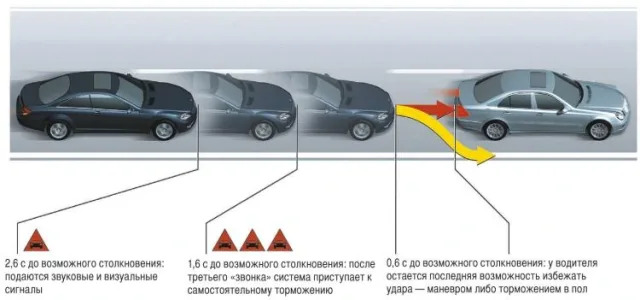
The advanced "brake" assistant — the Pre-Safe Brake system — can stop the car with deceleration up to 0.4 g without any driver involvement: automatic braking begins about 1.6 seconds before a possible accident. But this system will not be available in Russia, as it uses "short-range" radars operating at the frequency of 24 GHz, which is prohibited for civilian use
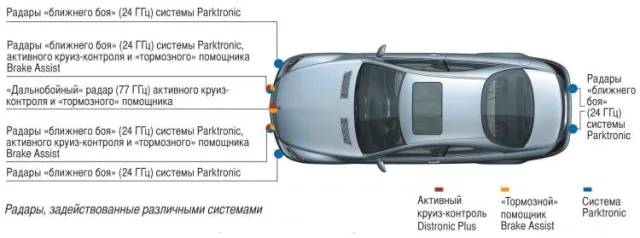
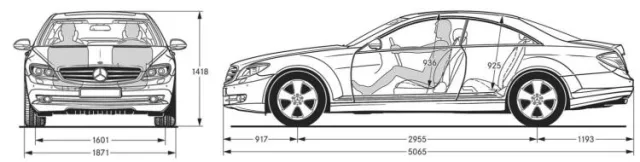
The new coupe has become 75 mm longer than the previous one, 14 mm wider, and 20 mm higher. In length, the new CL even surpasses the "one-forty" coupe
True, Russian buyers won't get the "autopilot" — the "short-range" radars hidden in the front bumper operate at 24 GHz, which is still prohibited for civilian use in Russia. Therefore, both the S-Class sedans supplied to Russia and the CL coupe will have the previous Distronic — with one "long-range" radar that operates in the range of 30-180 km/h and cannot completely stop the car. Honestly, this is even for the better — otherwise, you might fall asleep. Although even on the "greenhouse" Spanish roads, Distronic Plus did not inspire full confidence: several times I still braked myself.
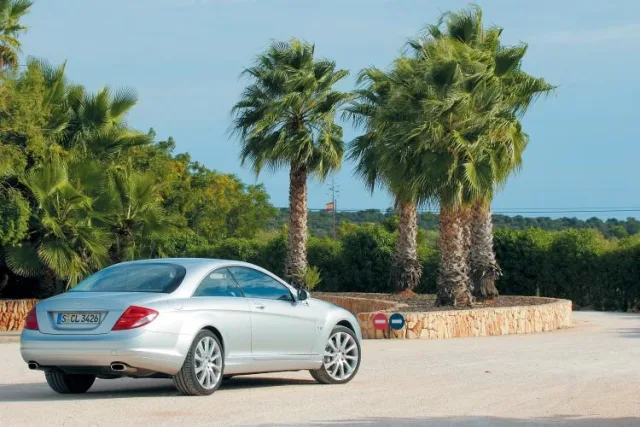
In short, if behind the wheel of an ordinary car the driver is both a strategist and a tactician, then behind the wheel of a CL — only a strategist: the computer chooses the tactics.
 |  |
| In the wind tunnel, the car undergoes acoustic testing: a special microphone with a focusing antenna measures the noise of the oncoming airflow. Thanks to this, engineers improve aerodynamics and sound insulation. The CL is fine in this regard: the drag coefficient stays in the range of 0.27–0.28, and at a speed of 140 km/h, the noise level near the driver's head does not exceed 66 dB | Steffen Köhl, exterior designer of the coupe: “The wide radiator grille and headlights extending onto the fenders give the new CL an imposing and dynamic appearance” |
 |  |
| Under the hood of the “six hundred” is a biturbo engine, familiar from the S-Class (517 hp, 830 Nm) | The trunk has become 40 liters more spacious |
In about twenty years, such an assistant would definitely come in handy for me, as would the realization that I am driving possibly the best coupe on the planet. But for now... For now, I want to drive myself. However, I can start saving now — who knows, by retirement I might have saved up: in Russia, the Mercedes CL 500 costs from 131 thousand euros, and the CL 600 from 185 thousand. I'll save up, buy it, and enjoy the savings: the same Bentley Continental GT would cost another 50 thousand euros more.
 |  |
| For now, AMG offers only “little things” for the coupe — wheel rims, bumpers, side skirts. But soon the CL 63 AMG with a 525-horsepower V8 will debut, and then the lineup will be joined by the CL 65 AMG with a 612-horsepower biturbo V12 | Compared to the previous model, the share of high-strength and ultra-high-strength steels in the body has increased from 11% to 44%, and only 26% of ordinary steel remains. The outer door panels, hood, and front fenders are aluminum, and the inner door panels are made of magnesium alloy |
Returning to Moscow, I found my Renault Logan in the airport parking lot, started it... And felt the anesthesia wearing off. But here's what's interesting: no withdrawal, not even a hint of it!
| Specifications | ||
| Vehicle | Mercedes-Benz CL | |
| Modification | CL 500 | CL 600 |
| Body type | coupe | coupe |
| Number of seats | 4 | 4 |
| Trunk volume, l | 490 | 490 |
| Curb weight, kg | 1995 | 2185 |
| Gross weight, kg | 2510 | 2620 |
| Engine | gasoline, with distributed fuel injection | gasoline, with distributed fuel injection and turbocharging |
| Location | front, longitudinal | front, longitudinal |
| Number and arrangement of cylinders | 8, V-shaped | 12, V-shaped |
| Displacement, cm³ | 5461 | 5513 |
| Max power, hp/kW/rpm | 388/285/6000 | 517/380/5000 |
| Max torque, Nm/rpm | 530/2800—4800 | 830/1900—3500 |
| Transmission | automatic, 7-speed, 7G-Tronic | automatic, 5-speed |
| Front suspension | independent, spring, with hydraulic adjustment, on double wishbones | independent, spring, with hydraulic adjustment, on double wishbones |
| Rear suspension | independent, multi-link, with hydraulic adjustment | independent, multi-link, with hydraulic adjustment |
| Front brakes | disc, ventilated | disc, ventilated |
| Rear brakes | disc, ventilated | disc, ventilated |
| Tires | ||
| front | 235/55 R17 | 255/45 R18 |
| rear | 235/55 R17 | 275/45 R18 |
| Maximum speed, km/h | 250 | 250 |
| Acceleration time 0—100 km/h, s | 5.4 | 4.6 |
| Fuel consumption, l/100 km | ||
| urban cycle | 18.1 | 21.7 |
| extra-urban cycle | 8.5 | 10.0 |
| combined cycle | 12.1 | 14.3 |
| Fuel tank capacity, l | 90 | 90 |
| Fuel | gasoline AI-98 | gasoline AI-98 |
Milestones of Elegance
Igor VLADIMIRSKYThe history of large Mercedes-Benz coupes after the war started in 1951, when the 300 S Coupe (series W188) was shown in Paris. This two-door car, unified with the 300 Adenauer sedan (W186), was produced in both open and closed versions. Early “Adenauers” were powered by inline three-liter six-cylinder engines with 150 hp. In 1955, the carburetor gave way to direct injection, which raised power to 175 hp, and the rear suspension was also refined. The updated version, the 300 Sc, was produced for three years, and from 1952 to 1958, a total of 314 coupes of the W188 series were built.
 | |
| Mercedes 300 Sc — an updated version of the 300 S coupe, which was made from 1952 to 1955. Externally, it is distinguished by vent windows in the doors, enlarged turn signals, and more chrome | Mercedes 220 S—220 SE Ponton W180/128 (1956—1960)... |
 |
| Mercedes 300 Sc |
In 1961, the Ponton was replaced by the W111 series coupe with a fundamentally new unibody. Unlike the sedan of the same series, which was remembered for its American-style “fins,” the rear of the coupe looked more restrained. The base Mercedes 220 SEb received a six-cylinder engine (2.2 L, 120 hp) and front disc brakes. In 1962, the 300 SE (W112) version came out with a four-speed automatic, power steering, and air suspension as standard. The cylinder block of the three-liter engine (160 hp) was cast from aluminum. Seven years later, the 280 SE modification with a 3.5 V8 engine producing 200 hp debuted. Over ten years, 28,918 coupes of the W111/W112 series were produced.
 | |
| Mercedes 220 SEb—300 SE W111/112 (1961—1971) with unibody and its interior, where the central console is already discernible | Mercedes 380 SEc—560 SEc series C126 (1981—1991) |
 |  |
From 1971 to 1981, the place of the large coupe in the Mercedes lineup was actually vacant. It can only be considered a replacement with a stretch: the four-seat SLC coupe, created on the basis of the SL roadster (R107) with a hardtop and extended wheelbase. Order was restored by the elegant coupe of the C126 series, built on the platform of the “one hundred twenty-sixth” sedan. Two versions with V8 engines went on sale — the 380 SEC (204 hp) and 500 SEC (231 hp). The coupe, like the sedan, was renowned for passive safety: the bodies were designed for an offset frontal impact, the driver's airbag was standard, and the passenger's was optional. In 1985, the Mercedes-Benz 560 SEC with a 272-hp V8 appeared. Over ten years, 74,060 coupes of the C126 series were assembled.
In 1992, at the Detroit auto show, the world first saw a large coupe with the factory index C140. Initially, it was offered in two versions: 500 SEC with a V8 engine producing 320 hp and 600 SEC, which had a V12 under the hood with an output of 394 hp. After Mercedes renamed its entire passenger car lineup, these coupes became known as S 500 Coupe and S 600 Coupe, and from 1996 — CL 500 and CL 600. Two years after sales started, in 1994, the range was expanded with a third version — S 420 Coupe with a V8 producing 279 hp. All modifications were equipped exclusively with automatic transmissions. Over seven years of production, from 1992 to 1998, 26,022 such coupes were built.
 |  |
| The C140 series coupe (1992–1998) after a series of renames (for example, from 500 SEC to S 500 Coupe) received the CL index in 1996 | The predecessor of the current large coupe — Mercedes CL 500— CL 600 of the C215 series (1999—2006) |
 |  |
But the direct predecessor of the current model, the C215 coupe, was shown to the public in Geneva in 1999. Initially, it was the CL 500 with a V8 producing 306 hp, and a year later the "six hundred" version appeared — with a naturally aspirated twelve-cylinder engine producing 367 hp. In 2002, the CL 600 was switched to a twin-turbocharged "eight"? No, to a twin-turbo V12, and power jumped to 500 hp. The flagship of the lineup was the CL 65 AMG — a real monster with 612 hp and 1000 Nm of torque. Production of the C215 coupe ended this year, with a total output of 46,800 cars.