
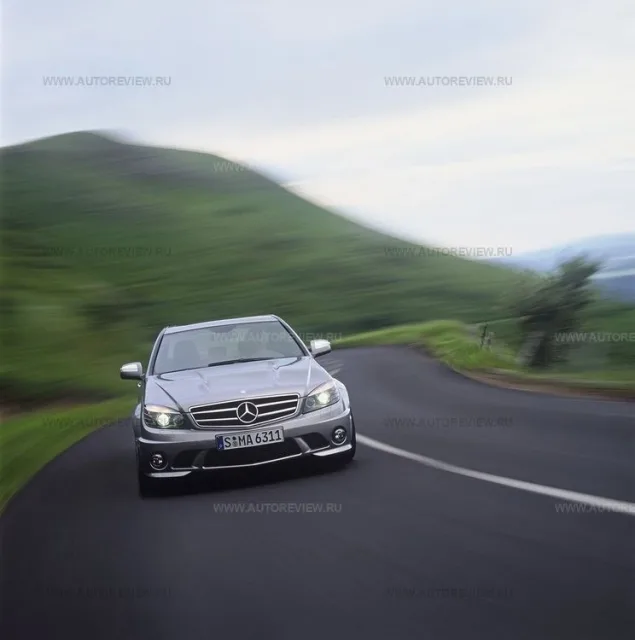
Over time, you develop a sixth sense: sometimes you just know, by some gut feeling, that the road beyond the closed turn is empty. It's as if a certain part of the brain signals: now. You can press the accelerator pedal more boldly — and, without risking giving the driver of an oncoming car a heart attack, carefully send the Mercedes C 63 AMG into a controlled drift. Even without engaging a lower gear.
Not surprising, because the torque here is six hundred newton-meters without any turbocharging…
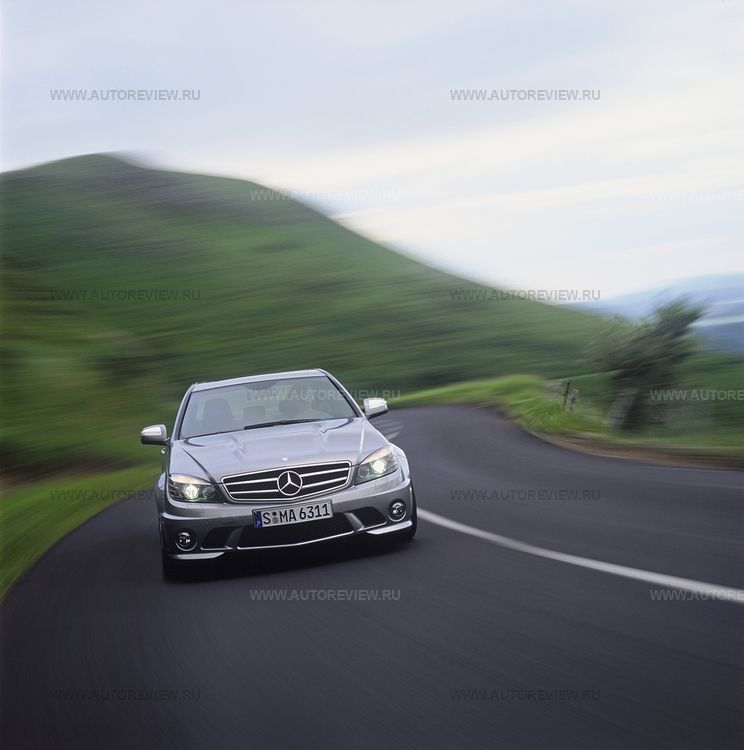
Six years ago, my intuition wasn't so developed. And I still remember how desperately some little Fiat flashed its headlights at me near Marbella. A nightmare — a Mercedes flying sideways into the oncoming lane!
You can't just stop and explain to that Spaniard that this isn't an ordinary Mercedes, but a "tuned" one — a C 32 AMG with a supercharged engine producing 354 horsepower (see AR No.9, 2001). And that it's sliding in a drift not because the driver lost control, but quite the opposite — because even in a slide, control over this car can remain absolute…
In those years, I believed that nothing faster or better than the C-Class existed in the world and nothing else was needed. Huge torque of 450 newton-meters, fantastic sound of the "supercharger" — with the whine of the blower and the bandit-like whistle of the exhaust system. Perfectly balanced chassis — comfort and soft but precise handling in one bottle. No wonder the Mercedes C 32 AMG was loved not only by me — it became the most popular "tuned" C-Class in AMG history. It was the first Mercedes truly capable of competing with the BMW M3! But the eight-cylinder C 55 AMG that followed it wasn't a big event. Sure, power grew to 376 hp, and torque reached as much as 510 "newtons"...
And now — the Mercedes C 63 AMG of the new W203 generation.
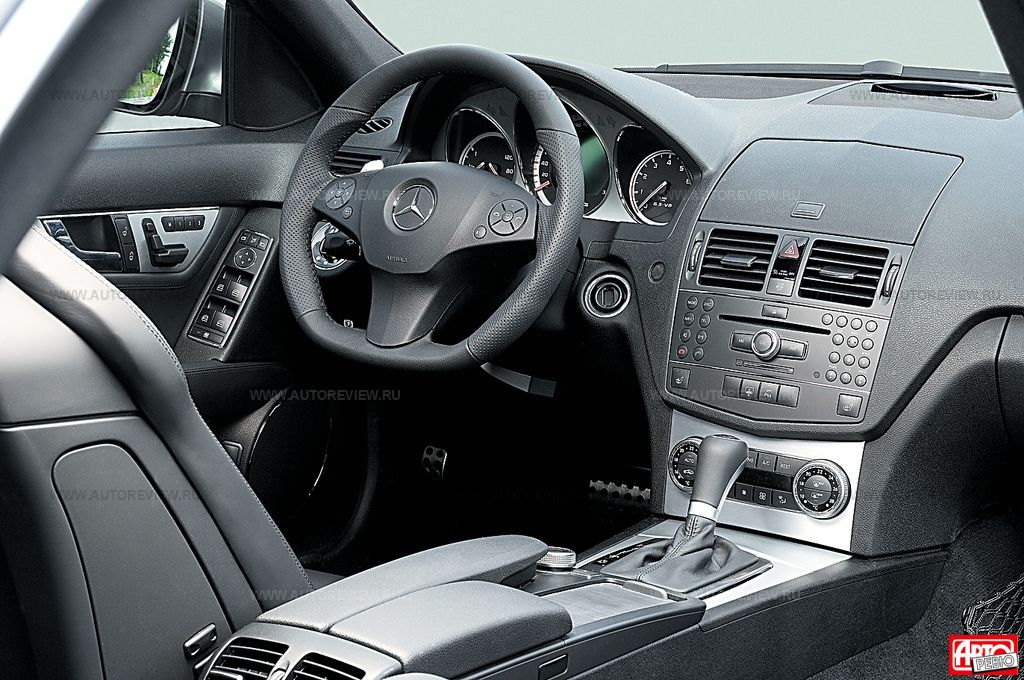 | 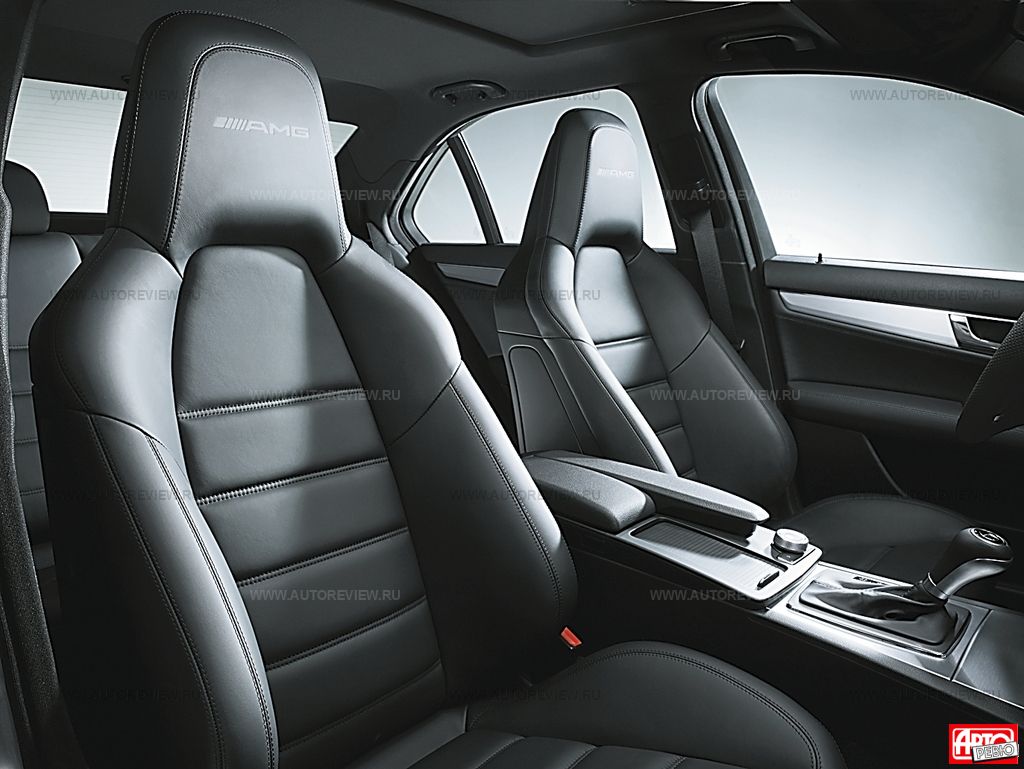 |
| Aluminum or "carbon" inserts, a three-spoke steering wheel flattened at the bottom — and servo profile adjustment buttons on the right side of the driver's seat | For the first time in a Mercedes C-Class — seats with integrated headrests |
It looks magnificent. Powerful bumpers, a huge star at the front, aerodynamic sills, a small spoiler on the trunk lid that reduces lift. This body kit can also be ordered for regular C-Classes, but only a true C 63 AMG gets two expressive longitudinal ribs on the hood in the spirit of the legendary "gullwing" and a pair of twin exhaust tips — like other AMG cars with the new naturally aspirated 6.2-liter V8. The interior, however, was a bit disappointing — it's the same hard plastic as in the standard C-Class. Aluminum or "carbon" trim, alas, doesn't save the situation. The audio system is mediocre. One joy — the excellent graphics on the large screen that slides out from under an automatically opening cover, just like in other expensive C-Class versions.
But the main thing — the seats with the AMG logo. While they can't be placed in the same league as the luxurious Alcantara "buckets" of the Audi RS4, they are comfortable and hold you well. With three buttons on the inner side, you can squeeze the "ears" of the side support and adjust the height of the lumbar support roller: even the BMW M3 doesn't have this.
Your hands naturally find the comfortable three-spoke wheel. Your right foot easily rests on the floor-mounted gas pedal. At its base is a small potentiometer. You press the pedal, the potentiometer's resistance changes, the digitized signal goes via the CAN bus wires to the engine control unit… And stepper motors slowly and carefully, following my press, open both throttle butterflies. Behind them — the suction from eight huge pistons with a diameter of 102.2 mm.
Six liters plus another 208 "cubes" under the hood of the C-Class!
The sound is stunning — eight-cylinder overtones, intertwining with each other and complementing the deep rumble of the exhaust, create a unique acoustic picture. And the torque…
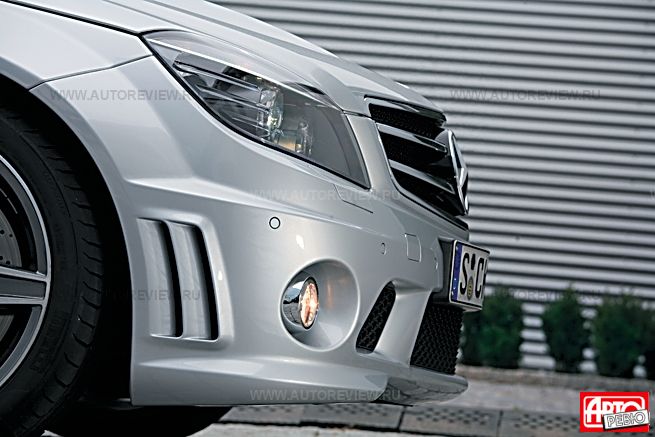 | 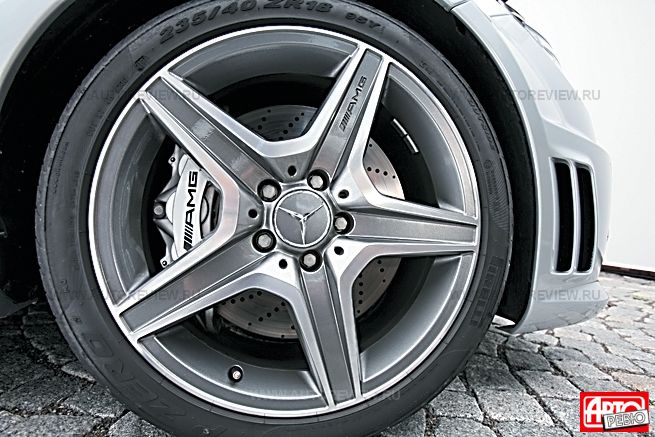 | 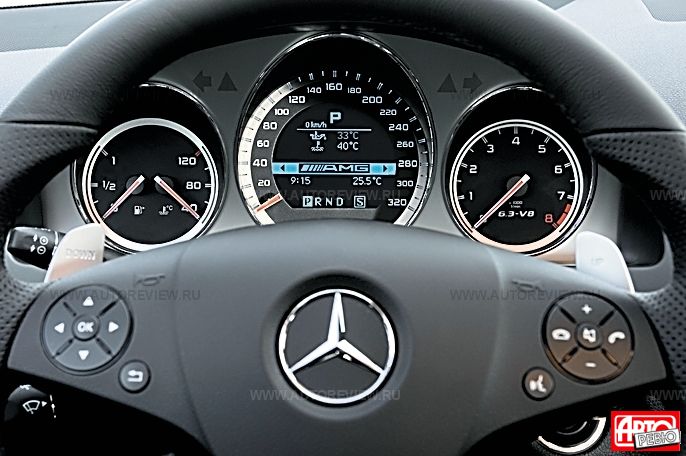 |
| Behind the right gill slot, one of three oil radiators is installed | The most powerful brakes with a diameter of 360 mm can be replaced with composite ones for an extra charge | When in manual mode of the "automatic" the revs approach 7000 rpm, the entire center of the speedometer turns red — time to pull the right paddle shifter |
Under the hood of the Mercedes CL 63 AMG coupe, the same engine produces 525 hp, but for the C-Class it's detuned to 457 hp. Therefore, its character no longer has that fierce frenzy with which the BMW M3 engine revs to the very top. But it has something else — the most powerful, smooth, and confident torque from idle up to 6800 rpm, where maximum power is achieved. If the BMW M3 engine wrings space-time like a high-revving centrifuge, the AMG engine stamps it like a hydraulic press. Press the gas — and the Mercedes begins to evenly flatten reality.
The seven-speed "automatic" AMG Speedshift Plus works perfectly — even in "comfort" mode C. Having found the inconvenient smooth button near the lever, you can switch mode C to S — in "sport" the 7G-Tronic gearbox shifts more actively, and the shifting process itself speeds up by a third. Another press — and "manual" mode M allows you to control gears by rocking the lever left-right or pulling the massive cast paddles toward the rim. The gear changes themselves become even faster — synchronous clutch engagement with power flow changes in the depths of the planetary gearsets become one and a half times faster compared to "comfort" mode. Moreover, as soon as the tachometer needle crosses the seven-thousand mark, the round display in the center of the speedometer entirely turns an alarming crimson, and in addition, large letters start flashing on it — UP! Time to shift "up"! You notice this "hint" even with peripheral vision. And there's no point in revving the engine above seven thousand — the acceleration pace subsides, and the engine firmly hits the limiter at 7200 rpm: the gearbox's manual mode is "honest"!
By the way, the word Plus in the name of the "automatic" means that AMG engineers "taught" the hydromechanical transmission to perform throttle blips on downshifts. The snarls are pleasant but short and restrained: after all, with a torque converter, achieving this is harder than with a regular clutch, like in BMW's robotic gearboxes.
But they did it. They can, if they want!
Judging by the chassis tuning, at AMG they want. They really want to surpass the BMW M3.
At the front — a new subframe and stiffer McPherson strut mounts. At the rear, the multi-link suspension has slightly altered camber. The track is widened by 35 mm at the front and 12 mm at the rear. And, of course, stiffer springs, dampers (ordinary, without any electronics), and anti-roll bars.
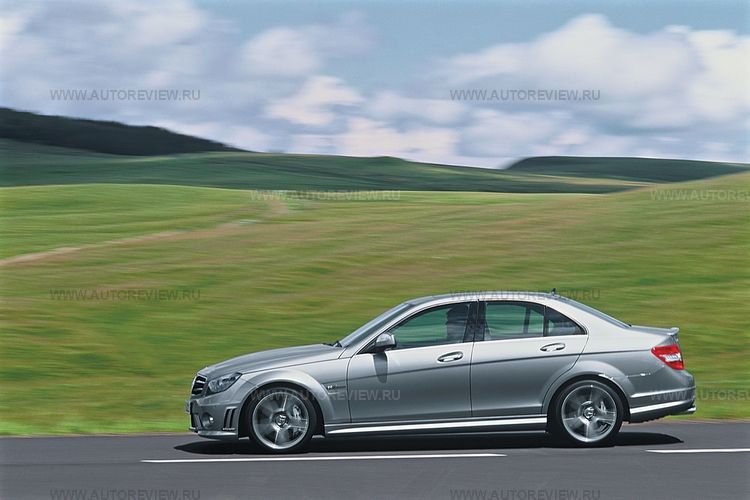
Notice — no radical changes like completely new suspension arms, as in the BMW M3. And the steering mechanism is the standard "short" one (two versions of the "rack" are provided for the new C-Class). Except with a "pinched" spool valve for greater reactive action.
But the result…
The Mercedes C 63 AMG most of all resembles… the Mercedes CLK 63 Black Series — a Black Series coupe refined with racing technologies that Affalterbach uses to build safety cars for Formula 1 (see AR No.11, 2007). The steering is precise and firm, at any speed, from pedestrian to the maximum "limited" 250 km/h. No body roll, one hundred percent composure and integrity of reactions. Ideal! And it doesn't shake much — the suspension decently smooths out asphalt ripples and bumps from "speed bumps".
Driving such a car is a pleasure. Even slowly. Even crawling through the streets of German towns at a strictly mandated speed of 50 km/h, you get your kick. From the deep vibrations of the powerful engine, which responds sensitively to every millimeter of pedal travel. And from the fact that such a Mercedes allows you to relax and look around — to follow the trajectory, peripheral vision and a one hundred percent reliable "feel of the wheel" are quite enough.
And if the town has ended and a sign "end of all restrictions" flashed on the right… On a damp from morning fog mountain road in the forests of the Bavarian Black Forest, the yellow ESP triangle starts flashing hysterically in response to any serious press on the gas!
Moreover, on the Mercedes C 63 AMG, the stability control system turns off. Completely. Scary! Utterly terrifying.
The Drexler disc differential with 40 percent self-locking under load can only be ordered at extra cost — the presentation car does not have it. Thank God, the electronic imitation of the lock remains active even when ESP is switched off. Full throttle on a straight — and the brakes "bite" the rear wheels, making them spin more or less evenly. But just a little too much throttle in a corner — and the "whip" of the rear end to the side will be instantaneous!
I carefully press the gas, trying to act as precisely and carefully as possible…
For moments when you want to hooligan and not take risks, AMG came up with a solution. More precisely, it has long existed at BMW, and now it has appeared on Mercedes-Benz for the first time. One press of a button — and the electronics switch to an "intermediate" mode — ESP Sport. This is a direct analogue of the Bavarian M Mode: the stability system continues to work, but allows the car to slide within acceptable limits. On the winding roads of the Black Forest, this means that on every corner you can safely "throw the rear" into a slide. If, like an experienced racer, you correctly calculate the throttle and steer in time, ESP will not interfere at all. Enjoy! But if the drift angle goes beyond reasonable limits, the brakes are applied, and an invisible assistant gently returns the car to the trajectory, preventing it from spinning out of control.
You can turn off this "guardian angel" by holding the ESP Off button for three seconds. I tried it — for about ten minutes, purely out of curiosity. But then I returned to ESP Sport mode. With support, it is still calmer.
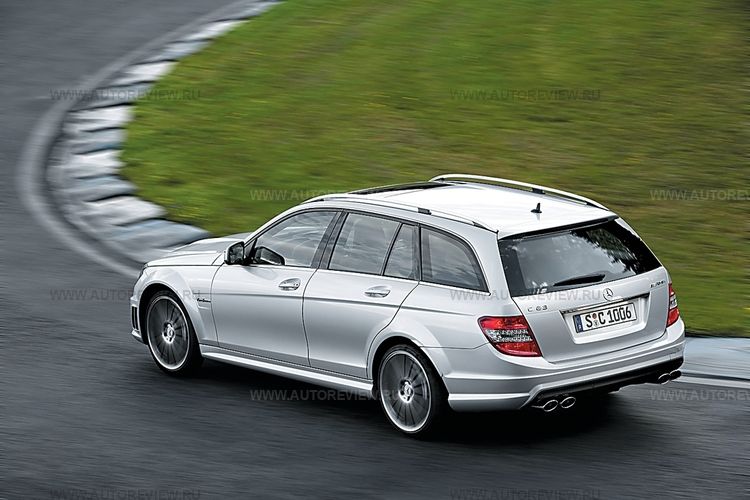
The Mercedes C 63 AMG estate is 65 kg heavier and 0.1 s slower in acceleration to 100 km/h: I have not been able to drive it yet
As for the brakes — for a full assessment, they need a race track. At the front there are ventilated cast-iron discs with a diameter of 360 mm with six-piston calipers, at the rear — discs of 320 mm with four-piston calipers. For an extra charge, ceramic composite brakes are also available for the C 63 AMG.
By the way, why was the presentation not held, say, in Spain or the south of France, as is often done, with track sessions?
— This car is still not for racing, — Mercedes representatives answer, as if apologizing. — None of the customers will take it to the track…
But then why offer an even more sporty suspension with springs and shock absorbers whose stiffness is increased by 10%? Why are there Warm Up and Race modes in the on-board computer? In the first, the oil and coolant temperatures are shown on the display, and in the second — a lap timer?
And finally, was the Mercedes C 63 AMG not tuned at the Nordschleife?
— We are not revealing the lap time yet, — smiles Wolf Zimmermann, a member of the AMG board of directors, tall and long-haired. — Let's wait for independent journalistic tests. But I can say that for the first time, our engineers during the fine-tuning of the "sixty-third" on the Nürburgring Nordschleife turned out to be faster than their colleagues from BMW on the M3…
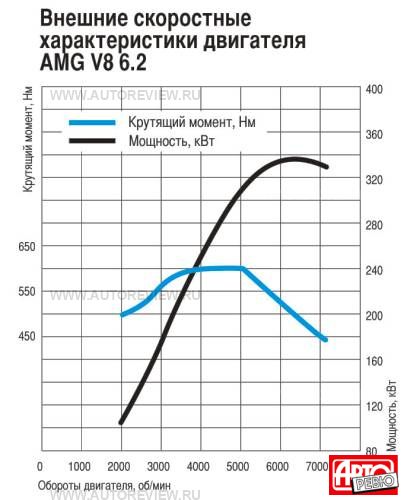 | 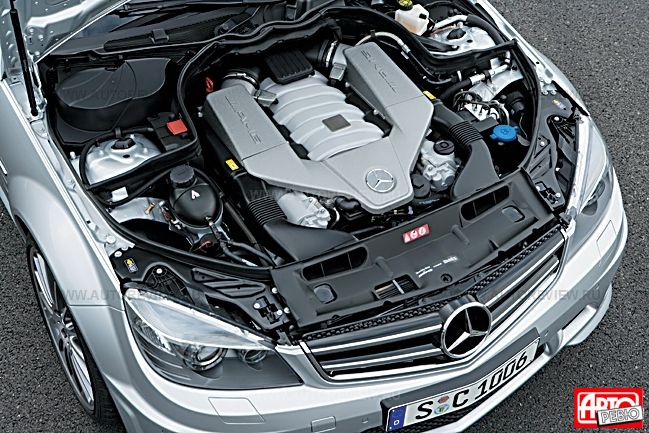 |
| The V8 6.2 engine is the first fully independent AMG development. Aluminum block with innovative TWAS cylinder wall spraying, four-valve heads with double variable valve timing and vertical intake and exhaust ports, adjustable intake manifold made of magnesium alloy with two throttle valves. For the C 63 AMG version, the engine is "restrained," which is clearly visible from the sharp drop in the torque curve after 5000 rpm | |
I am sure that the Mercedes C 63 AMG will at least not yield to the "M" in lap time. At least one lap. After all, the people at AMG have their own reasons why the presentation takes place in cold autumn in Germany. Previously, the CLK 63 AMG versions were tested in the heat — in Spain or America. And each time it ended the same way — critical overheating of the transmission and emergency shutdown of the "manual" mode of the "automatic."
Did AMG engineers manage to eliminate this drawback in the new "C"?
Zimmermann avoids answering.
But it is obvious that AMG engineers are doing everything possible. The front of the C-class is literally stuffed with radiators of the engine and transmission cooling systems — there are four of them, not counting the air conditioner heat exchanger! One of the oil radiators even had to be moved to the side — it is hidden in the right lower corner of the bumper. The side gills next to it are not just decor — they remove hot air that has passed through the radiator.
A six-liter high-boost engine in the body of an ordinary D-class sedan is a challenge to the laws of physics. This is an extreme thermal regime. In Affalterbach, they know how to cope with such tasks — it is enough to recall the lap time with which the Mercedes CLK 63 AMG with orange flashing lights carries the Formula 1 peloton. But "safety cars" are built without regard to civilian qualities and cost. And road Mercedes AMG cars are still a compromise. For example, the C 63 AMG sedan does not have an additional radiator for the final drive cooling system. But the safety cars for Formula 1 have it.
Now it is clear why the V8 6.2 engine under the hood of the "C" produces about fifty horsepower less than it could?
Zimmermann smiles slyly:
— So, we have a reserve for boosting, don't we?
Everything is clear: they are preparing a Mercedes C 63 AMG Black Series — slightly lightened due to carbon fiber trim, but weighted down with additional radiators, with an "unrestrained" engine that will develop its full five hundred plus horsepower. That is, they already have an answer to the upcoming BMW M3 CSL! And to the future new-generation Audi RS4 as well.
| Specifications | |||
| Parameters | Vehicle | ||
| Mercedes-Benz C 63 AMG | |||
| Body type | 4-door sedan | 5-door estate | |
| Number of seats | 5 | 5 | |
| Dimensions | Length, mm | 4726 | 4711 |
| Width, mm | 1795 | 1795 | |
| Height, mm | 1439 | 1442 | |
| Wheelbase, mm | 2765 | 2765 | |
| Track front/rear, mm | 1569/1525 | 1569/1525 | |
| Trunk volume, l | 475 | 485—1500* | |
| Curb weight, kg | 1655 | 1720 | |
| Gross weight, kg | 2170 | 2275 | |
| Engine | petrol, with distributed injection | petrol, with distributed injection | |
| Location | front, longitudinal | front, longitudinal | |
| Number and arrangement of cylinders | 8, V-shaped | 8, V-shaped | |
| Displacement, cm³ | 6208 | 6208 | |
| Cylinder bore/piston stroke, mm | 102.2/94.6 | 102.2/94.6 | |
| Compression ratio | 11.3:1 | 11.3:1 | |
| Number of valves | 32 | 32 | |
| Max. power, hp/kW/rpm | 457/336/6800 | 457/336/6800 | |
| Max. torque, Nm/rpm | 600/5000 | 600/5000 | |
| Gearbox | automatic, 7-speed | automatic, 7-speed | |
| Gear ratios | I | 4.38 | 4.38 |
| II | 2.86 | 2.86 | |
| III | 1.92 | 1.92 | |
| IV | 1.37 | 1.37 | |
| V | 1.00 | 1.00 | |
| VI | 0.82 | 0.82 | |
| VII | 0.73 | 0.73 | |
| reverse | 3.42 | 3.42 | |
| final drive | 2.85/2.23 | 2.85/2.23 | |
| Drive | rear | rear | |
| Front suspension | independent, spring, McPherson | independent, spring, McPherson | |
| Rear suspension | independent, spring, multi-link | independent, spring, multi-link | |
| Brakes | disc, ventilated | disc, ventilated | |
| Front tires | 235/40 R18 | 235/40 R18 | |
| Rear tires | 255/35 R18 | 255/35 R18 | |
| Maximum speed, km/h | 250 | 250 | |
| Acceleration time 0—100 km/h, s | 4.5 | 4.6 | |
| Fuel consumption, l/100 km | combined cycle | 13.4 | 13.7 |
| Fuel tank capacity, l | 66 | 66 | |
| Fuel | petrol AI-98 | petrol AI-98 | |
| * With rear seats folded | |||
But the regular Mercedes C 63 AMG is also a serious rival to the "charged" BMW and Audi. Including in price. In Germany, the Mercedes C 63 AMG sedan costs 67,235 euros, the estate — 69,853 euros. In Russia, as usual, you will have to add about 15 thousand to this — as a result, the Mercedes will be more expensive than the BMW M3 (72,000 euros), but cheaper than the Audi RS4 (about 100,000 euros).
All that remains is to wait until the whole trio appears in Russia. Will we live to see spring?
Homeland
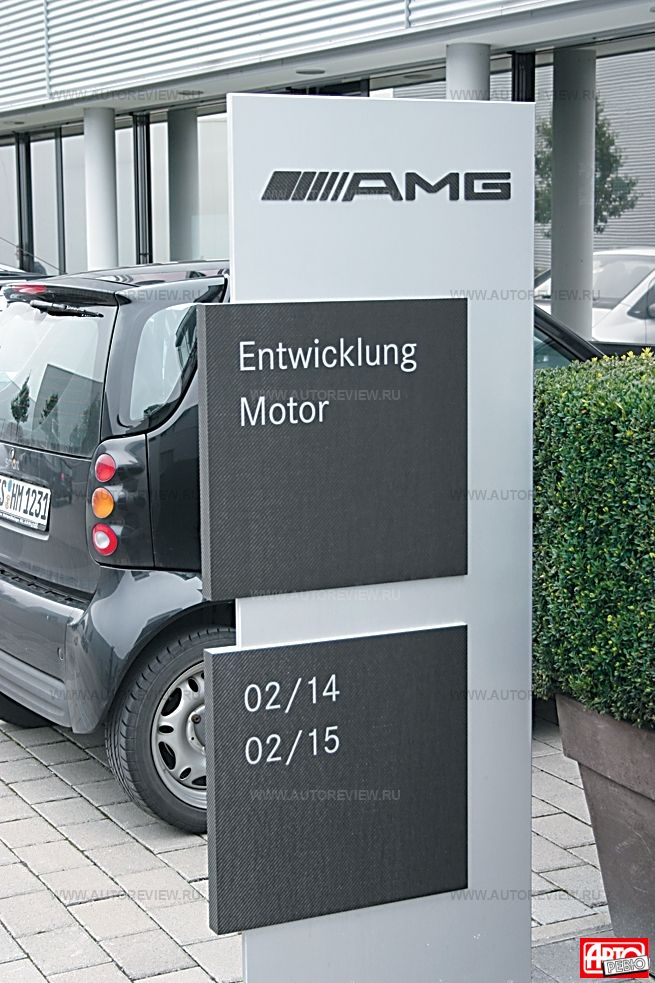
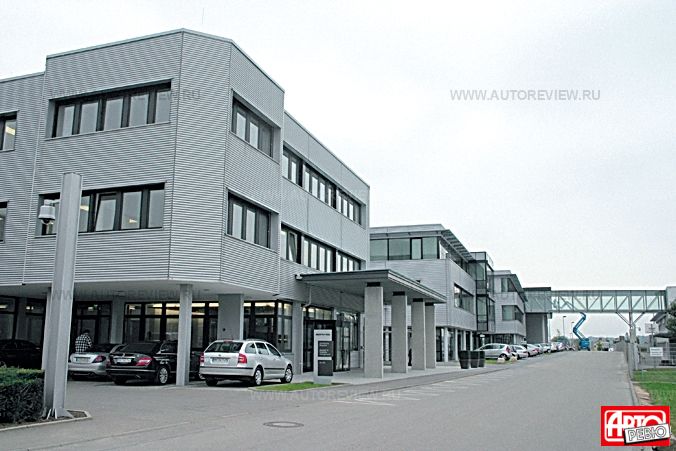
You turn off the autobahn, drive along winding and broken village roads — and there on the right appears a modest sign: Affalterbach. A couple of turns — and behind typical two-story German houses, taller buildings with corrugated metal walls become visible. Here is the Mercedes-AMG GmbH division — it is in this small provincial town near Stuttgart that the fastest production Mercedes are born. And most importantly, every AMG engine is assembled within these walls. By hand, according to the principle of "one master — one engine."
People in blue uniforms walk slowly through the workshop, each pushing a cart in front of them. On it — a computer terminal with a wireless interface, a laser scanner like cashiers use in supermarkets, and a rotating stand with a secured engine block. This is part of the AMG Trace electronic control system, which allows tracking the fate of each engine and protects against assembly errors. Before installing the next part, the master must scan the barcode from its tag. Moreover, every tool — from a regular wrench to an automatic machine for tightening cylinder head bolts — adjusts the tightening torque for each operation.
 |  |
But the role of man here is still important. Each of the fifty AMG mechanics performs the work from start to finish independently. He puts rings on pistons, installs pistons on connecting rods, attaches oil cooling nozzles to the block, assembles the valve timing mechanism... And at the end, he sticks a heavy metal plate with his signature onto the plastic decorative cover of the exhaust system.
Who are they, these masters?
On the tag of the nearest engine, which a young strong guy is pushing in front of him, there is a Yugoslav surname. The master's name is Almir Džudžavović: born in Split, moved from Croatia to Germany five years ago, got a job at the Mercedes factory two years ago, and within a year ended up here, at AMG. Lucky? The guy smiles: yes, this is excellent work — interesting and responsible. He must really be a genius mechanic, if at 22 years old he was entrusted with such an honor...
On the second floor is the assembly shop for twelve-cylinder bi-turbo engines for versions with the index 65 AMG and supercharged "eights" (for example, for the SLR supercar). There are fewer people here — not many AMG cars with V12 are sold. If assembling a V8 6.2 engine takes three and a half hours, then each V12 bi-turbo unit requires more than five hours and necessarily undergoes hot running-in on one of the nine engine test stands. And naturally aspirated "eights" are checked only by the "cold" method — they are sent to the stands selectively.
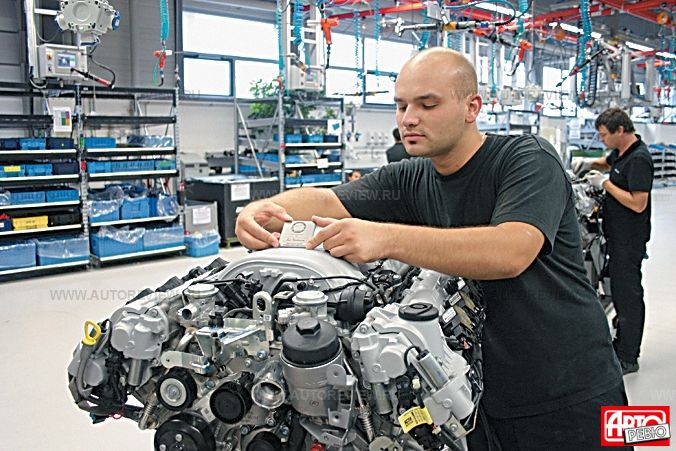 | 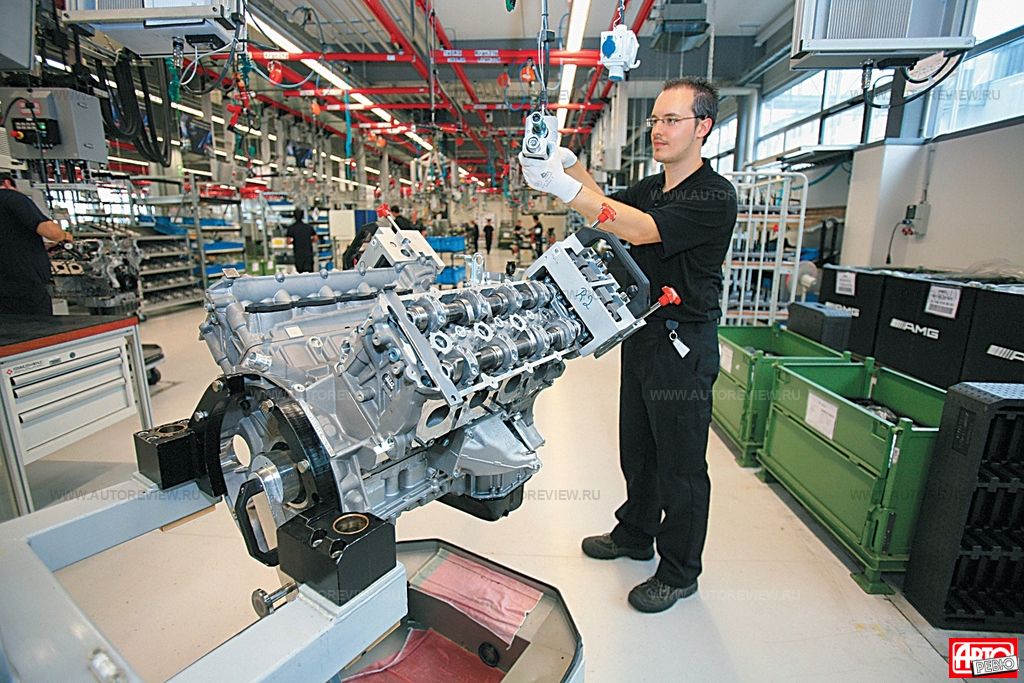 | 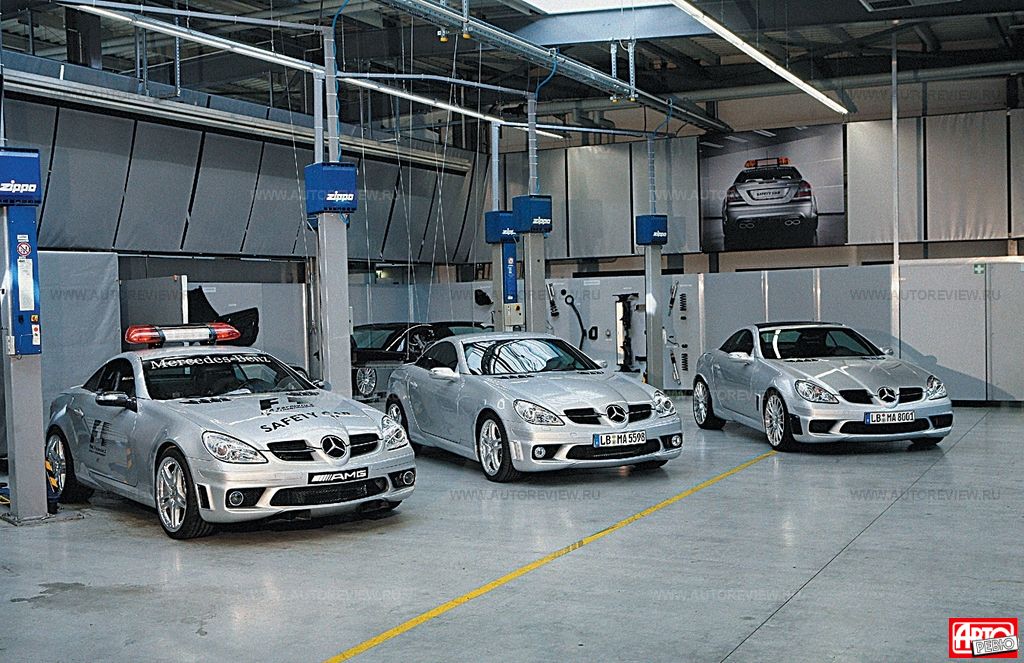 |
| AMG mechanic Almir Džudžavović glues a nameplate onto another V8 engine he has assembled | Each engine is assembled by one master using such a mobile stand with computer accounting of each operation | The AMG Performance Studio department is a workshop with lifts, where, for example, these SLK 55 AMG roadsters for Formula 1 and road versions of Black Series are slowly assembled by hand |
What about cars? In Affalterbach, only SLR, SLK, and CLK Black Series are fully assembled — and, of course, safety cars for Formula 1. Other models are assembled on factory assembly lines, where engines are sent from Affalterbach. But AMG has a "special workshop," recently named Performance Studio — here individual orders are fulfilled. The "Studio" is a mini-service center with lifts. On one hangs a disassembled Mercedes SLK — they are making a "charged" car with roll bars for the branded AMG driving skills courses that take place on race tracks. On another lift is a gutted Mercedes SL600 of the old R129 series from 1996: at the owner's request, the roadster is being repainted in a different color and upgraded to the restyled appearance of the 2001 model year. And here are several G-wagons — demand for the Mercedes G 55 AMG Kompressor "special assembly" still exists, mainly among Middle Eastern and Russian clients.
In total, the Mercedes-AMG division currently employs about a thousand people, 750 of whom are engineers, testers, and mechanics.
C AMG: history
Igor VLADIMIRSKYThe current Mercedes C 63 AMG has a direct "official" ancestor — this is the Mercedes-Benz C 36 AMG of 1993. But if we talk about dimensions, the Mercedes W123 series of the 70s-80s is the direct ancestor of the current C-class. And the "one hundred twenty-thirds" were frequent guests at the AMG studio in those days. Production of these cars began in December 1975, and Hans-Werner Aufrecht and his colleagues immediately prepared a program for upgrading the top version 280 E — with an inline "six" M110 with 177 hp with Bosch K-Jetronic fuel injection. Clients were offered three degrees of engine boosting — the power increase was 15, 30, or 45 hp, with the cost of the last version being almost a third of the price of the original car. And in 1978, AMG made an attempt to implant under the hood of the W123 sedan a 5.6-liter "eight" from the then S-class of the W126 series!
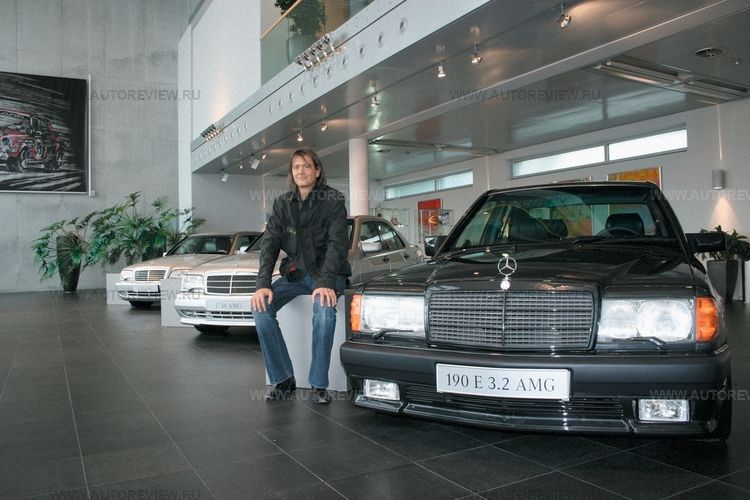
AMG top manager Wolf Zimmermann next to the first Mercedes 190 E 3.2 AMG of 1991, which was the first to be sold through official Mercedes brand dealers. "If you knew how we selected the gearbox for it..." A total of 200 cars were made
Well, in 1982 the "compact" Mercedes-Benz 190E of the W201 series appeared — the direct ancestor of the current "C-class." But in the 80s, Daimler-Benz was cool towards the AMG studio — the "charged" Mercedes 190 E 2.3-16 was developed by Mercedes people jointly with the English company Cosworth. Meanwhile, Aufrecht's people were not idle. Tuning packages were offered both for the 190 E 2.3-16 version (power increase from standard 170-185 to 204 hp) and for the base Mercedes 190 with a two-liter engine, and (later) for cars with an inline "six" of 2.6 liters. Since 1986, Aufrecht's studio began preparing engines for factory touring 190s in the DTM championship, and in 1988 a partnership agreement was finally concluded — and the Mercedes 190 E 2.5-16 Evolution II of 1990 became the first Mercedes in the development of which AMG engineers had a hand. Well, a year later the Mercedes 190 E 3.2 AMG appeared — the first car from Affalterbach that went on sale through the Mercedes-Benz dealer network and was covered by the factory warranty.
Next came that very Mercedes-Benz C 36 AMG of 1993 — the first joint development of designers from Stuttgart and Affalterbach. The W202 sedan with a 280-horsepower inline "six" of 3.6 liters was equipped only with a four-speed "automatic" and reached 100 km/h in 6.7 seconds — 0.7 s slower than the then BMW M3 of the E36 series. In Affalterbach they sought to close the gap — in 1997 the C 43 AMG version appeared with a V-shaped "eight": 4.3 liters, 306 hp, and 410 newton-meters of torque, and a new five-speed "automatic" with manual shifting capability. But the acceleration time to "hundred" remained at the same level, and sales fell. Compare: Mercedes C 36 AMG — 5,400 cars sold (1993-1997), Mercedes C 43 AMG — only 3,850 cars (1997-2001). Even the C 55 AMG version with a V8 5.4 engine (347 hp) did not help — only 59 such cars were sold. And this despite the fact that eight-cylinder "C-classes" from AMG were offered with sedan and station wagon bodies.
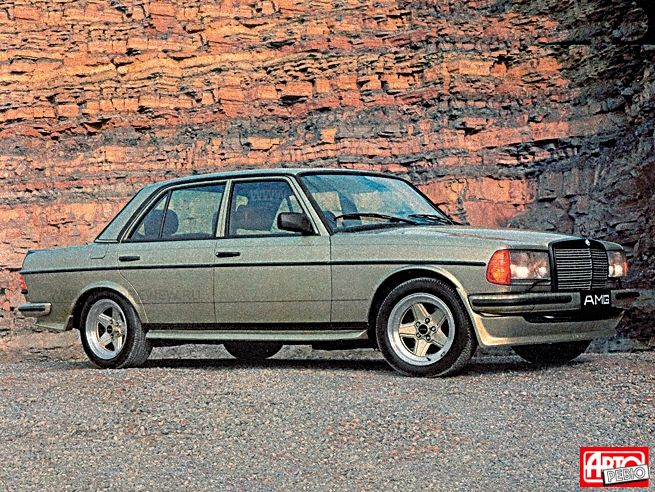 | 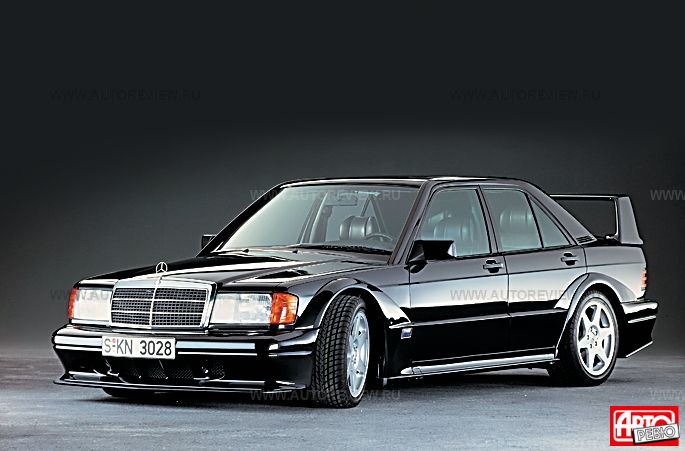 |
| It all started with the history of "charged" small Mercedes AMG — a W123 series sedan with a boosted engine and naive plastic body kit | Mercedes-Benz 190 E 2.5-16 Evolution II (1990) with a boosted AMG four-cylinder engine (235 hp). 502 sedans were built |
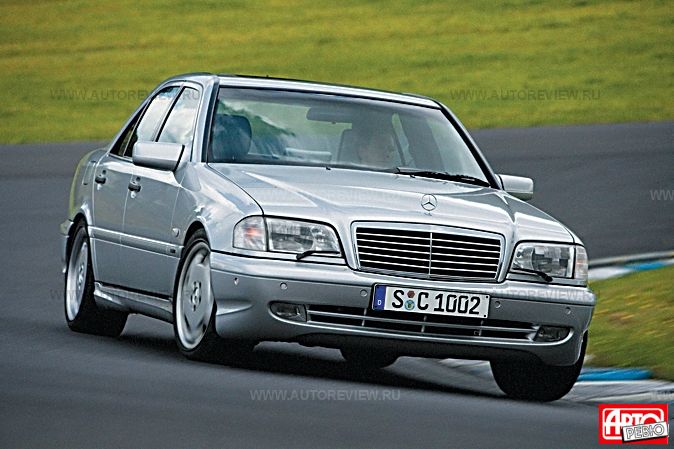 | 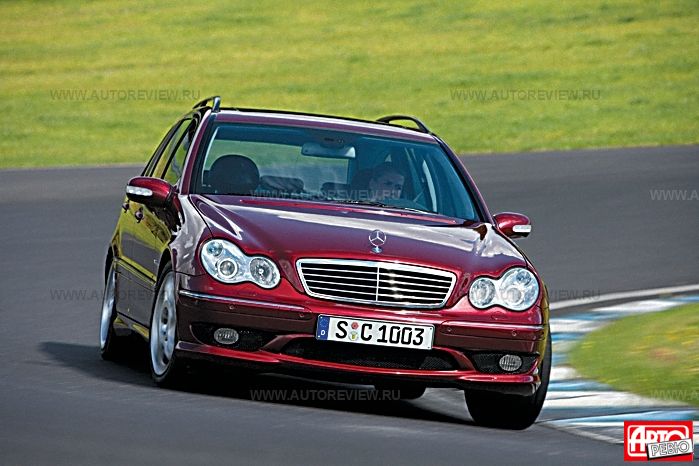 |
| From 1993 to 2001, about 9,300 Mercedes AMG C-class W202 series were sold — first the C 36 AMG versions (280 hp, 5,400 sedans until 1997), and then the C 43 AMG (V8 306 hp, 3,850 sedans and station wagons) | Sales of Mercedes AMG C-class W203 series sedans, station wagons, and hatchbacks reached 12,850 cars — 8,250 "supercharged" C 32 AMG (2001-2004) and 4,600 eight-cylinder naturally aspirated C 55 AMG (2004-2007) |
But the competitor from Munich — the BMW M3 in the E36 body — from 1992 to 1999 sold more than 70 thousand units...
Then came a turning point: in 2002, the Mercedes C 32 AMG debuted on the W203 platform, equipped with a supercharged V-shaped "six" with 354 hp, as well as a unique diesel version C 30 CDI AMG with a 231-horsepower unit. From 2001 to 2004, the company sold 8,250 such sedans with six-cylinder AMG engines. These models could already compete on equal terms with the BMW M3! The success inspired engineers from Affalterbach to return to eight-cylinder engines — but from 2004 to early 2007, sales of the C 55 AMG with a naturally aspirated "eight" of 5.4 liters and 367 hp amounted to only 4,600 units.
Thus, over 14 years of production of "charged" Mercedes C-class in Affalterbach, the total output of three generations stopped at 22,000 cars. For comparison: the BMW M3 of three generations from 1985 to 2006 found 175 thousand buyers — the difference is obvious. Perhaps the new C 63 AMG of the W204 series will be able to close this gap?