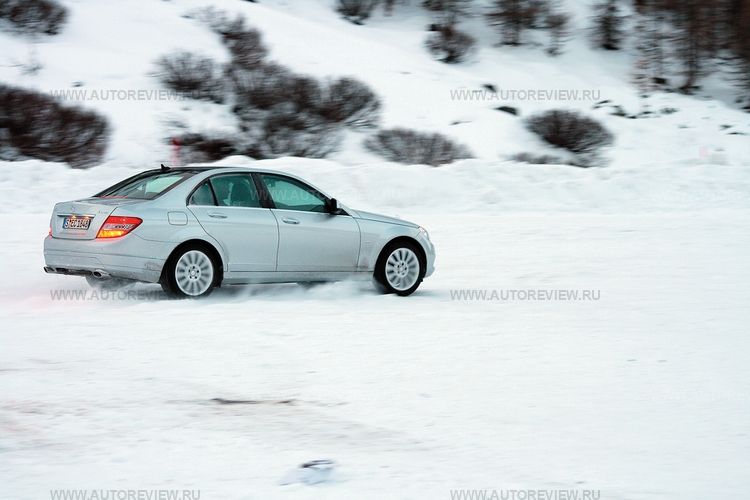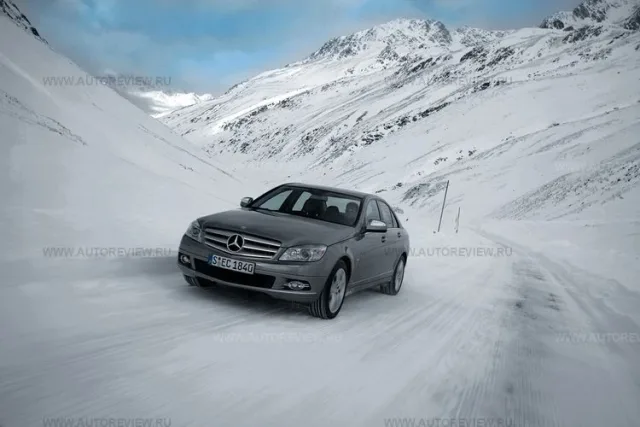
Do they even know what they're doing? And if they do, how did they manage to let us loose on a winding, snow-covered road — almost like a rally special stage? And not in sports cars, but in ordinary, production Mercedes! Even if they are all-wheel drive...
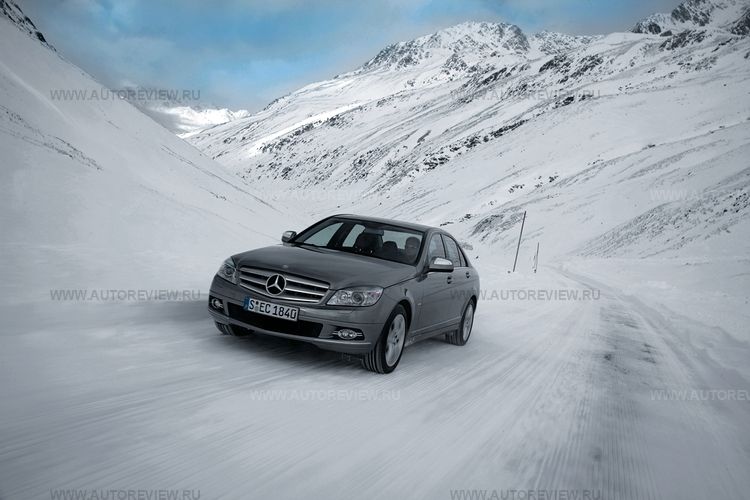
All-wheel drive on the C-Class is not a novelty. A similar scheme is already familiar from the flagship S-Class, which we tested in 2006, and in the near future it will appear on the GLK crossover and the new E-Class. We are talking about the fourth generation of the 4Matic system. It is based on a cylindrical center differential, which is supplemented by an uncontrolled two-disc friction clutch. Under normal conditions, torque is distributed between the axles in a 45:55 ratio in favor of the rear wheels. When starting on slippery surfaces, the clutch locks the differential, which improves directional stability. If the difference in torque on the front and rear axles exceeds 50 Nm, the clutch begins to slip — for example, in corners or with uneven traction. However, the wheels do not spin at this moment: the 4ETS electronics handle the metering of traction, braking the necessary wheels.
In all-wheel drive Mercedes C-Class of the previous generation (2002–2006), everything was arranged differently: torque was divided by a free differential in a 40:60 ratio. But the transfer case had an extra intermediate gear, and the front drive shaft came out of a massive protrusion on the housing. Now the shaft is pressed against the gearbox housing, so the standard tunnel of the rear-wheel drive body did not have to be redesigned. The design has become more compact and lighter: the all-wheel drive version is only 60–70 kg heavier than the rear-wheel drive one, whereas previously the difference was 105 kg. Less weight means less appetite: in the combined cycle, fuel consumption increased by only 0.3 l/100 km, whereas previously the surcharge was 1.1 l.
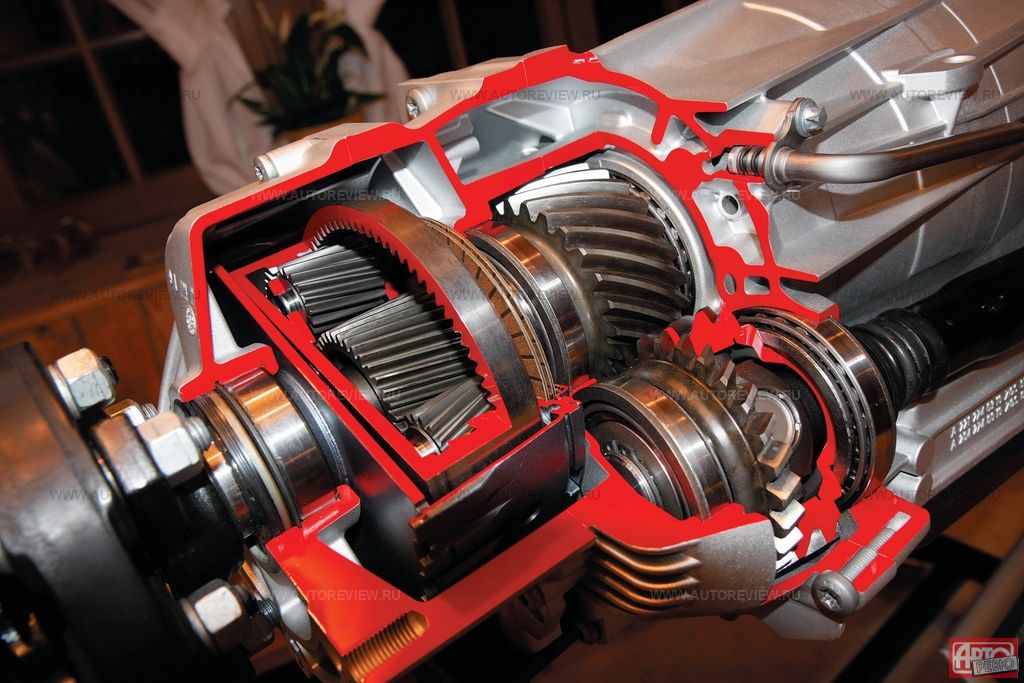 | 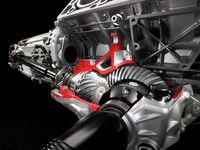 |
| There is no electronics in the transfer case, and the mechanics, according to the developers, are very reliable. They claim that the Torsen worm differential on Audi may start clicking by 100,000 km, but 4Matic calmly "runs" 300,000 km | The front axle shaft is located at an angle of 70 degrees to the longitudinal axis of the car and fits in the tunnel of the standard body |
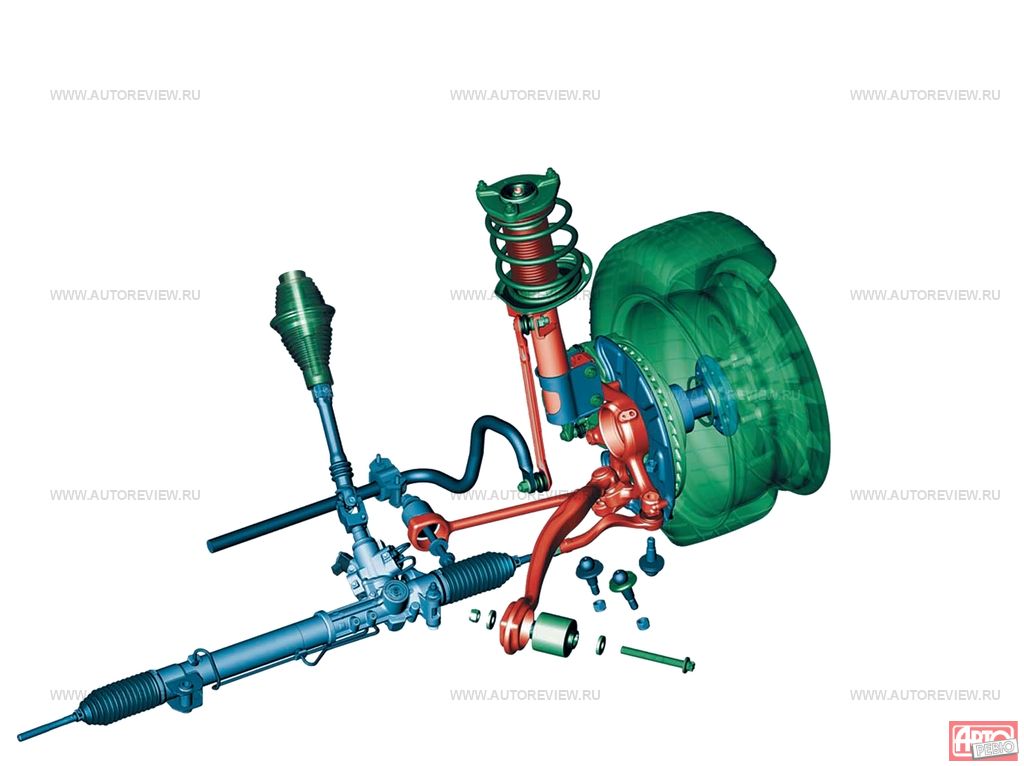 | 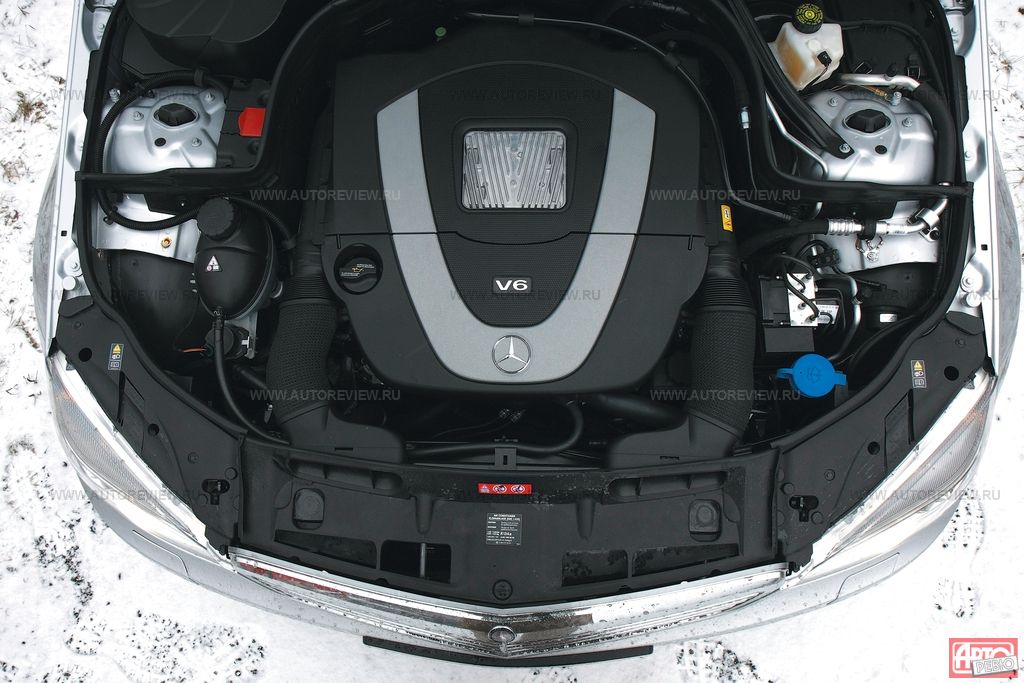 |
| The front suspension has its own steering knuckles and arms. Springs and shock absorbers have become stiffer to compensate for the added weight of the front drive. The steering mechanism is shifted forward by about 70 millimeters due to the reduction gear | Under the hood is the same V-shaped "six" as in the rear-wheel drive C 280 and C 350. By the way, the hood of the C-Class opens at 90 degrees! |
The all-wheel drive "C" comes only with an automatic transmission: the transfer case is integrated into the hydromechanical unit 7G-Tronic. The front reduction gear is rigidly connected to the engine oil pan, through which the left front wheel shaft passes. Engines are exclusively six-cylinder: C 280 and C 350.
In the mountains near Innsbruck, I got only the most powerful modification — the 272-horsepower C 350 4Matic. At first, driving was on asphalt.
It would seem that acceleration to 100 km/h in 6.3 seconds is almost a hot temper: only 0.1 seconds slower than the rear-wheel drive version with the same engine. But that's what the numbers say, but in reality the start seems thoughtful. Maybe it's the signature Mercedes comfort? Not only. The compact transfer case is designed for a torque of no more than 700 Nm, so in first gear the electronics "hold back" the engine — otherwise its peak 350 Nm, multiplied by the gear ratio of 4.38, would simply cut the gears. And the acceleration time to 100 km/h is comparable because the rear-wheel drive car is also limited by electronics at the start, only there the traction control system acts as a limiter.
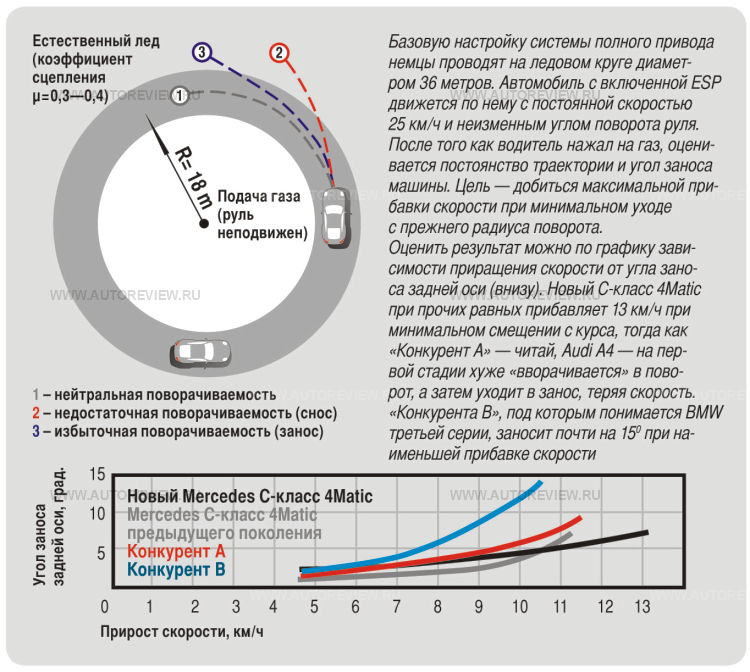
Otherwise, you hardly feel any differences from the regular C-Class. Yes, the front springs and shock absorbers have become stiffer, but exactly enough to compensate for the extra weight of the all-wheel drive. The steering mechanism was moved forward by 70 millimeters — otherwise the front reduction gear would not fit, but the effort on the steering wheel remained the same — slightly artificial.
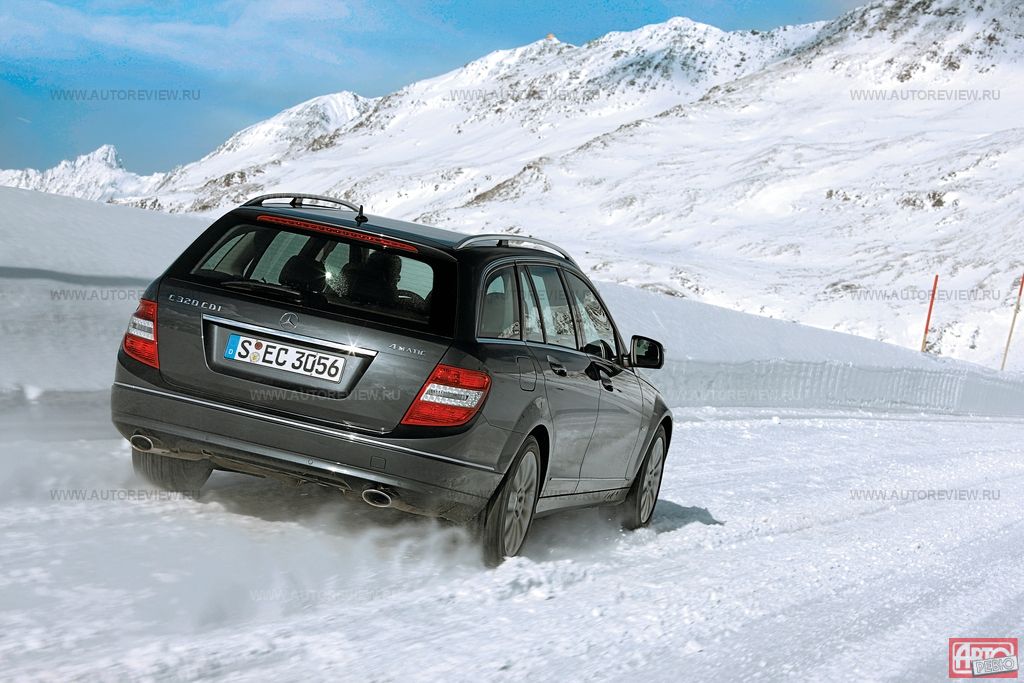 |
| The C-Class 4Matic is supplied to Russia only in a sedan body and only with two petrol engines. The Russian office of Daimler is not yet ready to bring diesel passenger cars, so the C 320 TDI 4Matic station wagons will not appear here. And no other engines are provided for them |
With every turn of the mountain road, there is more snow on the asphalt: we are climbing to an altitude of 2000 meters...
I remember the C-Class 4Matic of the previous generation — it was unshakably stable on the snowy slush of Moscow avenues and strictly controlled by ESP in corners. But the newcomer accelerates on the "mixed" surface even more confidently — no steering correction is needed at all. And on bends? ESP, of course, remains, although now it works softer. It's a different matter if you press the ESP off button. For the previous generation, this was like loosening the collar by one hole. Now — at least by three! And although officially this button is intended for driving with anti-skid chains, Mercedes and ContiTeves engineers clearly tuned ESP with an eye to letting you have a bit of fun. Even in the "off" state, the system still intervenes, but it does so noticeably later than before. I've never driven modern Mercedes like this in winter!
Packed snow creaks under the non-studded Continental WinterContact TS810 tires. Before a turn, I brake, at the entrance I only slightly indicate the trajectory with the steering wheel — and add gas. The car smoothly goes into a drift, which is so pleasant to control with throttle. Moreover, when pressing the gas, the Mercedes accelerates, and the drift remains only a pleasant side effect. Everything is exactly as you expect from a well-tuned all-wheel drive. Mercedes understood me, and I understood it! The main thing is not to jerk the steering wheel, otherwise ESP will remind you of itself and return you to the "right path." If you steer delicately, the system sleeps peacefully — you can even spin around the front wheel. But as soon as you press the brake, the electronics immediately take the car into its reliable embrace.
You don't need to catch the microns of accelerator pedal movement, like on the all-wheel drive BMW 3 Series. You don't need to adjust the fuel supply timing, like on the Audi A4. And if you haven't learned to work the steering wheel laconically from Evgeny Vasin or Gennady Broslavsky, the Mercedes electronics will start their part earlier — and keep you within reasonable limits.
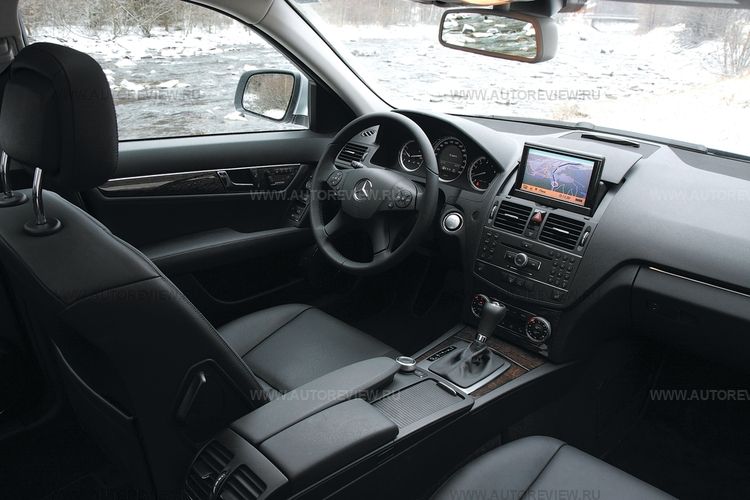
The interior of the all-wheel drive C-Class is no different from the regular one. The compact transmission made it possible to remove the "hump" in the front passenger's footwell
Of course, the Mercedes C-Class 4Matic is not a driver's car. Its 7G-Tronic automatic, both in sport and pseudo-manual modes, sometimes chooses the wrong gear needed before the next snow-covered bend. And you have to turn the rather large steering wheel a lot — at least if it's a Mercedes in Elegance trim, like my test car. But it's Elegance that two-thirds of buyers choose... For them, the new 4Matic is exactly what they need.
But "torque vectoring" rear differentials, like those in BMW or Audi, are hardly needed for them. Therefore, it's not at all certain that such systems will appear on cars from Stuttgart. For them, the main thing is stable, calm behavior on snow and ice, and the all-wheel drive Mercedes C-Class has plenty of that.
It's a pity that in Russia the 4Matic system for the "compact" Mercedes costs at least 4000 euros, compared to 2600–3000 euros for all-wheel drive transmissions on the BMW 3 Series or Audi A4. Perhaps that's why the 4Matic version is not in great demand: in 2006, only 11 percent of buyers of the then C-Class ordered all-wheel drive cars, while the share of all-wheel drive versions of the BMW 3 Series and Audi A4 is the same and reaches 23 percent. But on more expensive Mercedes, "4Matic" is more popular: the all-wheel drive E-Class is ordered in 40 percent of cases, and the S-Class — 55 customers out of a hundred! If the share of all-wheel drive "C" cars still grows, I will only be glad: I really liked the new 4Matic.
The C-Class became the second Mercedes to receive the compact 4Matic transmission of the fourth generation. Many components are unified with the flagship all-wheel drive S-Class: the automatic gearbox and transfer case unit, the driveshaft going to the front reduction gear, as well as the front differential itself. But the rear reduction gears here are their own — they are lighter, since the rear axle bears a smaller torque load.
| Passport data | ||
| Parameters | Vehicle | |
| Mercedes-Benz | ||
| Modification | C 280 4Matic | C 350 4Matic |
| Body type | 4-door sedan | 4-door sedan |
| Number of seats | 5 | 5 |
| Dimensions, mm | ||
| length | 4581 | 4581 |
| width | 1770 | 1770 |
| height | 1444 | 1448 |
| wheelbase | 2760 | 2760 |
| track front/rear | 1541/1544 | 1533/1536 |
| Trunk volume, l | 475 | 475 |
| Curb weight, kg | 1560 | 1595 |
| Gross weight, kg | 2120 | 2155 |
| Engine | petrol, with distributed injection | |
| Location | front, longitudinal | |
| Number and arrangement of cylinders | 6, V-shaped | |
| Displacement, cm³ | 2996 | 3498 |
| Cylinder bore/piston stroke, mm | 88.0/82.1 | 92.9/86.0 |
| Compression ratio | 11.3:1 | 10.7:1 |
| Number of valves | 24 | 24 |
| Max. power, hp/kW/rpm | 231/170/6000 | 272/200/6000 |
| Max. torque, Nm/rpm | 300/2500—5000 | 350/2400—5000 |
| Transmission | automatic, 7-speed | |
| Drive | permanent all-wheel drive | |
| Front suspension | independent, spring, McPherson | |
| Rear suspension | independent, spring, multi-link | |
| Front brakes | disc, ventilated | |
| Rear brakes | disc | disc, ventilated |
| Tires | 205/55 R16 | 225/45 R17 |
| Maximum speed, km/h | 243 | 250 |
| Acceleration time 0—100 km/h, s | 7.3 | 6.3 |
| Fuel consumption, l/100 km | ||
| combined cycle | 9.4—9.6 | 10.0 |
| Fuel tank capacity, l | 66 | 66 |
| Fuel | petrol AI-95 | petrol AI-95 |