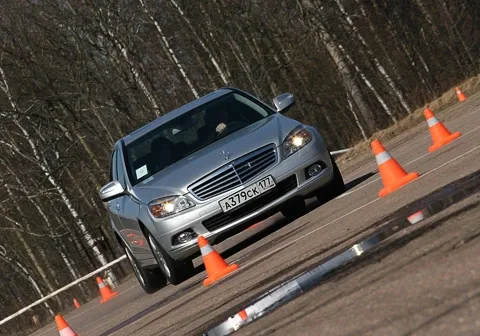
When one of the fellow journalists asked whether the Pre-Safe system would work if stability control is turned off, the engineer replied that it's impossible to turn it off completely. The ESP off button essentially only limits the ASR functions. However, there's not much to be upset about — the system works very carefully. In active mode, it allows only slight drifts, which it immediately suppresses, but at the same time doesn't strangle the engine and doesn't prevent driving fast enough. When stabilization is in an intermediate position, it can suppress sliding at an early stage, but leave a sharp and deep drift almost without intervention.
After completing the tests at the track, Ulrich Anzen arranged something like a mini-competition for journalists — you had to complete the exercises faster than everyone else. I managed to take third place, which was pleasant.
From the track, I set off in a more powerful version — the C350, not the C200 Kompressor. On the highway, this car behaves excellently. The seven-speed automatic 7G-Tronic shifts quickly and smoothly, and the power reserve is enough in any situation. The car easily accelerates to over 200 kilometers per hour, and any overtaking becomes a pleasure.
Interestingly, speed is completely imperceptible here. Usually, they say "you don't feel the speed" or "you're going 160, but it feels like 120." Here, you drive and have no idea what's on the speedometer. Sound insulation is excellent, vibrations are almost absent. And this applies to the base version of the C-Class as well. So you can determine speed in two ways — look at the instruments or drive past an inspector with a radar. The second option, though, will cost more, but the measurement accuracy is higher.
Now about money. The new C-Class has risen in price slightly — on average by only three percent. For the base C200 Kompressor, dealers ask 34,100 euros. Six-cylinder modifications cost more: for example, the three-liter C280 — from 38,700 euros. For the C200 and C280, the base gearbox is a six-speed manual, with an automatic offered for an extra charge. The only version that will be sold immediately with the 7G-Tronic automatic is the C350 for 47,800 euros.
Expensive? But the C-class has become significantly more modern and safer. Still expensive? Then there are special versions with fixed trim levels. For example, the C200 Kompressor with an automatic transmission, parktronic, and bi-xenon headlights will cost 37,900 euros. The C280 with a similar set of options is six thousand more expensive. In autumn, the C180 and C230 versions will appear in Russia, along with the all-wheel-drive 4-Matic modification.
The handling of the C-class is, of course, not yet sporty. The chassis is well balanced, and the car is very easy to drive. But fans of fast driving will only enjoy themselves if they drive in a straight line. However, the confidence with which this car drives on any road is worthy not only of a Mercedes but also of a railway train. The company expects that the high level of comfort will allow buyers to forget about the "unimpressive" interior or the high price, and they will help Mercedes-Benz conquer leadership in the class. The main thing is to decide between the two front-end design options.
Technical specifications
| Specifications | C200 Kompressor | C280 | C350 |
|---|---|---|---|
| Body | |||
| Number of doors/seats | 4/5 | ||
| Length, mm | 4581 | ||
| Width, mm | 1770 | ||
| Height, mm | 1447 | ||
| Curb weight, kg | 1490 | 1555 | 1610 |
| Gross weight, kg | 1975 | 2040 | 2095 |
| Trunk volume, l | 475 | ||
| Engine | |||
| Type | Petrol, with multi-point fuel injection and mechanical supercharger | Petrol, with multi-point fuel injection | Petrol, with multi-point fuel injection |
| Location | Front, longitudinal | ||
| Number and arrangement of cylinders | 4, in-line | 6/V | 6/V |
| Number of valves | 16 | 24 | 24 |
| Displacement, cm3 | 1796 | 2996 | 3498 |
| Max. power, hp/rpm | 184/5500 | 231/6000 | 272/6000 |
| Max. torque, Nm/rpm | 250/2800—5000 | 300/2500—5000 | 350/2400—5000 |
| Transmission | |||
| Gearbox | Manual, six-speed (automatic, five-speed) | Manual, five-speed (automatic, seven-speed) | Automatic, seven-speed |
| Drive | Rear | ||
| Chassis | |||
| Front suspension | Independent, McPherson | ||
| Rear suspension | Independent, multi-link | ||
| Front brakes | Disc, ventilated | ||
| Rear brakes | Disc | ||
| Tires | 205/55 R16 | 225/55 R16 | 225/45 R17 |
| Performance characteristics | |||
| Maximum speed, km/h | 235 | 250 | 250 |
| Acceleration time from 0 to 100 km/h, s | 8.6 | 7.2 | 6.4 |
| Fuel consumption, l/100 km | |||
| Urban cycle | 11.1 (11.3) | 13.8 (14.0) | 13.9 |
| Extra-urban cycle | 6.1 (6.3) | 6.9 (7.1) | 7.3 |
| Combined cycle | 8.0 (8.2) | 9.5 (9.7) | 9.7 |
| Emission standard | Euro 4 | ||
| Fuel tank capacity, l | 66+8 | ||
| Fuel | AI-95 | ||
Mercedes-Benz C-class trim levels
| Standard equipment | Classic | Elegance | Avantgarde |
|---|---|---|---|
| Agility Control steering | + | + | + |
| Airbags for driver and front passenger | + | + | + |
| Front side airbags | + | + | + |
| Rear side airbags | - | - | - |
| Inflatable "curtains" | + | + | + |
| Driver's knee airbag | + | + | + |
| Neck-Pro active head restraints | + | + | + |
| ABS | + | + | + |
| ESP | + | + | + |
| Power steering | + | + | + |
| Height- and reach-adjustable steering column | + | + | + |
| Front and rear power windows with automatic mode | + | + | + |
| Heated front seats | + | + | + |
| Thermatic two-zone climate control | + | + | + |
| Thermatronic three-zone climate control | - | - | - |
| Power-adjustable and heated exterior mirrors | + | + | + |
| Multifunction steering wheel with leather trim | + | + | + |
| Fabric upholstery | + | + | - |
| Fabric and leather upholstery | - | - | + |
| Leather upholstery | - | - | - |
| Front seats with electric height and backrest adjustment, driver's seat with manual lumbar support adjustment | + | + | + |
| Decorative elements in "piano lacquer" wood | + | - | - |
| Decorative elements in "Eucalyptus" wood | - | + | - |
| Decorative elements in aluminum | - | - | + |
| Front fog lights | + | + | + |
| Tire pressure loss warning | + | + | + |
| Rear armrest with double cup holder and storage box | - | + | + |
| 4.5-inch display in instrument cluster | - | + | + |
| CD audio system | + | + | + |
Additional equipment
- Metallic body paint
- Natural leather interior trim
- Parktronic
- Power front seats with memory function
- Auto-dimming interior mirror and driver's side exterior mirror
- Leather-wrapped steering wheel and gear shift lever
- Folding 1/3 to 2/3 rear seat back for transporting long items with fastening elements
- Side airbags for rear passengers
- Pre-Safe system
- Rain sensor for windshield wipers
- Panoramic sliding roof with electric drive
- Glass sunroof with electric drive (sliding/tilting)
- Cruise control with Speedtronic function
- Power-folding exterior mirrors
- Audio 20 CD audio system with six-disc changer
- Audio 50 APS system with CD player, DVD navigation, six-disc changer, and Linguatronic voice control
- Comand APS multimedia system with CD, DVD-Audio/Video, hard drive navigation, six-disc changer, and Linguatronic voice control
- Electric rear window sunshade
- Bi-xenon headlights with dynamic range adjustment and washers
- Bi-xenon Intelligent Light System headlights with dynamic range adjustment and washers
- Decorative walnut wood inserts in Classic trim
- Decorative "bird's eye" maple inserts in Avantgarde trim
- Decorative "curry" eucalyptus inserts in Elegance trim
- Aluminum decorative elements in Avantgarde trim
- AMG styling package
- Harman Kardon Logic 7 Surround sound system
- Keyless-Go keyless access system
Behind the scenes