
Mercedes-Benz B-Class. German tourer
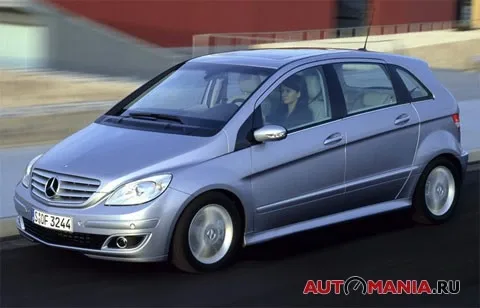
Three years ago, Stuttgart engineers first realized their idea of creating a sports tourer — a car that combines the strengths of different vehicle types. In the Old World, this concept appealed to many, but here this compact MPV did not cause much excitement. However, dealers are not giving up, because the model, if you look into it, turned out to be extremely successful.
The second-largest minivan from Stuttgart, if you don't look closely, can easily be mistaken for a stretched version of the A-Class or even its facelifted modification. The stylish front end with a funny "alien" expression, the recognizable side profile, the signature roofline with a visor over the tailgate, familiar trim details, and, of course, the star on the radiator grille — all this reveals kinship with the "A". It seems that the letter "B" on the rear still baffles some drivers who mistake this minivan for something else.
The resemblance to the younger model in the B-Class is indeed striking. Moreover, it inherited from the "A" both the chassis, engines, and gearboxes. The body construction also repeats the double-floor principle, which is designed to improve safety in an accident. However, the Germans themselves insist: externally, the cars are only "very similar," but no more. According to them, this is an independent model — that very Sports Tourer, albeit unified with the A-Class. True, with the prefix Compact, because the full-fledged representative of this family became the larger R-Class, which grew out of the Vision R concept.
And, it must be admitted, such statements have grounds: if you look closely, almost all body panels here have a different profile, their own stampings and stiffening ribs. Moreover, the car is noticeably longer, taller, and wider, and the wheelbase has become significantly larger. But still, the feeling does not leave that we have a well-known "donor" in front of us.
In the cabin, the feeling of déjà vu also does not go away. The designers, of course, worked on the interior, but their efforts mainly came down to new trim materials. There is a lot of aluminum inside, but the key elements — the dashboard, center console, instrument cluster, steering column stalk, and multifunction steering wheel — have moved here directly from the A-Class. And the equipment is corresponding: climate control, radio with CD player and six speakers, front electric windows, electric mirror drive, and a bunch of drawers, pockets, and boxes that no family one-box car can do without.
As for passive safety, at first glance the list has not changed: four airbags, a full set of electronic assistants like ABS, ASR, ESP, and BAS, as well as the mentioned "layered" floor that absorbs impact energy. But there is also a new feature that the "A" did not have — the Steer Control system. This is an auxiliary steering that can slightly steer, correcting the trajectory before ESP intervenes.
The main trump card of the B-Class cabin is not the design or the list of options, but incredible spaciousness. In the front, as a rule, it is comfortable in any car, but the question is — is there enough space in the back? So, here the car leaves its "brother" far behind. Such a reserve of space is usually found in a luxury sedan, not in a C-class compact MPV. I, being almost two meters tall, easily settled in the second row, even though the front seat was moved back for an equally tall driver. Agree, this is not common. And if someone shorter is driving, then in the back you can even cross your legs. There is also plenty of headroom, although with three people of such dimensions it will be a bit cramped — still not an S-Class.
The trunk, meanwhile, has not suffered at all: it easily holds up to 550 liters of luggage. And if you fold the seats, the volume even doubles. True, there are nuances here. In the optional Easy-Vario transforming interior, if you remove the rear sofa and the front passenger seat, the driver, left alone, will have as much as 2245 liters of free space at their disposal.
With engines for the B-Class, everything is also in order — the choice is not limited. Dealers have the entire European range: four gasoline units and two turbodiesels. I got a version with a two-liter engine paired with a six-speed sequential variator Autotronic.
As I already said, the B-Class inherited all the main components from the "A", including the suspension — classic McPherson in front and a semi-independent beam with a Watt mechanism and stabilizer in the rear. But on the move, the car feels completely different. The extended wheelbase did its job: the B200 drives much smoother. I was especially pleased that the car almost does not care about longitudinal waves of asphalt, ruts, and other road troubles — the main thing is to choose the right speed. At the same time, the suspension is both maximally comfortable and stiff enough to prevent strong rolls in corners and during sharp maneuvers. The steering wheel is sharp and informative. In character, the car is more reminiscent of the C-Class. Yes, due to the high center of gravity, it sways slightly at speed, but it remains extremely stable and inspires confidence.
The dynamics were not a revelation, although the car cannot be called boring. Rather, it is calm. In automatic mode, it is a typical family car: the engine pulls evenly in almost the entire rev range, responds smoothly and with a noticeable pickup to the gas, and without dips — this is certainly the merit of the variator. The "automatic" allows you to move around the city quite briskly, but it is unlikely to really "get fired up" with it — the character is not the same. In manual mode, Autotronic is also not bad, although I did not get much pleasure from shifting. With a six-speed manual, the B200, I think, would be livelier.
If someone finds this engine boring, you can pay attention to tuning from the court atelier AMG — there they will definitely satisfy driver ambitions. But seriously, the range also has the top version B200 Turbo. Lowered suspension, 193-horsepower turbo engine, acceleration to a hundred in 7.6 seconds, with a choice of manual or variator. This is, of course, not a racing car, but the dynamics of such a car are certainly decent. However, given current fuel prices, it would be more practical to look at diesels — a 1.8-liter with 109 hp or a two-liter with 140 "horses". By the way, the gasoline B200 also turned out to be quite economical: it did not reach the passport figures, of course, but in the city I got about 11 liters per hundred, and on the highway — no more than 8.5.
In general, the B-Class will certainly appeal to many. The main thing is that the owners of this "yard" have at least 864,000 rubles — that is how much they ask for a car with a 1.5-liter engine. For the B200 Turbo version in basic configuration, you will have to pay more than a million. The version I tested was valued at 964,200 rubles, and taking into account all options — at 1.13 million. Perhaps this is the only drawback of the Mercedes-Benz. But, on the other hand, such a car cannot be cheap. And, it must be said, there is something to pay for here.
Technical characteristics:
Mercedes-Benz B-Class is not quite a familiar station wagon and not a minivan in the classic sense. The manufacturer calls such a body a sports tourer. In essence, we have a compact MPV with a rather unusual layout: the seats here are located higher than in ordinary passenger cars, but lower than in traditional "heel" vans. Due to this, the seating position is comfortable — you sit as if in a chair, and do not "dive" down.
The exterior of the car is calm, without sharp lines, but in traffic you will not confuse it with others — the brand's signature style is read immediately. Inside, there is typical Mercedes neatness: materials are solid, assembly is tight, nothing wobbles or creaks. The dashboard is informative, everything you need is at hand. Ergonomics are excellent, although there are many buttons, you quickly get used to them.
Under the hood is a two-liter gasoline engine with 136 horsepower. For a car weighing about 1270 kilograms, this is enough to feel confident both in the city and on the highway. Acceleration to a hundred takes 10.1 seconds — not a record, but enough for everyday driving. The maximum speed is 196 km/h, which also covers the permitted values on our roads with a margin. The engine's appetite is moderate: in the combined cycle it fits into 7.4 liters per hundred, which is pleasantly surprising for such a body.
An interesting feature is the trunk. In its normal state, it holds 550 liters, and if you fold the rear seats, the volume grows to 2245 liters. True, you will have to tinker: the seats do not fold in one motion, but in parts. But when they are removed, you get a flat platform on which you can transport something truly bulky.
On the move, the B-Class behaves collectedly. The suspension is elastic, but not shaky — small joints and irregularities pass with a slight knock, which, however, does not annoy. Rolls in corners are moderate, the steering wheel is informative, the brakes are tenacious. Overall, the car handles predictably and does not make the driver strain unnecessarily.
Among the disadvantages, it can be noted that for such money you want a little more dynamic reserve — on overtaking you have to plan the maneuver in advance. But if you do not chase sports sensations, but consider the car as a spacious and comfortable tool for everyday use, the Mercedes-Benz B-Class looks like a very worthy offer. The price at the time of the test started from 864,000 rubles.