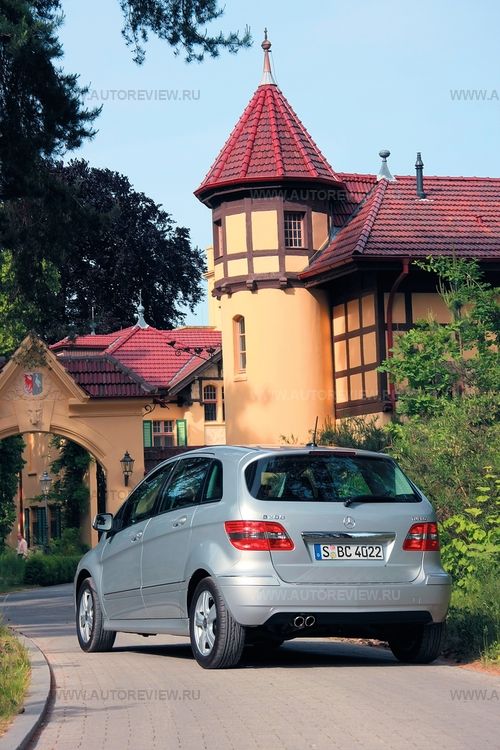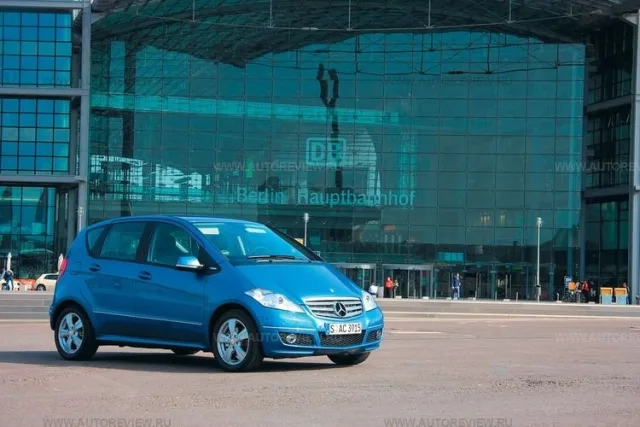
That my Mercedes A-Class was speeding along the track of Germany's oldest racetrack, AVUS, I realized not immediately — the loop laid back in 1913 became part of a regular highway on the outskirts of Berlin a few years ago. You can understand that Rudolf Caracciola and Pierre Veyron once shone here only by the rusty grandstands drowning in roadside thickets.
And noticing the differences of the updated Mercedes A- and B-Class hatchbacks, which I met in the German capital, is even harder.
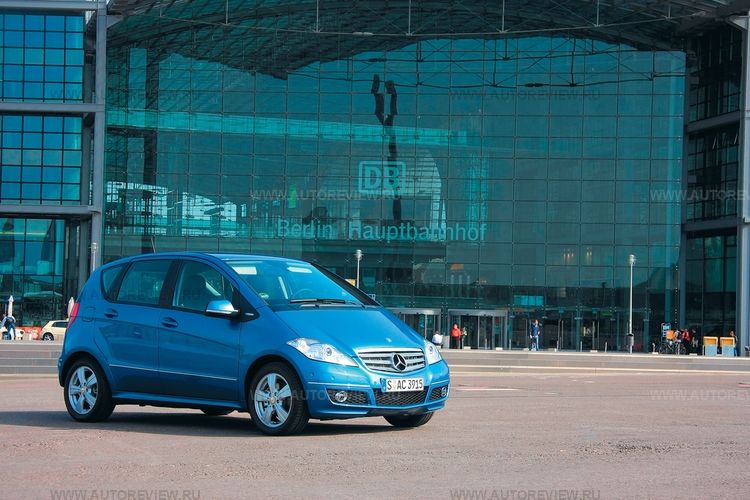
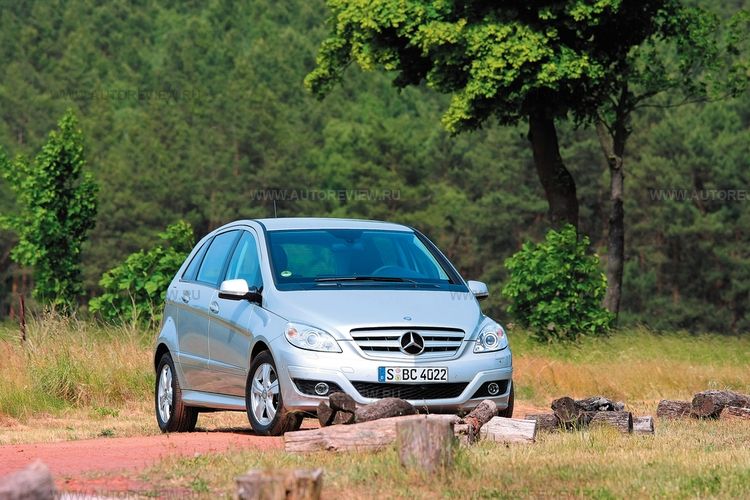
These little Mercedes are real twins: they share the same technical content and identical interior. The light facelift program is also the same. For the B-Class — extended turn signals in mirror housings, transparent "inserts" in the rear lights, and new bumpers. For the A-Class, everything is the same, but there is one additional detail: if the horizontal slats of the radiator grille are narrow and perforated — you have the previous "A", but if they are thick and angled to each other — this is already the updated version.
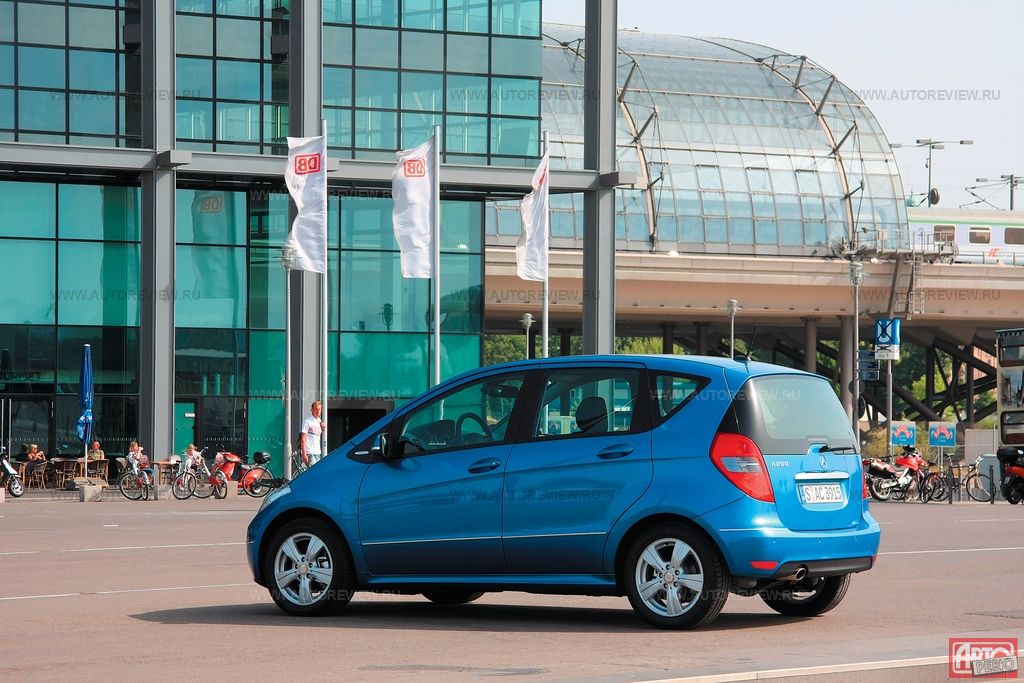 Sales of both models are counted together by Mercedes — last year, 275 thousand cars were sold. They are far from the leaders of the golf class, but the BMW 1 Series sells one and a half times worse. Despite the "moose" incidents with the first A-Class and the failure of the niche R-Class, the unconventional compact Mercedes turned out to be quite successful — only the C-Class sells better, and there are no direct competitors in the "premium" segment after the Audi A2 left. In Europe, the A-Class is slightly more popular than the B-Class: since 2004, 600 thousand units have been sold, while the "B" has 350 thousand over three years. But the main thing is that the A-Class perfectly fulfills its key task: for half of the buyers, it became their first Mercedes in life.
According to Mercedes representatives, customers previously lacked only pleasant little things — for example, an iPod player connector, a hill-start assist, or a COMAND multimedia system with graphics at the level of the S-Class. Now all this is available. And for an additional 1050 euros, an "auto-parker" will also appear!
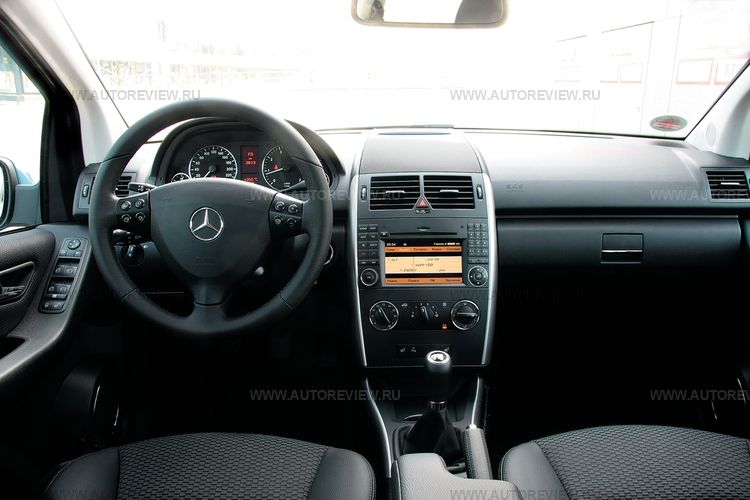
The new multimedia system has a radio tuner scale in retro style, like in older Mercedes models
I slowly drive the A-Class along a row of parked cars. An icon appears on the display — this is Active Parking Assist finding a suitable parking spot. Then you need to engage reverse, activate the function with a button on the steering wheel, and take your hands off — and the Mercedes will park itself in the "pocket" in reverse. True, like the self-parking Volkswagen Touran we tested (see AR No. 23, 2007), the A-Class parks a bit crookedly. But the Bosch system used by Mercedes requires a total gap of 130 cm between the bumpers of neighboring cars — 65 cm front and rear. The similar Volkswagen-Valeo system requires 140 cm. However, FIAT with Valeo already offers an even more agile parker that needs only 120 cm.
Also, the updated Mercedes can go into "short-term hibernation"! The ECO Start/Stop system is responsible for this — it automatically turns off the engine during stops in traffic jams: just like in the updated BMW 1 Series. But Bavarian engines after a pause at a traffic light start with a regular starter, while Mercedes engines use a belt-driven starter-generator. This happens faster, quieter, and smoother.
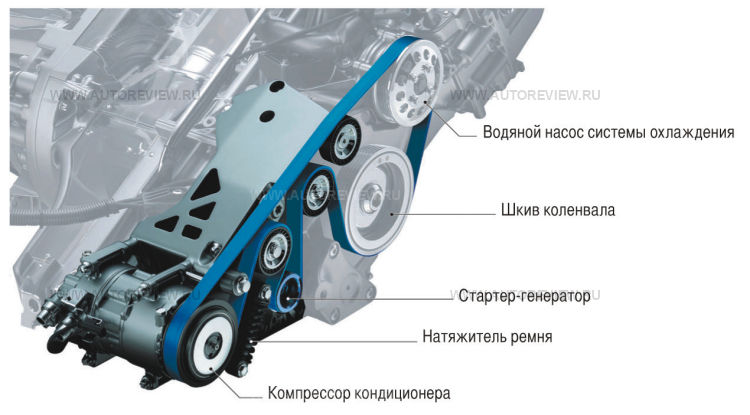
The engine of cars with the ECO start/stop system first starts with a standard starter, but after stopping at a traffic light, it comes alive again thanks to a three-phase starter-generator from Valeo with a power of 2 kW, which required changing the layout of auxiliary equipment and reinforcing the belt. While the engine "sleeps", the electrical system is powered by two batteries — the main one and an additional one in the trunk. And during braking, the starter-generator recharges both
Indeed, the operation of the "killer" is almost imperceptible: you brake before an intersection, put the manual gearbox lever in neutral — and a moment before a complete stop, the tachometer needle drops to zero. But as soon as you release the brake or press the clutch again, the engine, with a slight shudder, wakes up before an ordinary driver manages to engage first gear.
And everything would be fine, but along with the engine, the climate control also "falls asleep". And if it's hot outside and you have to stand in a traffic jam for a long time? Then you have to press a button on the panel — and the "start-stop" will turn off, starting the engine.
Of course, if the air conditioning compressor had an electric drive, this problem would not exist. But for the "entry-level" Mercedes, this is too expensive — "autonomous" climate systems, like electric oil pumps that maintain pressure in the circuits of the automatic or CVT during the engine's "hibernation", will appear only on models of higher classes.
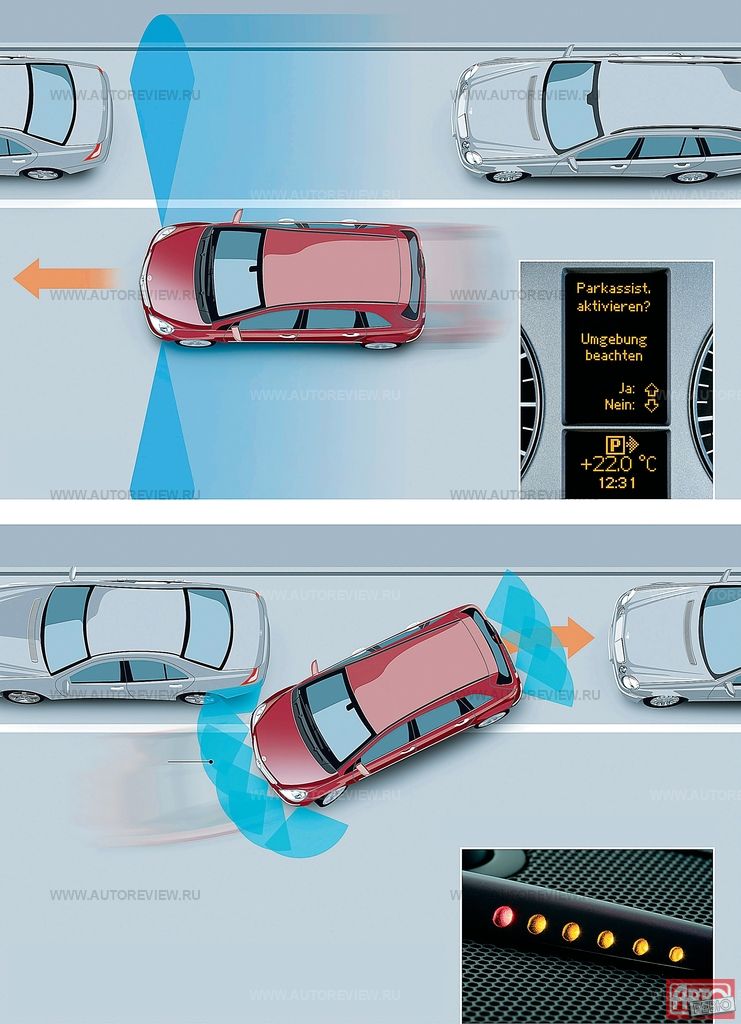 |
The active parking assist system, in addition to the eight standard ultrasonic parking sensors, has two more on the sides of the front bumper — they allow the electronics to "see" a curb higher than 5 cm, along which the system aligns the car. The range of the sonars is 4 meters. The system needs a gap of 1.3 m — for the A-Class this is a minimum of 5.18 m, for the B-Class — 5.57 m. Searching for a spot on the right is carried out constantly as soon as the speed drops below 35 km/h (this is indicated by the "P" symbol on the display). Searching on the left is activated if, at speeds up to 35 km/h, the left turn signal is turned on. The presence of a spot and its side (left or right) are shown by an arrow next to the letter "P" — the driver only needs to engage reverse and start the auto-parking with a button on the steering wheel |
For now, only the most popular versions with manual gearboxes will be equipped with the ECO Start/Stop system: A 150, B 150, A 170, and B 170. But since such Mercedes, already not too voracious, save up to half a liter of gasoline per 100 km in the city, they are in high demand in the UK, Italy, France, and Germany. On the German market, the ECO start/stop system currently costs an additional 250 euros, but at the beginning of next year, it can be ordered for free.
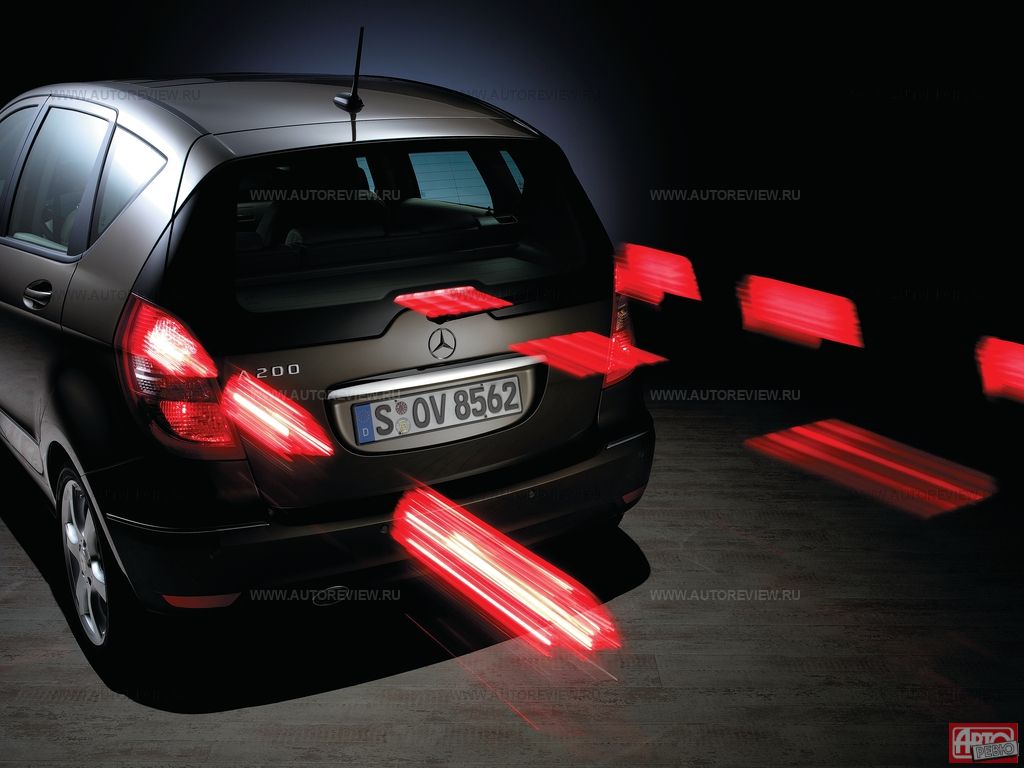 |
The brake lights of the updated Mercedes flash during braking — the reaction time of other drivers is reduced by 0.2 s, which reduces the braking distance from a speed of 80 km/h by 4.4 m |
Is "start-stop" needed in Moscow traffic jams? Mercedes representatives postponed the answer to this question until autumn — for now, such A- and B-Class hatchbacks will not be supplied to us.
The chassis settings remain unchanged. I liked the Mercedes B 200 Turbo with a 193-horsepower two-liter engine — excellent elasticity, energetic acceleration, precise operation of the "manual"... But the suspension is clearly comfortable, and the non-switchable ESP is tuned on the principle of "whatever happens" — this is a Mercedes, not a "hot" hatchback. The naturally aspirated A 200 and B 200 (136 hp) are more balanced in this regard, and the pinnacle of the idea is the versions with the Autotronic continuously variable transmission. It's no wonder that almost all cars sold in Russia (681 A-Class and 706 B-Class hatchbacks) are CVT versions.
| On cars with a "manual", the electronics use pictograms to suggest the optimal gear shift moment | While the engine "sleeps", the ECO indicator is lit on the panel. If you press the button on the center console at this time, the engine will come alive, and ECO Start/Stop will be deactivated | |
By the way, the most popular versions both in Europe and in Russia are with gasoline engines of 1.5 liters (95 hp), 1.7 liters (116 hp), and a two-liter "atmospheric" engine. Turbo versions are rarely bought, and diesel cars are supplied to us only on order. The updated hatchbacks will appear in Russia in July. Prices have increased by an average of 1000 euros — from 673,400 rubles for the three-door Mercedes A 150 and from 899,100 rubles for the Mercedes B 150.