
 Mazda CX-9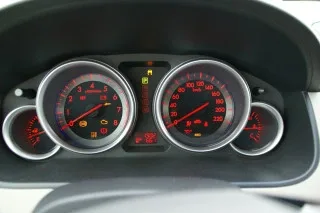
 Marat Makhmutov, expert
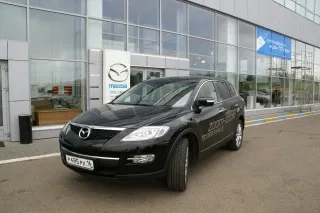
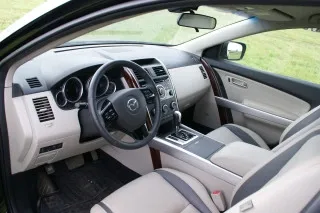
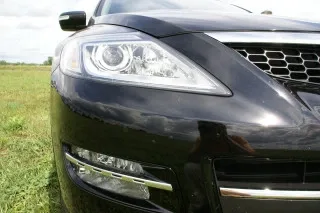
When you first see the MAZDA CX-9, it seems that you are just looking at an enlarged CX-7. But as you get closer, about six or seven meters away, it becomes clear: the "nine" is completely different in character, calmer and more family-oriented. The "seven" is a bundle of energy, a boxing glove ready to fight at any moment. The older model, despite its external similarity to the younger one, is designed and conceived completely differently. This is evident in the more classic optics and the interior, where strict rectangular lines prevail. And if you step back further, the car's dimensions can easily be confused with the AUDI Q7. And this is no coincidence: the new model, which debuted on the Russian market in August 2008, is indeed comparable in size to the flagship from Ingolstadt. Therefore, I will conduct the test drive while keeping an eye on both cars — the CX-7 and the Q7. The comparison with the AUDI will be purely formal, since they are united only by size and a certain aspiration of the new model towards premium quality. But I will compare the "nine" with its relative much more critically. So, let's begin. From the outside, the Japanese cars are almost indistinguishable, except for the mentioned dimensions and headlight shapes. Inside, there are many more differences. First of all, the trim materials have become noticeably better, although they are still far from premium level (read: Q7). The plastic in the cabin, both in appearance and feel, reminded me of the previous generation Toyota Camry (V30): solid, neat, slightly flexes when pressed, but nothing more. The front seats are comfortable, with many electric adjustments and memory settings. The steering wheel is multifunctional, you can enter the cabin without a key, and the tailgate closes electrically. The BOSE audio system with ten speakers and a subwoofer in the trunk can read MP3 from a six-disc changer. The climate control is three-zone, so second-row passengers can set their own temperature. The car has three rows of seats, designed for six people. I didn't climb into the third row, but the second row seemed not very comfortable to me — the seats, as it seemed, are positioned slightly too low. However, there is plenty of legroom. The third row folds easily and simply: pull the loops on the backrests — and the seats lie flush with the floor. Electronic assistants include ESP, ABS, and a rollover prevention system. There are six airbags, including curtains for all rows, plus active headrests. According to crash test results — five stars. From a safety point of view, the car is impeccable.
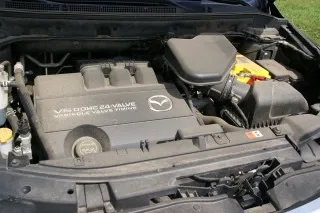
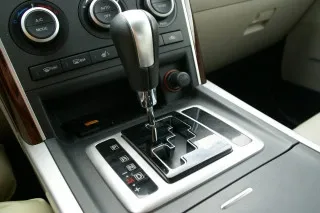 This time, the driving part fell to me, and I admit, it turned out to be long — both in time and mileage. Under the hood of the CX-9 is a Ford naturally aspirated engine with a volume of 3.7 liters and a power of 273 hp, while the "seven" has a bi-turbo 2.3 L with 244 hp. Paired with the engine is a six-speed AISIN automatic with manual mode. At first glance, a nearly four-liter engine should easily pull a fairly large car — after all, it's not a sports car. But it's not that simple. If you press the gas smoothly and steadily, everything goes smoothly: the car confidently gains speed, the gearbox imperceptibly shifts up. At sixty kilometers per hour, sixth gear is already engaged, and the tachometer shows about a thousand rpm. The transmission is clearly tuned for economy! Indeed, if you drive for a long time at speeds up to 90 km/h, the average consumption can drop to 15 liters per hundred — for such a large car, this is an excellent indicator. But as soon as you start sharply pressing the pedal to the floor with frequent accelerations and braking, consumption easily jumps to 25 liters. It's nice that American engines easily digest our 92-octane gasoline. However, an unpleasant feature also emerged: a sharp press on the gas (for example, for overtaking) does not provide instant and adequate acceleration. The automatic seems to hang in thought — the pause is short, but enough to doubt the feasibility of the maneuver. Only manual mode saves: there, the car's reaction depends entirely on how quickly you click the selector. On the "Samara" road, overtaking crawling trucks, I used exclusively manual mode — otherwise there was a real risk of meeting an oncoming car. The excellent DSG immediately comes to mind... On this same road, we traditionally check the energy intensity and comfort of the suspension. Twenty-inch wheels with a fifty-percent profile are not the best choice for such a surface, and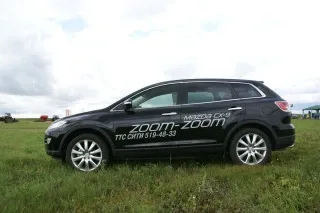
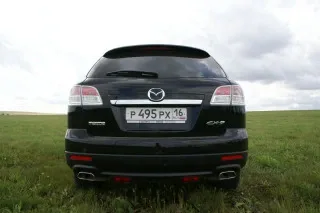 they are exactly what's on the test car. Thanks to the long wheelbase and a mass of over two tons, the "nine" handles the "washboard" quite decently — unlike the "seven", on which passengers would have counted all the fillings. But this comfort is relative. The driver finds the suspension's energy intensity on a broken road quite acceptable, the front passenger — not so much, and the second-row passengers even asked to drive slower: the vibrations on bumps were unpleasant for them. Further along the route, there was a section with a series of S-shaped turns — an ideal place for rallying. And here the big CX-9 showed that it can handle complex combinations at speeds around 100 km/h. And this is, in fact, not even a sedan!
In the end, I'll say: the car, in my opinion, fully corresponds to its concept of a large family car for those who have already outgrown youthful enthusiasm. Spacious interior, all-wheel drive, powerful engine, pleasant appearance, excellent build quality — what else does an experienced family head need? An adequate price? At the time of the test, there was just a promotion with very attractive prices for these cars. But if we talk about the branded ZOOM-ZOOM philosophy, I still consider the more fiery and youthful CX-7 to be its fuller embodiment.
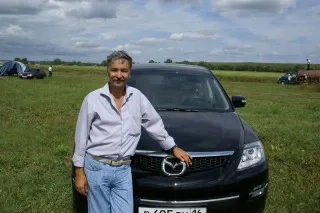 Vadim Sadykov, "Autoclub-Kazan"
After driving a bit, I realized: writing about this car will not be easy. Because, as an axiom, every car has flaws that we must talk about. But finding them here is not an easy task. You could, of course, take the simple and stupid path, for example, comparing the handling of the large SUV CX-9 with the Audi TT. And then spend a long time and with pleasure describing its shortcomings. I'm not joking — this approach to evaluating cars is found everywhere. So let's focus on the advantages of the CX-9, noting the differences in behavior with other cars.
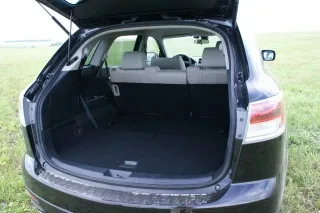
In terms of cabin capacity, the CX-9 is hard to find rivals. Even when three people sit on the rear sofa, no one bothers anyone. There's also plenty of legroom — you can settle in with maximum comfort. But the third row is noticeably tighter. If you fold the two rear seats, the trunk becomes huge. But the second-row backrests also fold, turning the car almost into a cargo van.
The 3.7-liter engine itself might scare off buyers: what if it turns out to be thirsty? But the times when fuel was burned wastefully for sharp acceleration are long gone. The Euro-4 standard dictates its own rules: exactly as much fuel is supplied to the cylinders as can burn completely. What follows from this? Every gram of gasoline is used with maximum benefit. Suffice it to say that the average consumption during the test did not reach 15 liters! If you drive at a constant speed, the engine speed stays around 1500. At the same time, a power reserve is felt at any moment — that's what a large displacement means. Fuel economy is also aided by the disconnection of permanent all-wheel drive. This is logical: on good pavement, the car behaves like a front-wheel-drive vehicle, and the rear axle engages automatically when needed. The settings of the 6-speed automatic also work toward efficiency. Subjectively, you expect an instant response from the combination of the 3.7 engine and modern automatic transmission when you sharply press the gas. But what you get is this: a slight hesitation, revs shoot up, another pause, and only then acceleration. The first thought is that the gearbox can't work quickly. I check. I accelerate and sharply release the pedal: the automatic instantly, without delays, shifts up, dropping the revs. Now I try shifting manually — maybe the downshift response will be faster there? Alas, the pauses remain. Since economy is a priority for the CX-9, I try a different algorithm: I press the pedal smoothly but confidently. And, lo and behold, the car really does pick up speed very quickly.

 Let's take a minute away from the CX-9 and talk about general trends. Almost all new cars behave the same way: the electronic gas pedal and the automatic (whether it's a classic automatic, robot, or CVT) work on similar logic. This leads to an apparent paradox: with each generation, power grows while consumption falls. Here, for example, are the official figures: the second-generation Avensis (1.8, 129 hp, 9.4 L in the city) and the third-generation Avensis (1.8, 147 hp, 8.6 L in the city). The Accord 2.4 stands apart: up to 4500 rpm it accelerates sluggishly (but is economical), and after that — it literally explodes.
Since the CX-9 is not an SUV but a crossover, we didn't drag it into the mud. Its philosophy is different — a large family car that can get to a village along a dirt road. But we did test the handling (the memory of how the CX-7 behaved is still fresh) on a winding road with many turns, some of which were "blind" — the trajectory was hidden by trees. The CX-9 handles smooth arcs excellently and comfortably. On sharper turns, you already have to watch your speed carefully: body roll increases, and confidence in the car fades. And "blind" turns need to be taken with particular caution. Overall, this is decent behavior for such a large and tall car. For a solid family vehicle, nothing more is required.
But what I categorically disliked was the excessive stiffness on a "washboard" road. Alas, 20-inch wheels are beautiful, but... stiff. As the dealership manager noted, in winter they put 18-inch wheels on the test car. I think in summer it's worth doing the same. Then trips on any roads will be truly comfortable. But for now, sitting in the back row was unpleasant — it shakes! By the way, the drawbacks of such wheels only show on a "washboard" road, while the car handles regular potholes and bumps well. This speaks to a quality suspension.
The CX-7 and CX-9 are completely different cars. The younger "brother" is somewhat abrupt in its movements, loves aggressive driving, and is quite thirsty. The older one is solid, comfortable, and economical. But if needed, it allows you to "show off" a bit. And then return to a smooth and stately pace. A good balance of capabilities.
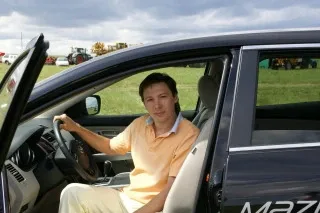 Alfred Mardanov, "Autoclub-Kazan"
This car is far from the first "American" that reached our market with a delay. The CX-9 repeated the fate of the Pilot and Tribeca: these models first quietly conquered North America and only then entered our market. By that time, "gray" dealers had already skimmed off the main cream. Strange logic from manufacturers — they still don't realize that our market is unpretentious and accepts everything: from subcompacts to huge SUVs, from budget to premium. It seems to me it would be wiser to launch such large cars simultaneously both here and in the US, where this format is traditionally in demand.
Comparing the CX-9 with the younger CX-7 comes naturally. At first glance and at a short distance, they are easy to confuse — the styling is almost identical. The same swift sporty lines, similar proportions, and similar architecture (though, perhaps, the CX-7 looks a bit meaner). Up front — McPherson, at the rear — a multi-link with one trailing and two lateral arms per wheel. All-wheel drive, like the CX-7, distributes torque between the axles in a range from 100:1 to 50:50 depending on the surface.
Visually, the CX-9 seems to match the CX-7 in size. You realize the difference only when you park them side by side — then the enormity of the older model becomes obvious. The optical illusion dissipates as soon as you find yourself in the cabin: it's truly gigantic. Such dimensions have their advantages: getting in and out is easy, nothing gets in the way. Even the third row can be accessed without problems — the second-row seat slides forward. I myself never dared to climb in there and now, looking at the photos, I regret it: with my teenage build, I would have been quite comfortable there. By the way, the second row is a bench for only two, with two seatbelts, so apparently, along with the third row, the car is six-seater. The rear is very spacious and comfortable, with a central armrest with cupholders and separate climate control for rear passengers. The status of rear passengers here is clearly high. If you fold the third row, you get a huge trunk with a flat floor — I won't give numbers, just trust me: there's a lot of space.
The engine starts with a button, the main thing is to have the chip key, resembling a chocolate bar, with you. Sound insulation pleasantly surprised: it muffles engine sounds so well that its roar is only heard at high revs. Mazda, which usually treats insulation carelessly, clearly made an effort here. These were the first impressions from a short photo session at the dealership — time to hit the road.
This time we have an unusual test drive: no city mode (only briefly), no slalom or lane-change tests on the lot. We're heading to the Pestrechinsky district — to a tractor race! Yes, such things happen even in our time and in our — um — region. The road is dense, just one lane in each direction. Marat, who drove first, constantly switched to manual mode during overtakes and downshifted, which visibly annoyed him. But on winding sections, he perked up: smoothly, without leaving his lane, he drove the car, which confidently held its line and didn't try to slide off the surface. It's precisely for this behavior that you pay with suspension stiffness.
Having split the route roughly in half, I get behind the wheel second. The first thing I notice is the sportily small and thin steering wheel, plus a comfortable seating position. Adjusting the seat is simple, especially since it's power-adjustable. The front pillars are raked and don't obstruct the view. The red display — Mazda's signature feature — is present here too. The round climate controls are also familiar and convenient. The instrument panel reads perfectly, and when you turn on the parking lights, the red backlighting of the scales is complemented by a beautiful blue glow. It's a pity we don't test cars in the evening — it would be interesting to see this backlighting in the dark.
By the time I reached the destination, I was driving without haste: I didn't want to overtake, brake, or jerk around. The car sets a solid pace, not a fussy one. I never once switched the automatic to manual mode or used kickdown. Why? And here's the field — we proudly drive onto it. The CX-9 looks defiant here. The crowd showed interest and offered to swap: we take the tractor, they take the CX-9. We declined. The air smells of fresh hay and pollen, the grass radiates warmth, you want to walk barefoot, and for some reason, your appetite kicks in. But it's time to return to the city — to intersections, bridges, tram tracks, and tinted "tens". It's a shame we won't see the event itself — it would have been fun to watch the tractor competition.
On the way back, I perked up and drove a bit more actively, though without fanaticism. Thank you to the manufacturer for not making the chassis fully tuned for driving pleasure — it doesn't suit this car at all. Although no, I'm lying: it does suit it, its appearance is value-like — big, sporty, and not scary at all. But you still don't want to race it. I liked the steering wheel: informative, with sharp steering, accurately guiding the car along the desired trajectory despite its dimensions. Colleagues complained about the emptiness and excessive lightness of the wheel, but I'd argue. However, body roll in corners at speed is a fact. Honestly? I would choose a more comfortable suspension for it: let it rock on waves rather than tremble. But that's a matter of taste: some like refined sugar, some like sand, not to mention watermelon with a pig's tail.
And one more important point. How do we choose a car? By features? No! Price decides. "What do I get for this money?" — that's the buyer's main question. So, if you count roughly, by weight, it's hard to buy this much car for this money. More than two tons of the Mazda brand — that's a good offer. An ideal spacious family, I'd even say universal, car for a successful businessman. It won't embarrass you at the office, will be appropriate at a picnic, and will draw envious glances in city traffic. And if you overtake it on the highway, know: the CX-9 owner simply has nowhere to rush.