
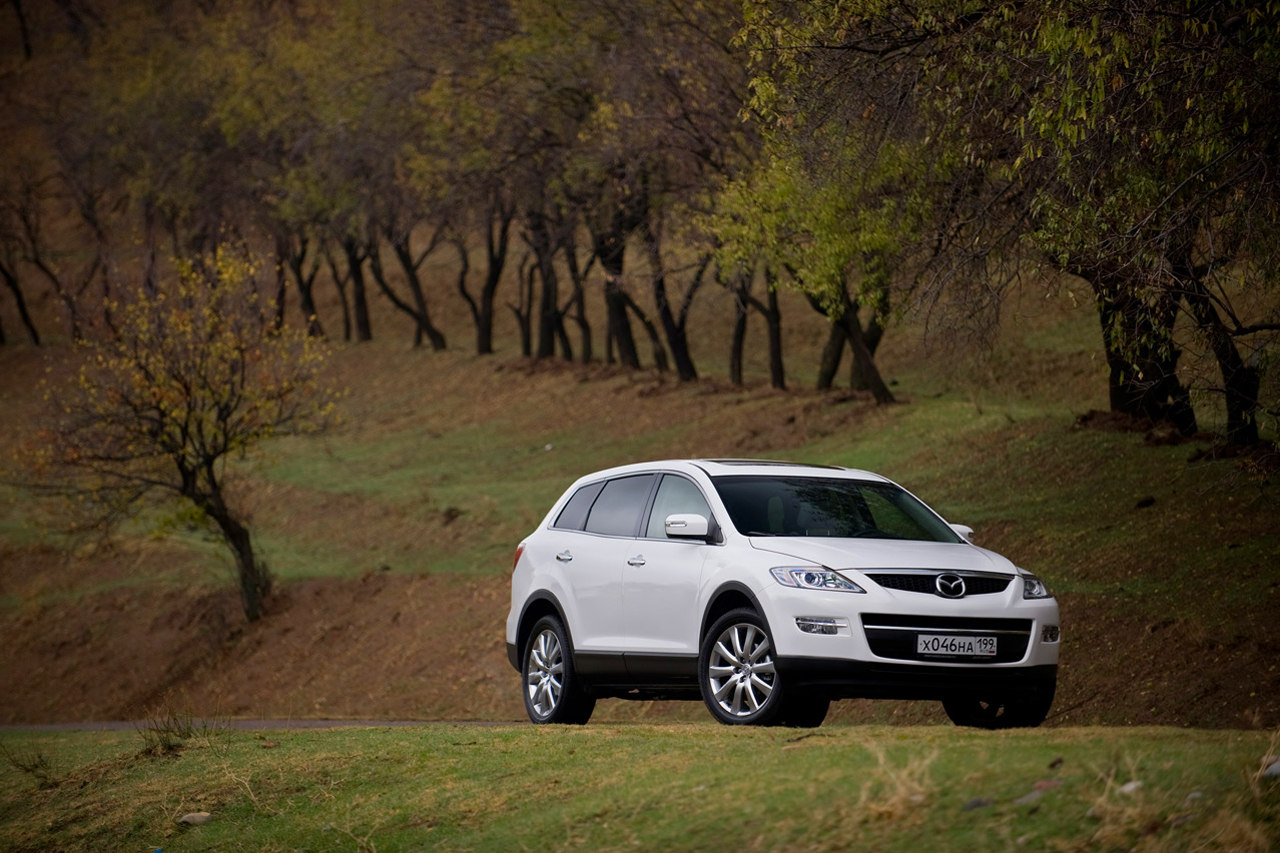
 Immediately after its debut, this SUV attracted everyone's attention with its unusual appearance (that very Zoom-Zoom), which sharply distinguished it from the bulky seven-seat "bricks" typical of the American market.Comments (1)
In the spring of 2006, a pre-production version of the Mazda CX-9 was shown in New York. Sales in North America started in early 2007, then the car reached South America, Australia, and Saudi Arabia. In those years, the Japanese did not even think of bringing their large SUV to Russia. But our market was growing at such a pace that almost all manufacturers rushed to develop it, pulling out as many models as possible, and priorities changed.
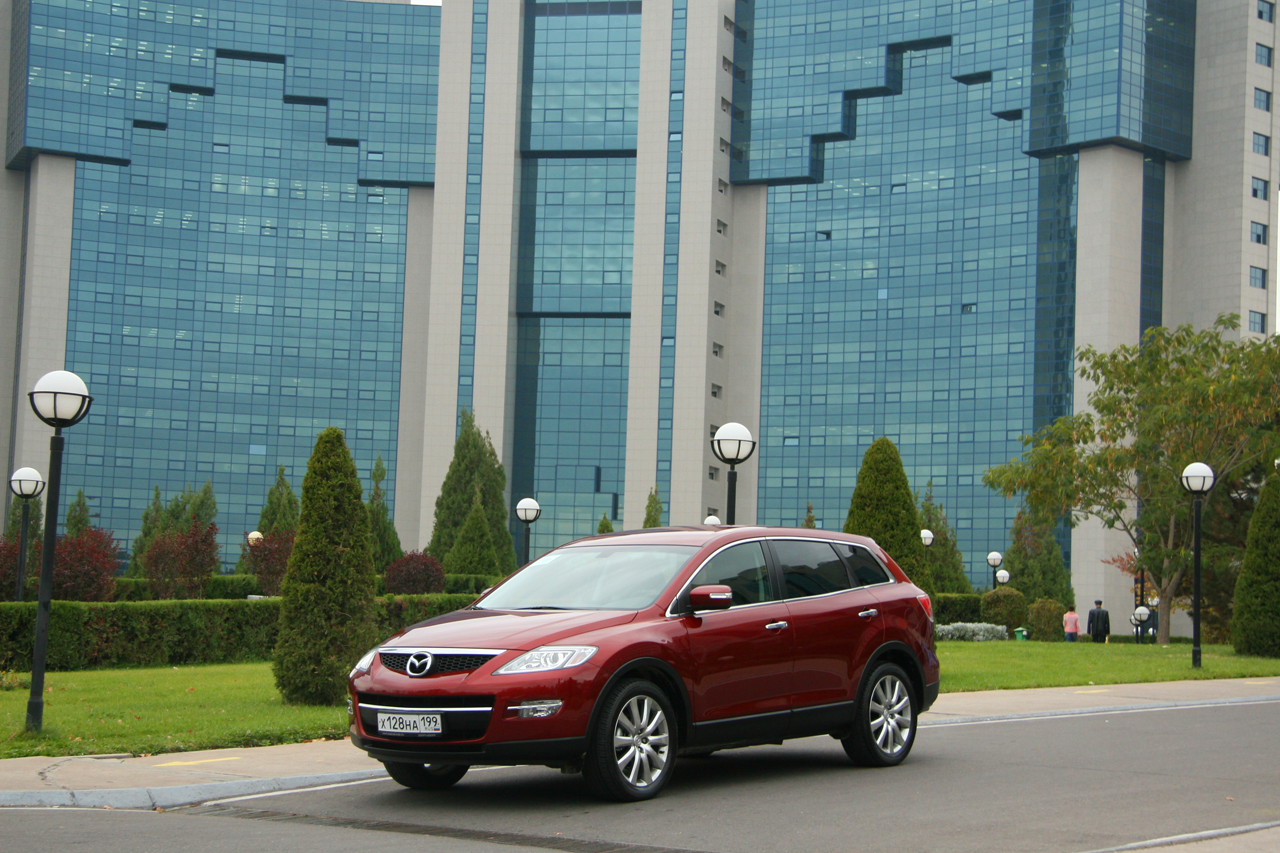 |
| Not everyone can immediately distinguish the older CX-9 from the younger crossover CX-7 — the designers managed to increase the interior volume without going beyond the visual framework. |
As for the Mazda CX-9 itself, after its premiere it instantly attracted attention with its non-standard design in the spirit of Zoom-Zoom, which favorably distinguished it from other large angular seven-seat cars that people across the ocean were used to. The streamlined body lines, carrying the sporty character of the brand, the strongly raked front pillar, narrow window openings, a high beltline, and massive fenders perfectly mask the real dimensions: length — 5089 mm, curb weight — 2040 kg. For reference: the Mercedes GL stretches to 5088 mm, the Audi Q7 — to 5086 mm. At the same time, even experts cannot always distinguish the large CX-9 from the mid-size CX-7 at first glance. This is the merit of the designers, who managed to add useful space without visually inflating the body.
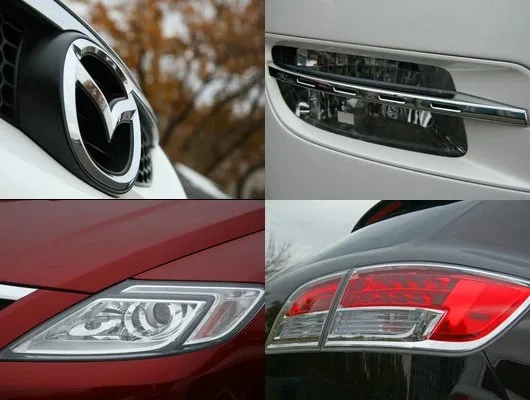 |
| Some elements, such as the optics, were enlarged and carried over to the CX-9 from the younger CX-7. |
Many details, including the lighting, were carried over to the CX-9 from the CX-7 in an enlarged version. The model's chief designer, Riuichi Oya, calls it a sports car operating on the SUV field — and it is precisely this duality, in his words, that distinguishes the Japanese car from other SUV classmates. In my opinion, this formulation perfectly conveys the approach of the creators of the large Mazda SUV.
The Russian office of Mazda Motor Rus traditionally chooses unusual and memorable places for presentations. This time, journalists were sent to Uzbekistan: a flight to Tashkent, and then — a route from Tashkent to Samarkand behind the wheel. In a country where "Nexias" and "Matizes" from Daewoo reign, the stylish Mazda SUV caused a real stir. People stopped, examined, photographed, and asked questions — most often about the power and appetite of the engine. In Uzbekistan, the car is available only to the wealthy: queues for new Daewoo cars stretch for years, and resellers sell a "Nexia" without waiting, but almost twice as expensive.
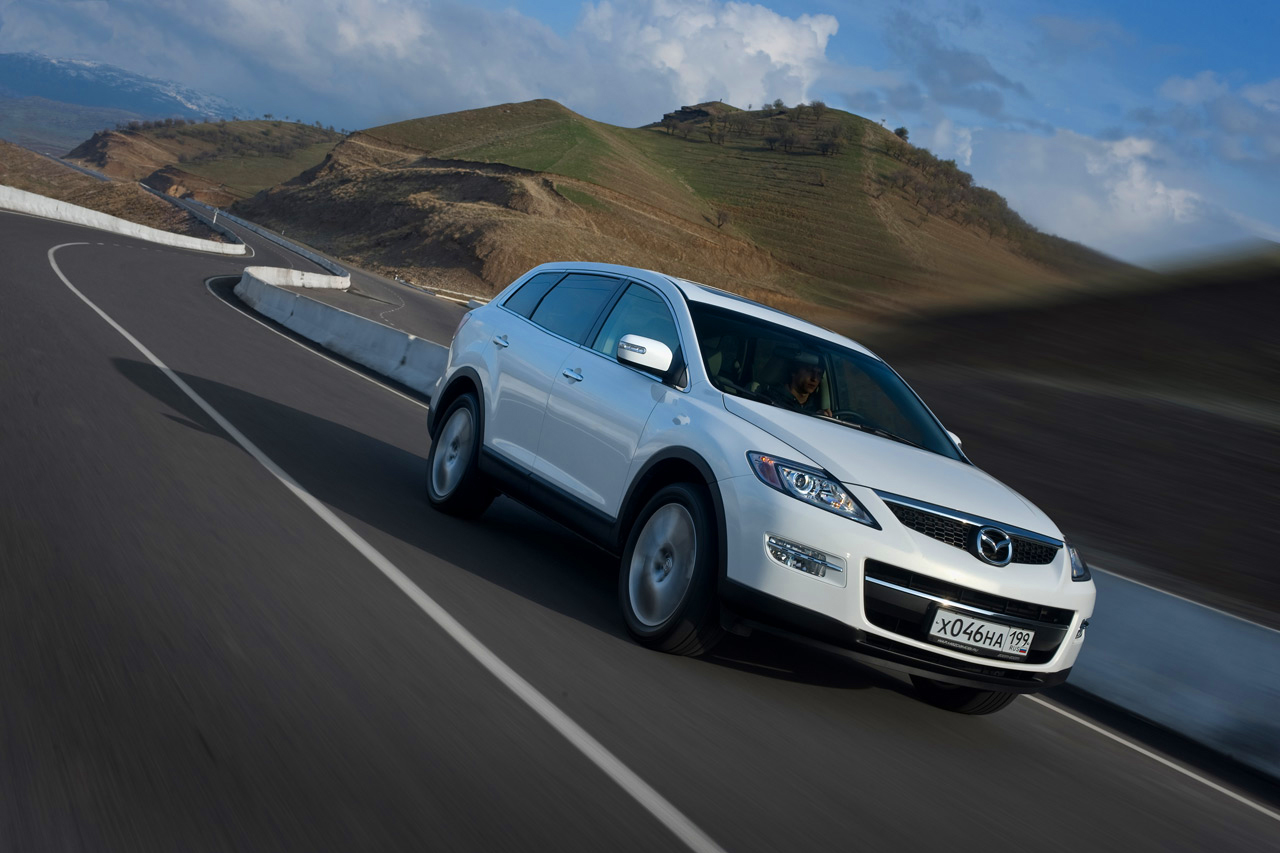 |
| The swift body lines emphasize the sporty style of the Mazda brand. |
Let's return to the CX-9. Inside — a recognizable "Mazda" interior, but for this model it is executed more solidly than in the rest of the lineup, which adds status — the driver of one of the largest cars in the class needs this. At first it seems that you are facing the same hard plastic, but on closer inspection you can see: the texture of the materials is more pleasant than in the Mazda6 or CX-7. The only thing I would change for our market is the pretentious "wooden" inserts on the center console and front doors, which Americans love so much. Instead, black lacquered plastic would be more suitable, better matching the sporty spirit of the "nine". But unification is unification, few people pay attention to such trifles.
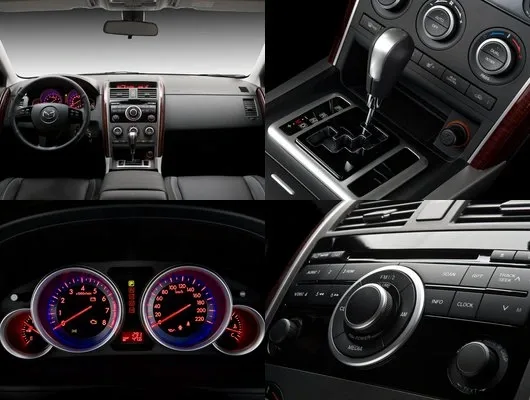 |
| The CX-9 interior is more solid than that of other Mazdas. The materials are just as hard, but the texture of the plastic is more pleasant. |
Otherwise, the cabin of the CX-9 pleased with its comfort and thoughtful ergonomics. The front seats with electric adjustments and a well-designed profile reliably hold the driver with lateral support bolsters. Despite the "Americanization", the developers did not forget about the steering wheel reach adjustment — a sin of almost all manufacturers. On the center console, between two vertical "wood-look" strips, are the climate control and audio system units. The version with a touchscreen display is not yet supplied to Russia. The audio system itself, as stated in the press release, was created by Bose specialists specifically for the Mazda CX-9. In practice, it really sounds decent. In addition to the 6-disc changer and MP3 support, there is an input for an external player.
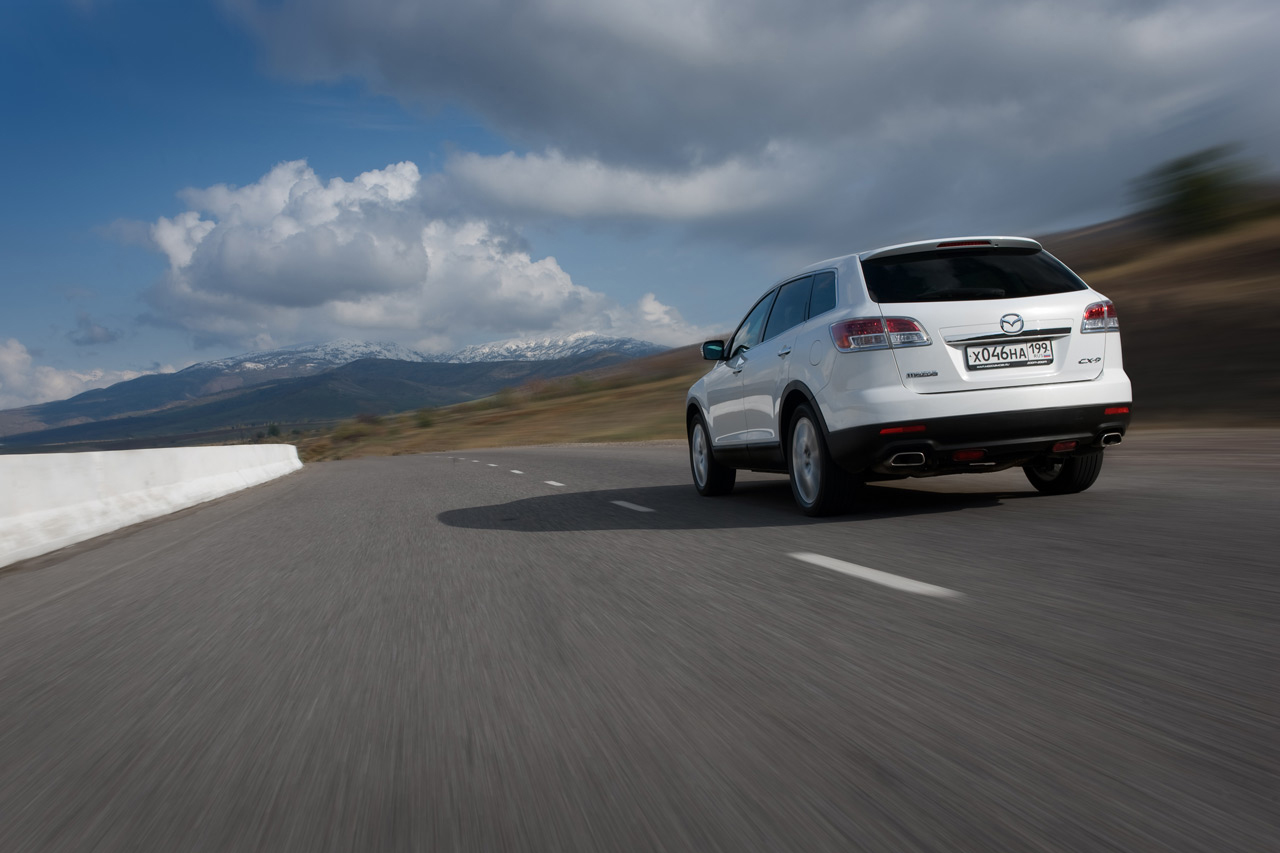 |
| The rear of the CX-9 is more solid than that of the CX-7, but does not look overloaded. |
Rear passengers get a comfortable sofa with an armrest, a decent amount of legroom, and their own microclimate unit with two rotary controls. The sofa can be moved longitudinally and the backrest angle adjusted. With the third row raised, the trunk holds a modest 267 liters. Fold down the gallery — you get 928 liters. And if you also remove the second row, the volume grows to 1887 liters. I will separately note the power tailgate button.
Under the hood of the Russian Mazda CX-9 — a 3.7-liter V6 with 277 hp. With a weight of over two tons, you should not count on hurricane acceleration. But is it needed for a solid SUV? The power reserve is enough for overtaking on the highway and for a brisk start from traffic lights. Special thanks to the responsive 6-speed automatic with manual mode: it quickly selects the right gear and works smoothly.
 |
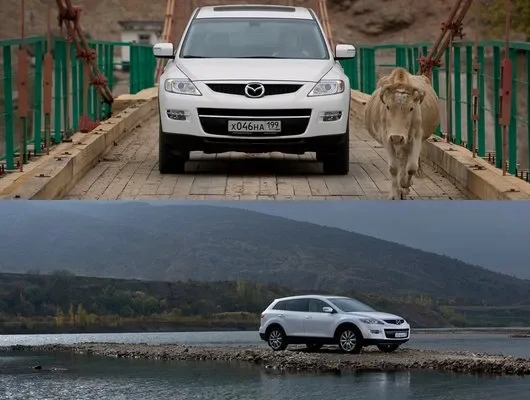
On the way from Tashkent to Samarkand, there were both fresh asphalt and broken roads without major repairs for years. On smooth surfaces, the Mazda CX-9 drives like it is on rails. Despite its impressive mass, there is no lateral rocking at all — here it is, the sporty character of the brand. In the city, driving a five-meter SUV is a sheer pleasure; sometimes you forget that you are sitting in one of the largest cars in the class. Corners are taken predictably and clearly — thanks to the excellent suspension settings (McPherson in front, multi-link in the rear). But on uneven surfaces, the sporty nature of the large SUV shows its downside: the occupants start to shake. The 20-inch wheels with 245/50 tires contribute their share. However, this does not spoil the overall driving pleasure.
 |
When the speedometer needle goes past 120 km/h, the steering wheel begins to lose feedback. At medium speeds, the effort on the wheel pleasantly pleases with adequate weighting, but on the highway it seems to evaporate, and the steering wheel becomes empty. It is also worth mentioning the weak sound insulation of the wheel arches and underbody — this is a long-standing problem of both the entire Mazda lineup and many other Japanese manufacturers. But in everything else, the Mazda CX-9 can give the driver a lot of positive emotions. Off-road qualities have not yet been tested. The all-wheel drive of the "nine" is arranged so that in normal conditions the car remains front-wheel drive. Only when the front wheels start to slip does the center differential transfer up to 50% of the torque to the rear axle.
On the Russian market, the Mazda CX-9 is priced at 1,713,000 rubles. The only available option is an electric sunroof, which adds another 25,000 rubles to the price tag. Everything else is already included in the standard equipment: three-zone climate control, a seven-seat cabin, an audio system with 10 speakers and an amplifier, electric front seats, leather upholstery, a full electric package, 6 airbags, and a whole arsenal of electronic assistants.
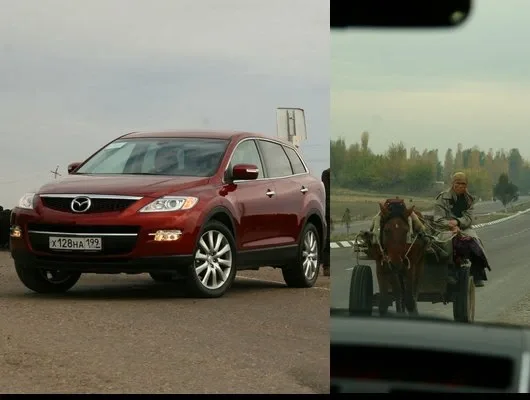 |
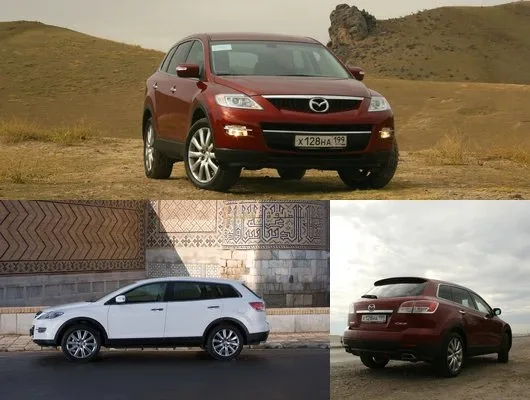
| The stylish Mazda CX-9 contrasts with the harsh Uzbek reality. |
For reference: the base Audi Q7 with a 3.6-liter engine costs 2.2 million rubles, the seven-seat Subaru Tribeca with 258 hp costs 1.7 million rubles, and the main rival Honda Pilot in a similar trim costs 1.5 million rubles. We are just about to test the driving qualities of the Pilot soon. As for the Mazda CX-9, it will be an excellent purchase for those who are looking for two seemingly incompatible qualities — a spacious and roomy SUV with the manners of a passenger car and the prefix “Sport” in its character.
Ruslan Galimov