
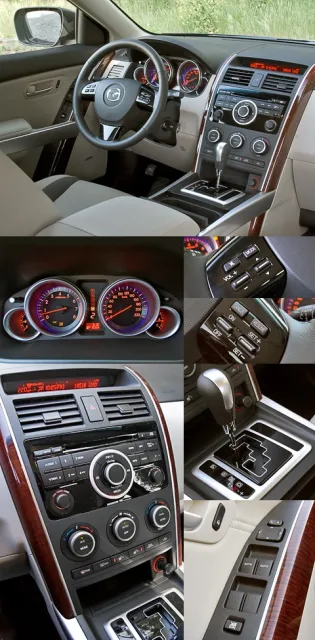
- The combination of two-tone plastic with imitation “wood” and “aluminum” is for amateurs.
- The central console has become even wider than in the CX-7. It's a pity the display hasn't grown: reading information from it on the go is not easy.
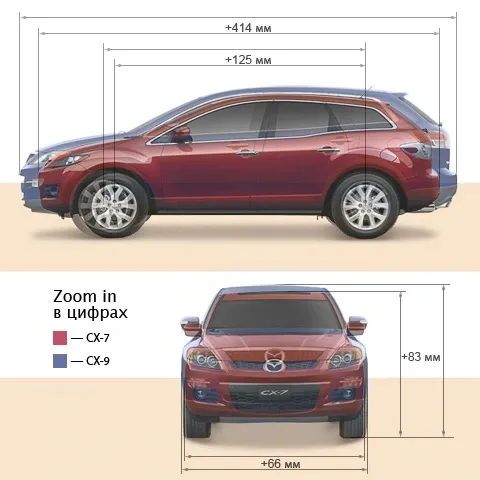
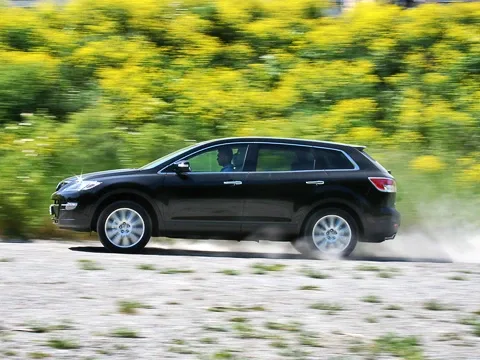
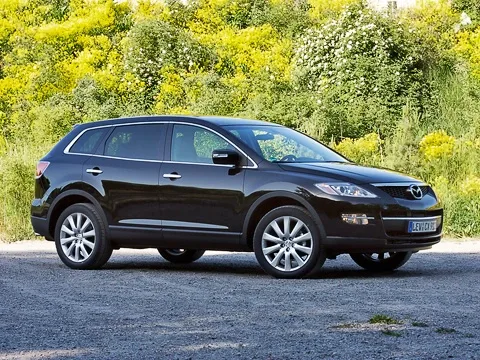
- The CX-9 in Sport trim is 297 thousand rubles more expensive than the similar CX-7. But the “Nine” has one more Bose speaker (ten in total), the steering column adjusts for reach, the climate control is three-zone, and the driver's seat has memory. True, there's no xenon or headlight washers, as in the CX-7.
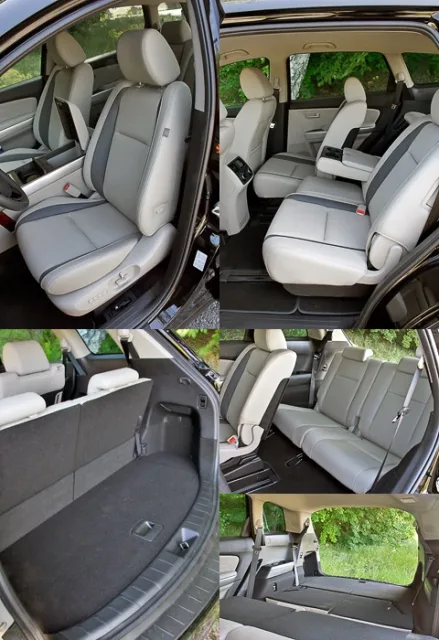
- The second-row seats move forward, and the backrests adjust for tilt. The car is considered six-seater — by the number of seat belts. The American version seats seven.
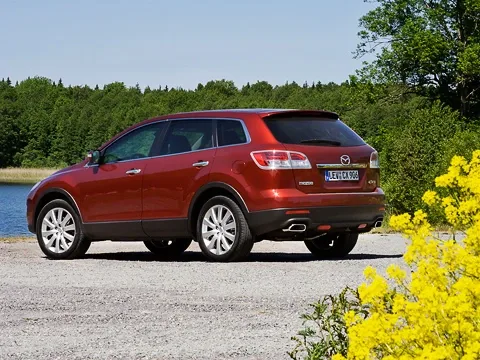
- In the trunk floor, there's a niche for tools and small items. The spare tire hangs under the bottom. In America, the massive trunk door is equipped with an electric drive, but in “our” CX-9, instead of the drive button, there's a plug.
- Most Russian owners of the CX-9 will carry the “gallery” folded: here they buy not it, but the status of the flagship model.
| Specifications | Mazda CX-9 Sport |
|---|---|
| Body | |
| Number of doors/seats | 5/6 |
| Length, mm | 5089 |
| Width, mm | 1936 |
| Height, mm | 1728 |
| Wheelbase, mm | 2875 |
| Track front/rear, mm | 1654/1644 |
| Curb weight, kg | 2040 |
| Gross weight, kg | 2712 |
| Trunk volume, l | 267–1991 |
| Engine | |
| Type | petrol |
| Location | front, transverse |
| Number and arrangement of cylinders | 6, V-shaped |
| Number of valves | 24 |
| Displacement, cm3 | 3726 |
| Max power, hp/rpm | 277/6250 |
| Max torque, Nm/rpm | 366/4250 |
| Transmission | |
| Gearbox | automatic, six-speed |
| Drive | all-wheel |
| Chassis | |
| Front suspension | independent, McPherson |
| Rear suspension | independent, multi-link |
| Front brakes | disc, ventilated |
| Rear brakes | disc, ventilated |
| Ground clearance, mm | 204 |
| Performance characteristics | |
| Maximum speed, km/h | 181 |
| Acceleration time 0–100 km/h, s | 10.1 |
| Fuel consumption, l/100 km | |
| urban cycle | 18.4 |
| extra-urban cycle | 9.9 |
| combined cycle | 13 |
| Toxicity standard | Euro-4 |
| Fuel tank capacity, l | 76 |
| Fuel | AI-95 |
- ABS
- Dynamic stability control DSC
- Front airbags
- Side airbags for front passengers
- Inflatable curtains
- Driver's seat with electric drive and height adjustment
- Heated front seats
- Electric windows
- Exterior mirrors with electric drive and heating
- Three-zone climate control
- Rain sensor
- On-board computer
- Cruise control
- Leather interior trim
- Bose audio system with MP3 support
- CD changer
- Fog lights
- Immobilizer
- Keyless entry system
- Alarm system
- Alloy wheels 245/50 R20
Technical specifications
When the CX-9 first came into existence, the Japanese did not have a suitable engine of their own with sufficient power, so for the first year of production the crossover made do with a Ford gasoline naturally aspirated Duratec V6 with a displacement of 3.5 liters, producing 263 horsepower. This unit with aluminum block and heads, as well as a sequential valve timing system, became the basis for Mazda's own engine — the MZI V6 3.7 with 277 hp. It turned out to be the most powerful in the Japanese brand's lineup and the first V6 created by the company in the last five years.
A diesel version for the CX-9 is not yet planned. The appearance of such an engine directly depends on how quickly the main market for the model — the United States — adopts diesel. In the future, the Japanese are also considering Ford units, but they stipulate: a diesel CX-9 must at least not be inferior to the gasoline version in terms of torque characteristics.
Platform and drive
The CX-9 is based on a "hybrid" platform: at the front there is a McPherson suspension from Mazda, and at the rear — a multi-link design from Ford. The same architecture served as the base for the American Ford Edge and Lincoln MKX. However, the Japanese assure that they have worked extensively on the chassis of their crossover for the sake of the signature "zoom-zoom".
The all-wheel drive CX-9 is equipped with an active torque distribution system. The multi-plate clutch, borrowed from the "six" MPS, allows torque to be distributed in the range from 100:0 in favor of the front wheels to a fair 50:50. However, no off-road modes or special tools are provided here.
Japanese opinion
Masahiro Moro, who holds the post of Vice President of Marketing at Mazda Europe, is well aware of the tastes of the Russian audience. According to his observations, we, like Europeans, value expressive design, clear handling, and solid interiors, but at the same time we noticeably more often buy large cars. As for power units, here Russians are close to Americans: respect for gasoline engines and automatic transmissions. That is why on the Russian market the Mazda2 and CX-7 are offered with automatic transmissions, while in Europe there are no such modifications. By the same logic, the CX-9 was also addressed to us. Mr. Moro believes that the combination of Japanese and American origins of this model has not hurt it. He also noted that the development of each car takes the company about four years, and in the case of the CX-9, no one anticipated a rapid growth in Russian sales or a program of serious adaptation to local conditions. But perhaps "Mazdas" with a pronounced Russian accent will appear — the flexibility of production allows adapting to the specifics of a particular market. Analysts predict at least another five years of stable growth for Russia, and natural resources should be sufficient for this.
Why Sweden?
Evening Stockholm lives its own life: bars and discos are packed, schools have graduation balls, and Porsches with bassy exhausts drive by every now and then. And here is the question: why was Sweden chosen as the venue for the CX-9 presentation? Not at all because family values are elevated to a cult here, the roads are full of huge American cars from the 60s-70s, and the landscapes sometimes painfully resemble Russian ones. It would seem that all this should hint at the "Mazda CX-9". But the reason is much more prosaic — these days Sweden had sunny and very hot weather, and the forecast for other European countries did not please the Japanese. By the way, in parallel with the CX-9 presentation, the company was conducting test drives of the three-door Mazda2 in the vicinity of Stockholm. Russian representatives were not invited there — this little car is not for us yet.