Both cars start with a button, without a key. Nice. But in the Forester, this is implemented more conveniently. And it's not that the Toyota-style button is more ergonomic than the Mazda's rotary knob — that's still a question. But the sound! No matter how much orthodox fans insist that current Subarus are not what they used to be, the Forester sounds excellent. And how does it drive?
The Forester accelerates definitely more briskly than the Mazda. The difference in seconds is not so great, but in terms of feel, after the Forester, the Mazda is no longer able to surprise the driver. With it, everything is simple: you press the gas, and after a couple of moments, when the six-speed automatic figures out which gear is needed, a dense, persistent acceleration begins.
With the Subaru, the picture is different: first you need to wait a bit while the archaic automatic sorts out its four gears, and then — whoosh! When the tachometer needle reaches 4000 rpm, that famous turbo surge makes you recall all journalistic clichés. Both about being pressed into the seat back and about the horizon rushing away... The acceleration is exactly what you expect from a Subaru. The delay when releasing the gas adds sharpness: after you let off the pedal, the car continues to accelerate for a while rather than slowing down with the engine.
The Subaru's automatic, of course, is a dinosaur that hasn't gone extinct only by some accident. But the inconvenience in managing acceleration is compensated by the sport mode and a smart engine that, apparently, doesn't care at all which gear is currently engaged. With the Mazda, it's the opposite: the gearbox is both fast and has plenty of gears. But its training is not combat: you ease off the accelerator a bit — it immediately shifts up a gear. And there's no sport mode, only innate adaptability. For the Mazda to accept the challenge and start driving fast, it needs a two-minute pressuring of the gas pedal.
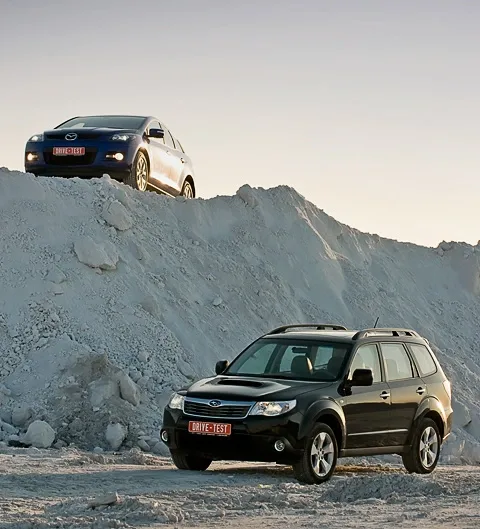
Yes, on a straight line, the Forester will leave many behind, including the CX-7. That's good. The bad thing is that before every turn, you literally have to bow. The Subaru's habits are something unexpected. Here you have huge body rolls, nose dives, and all conceivable types of pitching. The suspension is very soft even for a regular car, let alone a turbo monster that hits a hundred in seven seconds. Driving the Forester at the limit is just scary!
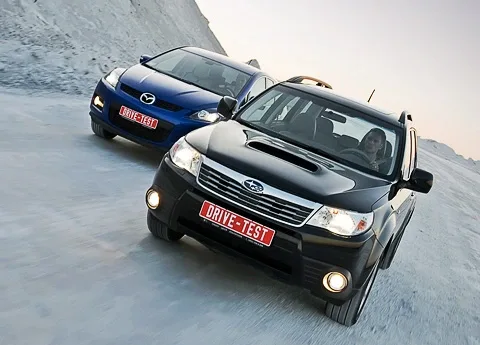
The Mazda CX-7 is a completely different matter: sometimes you even forget that you're sitting behind the wheel of a crossover. At least in a tense turn, when the weak tires (no better than the Forester's) start to squeal, the thought doesn't arise: "Oh, I'm about to roll over!" The Mazda responds to the steering wheel with moderate precision and sharpness, and the suspension, which seems overly stiff at low speeds, becomes gentler to passengers' rear ends as speed builds. Therefore, you don't feel like going over speed bumps at 40–60 km/h: it's better to speed up to 80.
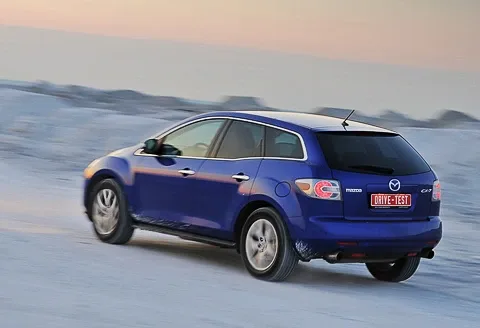
The Subaru's soft suspension at low speeds, on the contrary, is good: the Forester is much more comfortable than the CX-7. But if you go faster... No, you'll only manage to break through the suspension if you're hobbling over bomb craters, but it allows considerable pitching, and when going over speed bumps, repeated body oscillations are clearly felt.
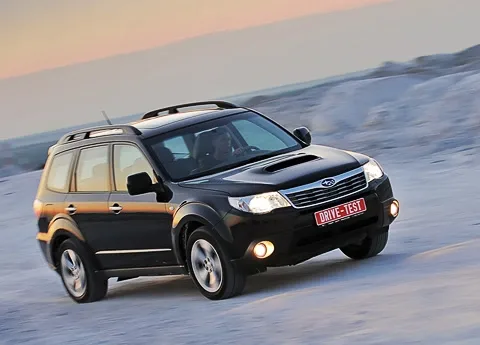
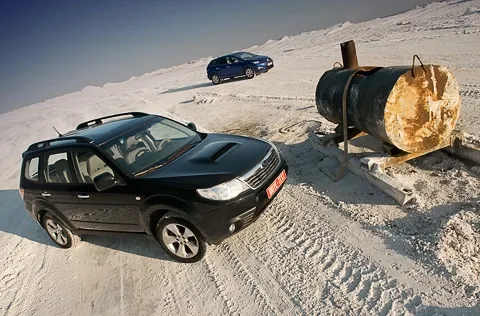
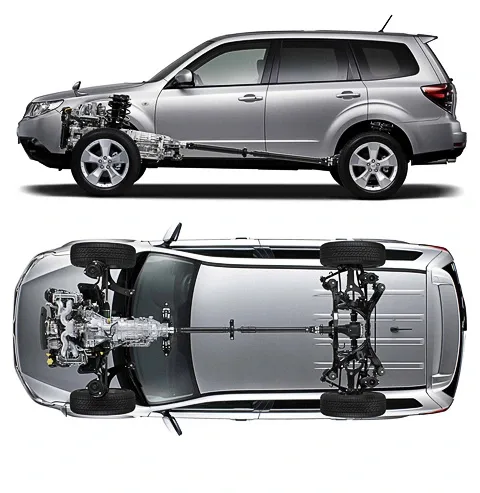
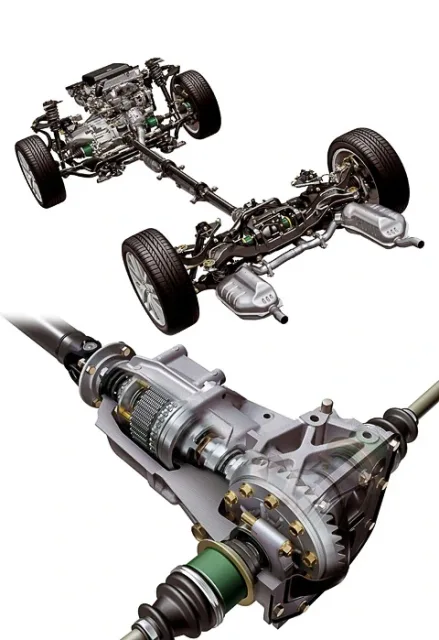
But as soon as you get onto slippery surfaces, you remember everything you love about Subaru. I turn off the stability control and easily guide the Forester into a controlled slide. The algorithm is simple. I hit the gas pedal and immediately release it: after a moment, the car seems to become rear-wheel drive. Gas again, now in doses. The car goes into a drift, the angle of which is easy to control with throttle and steering. Simple and clear. The main thing is not to make a mistake with the entry speed into the turn. Then the Forester will give you a lot of pleasure!
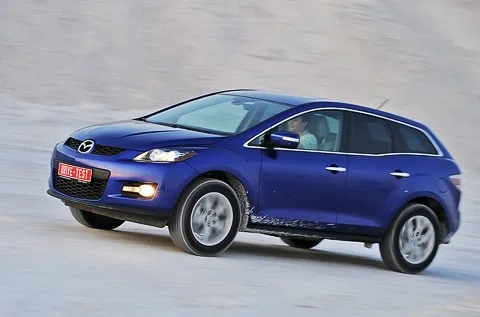
The Mazda is tuned completely differently: sliding is taboo for it. Here, you can only disable the traction control system, and even then at a ridiculous speed. Therefore, drifts are not the CX-7's forte, although we know that not only the turbo engine but also the transmission here are almost identical to those on the MPS "six." That one drove sideways excellently! But the Mazda folks decided to tune the crossover safely. In an American way. A pity. With such potential...
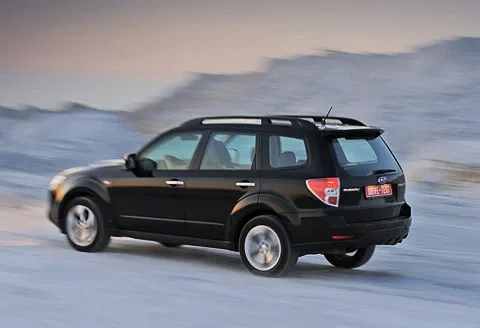
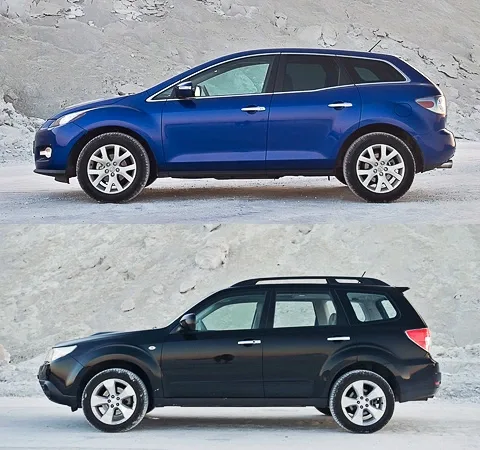
And what about the non-sporty but equally important part — practicality? The Forester, although smaller, is preferable: it has a spacious cabin, a large trunk, and a comfortable driving position — thanks to the high roof and the steering column adjustable for reach. In the Mazda, the steering wheel adjusts only for height, which is bad manners for a car at such a price. And the roof, the scoundrel, is too low: with my height of almost 190 cm, I couldn't get comfortable behind the wheel.
But the CX-7 has such nice little touches as a comfortable steering wheel or the smoothly awakening instrument lighting when the ignition is turned on. And the current gear is displayed on the onboard computer screen even in D mode. Pleasant! There's also plenty of silly stuff: for example, to see the time or outside temperature, you have to press buttons specially configured for this — like on the now previous-generation Mazda 3. The plastic, wherever you touch, is hard, and the leather can't be called quality. But the Mazda is a real premium compared to the "Forester."
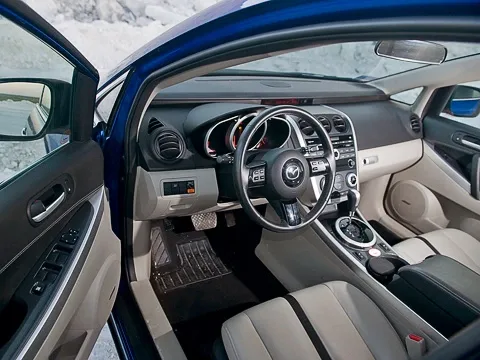
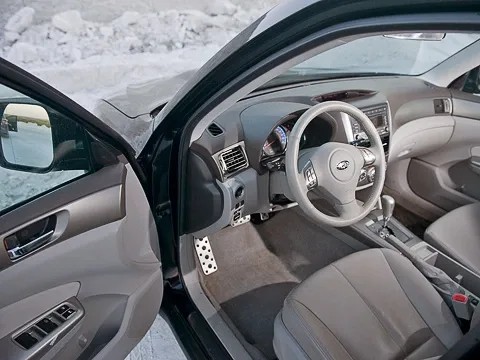
This one seems to have really come out of the forest. It's not just about the uncomfortable seats and drawn-on instruments, but also the trim materials: hard and, moreover, resonant. You barely slap the dashboard with your palm — and you go deaf from the ringing resonance. The color scheme also spoils the interior: American-style gray plastic looks even cheaper than it actually is. However, the Forester also has a version with a black interior. But is it worth even considering buying a Subaru?
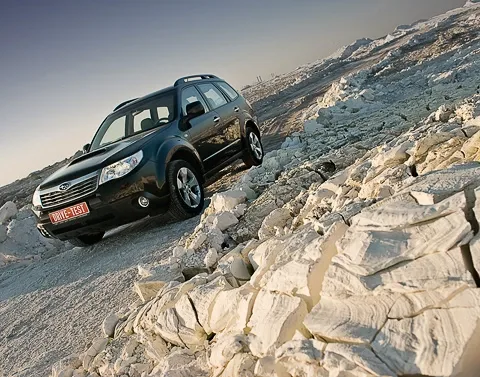
In theory, for every jab from the Mazda, the Subaru has a counterargument. The CX-7's automatic is smarter, but the Subaru's boxer is more fun! Does the Mazda have a nicer interior? But the Subaru has a more comfortable seating position and more space. Is the Bose music in the CX-7 better? But the Forester has proper sound insulation. And so on.
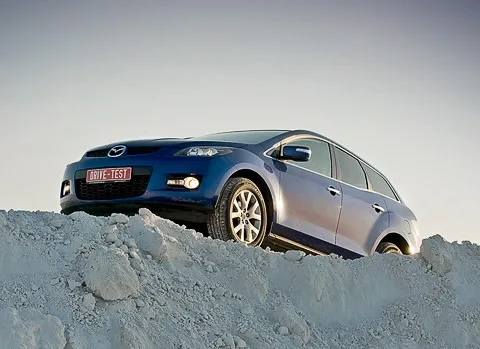
But the Forester is so clumsy on asphalt that even I, a person who has already switched to my third Subaru, must admit: the new Forester in its turbo incarnation turned out unconvincing. Contradictory. And also — even more American than the Mazda CX-7, which was originally created exclusively for the States.
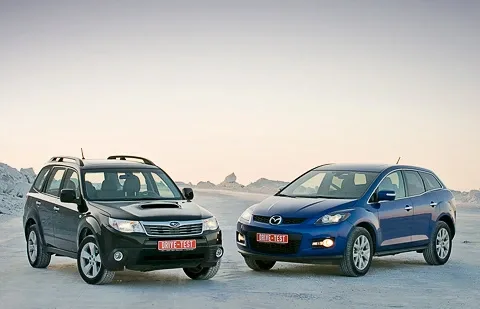
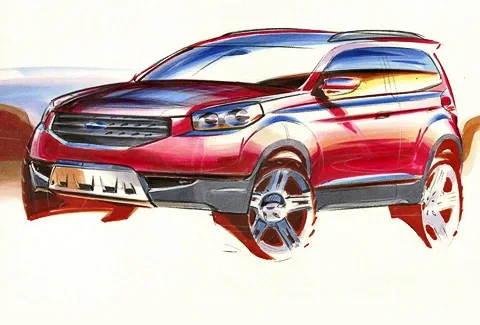
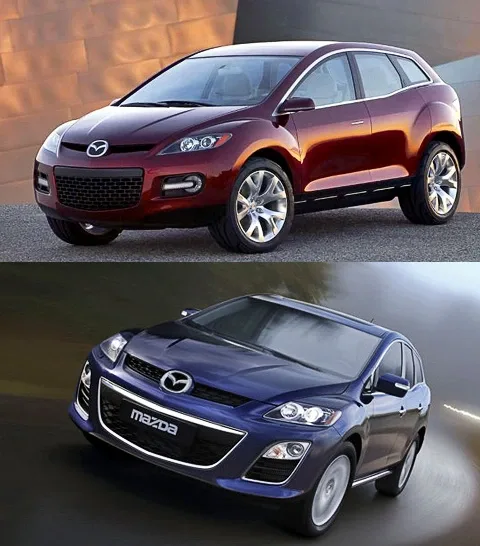 In 2004, shortly before the premiere of the production version of the CX-7, Mazda showed the MXCrosssport concept, which, however, differed from the production crossover only in details. And now the CX-7 has already undergone a restyling, receiving a large grille in the style of the new Mazda 3.