
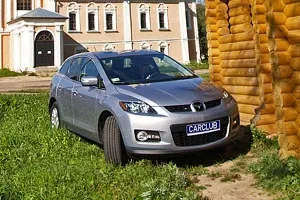
 Although the Mazda CX-7 is positioned as a classic family crossover, the first encounter with it almost always begins with the driver flooring the accelerator pedal.Comments
 In the modern history of Mazda, which can be traced back to the debut of the "six" in 2002, there has long been no car capable of claiming business-class status. The "six" is a fine family sedan, but it clearly doesn't reach the level of "business." So what should those brand loyalists do who have outgrown the Mazda6 but have no intention of switching to another favorite brand?
The company came up with a solution a year ago when the CX-7 went on sale in America. But this crossover only reached Russia now, and queues have already formed for it. You can't expect serious off-road feats from such an SUV, but its flashy looks and impressive dimensions eloquently hint at the owner's wealth and taste. Moreover, compared to traditional sedans, the CX-7 wins in almost every way: it has a spacious trunk, decent ground clearance, excellent visibility, and suitability for nature outings. Of course, due to the tall body and large wheels, handling suffers somewhat, but who among us really uses the full potential of a car one hundred percent?
It was said that the CX-7 would appear in Russia at last year's auto show, but the crossover only reached us now. We got the chance to test it on the roads of the Yaroslavl region, where we found a variety of surfaces.
Statistics say that despite the family positioning of the Mazda CX-7, most potential buyers get acquainted with it by flooring the gas. I admit, I also couldn't resist the temptation, and on the first straight, the crossover lunged forward with a menacing roar and unexpected agility. The speedometer needle swiftly passed the first hundred and, barely losing pace, flew on. A noticeable drop in dynamics is felt only after 150 km/h, when third gear ends. True, one should make allowance for the fact that the car was completely unrun — the odometer showed only 16 km at the start, so dynamics will likely improve later. But the "automatic" already works flawlessly — shifts are imperceptible even in kick-down mode and with manual gear selection; you can only guess about a gear change by the tachometer, since it doesn't affect acceleration. It seems the CX-7's top speed could significantly exceed 200 km/h, but electronics intervene — the limiter kicked in at 190 km/h, which corresponds to the claimed 181 km/h. The thrill and thirst for speed protest: why clip the wings if the car holds the steering wheel perfectly, doesn't wander during acceleration, unlike the Mitsubishi Outlander XL, and allows you to maintain control even at top speed? After the test, upon reflection, you realize that an extra 20–30 km/h hardly matters in real travel speed, but safety is more important. After all, the CX-7's mass is about 1900 kg, plus driver and passenger, and the total weight exceeds two tons. In an emergency, stopping such a beast is not easy. It's good if there's smooth dry asphalt under the wheels. But what if it's raining? Speed in the CX-7 is almost imperceptible — a couple of times I hit the limiter just while chatting with a colleague. Unlike the European version with a 260-horsepower engine and manual transmission designed for 98-octane fuel, the Russian CX-7 comes only with an "automatic" and, content with 95-octane, delivers 239 "horses." However, in practice, power is sufficient across the entire speed range, and the ability not to search for a gas station with specific fuel significantly simplifies the owner's life.
Contrary to expectations, the CX-7 is based on the chassis not from the Mazda6, but from the more affordable "three." For example, the front suspension of the crossover is not double-wishbone, but a regular McPherson, which affects handling. On medium-quality roads, noticeable vibrations are transmitted to the steering wheel. The car holds a straight line, but you want to grip the wheel tighter. And this behavior doesn't depend on speed — the wheel trembles at both 80 and 180 km/h. You just have to get used to it. It's good that there's always reactive force on the steering wheel, and the driver doesn't lose control. In corners, the CX-7 is surprisingly tenacious even on stock, not the best tires; the main thing is not to make sudden movements.
If you release the gas or jerk the wheel more sharply, a skid won't be long in coming. However, the stability control system doesn't sleep, and it's impossible to completely disable it, which, given the rather sporty chassis settings, is more of a plus. For off-road, ESP can be deactivated, but the electronics will turn back on at 30 km/h. So Mazda doesn't promise any winter fun on ice, which is a pity — the steering here is very informative, and you can control the car with filigree precision, and the all-wheel-drive setup, like the Mazda6 MPS, promises full control over power.
Having completed the maximum program for evaluating the CX-7's driving qualities, it's time to step out and inspect the car from the outside. Does the aggressive handling match the appearance of the new Mazda? One hundred percent! A small hump on the hood in MPS style transparently hints at the turbo engine's capabilities, while the trapezoidal hood and strongly pronounced front fenders reference the RX-8 coupe. Excellent pedigree. The striking window line and powerful wheel arches support the muscular silhouette. And the observer has no doubt for a second: once behind the wheel of such a car, you need to floor the gas, otherwise why all this aggressive design?
The interior is calmer, though with a twist. The three-spoke steering wheel almost copies the "stylish" wheel of the MX-5 roadster, only with a larger diameter. The massive center console is heavily tilted forward and transitions into a powerful tunnel that separates the driver from the passenger. Although there's actually no transmission under it, as proven by the huge box between the seats — it's several times larger in volume than a traditional glove box and can therefore be locked with a key. All information about climate control, audio system, and onboard computer is displayed on a line under the windshield — this facilitates perception but requires getting used to a number of small pictograms.
Alas, the interior, like the suspension, did not escape simplifications. For example, as on the "three," the steering wheel adjusts only for height, and the plastic of the front panel only visually seems soft — in reality, it's hard. Even in the top Sport trim, only the driver's seat has power adjustments, which is somewhat surprising in a car that costs 1,239,000 rubles (about 48,000 dollars). For an extra charge, you can only order a power sunroof.
However, you can be sure — Mazda awaits a brilliant market future, and the current queues at dealerships are proof of that. Yes, the CX-7 is not without flaws, but they are all a continuation of its advantages, or rather, one of the most important ones. As you guessed, it's about price. It starts at 1,141,000 rubles, or about 44,000 dollars. Quite reasonable for a car with a 239-horsepower engine, an excellent "automatic," and "smart" all-wheel drive.
If you look for competitors for the CX-7 by price, the closest rival would be the Mitsubishi Outlander XL. The "three diamonds" have better off-road capability and a more spacious cabin, but the Mazda definitely wins with its appearance, more dynamic engine, and better handling. For many, these three components are much more important than the ability to fit an extra bag of potatoes in the trunk. And the CX-7's cabin is still better than the Outlander's. In class, the Mazda is closer to the more prestigious Nissan Murano and Lexus RX 350, but its price is significantly lower, which explains the minor shortcomings.
Text: Leonid Pavlov.