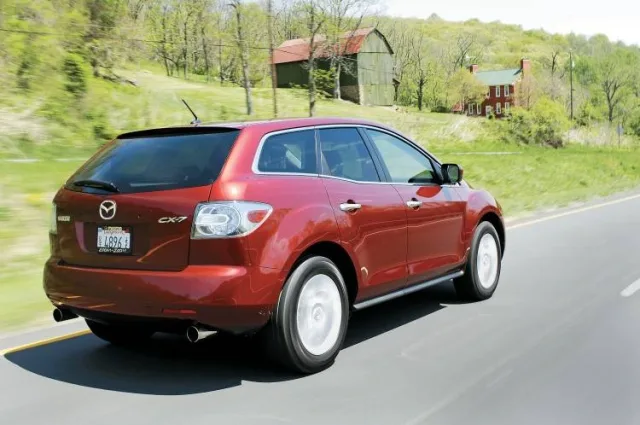
How do you like this: twenty-five and a half thousand dollars? And if you search, you'll find a variant for 23,750. But no, we'll leave the front-wheel-drive version of the crossover to the Americans. I, perhaps, will even overpay and choose the "well-equipped" Touring modification for 27,200: under the hood 244 hp, all-wheel drive, leather interior with heated seats, climate control, xenon headlights... And the top Grand Touring version is priced at exactly 28 thousand, and that's not euros, but dollars! Only one thing is upsetting: these figures are from the American price list. Here, for the Mazda CX-7, you'll have to shell out no less than 50 thousand dollars. Isn't that upsetting? In the States, in the richest country on the planet, cars, like many other goods, cost two to three times less than in Russia! And who among us will give such money for a compact crossover? Or does it only seem compact?
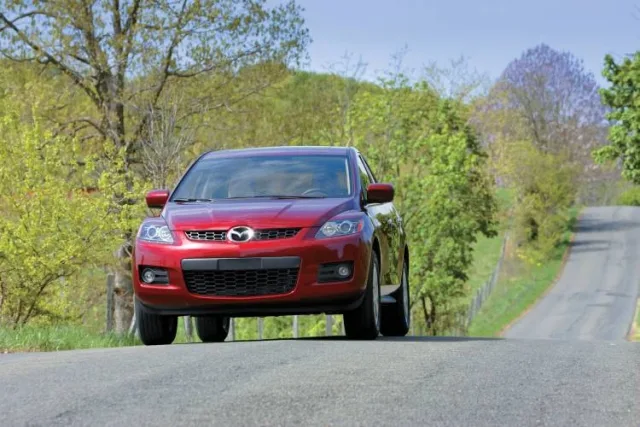
| The concept in which the Mazda CX-7 crossover was shown a year ago in Detroit was called the Mazda Crossport. There turned out to be few differences, and the most important thing — instead of a V6 engine, a four-cylinder turbocharged engine with 244 hp settled under the hood. |
However, how Mazda CX-7 sales will go in Russia doesn't worry the company's managers too much. They tirelessly repeat that the car was made from the very beginning for the American market. It was there, in Detroit, at the beginning of last year that the Mazda MX Crossport concept was presented, and in January of this year at the auto show in Los Angeles the premiere of the production version took place. And the test drive was organized in the States, in Washington, where along with hundreds of American colleagues there were also a few Russian journalists.
And the car turned out nice, positive, airy. A perky but not overly aggressive face, a sportily raked large windshield, a boldly rising beltline towards the rear. And the exaggerated bulges over the front wheel arches (in the style of the Mazda RX-8), firstly, don't weigh down the appearance at all (unlike, say, the Mitsubishi Pajero), and secondly, help to unmistakably recognize the brand: this is a Mazda. The rear is such that on the highway it sometimes seemed that a Mazda 3 hatchback was driving ahead. True, a colleague nearby said that the CX-7 reminds him of the Mitsubishi Outlander. No, it's a Mazda!
As for off-road capabilities, they are small in advance: 206 mm of ground clearance, 18-inch wheels, and frankly "car-like" suspensions with short travel: front — from the MPV model, rear — from the Mazda 3, essentially the same scheme as on the Focus, although reinforced and slightly modified for torque transfer. And the all-wheel-drive transmission itself, not counting the "automatic," is borrowed from the hot sedan Mazda 6 MPS — with an electronically controlled multi-disc clutch in front of the rear differential. And the engine is the same — four-cylinder, with balance shafts, direct injection, and a turbocharger, but slightly detuned: instead of 260 hp on the "six" MPS (according to some data, there are all 274), here "only" 244. They say, for better compatibility with the six-speed automatic gearbox from the Japanese company Aisin.
 |  |
| The design of the Mazda CX-7 was entirely created in the Japanese studio in Hiroshima. The exterior was handled by 46-year-old Iwao Koizumi, whose track record includes the Mazda 323F (1988), Mazda Eunos Cosmo (1990), Xedos 6 and Xedos 9 (1992 and 1993), as well as the styling of the current bestseller — the Mazda 6, including the "extreme" version Mazda 6 MPS. They say that Koizumi-san is one of the keepers of Mazda's design genetic code: since 1982, when he got a job here after art college, Koizumi has never changed employers. Until recently, such loyalty was typical for Japanese car companies | It seems that Japanese designers are not embarrassed, but even amused, that Mazda cars are called "Japanese Alfas": among the details that permeate the front panel, the characteristic "zero" position of the speedometer and tachometer needles — strictly at the bottom — is memorable. But this is only visible after turning on the ignition: the instruments are "optitronic," and when the ignition is off, they turn into black voids. The backlighting, of course, is red |
 | |
| The audio system pleased. Especially if it's the "optional" Bose with the Centerpoint function, which allows both the driver and the front passenger to feel themselves at the center of the musical action. Digital separation of a regular stereo signal into five channels, nine speakers, and 240 watts. In addition, the AudioPilot system already tested on the Mazda RX-8 coupe is used, which "drowns out" wind, tire, and engine noise. Subwoofers are built into the front doors |
The winding gate of the selector allows error-free control of the lever of the six-speed "automatic." It's pleasant that even in Drive mode, the number of the current gear is displayed on the panel. And the "manual" mode is engaged by moving the lever from Drive to the left. Then gears are selected according to the "Ford" principle: pushing the lever forward — upshift, pulling toward you — downshift. Automatic transition to the next gear when reaching maximum rpm does not occur, however, the system does not allow abusing the engine at too low rpm — and drops one or several gears down. Foolproof protection. To the left and right of the lever are seat heating buttons. It's a pity that the heating intensity has no "intermediate" steps. And the box under the lid is simply huge: a laptop will fit there! |
And the compatibility is excellent! If you describe the driving sensations briefly, it's lightness and airiness. Acceleration — without a strained howl and turbo-ultimatum of 244 forces. No wastegate sighs, no jerks, no aggression! You're not driving, you're soaring. And you rejoice. And your head is no longer so heavy because of the eight-hour time difference, and American roads are not so bad, and America itself seems light and smiling. Excellent compatibility! And even the Alfa-style red backlighting of the "optitronic" instruments does not irritate tired eyes. And the hard plastic of the front panel, if it causes melancholy, it's only when you remember the "Russian" price of this toy. In short, if the Mazda CX-7 was really made to American tastes, then, firstly, this taste exists, and secondly, it's not bad at all.
But why a four-cylinder engine here? Previously, Americans were sure that a real engine is a V8 or, at worst, a V6. And four cylinders are for lawnmowers...
 |  |
| The most modest (left) and the most immodest (right) equipment options. Among the "options" — a navigation system with an interactive screen, voice command recognition and automatic climate control, a Keyless system that allows you to do without a regular ignition key, a rear-view camera... Plus small embellishments, for example, overlays on the steering wheel made of "lacquered" plastic. The steering wheel itself, although it looks angular and simple, is quite comfortable, even despite the absence of recesses and bumps in the grip areas | |
— We found out how important it is for potential buyers what engine is in the car — four-cylinder or six-cylinder. It turned out that at most a third of respondents pay attention to this, and even fewer give a conscious preference to "sixes." People care about power, not the number of cylinders, — the Japanese man Shinsuke Kawasaki, CX-7 project manager, sitting in the back, answered my thoughts. And the press release says that, they say, a four-cylinder engine is lighter than a six-cylinder, more environmentally friendly, more economical, including in terms of maintenance costs. That's true, but there's plenty of guile here.
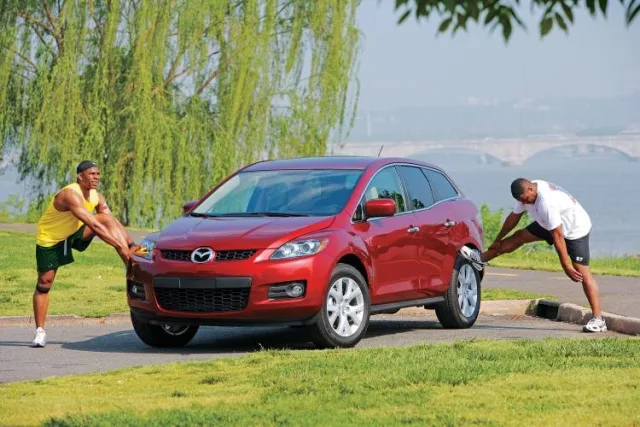
Contrary to fears, these nice guys approached the Mazda not for the wheels. Washington, although it's the capital, is all lawns with athletes. The surroundings of the White House are no exception. Clean air, quiet, calm... Judging by these guys, they only lack sports equipment
It's unlikely to assume that Toyota is less interested in the preferences of American buyers or saves on studying them. Nevertheless, unlike Europe and Russia, in the USA the RAV4 is available both with a four-cylinder engine (2.4 liters, 166 hp) and with a V6 (3.5 liters, 269 hp). Even the prototype of the CX-7, the Mazda MX Crossport concept, was shown to Americans with a V6. In fact, the point is not that Americans are indifferent to the number of cylinders, but that Mazda simply doesn't have its own V6. There are rotary engines, there are inline "fours" of various displacements, but "sixes" are usually taken from a partner — Ford. And since a larger crossover, the Mazda CX-9 (a platform sibling — the Ford Edge), was recently announced, the V6 was decided to be saved for it. And Mazda also doesn't have a powerful diesel. That's exactly why the CX-7 was created "exclusively for the American market."
But does this mean that the CX-7 is so Americanized that it won't take root in the Old World? Not at all! Stylish modern looks, floor-mounted transmission selector, excellent steering and handling settings, precise responses, good visibility, balanced and unobtrusive noise levels, no American-style leisurely rocking — the crossover is even a bit stiff in a European way... That very "American" optics, which recently caused a scandal in Russia, even comes with orange turn signals. And the recess for the rear license plate is made to European standards, and the engine meets Euro 4 norms. All that remains is to adjust the headlights and replace miles with kilometers on the speedometer — and you're ready to go!
 | |
| In the base configuration — six airbags. In addition to the two "frontal" ones, the driver and front passenger are protected by two side airbags, and in case of a rollover, "curtains" will deploy, designed to protect the heads of four people in the cabin. Front seat belts — with pretensioners and force limiters | |
Alas. Europe is so firmly hooked on the "diesel needle" that with just one gasoline engine, no matter how powerful and clean it is, great success cannot be achieved. But we want it! Therefore, Mazda will still supply the CX-7 to Europe. The company will even go to serious expenses, installing a six-speed manual on "European" versions and increasing power to about 255 hp by raising boost pressure. But even these steps do not inspire optimism: if they manage to sell five hundred to a thousand cars a year, that will already be a success. A drop in the ocean. Without a diesel in Europe, you're nowhere. And the needed diesel from Mazda will appear no earlier than next year.
And what about Russia? In terms of "SUV-driving," our preferences are close to American: a gasoline engine and an "automatic." Therefore, unlike Western Europe, the CX-7 will appear here in almost the same form as in the USA. Although, in addition to the mentioned changes, they will add a higher-capacity battery and slightly spoil the front end with a frame for the license plate (in America, you can drive without it). But the price of over 50 thousand dollars is already too much. And 244 horsepower, in my opinion, is not the most compelling argument.
 |  |  |
| Unlike the same RAV4, the rear seats cannot be removed from the cabin, but the backrests fold down with a very light movement: just pull the handle on the trunk wall | ||
 |
| Or maybe there really are problems with eyesight? When the CX-7 stands next to fire trucks, it becomes clear: the crossover is not that small at all! |
— Many, very many! — with unexpected pressure, one of the best market experts, who heads marketing for the largest car sales holding in Russia, rejected my arguments. — Such a car is awaited here! First, in America, where everything is big, your eyesight let you down: the CX-7 is more correctly compared not with the RAV4 or CR-V, but with the Nissan Murano or even the Lexus RX350. And when you conduct a comparative test in Russia, you'll understand that I'm right. Second, why did you decide that the CX-7 is a women's car? You'll see, men will be the first to pounce on it. And I'm among them. Third, if the Outlander Turbo were offered not only with a manual but also with an "automatic," its share would be higher. And Mazda has an "automatic"! And fourth, fifty thousand dollars is an adequate price for such a car. Next year in Russia, they'll sell at least three thousand of them.
I didn't argue, let alone bet. After all, I wouldn't mind if they sold ten thousand. But about the eyesight... Having doubted, I looked into the reference book and, despite the fine print, found out: the Nissan Murano is still longer than the CX-7 by 9.5 cm, the Lexus RX350 by 8 cm. The Honda CR-V is shorter by 6 cm, and the RAV4 by all 28. But it's still worth going to the eye doctor: I see the price tag of $50,000 — and I can't believe my eyes. Although the car is damn good, and that's definitely not an optical illusion.
 In the rear wheel drive — a multi-disc clutch with electronic control. The computer analyzes data on the rotation speed of each wheel, engine operating mode, ABS, and stability control system — and constantly "plays" with the clutch, up to full locking. The role of inter-wheel locks is partially taken over by the stability control system, braking the spinning wheels. By the way, the clutch is supplied by Toyota. But if on the RAV4 the steering is also integrated into the active safety system (the electric power steering at the right moment "prompts" the driver where and how much to turn the wheel to prevent a skid), then here the hydraulic power steering works "on its own." True, with increasing engine speed, the power steering performance drops — and the steering wheel fills with effort. It's a pity that the non-switchable stability control system will prevent you from fully enjoying the delights of all-wheel drive with an electronically controlled clutch (only the anti-slip "subsystem" Traction Control can be turned off)
 The combination of turbocharging with direct fuel injection gives a good result. Thanks to the large-area intercooler and active evaporation of the smallest droplets of gasoline in the mixture, the temperature in the cylinders decreases, which allows raising the compression ratio to 9.5:1 (on engines with "conventional" injection and turbocharging, it is usually from 8 to 9). In turn, increasing the compression ratio made it possible to raise the torque in the low and medium rpm range by about 10%. The cylinder block and head are aluminum, and to combat vibrations from second-order inertia forces, two balance shafts are installed. By the way, "four-cylinder" vibrations are indeed not felt even at idle
The CX-7 is based on a new platform, but most of the components are borrowed from other members of the Mazda family. At the front, a suspension from the MPV minivan is installed, and at the rear — a refined design from the "three," which, in turn, migrated from the Ford Focus II. Under the hood — an engine from the Mazda 6 MPS, but its output was reduced to 244 hp. The transmission with all-wheel drive is also taken from there, where a multi-disc clutch with electronic control on the rear axle is used. Brakes are disc brakes all around, with ventilation.