
I open the door and practically fall into the rear row. That's it, I've had enough—I just want to sprawl out on the seats and forget about everything. And you know, it's quite comfortable here! There's plenty of space, and the rear seatbacks can be reclined to the desired angle. Great! The only thing missing is dedicated ventilation vents and a separate climate control unit for rear passengers. But, to be fair, this isn't an expensive car: in Russia, it starts at $43,900. Okay, we'll deal with prices later—for now, I can catch a nap, and my partner can take the wheel.
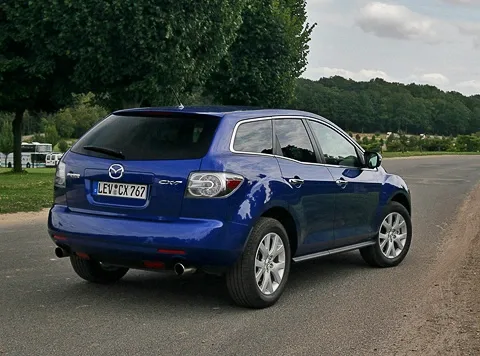
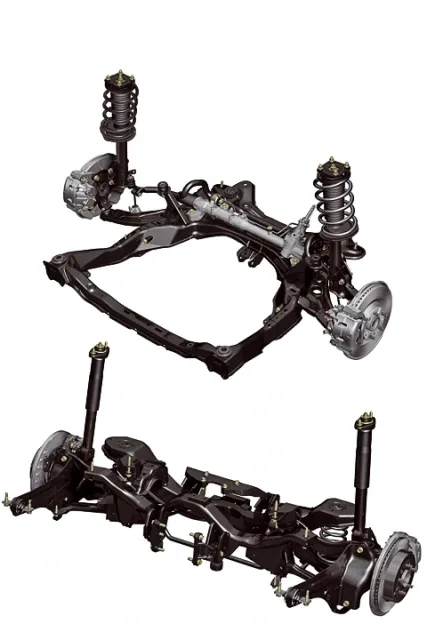
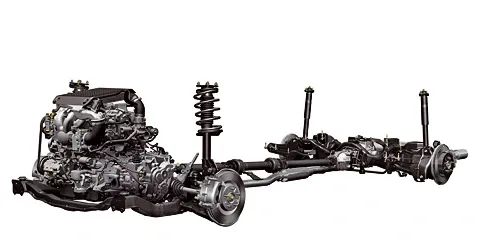
Creating a car of this format is a first for the company. Although the platform and body of the CX-7 were developed from scratch, the well-known Mazda5 and Mazda6 MPS served as "donors" for the components. The engine, transmission, and several chassis elements were borrowed from the latter.
Yeah, dream on! Every crack in the asphalt and every bump drove sleep away. The suspension here is frankly stiff. But that's only half the trouble. I was mercilessly tossed from side to side, pressed into the seat, then thrown up so that I hung on the seatbelt. Hey, colleague, how are you driving anyway? This won't do—I'd better take the wheel myself.
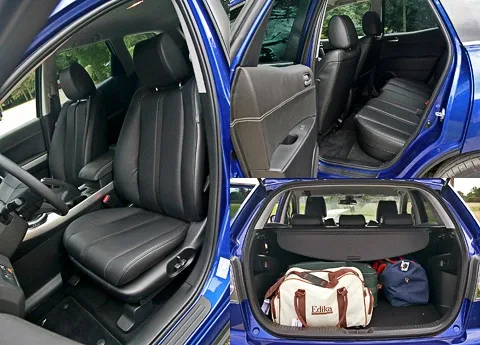
The front seats have proper lateral support, and there's plenty of room in the back. The CX-7's trunk is spacious, at 455 liters, and the loading height is convenient. By the way, the rear seatbacks fold down very easily: just pull the loops hidden in the trunk walls.
I settle into the driver's seat, adjust the steering wheel, seat, and mirrors—and immediately hit a surprise: the steering column doesn't have reach adjustment. How is that, gentlemen engineers? At my height of 198 centimeters, I couldn't find the perfect driving position. Oh well, never mind.
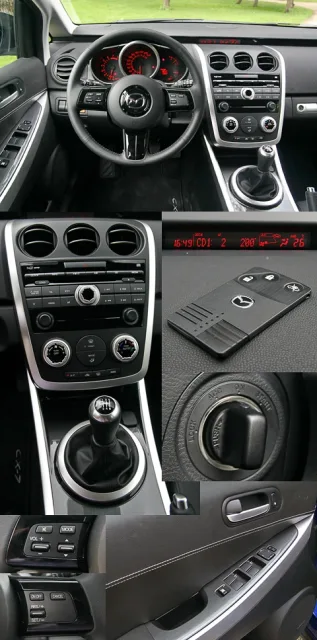
The CX-7's interior is a mix of solutions from the Mazda6 and MX-5. It looks nice and restrained, without unnecessary frills. The plastic on the dashboard is still hard and resonant. The car is equipped with a keyless entry system: to open the doors or start the engine, you don't need to take the key out of your pocket.
I press the clutch, engage first gear. Gas—and we're off. Oh, it stalled... Am I unable to drive? Unlikely. Rather, it's the clutch itself—it's quite stiff and engages somewhat abruptly, so it takes time to get used to. However, I think in Russia this embarrassment wouldn't have happened to me. If only because versions with a manual transmission won't be brought to us—only with a six-speed automatic.
And, by the way, that's a pity. The gearbox is excellent! The lever moves short and precise, and the heavy clutch, once you get used to it, you even start to appreciate. And, of course, the engine. The two-liter-plus turbocharged unit with direct injection pulls confidently from the very bottom, and in the range from 3,500 to 6,000 rpm it turns into a hurricane. It's clear that on the heavier CX-7 the dynamics aren't as impressive as, say, on the Mazda3 MPS, but 8 seconds to 100 km/h is also a serious indicator.
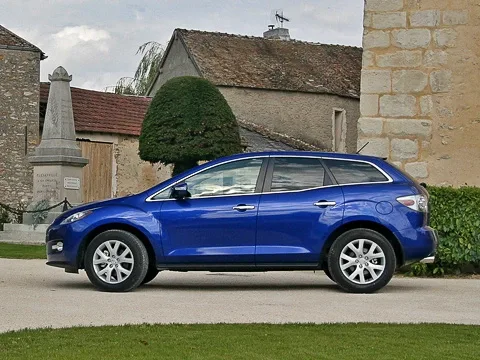
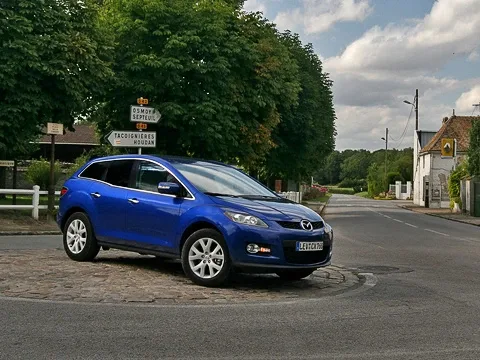
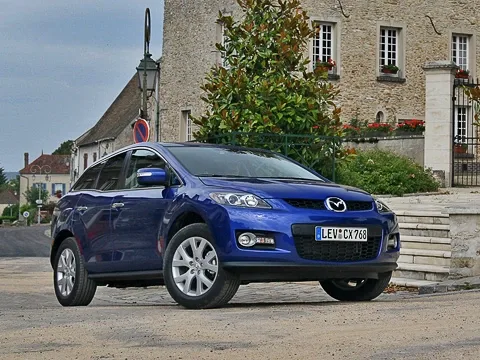
The muscular sides of the CX-7 loudly declare its sporting pedigree. And it must be said, they don't lie.
The steering wheel and three shallow instrument pods clearly came from the nimble MX-5 roadster. It's worth noting that the crossover's character (at least in the European version) isn't far from the little scamp. As I said, the CX-7's suspension is frankly stiff. The body transmits every little detail of the road surface to the driver, and such details in France, by the way, are hard to find.
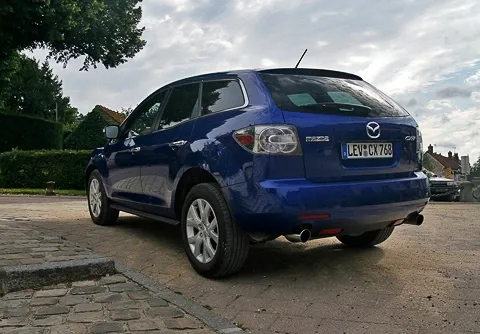
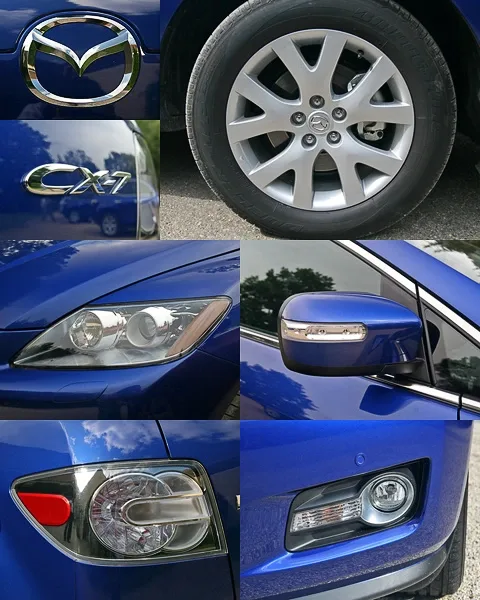
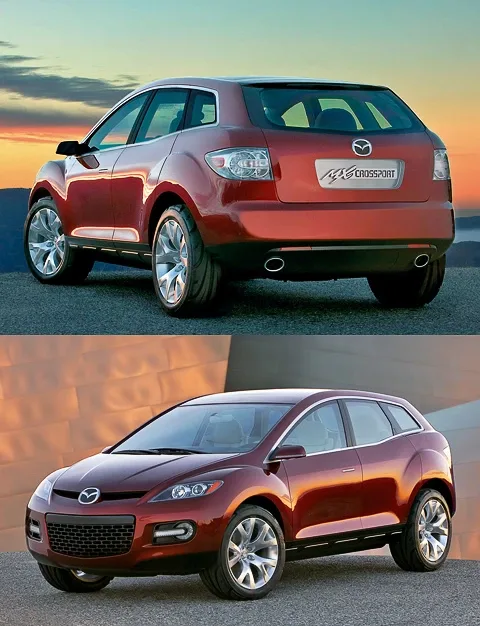
But the transparent rear lights, it must be admitted, have long gone out of fashion. Still, the rear of the CX-7 looks quite decent.
But for those who value sporty driving, these settings are just right. The crossover willingly shows its racing temperament. Under hard acceleration, it doesn't lift its nose, and in corners it stands surprisingly flat, without body roll. The small steering wheel receives maximum information about the asphalt's condition—sometimes even in excess. Drawing arcs and navigating sequences of corners in this crossover is a real pleasure. The CX-7 has a very rigid body, a low center of gravity, and independent suspensions—everything needed for active driving. In any mode, the car holds together solidly and composedly.
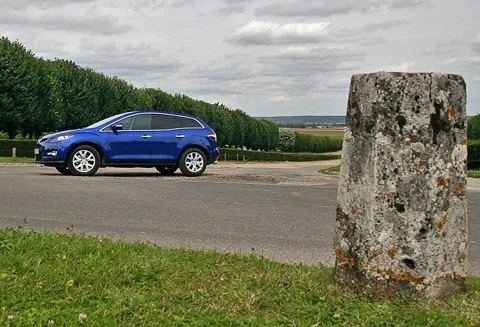
Even if you provoke the car into sliding, the dynamic stability system will catch it without ceremony, both in understeer and oversteer. By the way, in the Russian version, the electronics will start intervening even before the wheels break traction. And that's right: in our climatic conditions, you often have to drive on ice and snow. So it's better to nip skids in the bud.
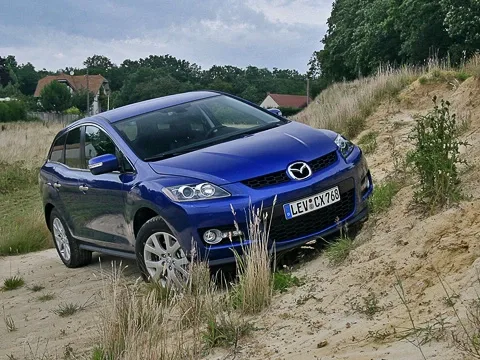
You can tackle relatively deep ruts, slopes, and small streams in the CX-7. But it's better not to overdo off-road excursions. The road tires the crossover is shod with don't like mud baths.
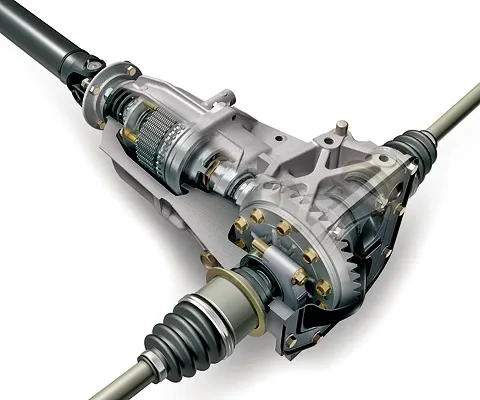
The all-wheel-drive system itself, by the way, moved to the CX-7 from the Mazda6 MPS almost unchanged. In normal conditions, the car is front-wheel drive, and the rear axle is engaged by a clutch located in front of the rear differential, on command from the electronics. If necessary, up to half of the torque can be sent to the rear wheels. On paper, this doesn't look too impressive, but in reality, it works just great.
In Europe, where everyone is obsessed with diesels, the CX-7 is unlikely to be in huge demand. But in Russia, huge queues have already formed for this car.
True, at the presentation, I was only allowed to drive European cars. So what will the Russian version be like? There are few changes here, but they are all significant. Instead of the 260-horsepower version, we'll get 238-horsepower ones. The loss of power is a consequence of converting the engine to different "fuel." The fact is that the 2.3-liter boosted DISI, which is installed on the Mazda6 MPS, requires exclusively 98-octane gasoline. Everyone who drives an MPS knows how capricious these engines are about fuel quality. So it was decided to detune the engine and switch it to the more accessible 95-octane.
In terms of ride smoothness, "our" car will be somewhere between the soft American and stiff European versions. In addition, the CX-7 adapted for Russia will receive enhanced anti-corrosion treatment. At the same time, it's completely unclear why Mazda decided to fit the Russian version with all-season tires. In summer, such tires will ruin handling, and in winter, they'll be as useful as an umbrella under Niagara Falls.
With all this, our compatriots dreaming of such a crossover will have to wait about five months. The number of people who have already reserved the car is approaching 2,300. And Mazda itself plans to sell only 2,800 units in Russia by the end of the year.
Do you still doubt that this car will stir up trouble among competitors? We don't. After all, it has everything needed for success.
This car simply cannot fail to succeed. Because the CX-7 is, first and foremost, a "Japanese" with a very interesting character and striking looks. And it's offered at very attractive prices—from 1,141,000 rubles ($43,900) to 1,265,000 rubles ($47,650) depending on the trim. Even in the "base" there's climate control, six airbags, a stability system, and other useful options. The top version will additionally get xenon headlights, a sunroof, leather seats with power adjustments, and a Bose audio system with nine speakers and a CD/MP3 changer. But the main thing is that it's a very bright car with excellent capabilities that won't let the driver fall asleep at the wheel, no matter how tired he is. Passengers, by the way, either.
Specifications
| Characteristics | Mazda CX-7 |
|---|---|
| Body | |
| Number of doors/seats | 5/5 |
| Length, mm | 4675 |
| Width, mm | 1872 |
| Height, mm | 1645 |
| Curb weight, kg | 1695 |
| Gross weight, kg | 2270 |
| Trunk volume, l. Rear seats folded/rear seats folded down | 455/1348 |
| Approach angle, degrees | 17.5 |
| Departure angle, degrees | 24.9 |
| Engine | |
| Type | Petrol, with direct injection |
| Location | Front, transverse |
| Number and arrangement of cylinders | 4, in-line |
| Number of valves | 16 |
| Displacement, cm3 | 2261 |
| Max. power, hp/rpm-1 | 260/5500 |
| Max. torque, Nm/rpm-1 | 380/3000 |
| Transmission | |
| Gearbox | Manual, six-speed |
| Drive | Front permanent, rear plug-in. With active torque distribution system (ASD) |
| Torque distribution (by default), front/rear axle | 100/0 |
| Chassis | |
| Front suspension | Independent, with MacPherson struts and anti-roll bar |
| Rear suspension | Independent multi-link with anti-roll bar |
| Front brakes | Disc, ventilated |
| Rear brakes | Disc, ventilated |
| Tires | 235/60 R18 |
| Ground clearance, mm | 205 |
| Steering | |
| Type | Rack and pinion with power steering |
| Number of steering wheel turns from lock to lock | 2.9 |
| Turning diameter, m | 12.2 |
| Performance characteristics | |
| Maximum speed, km/h | 210 |
| Acceleration time from 0 to 100 km/h, s | 8 |
| Fuel consumption, l/100 km | |
| Urban cycle | 13.8 |
| Extra-urban cycle | 8.1 |
| Combined cycle | 10.2 |
| Emission standard | Euro-4 |
| Fuel tank capacity, l | 69 |
| Fuel, octane number | 98 |
Equipment of the tested car Standard equipment
Price of car in maximum configuration 1,265,000 rubles ($47,650 at Mazda's internal exchange rate)
- Driver and front passenger airbags
- Side airbags for driver and front passenger
- Side curtain airbags
- ABS
- Dynamic stability control system DSC
- Traction control system TSC
- Power steering
- Height-adjustable steering column
- Heated front seats
- Multifunction steering wheel
- Cruise control
- Climate control
- MP3 receiver with AM/FM tuner
- Four-channel audio system
- Fog lights
- Interior rearview mirror with automatic dimming
- Folding power mirrors with heating
- Front and rear power windows with automatic mode
- Alloy wheels, tire size 235/60 R18
- Space-saver spare wheel
- Xenon headlights
- Power sunroof
- Leather seat upholstery
- Six-disc MP3 changer with AM/FM tuner
- Four-channel audio system with component speakers and subwoofer
- Power-adjustable driver's seat
Price of car in maximum configuration 1,265,000 rubles ($47,650 at Mazda's internal exchange rate)
Technology 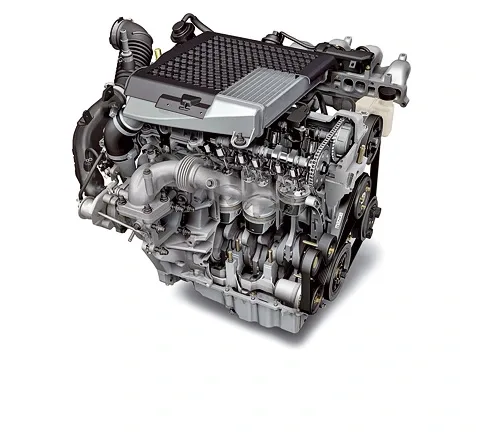
Safety 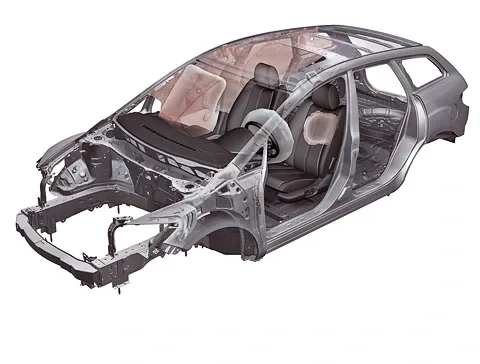
During crash tests according to the NHTSA methodology (US National Highway Traffic Safety Administration), the CX-7 earned the maximum five stars out of five for front passengers. Let me remind you that the American methodology involves a frontal impact at 56 km/h at a right angle into a non-deformable barrier with 100% overlap. Full test results can be viewed here. But in Europe, this crossover has not yet been tested for safety.
Design 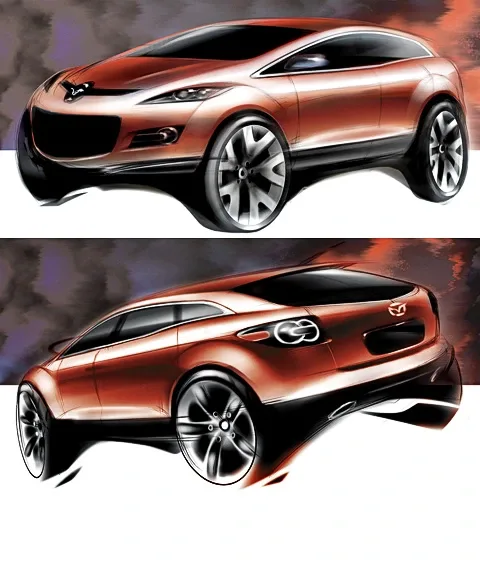
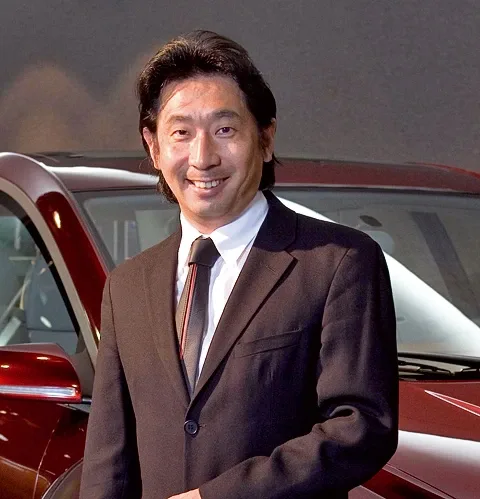
And here is that very Japanese gentleman — Mazda's chief designer Iwao Koizumi. It was he who shaped the concept of Mazda's crossover.
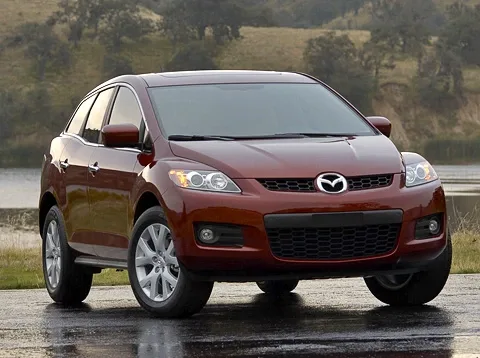
The American version, unlike the European (and Russian) one, does not have the lower bumper apron and turn signal repeaters on the mirrors.
Behind the scenes 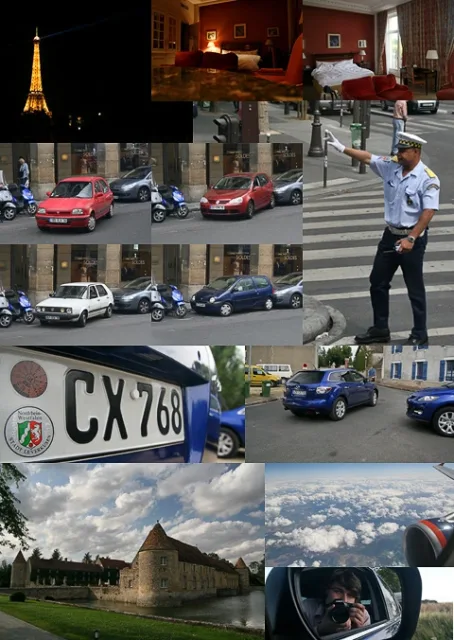
France, Paris. Yes, this is a completely different world. The roads here are an example of order and mutual respect. Nobody is in a hurry, everyone yields to each other, nobody cuts in or pushes ahead. Although city driving is a separate story. At first everything seems normal. But then you notice that the cars around are somewhat worn and battered. What's the matter? In the shortage of parking spaces. It is because of this that among Parisians (and indeed city dwellers in general) the so-called contact parking is accepted. And they absolutely do not care whether you have parking sensors or not. As long as there is an opportunity to touch the neighboring car. True, they do it lightly — in most cases, even scratches do not remain.
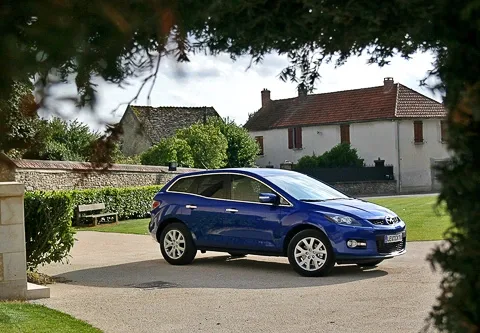
In the suburbs, of course, there are no such problems. But here's what's curious: when we drove along our test route, we passed several small towns or villages. And we were surprised not so much by the simple architecture as by the almost complete absence of people on the streets. Apparently, everyone is busy with business.
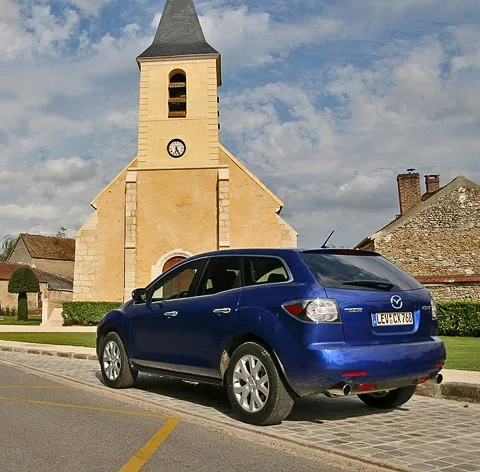
Although no, I'm lying. One lively fellow did meet us. And we, perhaps, agree that the scolding from his side was more than deserved. When I was photographing the CX-7 against the background of a chapel, I committed, by their standards, a completely unacceptable act — while choosing an angle, I began to walk on the lawn, which caused the anger of that very respectable elderly Frenchman. He, to give him his due, did not bother to express... No, perhaps, to shout out to us everything he thinks about it.
By the way, during the photo shoot, I inadvertently blocked (practically paralyzed) traffic in one of the small French towns. How did it happen? We placed the car neatly by the curb once again, and I began to photograph it from the opposite side of the street. And I was so carried away by the process that I did not even notice how drivers approaching us began to stop nearby and line up. Why? In order not to interfere and give us the opportunity to finish what we started... Culture, however! When will we treat each other like that?
In the suburbs, of course, there are no such problems. But here's what's curious: when we drove along our test route, we passed several small towns or villages. And we were surprised not so much by the simple architecture as by the almost complete absence of people on the streets. Apparently, everyone is busy with business.
Although no, I'm lying. One lively fellow did meet us. And we, perhaps, agree that the scolding from his side was more than deserved. When I was photographing the CX-7 against the background of a chapel, I committed, by their standards, a completely unacceptable act — while choosing an angle, I began to walk on the lawn, which caused the anger of that very respectable elderly Frenchman. He, to give him his due, did not bother to express... No, perhaps, to shout out to us everything he thinks about it.
By the way, during the photo shoot, I inadvertently blocked (practically paralyzed) traffic in one of the small French towns. How did it happen? We placed the car neatly by the curb once again, and I began to photograph it from the opposite side of the street. And I was so carried away by the process that I did not even notice how drivers approaching us began to stop nearby and line up. Why? In order not to interfere and give us the opportunity to finish what we started... Culture, however! When will we treat each other like that?