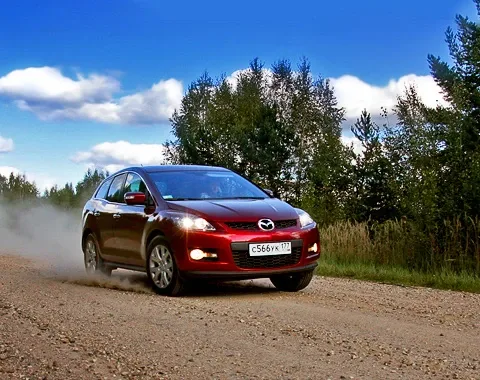
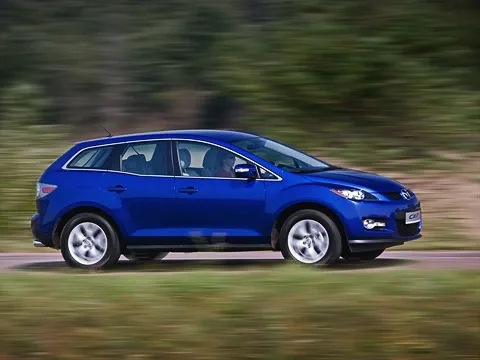
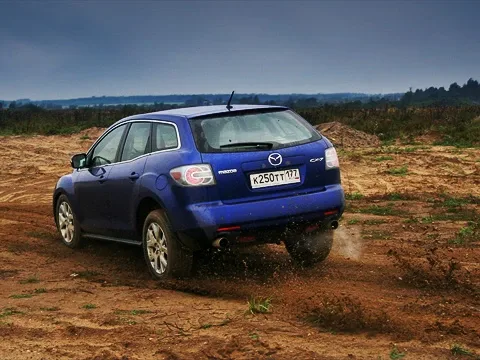
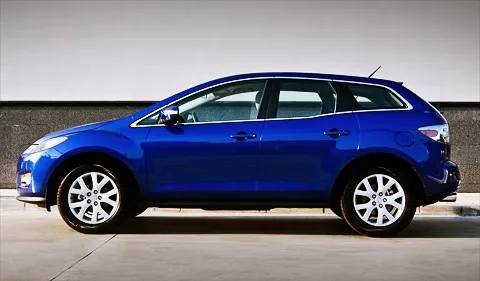
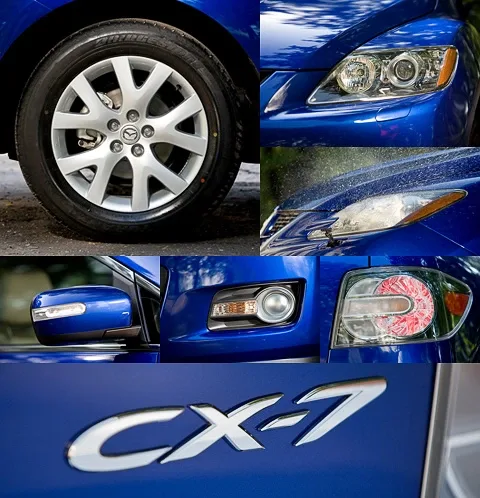
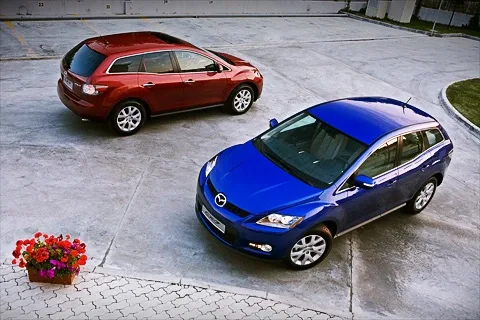
Recognizable silhouette, familiar lines — externally, the “Russian” CX-7 completely replicates its European relative. Inside, almost everything is also familiar; the only visible difference is that instead of a manual gearshift lever, there is a selector for a six-speed automatic transmission. For our market, only versions with an automatic transmission are provided. Otherwise — the steering column without reach adjustment, seats, instrument panel — everything is in its place. The trim materials are the same as those of the European version.
By the way, there are still three pedals at the driver’s feet. But don’t rush to look for the clutch — Mazda engineers certainly haven’t forgotten it. The left pedal here serves as the parking brake, and this solution has been carried over from the American version of the CX-7. Some may find this arrangement unusual, but they’ll have to accept it: moving the “handbrake” to the right hand would require serious investment in production, which would ultimately affect the price. Unification and economy. However, the automatic transmission selector and foot-operated “handbrake” are far from the most significant differences from the European version.
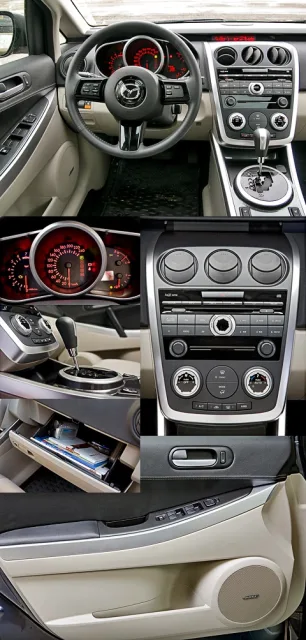
Even in the base trim, the “seven” offers climate control, four airbags, inflatable side curtains, pretensioner seatbelts, a stability control system, and other modern options.
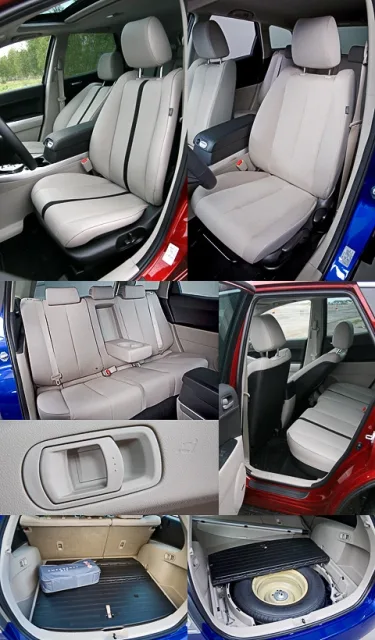
The interior can be ordered in either dark or light color schemes. Upholstery is fabric or leather. On the sides of the luggage compartment, there are convenient handles: just pull one of them, and the corresponding part of the rear seat backrest folds down, increasing the load area volume.
The turbocharged 2.3 DISI engine has noticeably lost power on its way to Russia: instead of the previous 260 horsepower, it now produces 238. But there’s no need to be upset — at least on long trips you won’t have to carry cans of 98-octane gasoline, which is hard to find on our highways even with a searchlight. And such freedom, you’ll agree, is worth the three-tenths of a second to 100 km/h that our car concedes to the European one. This small loss is the result of shorter gear ratios in the transmission and an increased final drive ratio. But there are no miracles: this had to be paid for with a lower top speed, which for the “Russian” version is almost 30 km/h lower than the European one. However, given the lack of autobahns and the prospects for fast driving, the Mazda engineers’ decision to sacrifice top speed in favor of acceleration looks very reasonable.
Nevertheless, that spirited character that won me over last time — the CX-7 has retained it, albeit not completely. Acceleration remains intense, especially on the first three gears. And the gearbox is not bad, although there are complaints about the programmers who wrote its algorithms. Yes, the “automatic” works better than many competitors, but it sometimes hesitates during kick-down. However, there is a manual mode, and it must be said, it’s quite honest.
On another bend, I caught myself thinking that the sporty essence hasn’t gone anywhere, but I can no longer bring myself to call the handling ideal. The thing is, during adaptation to our roads, the suspension was seriously recalibrated. The car has become softer, more prone to body roll in corners, and the responses to the steering wheel are no longer as lightning-fast.
Not to mention that during the lane-change test, the crossover stabilizes reluctantly and, before settling into its usual rhythm, tends to wag its shiny metal rear from side to side a couple of times. And on large expansion joints and potholes, parasitic vibrations of unsprung masses are occasionally felt.
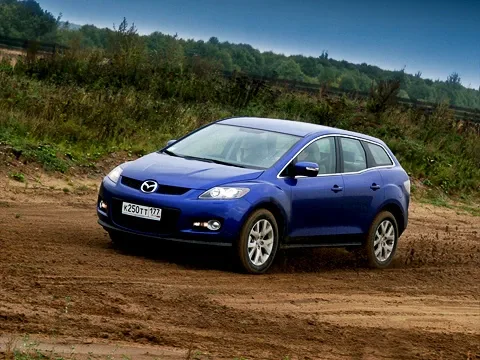
In standard mode, the crossover is front-wheel drive, and the rear axle is engaged via a clutch on command from the electronics. Up to half of the torque can be sent to the rear wheels.
However, I pondered the “watered-down” stiffness and lost enthusiasm only on smooth asphalt. As soon as I turned onto a broken country road, everything fell into place. Hats off to the engineers — the softened suspension showed itself in all its glory here. It swallowed one bump after another with enviable appetite, and greater stiffness would have been simply inappropriate. But even so, for those who fear tire squeal in corners and don’t understand how one can enjoy driving, the car might still seem overly jittery.
Be that as it may, at such a price, with such power-to-weight ratio, capabilities, and equipment, the thoroughbred “Japanese” is simply doomed to become a bestseller. Or rather, it already has: demand for the CX-7 is so high that Mazda cannot satisfy it. More than two and a half thousand of our compatriots have already bought or placed orders and are patiently waiting. And the quota for Russia until the end of the year is only 2,800 cars. So those who are late will have to wait more than six months. And believe me, the wait is worth it.
Yes, since our first meeting, the Mazda CX-7 has changed. But it hasn’t stopped being itself. The detuned engine, softened suspension, and “automatic” couldn’t break its character. And although on the winding roads of the Yaroslavl region the smile wasn’t as wide as in France, the face grimaced less on bumps, and the foot didn’t get tired in traffic jams. So, shortcomings are a continuation of merits. And this fully applies to the Mazda CX-7.
Technical specifications
| Specifications |
Mazda CX-7 |
| Body |
| Number of doors/seats |
5/5 |
| Length, mm |
4680 |
| Width, mm |
1870 |
| Height, mm |
1645 |
| Curb weight, kg |
1685 |
| Gross weight, kg |
2270 |
| Trunk volume, l (when loaded to the middle line of the body) |
455 |
| Trunk volume with rear seats folded, l (when loaded to the middle line of the body) |
774 |
| Approach angle, degrees |
17.5 |
| Departure angle, degrees |
24.9 |
| Engine |
| Type |
Petrol, with multi-point injection, turbocharging, and variable valve timing system |
| Location |
Front, transverse |
| Number and arrangement of cylinders |
4, in-line |
| Number of valves |
16 |
| Displacement, cm3 |
2261 |
| Max. power, hp/rpm-1 |
238/5000 |
| Max. torque, Nm/rpm-1 |
350/2500 |
| Transmission |
| Gearbox |
Automatic, 6-speed |
| Drive |
Front permanent, rear pluggable with active torque distribution system (ASD) |
| Torque distribution (by default), front/rear axle |
100/0 |
| Chassis |
| Front suspension |
Independent, MacPherson struts with anti-roll bar |
| Rear suspension |
Independent multi-link with anti-roll bar |
| Front brakes |
Ventilated disc |
| Rear brakes |
Ventilated disc |
| Tires |
235/60 R18 |
| Ground clearance, mm |
205 |
| Steering |
| Type |
Rack and pinion with hydraulic power steering |
| Number of steering wheel turns from lock to lock |
2.9 |
| Turning diameter, m |
12.2 |
| Performance characteristics |
| Maximum speed, km/h |
181 |
| Acceleration time from 0 to 100 km/h, s |
8.3 |
| Fuel consumption, l/100 km |
| urban cycle |
15.3 |
| extra-urban cycle |
9.3 |
| combined cycle |
11.5 |
| Emission standard |
Euro-3 |
| Fuel tank capacity, l |
69 |
| Fuel |
AI-95 |
Mazda CX-7 trims
| Trim level | Touring | Sport |
| Price | 1,141,000 ($43,900) | 1,239,000 ($46,755) |
| Front airbags | + | + |
| Front side airbags | + | + |
| Inflatable curtains | + | + |
| ABS | + | + |
| Dynamic Stability Control (DSC) | + | + |
| Switchable Traction Control System (TCS) | + | + |
| Power steering | + | + |
| Height-adjustable steering column | + | + |
| Leather steering wheel and gear shift knob | + | + |
| Fabric upholstery | + | - |
| Leather upholstery | - | + |
| Heated front seats | + | + |
| Headlight washers | + | + |
| Climate control | + | + |
| Halogen headlights | + | - |
| Xenon headlights | - | + |
| Fog lights | - | + |
| Daytime running lights | + | + |
| Power-adjustable and heated exterior mirrors | + | + |
| Front power windows | + | + |
| Rear power windows | + | + |
| Power sunroof | - | O |
| Split-folding rear seat | + | + |
| Audio system with CD receiver and four speakers | + | - |
| Audio system with MP3 changer and nine Bose speakers | - | + |
| Rain sensor | - | + |
| On-board computer | + | + |
| Smart start/smart keyless entry | - | + |
| Compact spare wheel | + | + |
| Cruise control | + | + |
| Price of tested car | | 1,265,000 ($47,650) |
Legend: + standard; - not available; o option installed on the tested car.
Behind the scenes
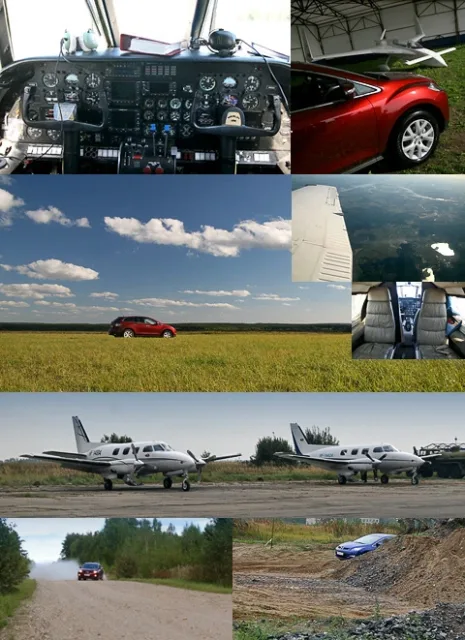
An ordinary person, planning a trip from Moscow to Yaroslavl, chooses between a train and a car. But we, journalists, are a special breed. For this test, the organizers put us on three planes, splitting us into groups of five. The weather, admittedly, was not pleasant. My Merlin IIB was tossed around in the sky as if I were a paper kite. After an hour of such flying, Yaroslavl seemed like paradise.
It turned out that there are two airfields near Yaroslavl. One is operational — that's where we landed. The other is an abandoned military transport airfield, and that's exactly where the test drive took place. The return flight was calmer, but the pilots' message spoiled the impression: on landing, our flaps jammed in the down position. However, we made it, and for that, we are grateful. All's well that ends well, Vasily!