
Mazda BT-50: A Pickup That Tried on a Business Suit
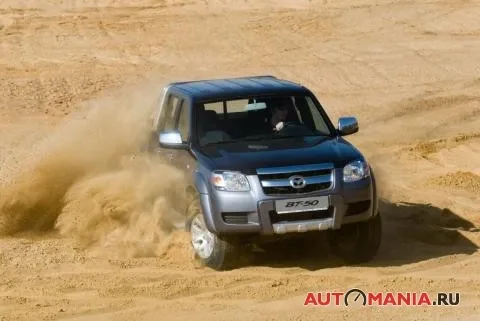
Previously, a pickup was perceived exclusively as a work tool: a Spartan cabin, no electronics, a cargo compartment in the back, and a price that had to pay off quickly. But the market entry of a whole line of new models from different brands changed everything significantly. The new Mitsubishi L200 can hardly be called a truck anymore, and the Ford Ranger is also gradually moving away from its purely "farmer" image, although it is still advertised as a workhorse. The Ranger's Japanese sibling, the Mazda BT-50, is moving in the same direction. The only difference is that Mazda's strategy is more radical: they want to fundamentally change our buyers' attitude towards their vehicle.
The previous generation, the Mazda B2500, did not have much success here. It was too expensive for rural residents, and for those who could afford it, it was not prestigious enough. The new generation seems unlikely to have such problems. First, the same field workers now have access to cheaper, albeit less modern, Chinese pickups. And second, Mazda itself has changed its concept: instead of a utilitarian truck, they got an affordable Sport Utility Truck (SUT). This term was first applied to the Nissan Navara, which was positioned as a "sport-utility truck" for people with an active lifestyle. In North America, such vehicles have long been held in high regard: they drive around the city all week like regular cars, and on weekends their owners load jet skis, snowmobiles, and other gear. In essence, an SUT is the same as an SUV, but with far more serious cargo capabilities. That is exactly how Mazda sees its new pickup.
In terms of overall layout, the Japanese did not reinvent the wheel: it is still the classic four-door Double Cab and a spacious cargo platform at the rear. The designers, as much as possible, managed to fit the BT-50 into the corporate Zoom-Zoom style, but the utilitarian essence of the vehicle greatly limited their imagination. However, the engineers worked on the dimensions. Compared to its predecessor, the vehicle has grown noticeably: length increased by 70 mm, cab height by 30 mm, and side height by 60 mm. The loading height, on the contrary, decreased by the same 60 mm, making loading more convenient.
As before, the BT-50 is based on a ladder frame integrated into the body with a classic suspension layout: a solid rear axle on semi-elliptic leaf springs, and an independent torsion-bar front suspension on double wishbones. This comes at the cost of ride comfort, but the payload capacity is serious — one ton. Given the new target audience, the bed will most often be loaded with ATVs, snowmobiles, and surfboards. But, of course, no one forbids carrying building materials or bags of potatoes. The cargo area is more than 2.5 square meters, and with the tailgate folded down, the platform length grows from one and a half to two meters. The loading height is not limited by anything, unless you order the optional roof. Need even more? You can hitch a trailer — the BT-50 will pull another one and a half tons.
What will please passengers? The cabin is five-seater, and it looks more like the interior of a decent SUV than a truck. Ergonomics do not quite reach the level of a passenger sedan, for example, the steering wheel does not adjust for reach, but finding a comfortable seating position is not difficult. The rear situation is slightly worse: the seatback is almost vertical, so second-row passengers will get tired on long trips. Plus, the central passenger will be bothered by a massive tunnel. However, these are typical features of all similar vehicles on our market.
Under the hood is a new 2.5-liter 16-valve MZR-CD turbodiesel with a variable-geometry turbocharger and intercooler. Power is 143 hp, but the key is 330 Nm of torque already at 1800 rpm. The result is excellent: the pickup feels confident both off-road and in the city. It works in tandem with a proven 5-speed manual, and it performs very well. If you handle the lever skillfully, the vehicle shows decent dynamics. But at high speeds, the BT-50 becomes noticeably calmer — the diesel's lack of torque at the top end takes its toll. At 130–140 km/h (maximum is 160 km/h), the pickup prefers measured driving, not provoking sharp overtakes, but it pleases with course stability and the absence of serious rolls in gentle bends. The leaf-spring rear suspension also performed well. You remember it on an empty vehicle only at joints, on a "washboard" road, or on poor gravel, when vibrations reach the driver despite the independent front suspension. This is cured by simply reducing speed. In sharp turns, you will also have to slow down — due to noticeable body roll and unloading of the outer rear wheel, which starts to spin when you press the gas carelessly. And this is despite the fact that the rear differential has a limited-slip unit that sends up to 45% of torque to the spinning wheel. This, however, does not affect off-road capability. The 207 mm ground clearance, two-speed transfer case with low range, and locking center differential allow the BT-50 to tackle loose sand, snowy virgin land, and soggy clay. But do not forget the folk wisdom: "The cooler the jeep, the farther you walk for the tractor." You should not get carried away with hard off-roading. On our market, the BT-50 is sold in four trims: Direct (from 611,000 RUB), Touring (from 663,000 RUB), Touring Plus (from 720,000 RUB), and Active (from 788,000 RUB). For our conditions, Touring Plus looks optimal: air conditioning, four airbags, ABS, alloy wheels, power accessories, and an audio system with MP3. The Active version additionally gets a chrome body kit and a CD changer, while the base does not even have power windows, ABS, or air conditioning.
Specifications:
| Length (mm) | 5075 |
| Width (mm) | 1805 |
| Height (mm) | 1760 |
| Wheelbase (mm) | 3000 |
| Ground clearance (mm) | 207 |
| Weight (kg) | 1800 |
| Payload capacity (kg) | 1137 |
| Engine displacement (cc) | 2499 |
| Max power (hp) | 143 at 3500 rpm |
| Max torque (Nm) | 330 at 1800 rpm |
| Max speed (km/h) | 158 |
| 0-100 km/h acceleration (s) | 12.5 |
| Average fuel consumption (l) | 8.9 |
| Price | 611,000 - 788,000 RUB |
Source – AUTOMANIA.RU