
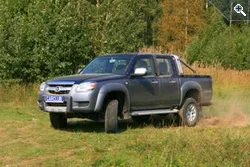
Finishing a pickup truck is a task that few manufacturers take on willingly. But the market dictates its own rules, and even successful models have to be updated. This is what happened with the Mazda B-series, which after a facelift received a new name — BT-50.
What do people expect from a pickup? First of all — that it doesn't break down and isn't capricious, and also that it feels confident where the asphalt ends. Then everyone has their own wishes: some want a lower price, some want a more comfortable cabin, and some dream of a spacious cargo platform and decent highway behavior. But these requirements often contradict each other. Try making a work vehicle that has to carry a ton of cargo comfortable when it's empty, and also fit into the price of the base version up to 611,000 rubles. We got the top trim for the test, packed with options, and it already costs 822,000 rubles.
And only when you realize what a difficult task the engineers were solving, and you start driving the pickup in various conditions, do you truly develop respect for the Mazda BT-50.

It all started with a trip out of town for 350 kilometers, and on the way we were caught in the rain. Starting from a traffic light, the pickup can even be mistaken for a sports car. Stiff all-season tires, which are no help on wet roads, plus an empty rear axle — that's the perfect recipe for drifting. The long wheelbase allows you to keep the slide under control, the main thing is to have time to turn the "long" steering wheel, which requires exactly 4 turns from lock to lock. And the turbo diesel's torque is such that the wheels break into wheelspin even in third gear.
For those who aren't looking for adventure, there's a simple solution — engage the front axle with the lever on the tunnel. Then the pickup, instead of polishing the asphalt, surges forward with excellent acceleration. True, you must not forget: this trick is only suitable for slippery surfaces. The front is engaged rigidly, without a center differential, which means that in corners the load on the engine and transmission increases, tires wear faster, and handling suffers. But acceleration becomes simply excellent.
On the highway, the Mazda turned out to be unexpectedly lively: on a long straight, the speedometer needle crept up to 175 km/h, although the specifications state a maximum of 158 km/h. Either the speedometer is lying, or the wind was helping. Maybe it's the cool weather: the turbo diesel is very sensitive to external conditions — the denser the air, the better the turbo works.


In a calm pace, you can forget about gear changes altogether, but for overtaking outside the city it's better to keep revs above 2500 rpm, although turbo boost is felt already after 1500 rpm. After the whole trip, average fuel consumption settled at around 9 liters — a very decent result for a two-ton vehicle.
At high speed, the only thing that bothers is the vertical pitching of the front end. It seems the torsion suspension doesn't cope very well with the load, or the shock absorbers have tired after intensive tests. Otherwise, driving the pickup is not difficult at all. The Mazda responds to steering inputs lazily, but quite predictably, while the brakes pleasantly surprise with their grip. In corners, the pickup noticeably leans and can even lift one rear wheel off the ground, but this doesn't affect stability, at least while the vehicle is unloaded.
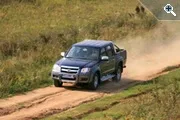
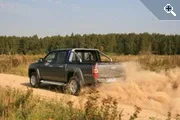
Keeping such a monster in the garage is a crime. And here we are with the BT-50 already storming off-road. First, on a country dirt road, we managed to drive even on rear-wheel drive — the suspension travel is so great that there's no fear of lifting a wheel. On diagonal articulation, the ladder frame noticeably twists and creaks, but all four wheels stay on the ground. Four-wheel drive had to be engaged already on clay, when the rear tires with universal tread gave up. Had the tread been more aggressive, the BT-50 would have continued on rear-wheel drive. Off-road, it's better to use four-wheel drive immediately with low range. The torque reserve grows by one and a half times, and on large bumps the vehicle is noticeably easier to control. And before tackling obstacles, you can skip gears — the pickup confidently picks up and gains speed.
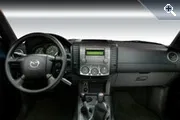
After having enough fun, you can inspect the cabin. The plastic here is expectedly hard for a vehicle of this class and price, but it's easy to wipe off any dust and dirt brought in after overcoming obstacles. Our BT-50 in maximum trim had a CD-MP3 changer — that's probably all the frills. Air conditioning, power windows, and remote central locking with the key are already standard for a car over $25,000.
The most surprising thing was the pull-out handbrake — although for off-road enthusiasts, there's probably nothing new in this. It turned out to be convenient to use, and on the tunnel there was room for cup holders and small items. The rear row of seats is much less comfortable. There seems to be enough space for three, but the hard bench forces you to sit with your knees at your chest, and it shakes a lot here — on a bump you can hit your head on the ceiling if you're not wearing a seatbelt.

But what really impressed was the quietness in the cabin. Even at 150 km/h you can talk without raising your voice — for a pickup, this is simply an excellent indicator. All noises and small bumps remain somewhere far outside the cab. So you can easily go on a long trip in the BT-50, but it's better to go with three people so the rear passenger can sit semi-reclined.
Despite the fact that the BT-50 left very pleasant impressions, we parted with it without regret, although we agreed to meet periodically and go out into nature. High seating position, excellent off-road capability, and low diesel consumption combined with confident dynamics are undeniable advantages. But on waves, the vertical pitching is annoying. However, for those who are building a dacha or love active outdoor recreation, a pickup could well be the only car in the family.
It turns out that the current generation of pickups — Nissan Navara, Mitsubishi L200, and Mazda BT-50 — essentially replace the traditional SUVs of ten to fifteen years ago. Those that were created for mud and had to survive in such conditions for years, rather than shine with almost car-like dynamics on asphalt.
Already now, most pickups are sold with a canopy that turns the truck into almost a full-fledged SUV. And if demand grows, shortened versions with a regular station wagon body will surely appear. Then automotive evolution will come full circle and return to where UAZ Patriot and similar true off-roaders still dwell.
P.S. When asked what the abbreviation BT-50 means, Mazda's marketers evasively remained silent. But in the end they admitted — it means nothing. Perhaps B is a reference to previous pickups, and the rest is just for beauty. Although it would have been possible to fit the pickup into the sleek naming of the model range by calling it, say, Mazda BT-9 or Mazda Breaktrue.
P.S.S. While the pickup was with us for the test, a friend needed to pick up a full compartment of watermelons and melons from Uzbekistan at the station. And the BT-50's bed fit 800 kg of melons, which sold perfectly. It turns out that instead of a stationary tent, you can drive a pickup to the busiest places — excellent sales and no fee for the spot. The business was a success.
Text: Leonid Pavlov