
Mazda6. Calm, and once again calm
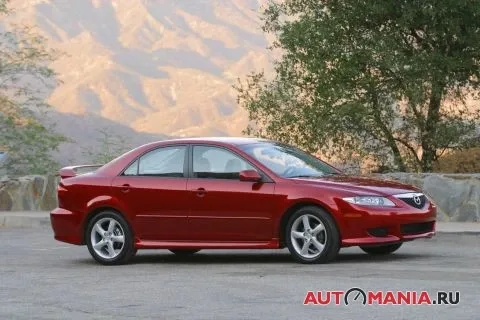
However, this is not surprising: only slightly redesigned bumpers, radiator grilles with a honeycomb pattern, darkened rear light lenses, and headlight trims fell under the surgeon's knife. In short, after such a delicate operation, the model remained practically the same as the first owners remembered it: swift, fast, but with all the usual attributes of a family sedan — a dome-shaped profile smoothly flowing into the classic contours of the trunk. The interior is also beyond praise. Mazda6 has always been famous for its harmonious cabin, and this applied not only to design or ergonomics but also to trim materials. But let's talk about everything in order.
Let's start with the design. Understanding that the main buyers would be family-oriented and respectable people, the stylists designed the interior in a classic key: a rounded front panel with an Eastern touch, massive round deflectors in the spirit of the early century, neat rows of buttons and switches on the center console. In post-restyling versions, the trim on the 'beard' became not silver but titanium, which added solidity to the interior. Japanese cars often sin with cheap plastic, and Mazda used to not disdain this, but those times, fortunately, are gone. From the inside, the 'six' is clearly designed for a picky European. The materials, of course, are not luxurious, but they try their best to seem so — both in texture and execution. The same can be said about assembly quality: 'crickets' in this sedan are rare. Even fabric seats do not spoil the impression, and there is nothing to say about leather.
As befits a true family car, the driver's seat is spacious, and the adjustment ranges of the seat and steering wheel allow a person of almost any build to sit comfortably. The shape of the seats is almost ideal, the only drawback is the 'pushing' backrest, although this feature is found in many competitors of the 'six' on our market. Passengers, especially rear ones, are not deprived of attention either. I remember, even during the first acquaintance with the Mazda6, I, a rather tall and far from thin person, was sincerely surprised: I not only fit 'behind myself' but also happily rode in that seat for about ten kilometers. Believe me, with my dimensions, such experiments rarely end in success, especially in D-class cars and below.
The audio system with decent sound and the climate control, which works properly in our latitudes, coping with both frost and stuffy urban smog, also deserve praise. By the way, in the latter case, the same can be said about the regular air conditioner. In fact, the final equipment level of a particular instance is not so important: even the base Mazda6 can satisfy the needs of most domestic buyers. In the base — air conditioning, power windows on all doors, power-adjustable and heated mirrors, heated seats, CD player, headlight washers, and a 'doughnut' spare tire. Plus six airbags, seatbelt pretensioners, and a full set of electronic assistants: ABS, TCS, EBA, EBD, and the DSC stability control system. The price of such a Mazda6 today is $23,900, which is quite inexpensive for a car in such a configuration. For those with a thicker wallet, it makes sense to look at more expensive versions. Dealers offer the 'six' in three trim levels: the mentioned Base, as well as Touring and Sport. In Touring, the base equipment is supplemented with climate control, cruise control, multifunction steering wheel, rain and light sensors, onboard computer, and fog lights. In Sport — leather interior, a more advanced driver's seat with extended adjustments, xenon headlights, alloy wheels, CD changer, and excellent Bose acoustics. All these options are also available to Touring owners, but in the form of six fixed packages.
Prices for these versions start at $24,750 and $31,900, respectively, and here it is worth considering serious differences in the technical filling. The base engine for Base and junior Touring is a 1.8-liter 'four' with 120 hp, working exclusively with a manual transmission. The top version (not counting the 'charged' MPS with 260-horsepower turbo engines) is a 2.3-liter naturally aspirated engine producing 166 hp. We will focus on the intermediate and most popular unit in our country — the 147-horsepower 2-liter engine. At the customer's request, it is combined either with a 5-speed manual or with the same 5-range adaptive automatic Activematic. I got the latter, and we will talk about it.
The behavior of the Mazda6 on the road strongly depends on the driver's mood. In a traffic jam or in dense traffic, when you only lightly touch the gas pedal, the car behaves calmly, imposingly, even lazily. It is clear that such automatic transmission settings are made for economy, but the fifth gear at a speed of 80–85 km/h, in my opinion, is already too much. However, making the car 'come alive' is not difficult — just sharply press the accelerator. The automatic transmission will downshift two gears, rev the engine to the maximum, and smoothly (!) shift up only before the cutoff. The acceleration turns out, maybe, not too impressive, but quite decent for a one-and-a-half-ton car. The main thing is not to release the pedal, otherwise, the electronics will decide that the run is over, and the Mazda6 will again become calm and judicious. It seems to dictate its own rules, constantly controls the driver, and sometimes tries to intercept the initiative — during the test, I was convinced of this more than once. This struggle is a bit tiring, and in the end, you give up. For those who like it hotter, it is worth trying the sequential mode. True, manual control of the 'automatic' here is organized specifically: to upshift, you pull the selector back, to downshift, you push it forward. The algorithm is, to put it mildly, not the most familiar, but you quickly adapt to it. But it is in manual mode that the Mazda really becomes what we used to call a 'driver's car': effective brakes, almost sporty handling, and a suspension that tightly works through bumps. By the way, about the suspension: the engineers used an ultra-compact multi-link design on a powerful subframe at the rear, which made it possible to increase the trunk but made the strokes short. This is a plus for handling, but it did not add comfort.
But even in this mode, it seems to me that the Mazda6 is not a sports projectile. It is active and, if necessary, even too dynamic, but for crazy city rides, this Japanese is too judicious. So the car is more for balanced people who prefer a calm, unemotional, and therefore initially safe driving style.
Source – www.automania.ru