
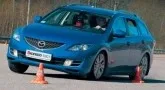
Our test subject today is the Mazda6 wagon. Our first encounter with this car took place in Spain, where it left the impression of a solid vehicle with brisk dynamics and quite intelligible handling. However, mountain serpentines are one thing, and the measuring instruments of the Dmitrov test track are quite another. It is here that the true worth of the newcomer from Hiroshima is revealed.
The very first acceleration run, when the tires had not yet warmed up and their temperature matched the air temperature, showed that the two-liter engine coupled with a manual gearbox can accelerate the wagon to 100 km/h in 10 seconds. A measurement in the opposite direction gave exactly the same result. It is worth noting that just 27 seconds after the start, you can easily lose your license — the car gains speed so confidently. The next exercise is the "lane change," which is designed to show at what speed the car can still hold a given trajectory, as well as to reveal its propensity for sliding. It is clear that the presence of stability control systems noticeably improves the result in this test, and we proceeded.
In the empty wagon, the breakaway of all four wheels begins only at a speed of 126.5 km/h. Interestingly, when loaded to full mass, the tendency persists, although the speed of the exercise drops to 124 km/h — for a wagon, this is a very respectable indicator. The "moose test," that is, checking stability during a sharp lane change, is one of the most important disciplines. Practice shows that not every car passes it smoothly and predictably. In the loaded Mazda6, a slight increase in speed is observed at the exit of the exercise, which should alert the driver: cargo in the trunk should be stowed evenly if you do not want surprises. By the way, the recommended gross vehicle weight should not exceed 1970 kg.
In the city, maneuverability is important, and there is something to pay attention to here. The steering wheel of the Mazda6 makes 2.8 turns from lock to lock, and the turning radius is 11.4 meters. The wagon completed the "slalom" exercise at a speed of 64.5 km/h, obediently weaving between cones placed 18 meters apart. In the loaded state, the speed was slightly lower — the inertial reactions of the rear axle take their toll.
The brakes of the Mazda6 are also in perfect order. Stopping from 100 km/h in the curb weight takes 35 meters and 3.3 seconds, and the braking system demonstrates enviable stability. Ten consecutive braking runs in the loaded state gave an average result of 38 meters — excellent. The car also did not disappoint when stopping from 160 km/h.
All these measurements concern active safety. As for passive safety, the Japanese have a whole arsenal: seatbelt pretensioners, active headrests for the front seats, and eight airbags. However, for many drivers, comfort is more important than any safety, and we did not ignore these parameters. At idle, you can tell whether the engine is running only by the click of the fan relay — the noise level does not exceed 36 dB. This indicator would be excellent even for a hospital ward during quiet hours. As speed increases, the noise picture does not change much.
Comfortable movement is also facilitated by the excellently tuned manual gearbox, which is equally good in traffic jams and on the highway. The engine's elasticity is impressive: in fourth gear, acceleration from 80 to 120 km/h takes only 11 seconds, in fifth — just over 15. The fifth gear generally has an extremely wide range: starting from 27 km/h, you can accelerate to a maximum of 208 km/h. Another question is how long it will take.
The car's interior can be called comfortable without exaggeration. Even if the driver moves their seat all the way back, the passenger sitting behind will not have their knees pressed against the backrest. The only exception would be basketball players nearly two meters tall. There will be no shortage of space for broad-shouldered people either: the cabin width at the front is 1475 mm, at the rear — 1480 mm.
The result of the track tests is simple: the parameters declared by the manufacturer were fully confirmed. The Hiroshima company is honest with its customers. The impressions from the Spanish serpentines were supplemented with objective figures. The comfortable and smooth suspension does not in any way compromise the universal capabilities of the newcomer. And, of course, one cannot fail to note the restrainedly aggressive design, which, alas, cannot be measured by any numbers.
Our assessment
The measurements at the Dmitrov test track only confirmed the subjective impressions from the first trip. The "family wagon" Mazda6 can give a head start to some sedans not only in its class.
Body
- + comfortable interior
- + very good sound insulation
Ride comfort
- + good handling
- + informative steering wheel
Powertrain
- + dynamic and elastic engine
Driving characteristics
- + comfortable suspension
- + good and reliable brakes
Safety
- + large set of airbags
- + large set of electronic passive safety systems in the base configuration
Environmental friendliness
- + low fuel consumption