Mazda 6

GROWN UP...
Engine: 2.0
Max power 147 hp at 6500
Max torque
Nm/rpm 184/4000
Max speed: 204 km/h
Acceleration 0-100 km/h: 10.8 sec.
Transmission: 5AT
Fuel consumption:
Urban cycle 11.1
Extra-urban cycle 5.4
Combined cycle 7.7
Length 4735 mm
Width 1795 mm
Height 1440
Tires 215/50 R17
Ground clearance 165 mm
Curb weight 1395
Trim level Touring+Package 1 (Xenon headlights)
Price: $27,777 (222,211 UAH) (base: 653,000 rub.)
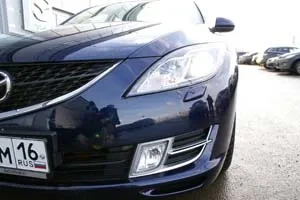

Mazda's history dates back to 1920, when Jujiro Matsuda, together with investors, acquired the bankrupt company Abemaki in Hiroshima, which was engaged in cork production. The enterprise was renamed Toyo Cork Kogyo, and a year later Matsuda headed it. By 1927, the word "cork" disappeared from the name, and the company became known as Toyo Kogyo, marking the transition to industrial production. After releasing a test batch of motorcycles in the 20s, the company switched to machine tools in 1929, and one of the motorcycles even won a race in 1930. In 1931, production of three-wheeled trucks with half-liter engines in a purely Japanese style began. For their designation, the name Mazda was chosen — the supreme Zoroastrian god of light, which is also consonant with the founder's surname. The new Mazda6 is a triumph of the Japanese, primarily over their own stereotypes in design. Its appearance demonstrates a fresh direction of development: classic brand features from legendary sports models are combined with innovative ideas, making the car truly noticeable. Strategically and in sales matters, Mazda closely cooperates with Ford, but the Americans do not interfere in production. Assembly at factories in 21 countries allows the brand to supply cars to 120 states.

Leonid Tsymbalenko.
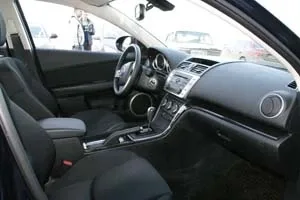
Unfortunately, I did not get to know the previous Mazda 6, so I cannot compare them. The new model at first glance wins over with its stylish and original design, which is characteristic of all brand models. I was very pleased with the spacious trunk, despite the fact that the car does not look bulky. The trunk opening button hidden in the brake light repeater is an original solution, but you will have to put up with dirty hands. Sitting in the back is comfortable, there is enough space, but the seat cushion, in my opinion, is a bit short — in a long journey, passengers are unlikely to be able to relax properly. But there are no complaints about the driver's seat: everything is thought out and convenient. The seats are moderately firm, the steering wheel adjusts in height and reach over a wide range — you can find the ideal position. The armrest is in place.
I was still wondering why Alfred did not start the engine, when suddenly the car moved. At idle, the engine is almost silent. The suspension is moderately firm, I liked it, although I am used to a softer one. Sound insulation in the cabin is top-notch. The only thing that really annoys while driving is some sluggishness of the automatic transmission. There is a pause between pressing the gas and acceleration. However, this is noticeable only on the highway. Fortunately, this drawback can be mitigated by the manual mode.
In the end, in my opinion, the Mazda 6 is a comfortable car for a respectable person. A rich set of options plays a significant role: rain and light sensors, headlight washer, cornering lights, folding mirrors. All this makes interaction with the car as pleasant as possible.

Vadim Sadykov
My impressions of the previous Mazda 6 remained the most vivid, and that was after 2.5 years! The car was truly memorable. Therefore, I involuntarily compared the new "six" with the old one all the time. Here is what came of it.
Interior and sound insulation. Inside, everything became more solid. Rear passengers got more legroom, but the seat cushion was shortened for some reason. The Koreans used to do this to create the illusion of space. Why this is in the new Mazda 6 is unclear. Sound insulation has noticeably improved — the old car had big problems with this. But in the back row, the wind is still audible, and in this indicator, the car is inferior to most classmates.

Suspension. It has become noticeably softer and more comfortable: even on a broken road, the car goes smoothly, without breakdowns and rocking. This behavior will clearly appeal to solid people over 30. The previous Mazda 6 was more youthful and bumpy. But handling has worsened: you have to pay for comfort. On an empty country highway, I took several turns at a hundred — on the new Mazda, this is already perceived as extreme. Keeping the desired trajectory was not easy, and only the stability control system saved from trouble. The old Mazda 6 was completely different: it provoked sharp maneuvers, and the steering was simply magnificent. The brakes on the previous car were reactive, on the new one — just adequate. The conclusion suggests itself: the Mazda 6 has grown up, become more solid and comfortable.
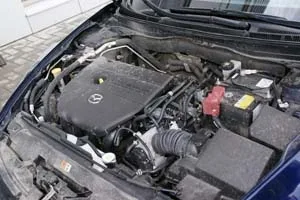
Engine and AT. In 2005, the Mazda 6 underwent a facelift: the 2.0 engine was updated, and the old 4-speed AT was replaced with a new 5-speed one. To make the comparison more accurate, I will tell you more about the facelift. The 2.0 engine was slightly boosted, raising power to 147 hp at 6500 rpm (was 143 hp at 6000 rpm). Modern systems appeared in the engine: variable valve timing and intake manifold length, electronic gas pedal. The new 5AT paired perfectly with this lively engine: shifts were very fast, and with a sharp press on the pedal, the gearbox could jump from 5th straight to 3rd or even 2nd. It was real drive! The 5AT also had an honest manual mode: if you selected "3", it really was 3rd gear, not a ban on 4th and 5th. We tried driving in manual mode, but quickly gave up: the automatic selects gears better and faster. True, there was also a minus: at low revs, the engine behaved sluggishly.
Now the new Mazda 6: the engine is the same. And the same modest for a modern 2.0 maximum torque — 184 Nm at 4000 rpm. Competitors have long had 196-200 Nm! Surprisingly, at low revs, the 2.0 in the Mazda does not yield to rivals. How did they manage it? In a simple and inexpensive way — by tuning the AT! The car no longer has a perky character at high revs, it is almost impossible to accelerate sharply from 2500 rpm, and when overtaking uphill, there is not enough traction — all these are consequences of the new "brains" of the 5AT.
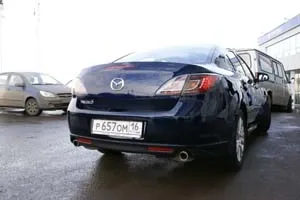

Instant downshifts by several gears have disappeared: now the 5AT carefully and with a delay goes through all downshifts one by one. As a result, in manual mode, the car has become more responsive. Having lost in aggressiveness, the new "brains" tuning allowed to noticeably win in elasticity. The engine calmly pulls in 5th gear (without pressing the gas) at almost idle speed, at a speed of less than 30 km/h. By the way, the 5AT in manual mode does not forcibly downshift at 1000 rpm, as the old gearbox did. I also liked the easy start from a standstill — the car simply shoots off. In normal city driving, the 5AT keeps around 2000 rpm, and low-end traction is very good.
The new "Mazda 6" has noticeably grown up and is clearly designed for a sedate audience: the suspension has become softer, the five-speed "automatic" shifts without unnecessary fuss, the exterior and trim materials have been improved, and the engine has a smooth, calm character. However, for a representative of the family D-class, such an approach is quite justified. Special thanks to mazda-club and personally to allegro for useful advice and constructive criticism.

Alfred Mardanov.
Comparing the previous "six" with the current one was extremely interesting. It's gratifying that the manufacturer went for deep changes rather than limiting itself to a cosmetic facelift — nowadays it's fashionable to update the optics and grille and call it a new model. Here, the changes are serious: a double-wishbone suspension appeared at the front, the body became slightly larger, and the functionality expanded. However good the previous design was, which seemed it would never age, a generational change was long overdue. The exterior hints at Lexus — whether that's good or bad, let everyone decide for themselves, but it's pointless to deny that the car looks more current. The interior, it must be admitted, retains the family traits of the "six": there are plenty of visual innovations, but they don't hurt the eyes, except that there are fewer round air vents. The seating position has become deeper, with a feeling of sinking into the seat.
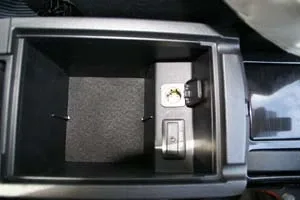

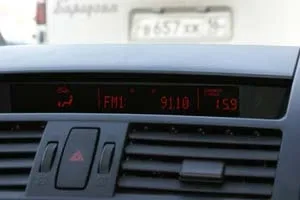
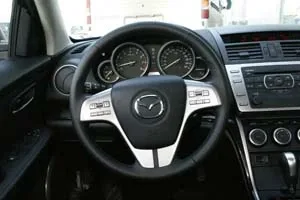
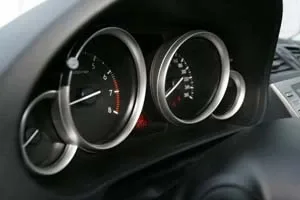
The instrument panel is in the spirit of functionality, without unnecessary frills. Readings are easy to read, except perhaps for the "signature" information display in the center of the dashboard. Unlike the predecessor, the instruments are now hidden under a visor and don't glare in the sun, but they remain just as small — it will take time to get used to deciphering them. A joystick for controlling "practically everything" has appeared on the steering wheel: with it, you can switch the stereo, climate, and something else. I experimented and realized that I'd have to adapt to it too. Under the ceiling, there's a small blue LED that should illuminate the automatic transmission lever in the dark. It probably looks interesting. Our car also had a "trick" with automatic light activation when turning — it's available in the version with bi-xenon headlights. The handbrake was a bit puzzling with its placement under the left hand (i.e., for right-hand drive). The manager explained that it's a legacy of the Japanese right-hand drive version. After plenty of highway driving, we returned to the city, and here, in dense traffic, I felt some discomfort due to the wide left pillar.
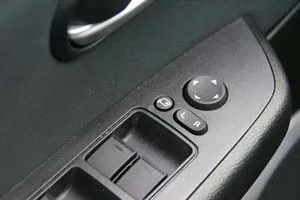

Strange, because in my own car the pillar doesn't seem narrower, but there's no such discomfort. Perhaps it's all about the lower seating position. I almost missed an obstacle on the left when changing lanes. Additionally, there are complaints about the exterior mirrors — they're a bit small, although they have a special curve to widen the view. As for driving qualities, Vadim is absolutely right. The car has lost its former driver's grip, but in return it has gained something more — solidity and composure. However, the manufacturer left a loophole for racing ambitions: with one button, you can disable modern electronic assistants and spin the "rear end" with the handbrake or hooligan in some other way. Nevertheless, there's a clear trend toward comfort and economy at the expense of handling and dynamics. The car has become noticeably more solid and mature.
(C) "Autoclub-Kazan"
TO$ 490 (3 916 UAH)
TO$ 912 (7 291 UAH)
TO$ 1 199 (9 585 UAH)
TO$ 1 654 (13 230 UAH)
Service interval 15,000 km
Warranty 3 years or 100,000 km
Cost per standard hour $ 33 (257 UAH)
