
Mazda 6. Japanese Motifs
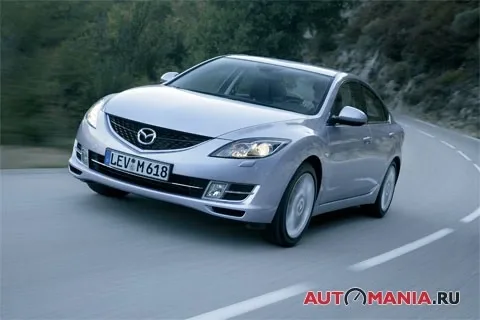
Last year, almost no automaker ignored the Russian market. This leap year, our compatriots are expected to buy over 2 million foreign cars — so global giants are trying to attract domestic buyers. They expand dealer networks, build factories... But there are also surprises more interesting for the average customer. For example, the one Mazda presented in early December by releasing the new "six." Moreover, contrary to tradition, this happened even earlier than in Europe. Although the appearance of this version was expected: last summer Ford introduced the Mondeo II, so updating the Mazda 6 built on the same platform was only a matter of time.
The Russian representative office of the brand has already announced its intention to sell about 15,000 units during 2008. Apparently, the task is not difficult, because the car has become noticeably more interesting. The previous version was also good, but it is worth remembering: it was the first embodiment of the modern zoom-zoom philosophy — a kind of transitional stage from the past to the future. When the concept was finally formed, the car was largely outdated. The update was long overdue, and the Japanese, it must be admitted, worked hard.
The chief designer of the project, Yoichi Sato, working on the new look of the Mazda 6, did not revise the corporate style, but only supplemented it with elements of traditional Eastern aesthetics. It is based on three principles: "yugen" — harmony with nature, "rin" — dignity, and "seichi" — refinement with perfection. According to the authors, this combination was supposed to endow the "six" with emotionality and a pronounced Japanese character.
Indeed, it is difficult to confuse this car with any other. It features traits of both its predecessor and later models. The current Mazda 6 looks beautiful, elegant, solid, and dynamic. But I would not dare call it impressive: in my opinion, it lacks a bit of originality (although tastes differ). However, is that so important for a solid family car? The model has long become a brand, and for many buyers, it is more important that after the update it became 65 mm longer, 15 mm wider, and 5 mm higher, meaning more spacious and comfortable. The wheelbase increased by 50 mm, which also positively affected driving qualities.
By the way, about driving qualities: three gasoline engines are provided for the car. Two of them are well-known units with a volume of 1.8 and 2 liters (120 and 147 hp, respectively). The third is a 2.5-liter engine (170 hp) from the new generation of the well-known MZR family. It replaces, at least for now, the 2.3-liter variant that previously topped the lineup of the previous version. The fact is that the fate of the "charged" MPS sedans has not yet been decided, and in any case, they will not be supplied to Russia. Domestic buyers will have to be content with exclusively civilian versions of the Mazda 6 in four trim levels: Direct, Touring, Sport, and Luxury, with the specified engines and manual or automatic transmissions. As for body types, the sedan and hatchback are already on sale, and the station wagon will appear at dealers in April-May. For the first acquaintance, I got the traditional sedan.
Interestingly, the sedan's interior, it would seem, has completely changed, but at the same time, the continuity of generations is fully felt. Everything seems to be done in a new way, but it looks almost the same. The Japanese kept the general direction in interior styling: here they removed a bit, there they added volume, here they slightly changed shapes...
However, not quite so. The Japanese would not be true to themselves if they did not equip their favorite with a couple of original electronic "gadgets." We do not take the on-board computer, climate control, and navigation into account — today, no one is surprised by them. Good Bose acoustics were also seen in the previous version, so the engineers came up with something new: perhaps the main operational innovation of the "six" is the Cross-Functional Network (CF-Net) system. In essence, it is a refined analogue of the Human Machine Interface (HMI) from the Ford Mondeo II, but unlike it, it is truly convenient. At least, the desire to reach for the familiar keys on the center console no longer arises for the driver of the new Mazda 6. The on-board computer, navigation, music, and climate can now be controlled with buttons on the steering wheel. It is only a pity that the engineers did not get to the Ford instrument panel with a built-in monitor — otherwise, we would have had an almost ideal car.
As for comfort and ergonomics, everything is as before. In front, there are a pair of comfortable, well-made seats. They are not particularly sporty, but on a long journey, your back and legs do not get numb. In the back, there is enough space for three, or rather, for "two and a half" passengers: adults will still have to jostle elbows. The Japanese claim that in the second row of the new "six," there is even more legroom. And this, of course, pleases, although even before, the Mazda gave a head start to most classmates in this parameter. Continuing the conversation about geometric changes, I will also note the gearshift lever that "moved" higher and closer to the driver. It seems like a trifle, but extremely pleasant — on the old version with a manual, I had to reach for fifth gear.
We all love fast driving, but as a rule, we love money more, and therefore we count it well. It is important for us that the new Mazda has risen in price by current standards quite a bit — only $1,000. But it is worth considering: in the first month of sales, the Japanese collected 3,000 orders, and the planned 15,000 cars will most likely be sold out before autumn. By the end of the year, the queue for these cars will stretch for three to four months, and the most in-demand will again be relatively inexpensive versions with 1.8 and 2-liter engines. The first of them came from the previous version, and the second is a modernized "four" that was installed on both Ford and Mazda.
The fact that the car drives well is probably obvious. Smooth linear traction without dips, but also without an adrenaline rush, appears at about 3000 rpm — there are no serious complaints about dynamics and speed qualities. The gearbox operation also deserves the most flattering words. I will also note the smoothness of the ride: the suspension works out bumps imperceptibly and clearly. And no matter how the "six" accelerates, it is very comfortable in it. At the same time, the car is quite stable: it "writes" turns like on rails, and only when the electronic "collar" is turned off, it slides a little. It is no less stable on a straight line. The only thing that slightly upsets is noticeable lateral sway at high speeds and tangible body rolls in corners...
However, after all, we are talking about a solid family car. And movement in it should be smooth and calm. Perhaps this is the very zoom-zoom philosophy, the very Japanese motifs of "yugen," "rin," and "seichi," but no longer embodied in metal or plastic, but dissolved in the air, simple and soothing, like a branch of blooming sakura.
Technical specifications:
| Dimensions: | Mazda 6 |
| Length (mm) | 4755 |
| Width (mm) | 1998 |
| Height (mm) | 1440 |
| Wheelbase (mm) | 2725 |
| Weight (kg) | 1370 |
| Trunk volume (l) | 519 |
| Engine displacement (cm3) | 1999 |
| Max. power (hp) | 147 at 6500 rpm |
| Max. torque (Nm) | 184 at 4000 rpm |
| Max. speed | 214 |
| Acceleration 0-100 km/h (s) | 9.9 |
| Average fuel consumption (l) | 7 |
| Price (RUB) | 653,000 — 883,000 |
Magazine "Autoguide" January 25, 2008 No. 50
Source – AUTOMANIA.RU