
The names of Siberian cities — Surgut, Nefteyugansk, Khanty-Mansiysk — even on a warm day evoke thoughts of bitter cold. If you flip through local newspapers, one detail immediately catches your eye: in car sale ads, the type of engine pre-heater is always mentioned. Without it, you simply can't survive here. Leave your car for a couple of hours — and that's it, you're done. Frost near forty below is common for these places.
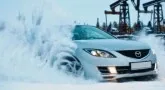
It was in such harsh conditions that Mazda decided to hold the presentation of the new "six." A bold move that no automaker had dared before. The route was as follows: from Surgut we drive a hundred kilometers towards Nefteyugansk. There, on the territory of an abandoned airfield, renowned pilots Oleg Keselman and Boris Shulmeister used a bulldozer to build two snow tracks for testing the car in winter conditions. The first, for evaluating handling, included an acceleration straight, a couple of "figure eights," and a "slalom" at the end. The second — a kilometer-long straight, ending with a classic "moose test." Here too, they looked at the car's behavior and dynamics.
Let me remind you that the new model comes with three gasoline engines: 1.8 L (120 hp), 2.0 L (147 hp), and the top 2.5 L (170 hp). At the first meeting with the car at the test site near Budapest, I chose the most powerful unit. Now I took the most modest one — to compare the sensations.
After driving on the tracks, you understand: the "six" has become noticeably more composed and stable. And this is not a trick of the senses. The chassis has been seriously refined. For example, the subframe of the front double-wishbone suspension is now attached to the body at two additional points. Plus, new dynamic vibration dampers for the upper arms and stiffer shock absorbers. Special mention deserves the power steering with electric assist, borrowed from the rotary Mazda RX8. At speed, the steering wheel fills with heaviness, and when parking, it becomes surprisingly light and obedient.
After all the exercises on the snow track, we had a two-hundred-kilometer drive to Khanty-Mansiysk — the capital of biathlon. As soon as we left Nefteyugansk, the Mazda6 quickly reached cruising speed. By the way, acceleration to 100 km/h for the version with the 1.8-liter engine takes 11.3 seconds. But who knew that the local traffic police have police KamAZ trucks? The inspector who stopped us politely asked us to come and look at our photos... in the bed of a modestly parked truck. It turned out to be a mobile camera that catches speeders across the entire district. Arguing was useless.
Despite the terrible frost, blizzard, and rapidly darkening sky, all cars reached Khanty-Mansiysk without breakdowns. The Mazda6 steadfastly endured the Siberian trials, but I would strongly advise installing an engine pre-heater. It's cold there — words can't describe it!