
This very question was the main reason why it was worth going to meet the new "six." And here it is, the main answer: Mazda does not intend to enter a game called "Unify Everything." No foreign engines or platforms. Simply put, the company remains true to itself — with all its pros and cons. And, as it turned out, it's also more profitable. It's funny that Ford, meanwhile, quite calmly uses both Mazda engines and platforms.
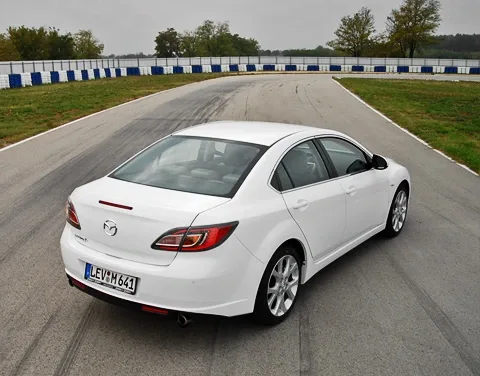
And even before the premiere, there were plenty of "verified rumors from reliable sources." There was talk that the new Mazda6 would be built on the Mondeo platform, and about Ford engines. But in reality, everything turned out to be its own, native. Even if old — the car was created on the basis of the previous generation. Ford engineers are probably very upset right now.
The engines, one might say, are the same. The 1.8 and 2-liter units were not touched at all, but the 2.5-liter engine is only half new — it was made on the basis of the already familiar 2.3-liter engine, and in terms of characteristics it hasn't gone far from it. Power increased from 166 to 170 hp, and torque — from 207 to 226 Nm. And the five-speed "automatic" also moved over from the previous model.
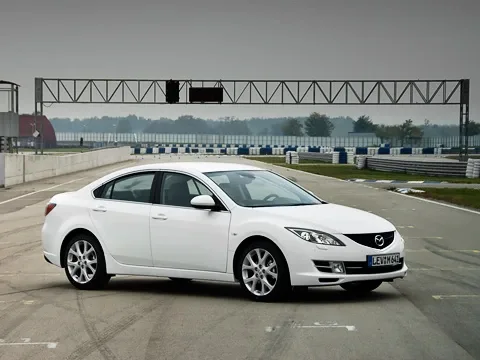
But don't rush to exclaim indignantly: "How dare you?!" This is normal practice. Many do this. Much more interesting is the new (and it really is new) body. Of course, now it is bigger, safer, and more spacious. But I wanted to say "thank you" to the creators when they announced that, contrary to tradition, the mass of the new generation car has decreased. And that's really great. We already know the advantages of new generations by heart — "safer, more spacious, stronger" and so on. But year after year, cars become heavier and more boring to drive. And so that the engines hauling these obese carcasses don't smoke like thermal power plants and don't guzzle fuel like flamethrowers, they have to be "choked" more and more...
Alas, this trend has crushed almost all manufacturers. Among classmates, only the Accord lost weight with the change of generations, and even then only by four kilograms. Without urgent "dietary" measures, the Mazda6 could have gained 90 kilos. But instead, it lost 35! So now the base version weighs only 1280 kg! I feel that if they continue in the same spirit, then in ten years it can be lifted with one hand. "This is our philosophy," the Mazda people say, "because the lighter the car, the better it handles and the less fuel it consumes. By reducing weight, we kill several birds with one stone. Therefore, the new 'six' is bigger, more spacious, and safer, but at the same time lighter and more economical."
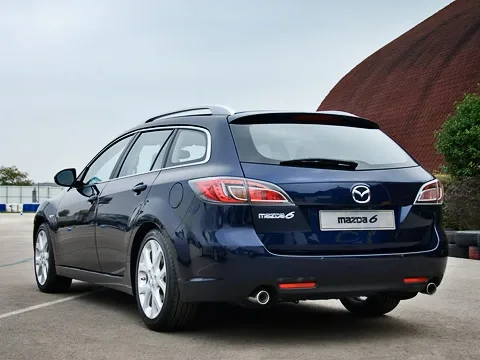
At the same time, the Mazda6 still has no aluminum or other "winged" metals — engineers continue to bet on ultra-high-strength steel. It helped not only reduce weight but also increase torsional rigidity of the body.
And the Mazda people are especially proud of the aerodynamics. The sleek silhouette is the work of not only designers. No joke, the drag coefficient of 0.27 is one of the best in the class! All this could not but affect efficiency — now the version with the 1.8 engine has reduced its appetite by 11.7%, and the 2.5-liter version consumes 6.9% less compared to the previous 2.3-liter.
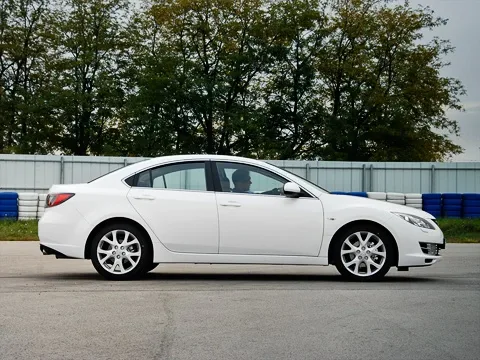
But even in the "old" platform there are plenty of news. At the front, there are still double wishbones, only the steering knuckle is attached to them not through two joints, but through one — for greater precision of reactions. If you want more bloody details, know that the subframe is now attached to the body not at four, but at six points. The steering has become "sharper," and the power steering is now electro-hydraulic. The rear shock absorbers are now not inclined, but vertical — this allowed the creators to play more subtly with chassis settings.
"First of all, we wanted to achieve more precise, more linear, and predictable reactions," says Matsumura, "that's why, by the way, double wishbones suited us better than McPherson, like on the Mondeo."
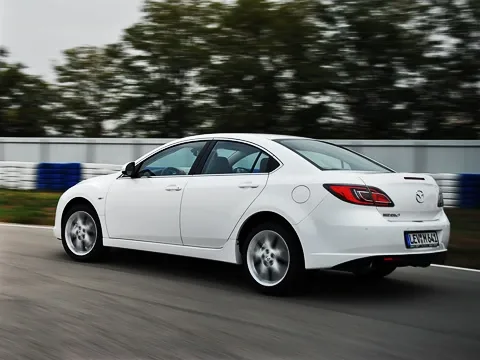
And when we drove pre-production cars onto the track, I began to understand what Matsumura-san was talking about. The Mazda was simple and understandable, as if I myself had been racking up test kilometers at the Miyoshi proving ground, selecting spring and shock absorber characteristics myself, and arguing with engineers, telling them: "We need to make it even sharper!" It's lively and very understandable to drive. You overdo the speed a bit — and the "six" smoothly leaves the trajectory. You lift off the gas — it starts to gradually throw the rear out. You cross the limit — the car lets you know about it softly and tactfully. You do something a little sharper — you get a proportional response. Linearity and again linearity. Except that the ESP system works a bit harshly, without unnecessary ceremony, directing the car to the true path.
The gearshift lever is excellent, and the engines still "ignite." I managed to drive versions with 2 and 2.5-liter engines, and both have convincing traction. Although the two-liter is calmer (and, as the authors would surely say, more linear) — it pulls smoothly and pulls. But to fully mobilize the forces of the 170-horsepower version, you'll have to push the tachometer needle into the right corner. And both engines, by the way, sound great.
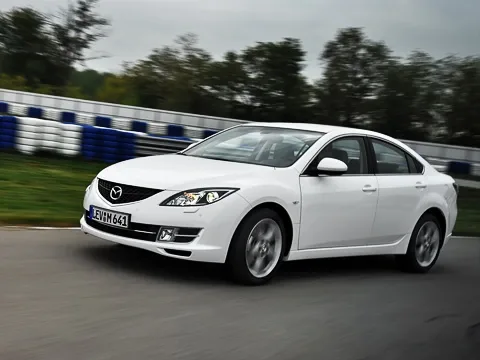
When I brought up the topic of "sound accompaniment" at dinner, a spark lit up in the Japanese eyes: "Yes, yes, we spent a long time tuning the engine sound. I remember, when we were working on the RX-8, they brought us an Alfa Romeo 156 — and it simply stunned us with its roar. And we decided that we would do no worse." I, of course, didn't say that the Mazda is still far from the sound of Alfas, but instead patted the guys on the shoulder and said they did a great job. And I didn't lie, by the way.
But I asked: "But why is it slower? If you believe the specification tables, the version with the 2-liter engine lost 0.2 in acceleration to 'hundred', and with the 1.8-liter — all 0.6. And only the 2.5-liter car became faster. The engine power is the same, the body is lighter and more streamlined — what's the problem?" Matsumura-san smiles in response: "The new Mazda6 is more economical not only thanks to aerodynamics and weight. For versions with weaker engines, we slightly 'lengthened' the transmission — it's quite appropriate there."
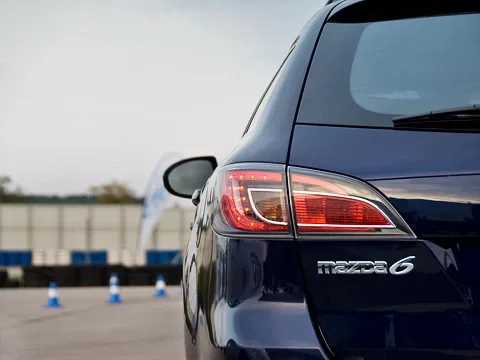
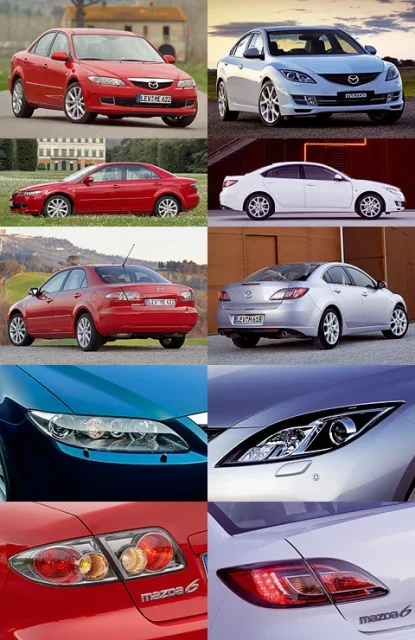
The taillights of the previous Mazda6 were wonderful. But when the round ones got boring, the designers came up with new ones, no worse.
A strange move for a Zoom-Zoom car, isn't it? But why? Why not make even the base version one of the fastest cars in the class? After all, that's how it used to be... And it's very simple — the Mazda6 has matured. And now it can offer its customers not only a good chassis and a peppy engine. Now it's a car in which, when you get in, you first pay attention not to the sporty design and characteristics, but to the quality and refinement of details. At the same time, it can deliver no less pleasure than its predecessor, and fuel consumption is lower. After all, its creators didn't spoil absolutely anything. They only improved it. This is Zoom-Zoom in the second edition, Zoom-Zoom 2.0.
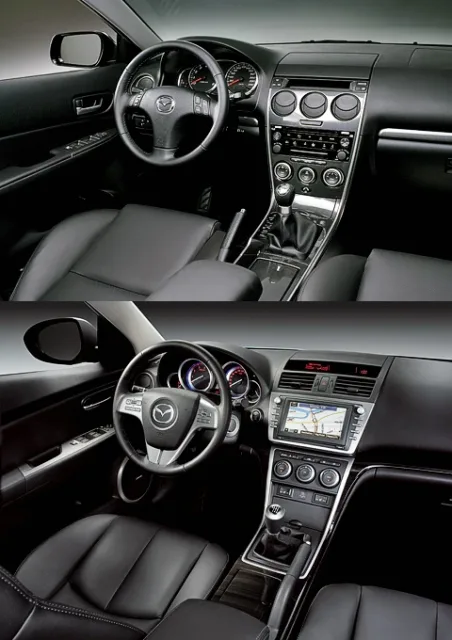
You understand this when you get inside. If earlier the Mazda6 had only a sporty spirit and a small price, now this car has gained new values. I like the instruments that greet the driver, "coming to life" one by one when the ignition is turned on. And the friendly illuminated inscriptions on the sills — except that they say "Mazda" instead of "Welcome!" And the quality plastic, and the pleasant leather — confident steps forward compared to the previous generation. And... a very calm design. The Alfa motifs have vanished, but the equipment is much richer — now the "six" has adaptive bi-xenon headlights, dual-zone climate control, and a keyless entry system.
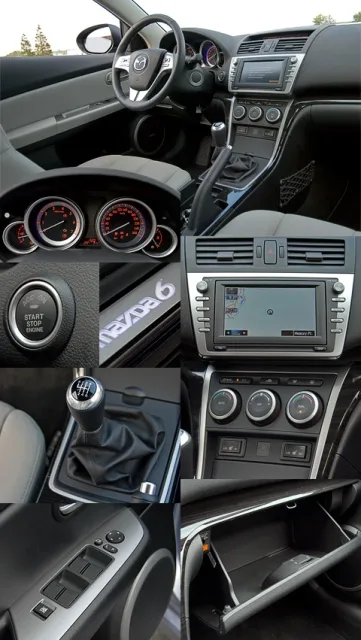
And inside it has become more solid. Both materials and equipment are better. Navigation, of course, won't be supplied to us.
But still, the Japanese don't yet reach the quality of interior refinement of European cars. The Mazda people themselves rated the quality of materials as a four (and the previous one as a three plus). "Oh, if I had the same budget as them, I would also do no worse," says Junji Takahara, responsible for quality, "but in our company they prefer to spend money on technology. But look how we worked out the ergonomics." Sitting is indeed very comfortable, he's not lying at all. The adjustment ranges are good, and the gearbox lever travel is almost ideal. Brilliant! Of course, there's more legroom in the back, and the trunk has become bigger.
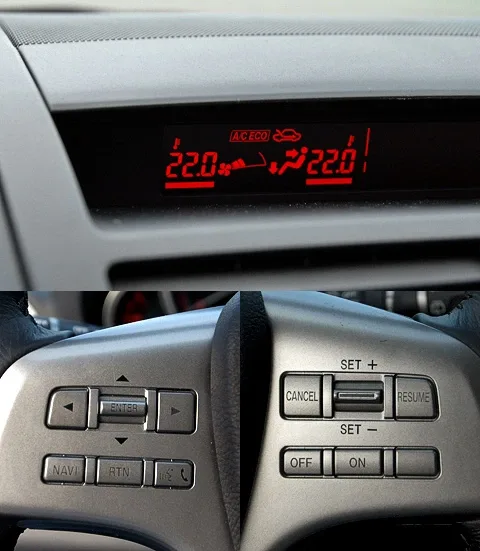
The CF-Net system — Cross Functional Network. A funny name, but an interesting thing — using the buttons on the left steering wheel spoke, you can change anything — from the radio frequency to climate control settings and airflow modes.
Was — became
Behind the scenes
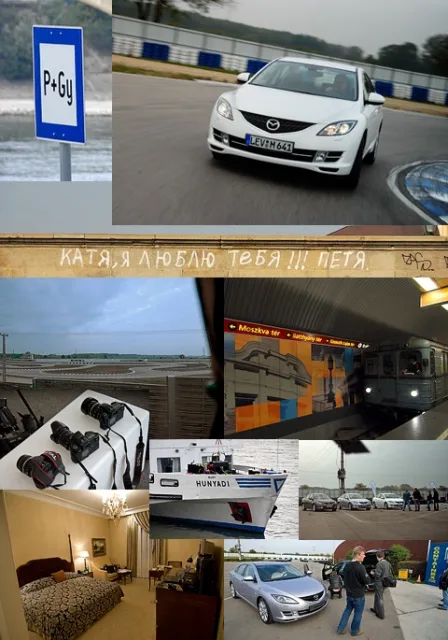
Budapest is a city with a rich history and is very picturesque. However, our goal was not to sightsee (although we did get to stroll a bit). Very close by is the private Euro-ring race track — something like Moscow's Myachkovo, but significantly better and much cheaper. That's where we wore down tires on the pre-production "sixes." There were three gasoline engine options: 1.8, 2, and 2.5 liters, and all of them were paired only with manual transmissions. True, the example with the smaller engine was the only one, so not everyone got to ride in it. The body for all cars was the same — sedan. Station wagons and hatchbacks were also brought, but we were forbidden from getting behind their wheels. For a first acquaintance, however, that's not critical.