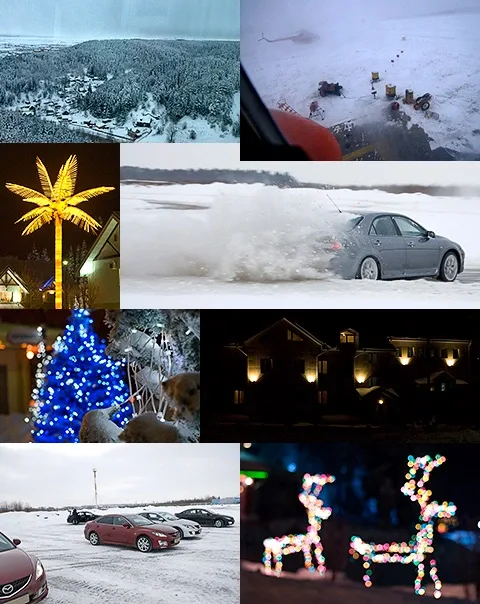
When I was flying to the Russian presentation of the new Mazda6 in Surgut, I already knew there would be no horror stories. At most — on the TV on board, and even that was unlikely. During the technical part, we were told a lot: why the car became more economical, what the "horseshoes" in front of the wheels are for, and how the engineers fought against excess weight (not their own). I even got five minutes behind the wheel. But now I'll have much more time.
Next to me on the plane sat Americans — they said they were in Russia for the first time, and had only heard about Siberia. They weren't destined to meet drunk bears with balalaikas, but the weather didn't disappoint — honest Siberian -30 hit.
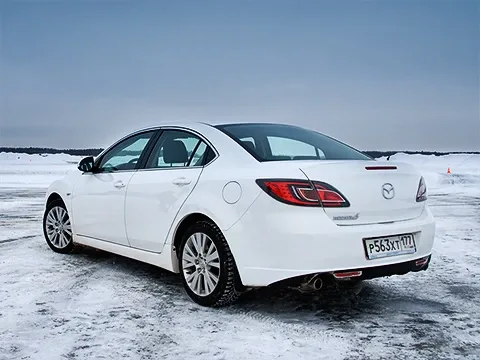
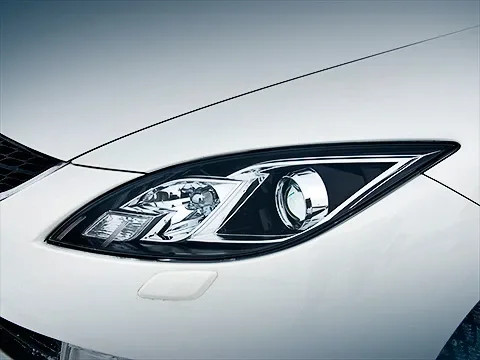
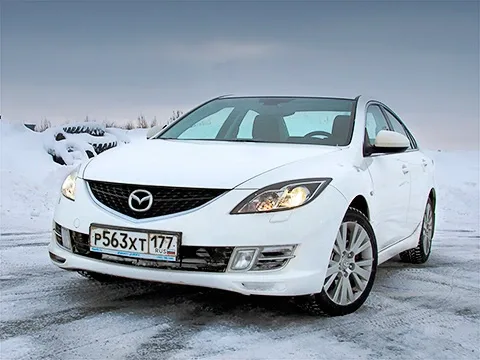
I'll answer the readers' question right away: I don't know! How the "sixes" started in the cold — I don't know, they were waiting for us with already warmed-up engines. A dozen familiar cars of all colors of the rainbow lined up in the parking lot. I chose white again (this time it was the only one). First, I'm a fan of white cars, and the white Mazda6 of the second generation is pure love. The color suits it incredibly, period. Second, it was the most popular trim for our market — a two-liter engine and a five-speed automatic. I didn't spend long examining it — I walked one circle, ran my hand along familiar lines, glanced into the crystal headlights — and into the cabin.
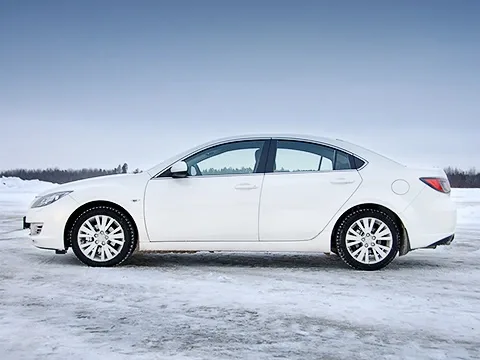
Now I had enough time to properly communicate with the Mazda. They didn't tell us about the rear shock absorber angles a second time, but once in the cabin, I finally appreciated the welcome lighting. The "Japanese hello" looks like this: you sit down, insert the key — and the climate control unit lights up in turn, then the audio system, the onboard computer, and only then the instruments. And hello to you, Mazda, long time no see!
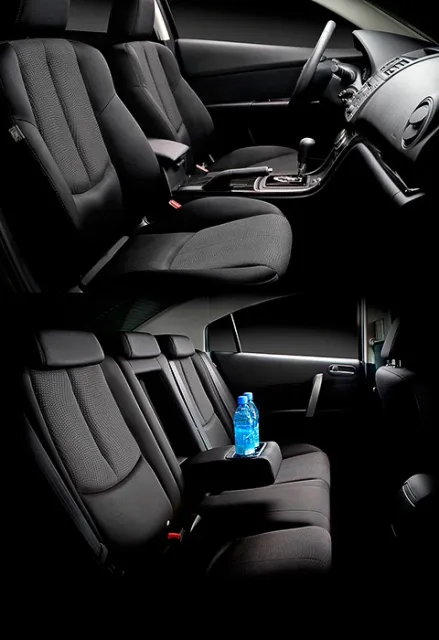
The large navigation screen, which won't be sold in Russia, has disappeared from the interior. Instead, there's an MP3 receiver with a CD changer, similar to the "music" from the Mazda RX-8. Everything else is familiar. Ergonomics are top-notch, the range of seat and steering wheel adjustments is wide, and the mirrors are large. The materials have become "more mature" than in the previous "six", and the interior design itself has grown up. True, some carelessness with details hasn't gone away. Well, that's in the blood of all "Japanese". But the prices are quite humane — the new Mazda6 has increased in price just a little.
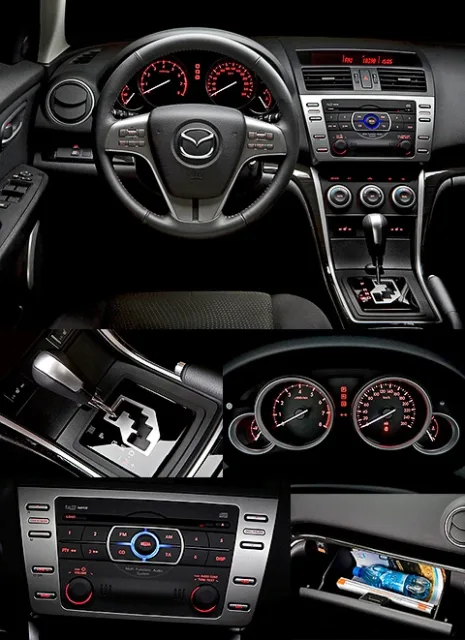
The interior has become more mature, although some may find it duller than its predecessor's. But the seating is more comfortable, rear passengers have more space, and the trims are richer.
I remember well how terrible the four-speed automatic was on the previous Mazda6 before the restyling — I had a chance to drive it. To move normally in traffic, I had to constantly play with modes and shift gears manually… Pure torment! On the new car, the engine and gearbox are from the first "six". But from the updated version, which added a fifth gear. And, as it turned out, not in vain.
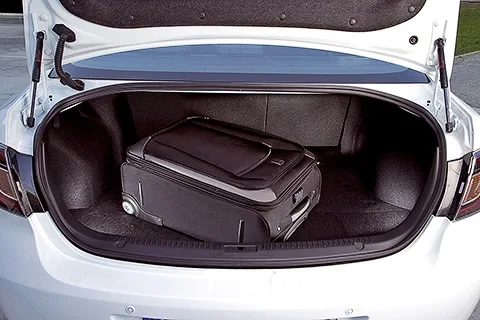
The trunk of the "six" is quite spacious, but without "conveniences" — a couple of niches on the sides wouldn't hurt.
With this gearbox, you can confidently maneuver in the city and not fear overtaking on the highway. Shifts are smooth and quite predictable. And thanks to lower weight and improved aerodynamics, the Mazda6 has become both faster and more economical. And note, with absolutely the same engine.
I also remember well how bad the sound insulation was on the previous Mazda6. But when in October I drove the second-generation car onto the asphalt of the Euro-ring track near Budapest, I was amazed: quiet! That almost deafening silence in the cabin impressed me almost more than the handling. Especially since I only got to drive for a few minutes.
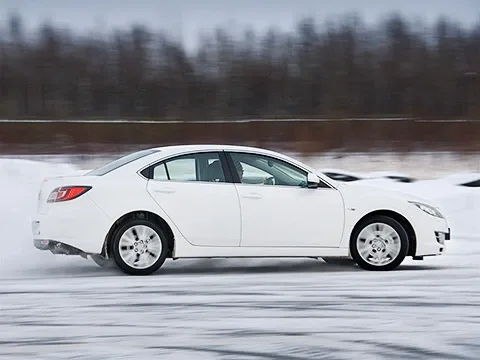
The Mazda6 handles very clearly, linearly, and with enthusiasm.
Two months later. The road between Surgut and Khanty-Mansiysk. Under the wheels — Russian asphalt, snow, ice, and their "cocktail" in all possible proportions. On the wheels — "toothy" Hakkapeliitta 5. The sensations, of course, are no longer the same — the tires are noisy, the wind is a bit audible. But the work of Japanese engineers is felt. And from the "disadvantages" column, sound insulation can be safely crossed out. Finally!
We drive. Over a hundred kilometers — not a single village, not a single soul, only rare oncoming cars. On the sides — a palisade of snow-covered fir trees. The picture is almost black and white. Gray sky, gray trees, gray road. Only somewhere in the distance the sky turns pink — it's not a sunset, but flames from a refinery pipe. The road is good, but without frills. One straight, then another, then another, and so on to infinity.
There's not much place to evaluate the chassis here — you just drive and drive. But even on an icy road, the car holds perfectly. I deliberately tried emergency braking to the floor both at speed, in a turn, and on a broken road — the Mazda behaves excellently, practically without yawing; I dodged a couple of imaginary moose (didn't find real ones) — also fine. Except that the ABS pedal kicks very unusually… But the ESP works quite delicately, much better than on the previous generation.
But on such a road, there's plenty of time to play with CF-Net (Cross Functional-Network). The system is quite interesting — with a few buttons on the left spoke of the steering wheel, you can change almost anything — the volume of the "music" (which is good, by the way), the climate control mode (dual-zone, by the way), and so on. You press the left or right keys — you choose what to change, and on the screen under the windshield, the corresponding data is underlined with a red line. And to change the parameters, there's a joystick that rocks up and down and an "Enter" button on it. Convenient, although even in these three pines you can get lost, especially when the selected mode stops being highlighted. But this is clearly better than the overly convoluted interfaces of some competitors. And while I was playing with CF-Net, the road had already ended.
Here I caught myself thinking that the fate of many airfields is to become racetracks in the next life. As soon as the plump wheels of aircraft stop touching the runway, others start driving on it — low-profile, on alloy wheels. How many racetracks and tracks have arisen exactly this way! And here we are on the empty runway of the airport in Nefteyugansk.
The endless straight driving ended, turns, U-turns, and slides began. And still, there's nothing to say about the car! I'm just satisfied with everything. It's stable, predictable, responds well to the steering wheel and throttle, easily stabilizes, and doesn't suffer from an excessive tendency to oversteer. The electric power steering works excellently — you feel the car perfectly both on asphalt and on snow. And you no longer feel that "biting" of the steering wheel during fast rotation, as with its predecessor. In short, good front-wheel-drive handling without any surprises. And the suspension isn't stiff at all.
And then there was again the road laid through the Siberian "desert", and many, many kilometers of travel. The Mazda6 has matured, become better in every way, retained its originality, and at the same time hasn't become a clone of itself — and that's worth a lot. At least, it's definitely worth the price increase with which dealers sell it. Will the Mazda6 be more popular than its predecessor? There's no need to even think about that.
But another question kept spinning in my head — should I recommend it to those who will tear up my phone line tomorrow? What should I tell them? And if they ask if it's better than some other car? I can answer that too. When I get to Moscow, I'll call the representative offices, and we'll arrange a face-to-face confrontation for the "six" with its competitors. So to be continued…
Technical specifications and trims of the Mazda6 are in the tables below. And after them — my impressions from the trip in this car.
Technical specifications of Mazda6
| Characteristics | 1.8 | 2.0 | 2.5 |
|---|---|---|---|
| Body | |||
| Number of doors/seats | 4/5 | ||
| Length, mm | 4735 | ||
| Width, mm | 1795/1998 | ||
| Height, mm | 1440 | ||
| Curb weight, kg | 1395 | 1410 (1430) | 1430 |
| Gross weight, kg | 1925 | 1950 (1975) | 1970 |
| Trunk volume, l | 504 | ||
| Engine | |||
| Type | Petrol, with distributed injection | ||
| Location | Front, transverse | ||
| Number and arrangement of cylinders | 4, in-line | ||
| Number of valves | 16 | ||
| Displacement, cm3 | 1798 | 1999 | 2488 |
| Max power, hp/rpm | 120/5500 | 147/6500 | 170/6000 |
| Max torque, Nm/rpm | 165/4300 | 184/4000 | 226/4000 |
| Transmission | |||
| Gearbox | Manual, five-speed | Manual, five-speed (automatic, five-speed) | Manual, six-speed |
| Drive | Front | ||
| Chassis | |||
| Front suspension | Independent, double wishbone | ||
| Rear suspension | Independent, multi-link | ||
| Front brakes | Disc, ventilated | ||
| Rear brakes | Disc | ||
| Ground clearance, mm | 165 | ||
| Performance | |||
| Maximum speed, km/h | 200 | 214 (204) | 220 |
| Acceleration 0-100 km/h, s | 11.3 | 9.9 (10.8) | 8 |
| Fuel consumption, l/100 km | |||
| Urban cycle | 9.5 | 9.8 (11.1) | 11.1 |
| Extra-urban cycle | 5.2 | 5.4 (5.7) | 6.3 |
| Combined cycle | 6.8 | 7.0 (7.7) | 8.1 |
| Emission standard | Euro-4 | ||
| Fuel tank capacity, l | 64 | ||
| Fuel | AI-95 | ||
Mazda6 Trims
| Trim name | Direct | Touring | Sport | Luxury |
|---|---|---|---|---|
| Front airbags | + | + | + | + |
| Side airbags | + | + | + | + |
| Side curtain airbags | + | + | + | + |
| ABS | + | + | + | + |
| ESP | + | + | + | + |
| Front and rear power windows | + | + | + | + |
| Power-adjustable and heated side mirrors | + | + | + | + |
| Power-folding side mirrors | - | + | + | + |
| CD stereo | + | + | + | + |
| Bose audio system with CD changer | - | - | + | + |
| Steering wheel audio controls | - | + | + | + |
| Air conditioning | + | + | + | + |
| Dual-zone climate control | - | + | + | + |
| Bi-xenon headlights | - | - | + | + |
| Upholstery: fabric | + | + | - | - |
| Upholstery: fabric and leather | - | - | + | - |
| Upholstery: leather | - | - | - | + |
| Alarm system | - | - | - | + |
| Central locking | + | + | + | + |
| Alloy wheels 16" | + | - | - | - |
| Alloy wheels 17" | - | + | - | - |
| Alloy wheels 18" | - | - | + | + |
| Prices, in rubles (US dollars) | ||||
| 1.8 MT | 653000 (26650) | 699000 (28530) | – | – |
| 2.0 MT | – | 759000 (31000) | 826000 (33720) | – |
| 2.0 AT | – | 798000 (32570) | 865000 (35300) | – |
| 2.5 MT | – | – | 852000 (34780) | 883000 (36050) |
Behind the Scenes