
Mazda6 MPS
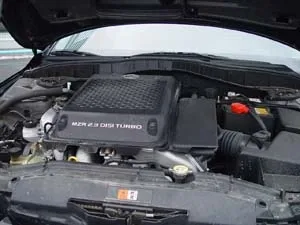
Powertrain: turbocharged gasoline engine with DISI technology.
Displacement: 2,261 cc
Output: 260 hp at 5,500 rpm
Peak torque:
380 Nm at 3,000 rpm
The sprint from standstill to 100 km/h takes 6.6 seconds.
The top speed is electronically limited to 240 km/h.
Gearbox: manual, six-speed.
Drive — all-wheel, with ATS system.
Fuel consumption: (only 98-octane)
in the city — 14.1 l/100 km
on the highway — 8.0 l/100 km
in combined cycle — 10.2 l/100 km
Body dimensions:
Length — 4765 mm
Width — 1780 mm
Height — 1420 mm
Permissible gross weight — 2085 kg.
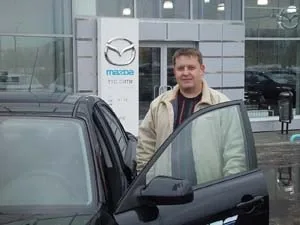
Igor Garipov, director of LLC "Color+", driving for 15 years.
I have long been a fan of D-class sedans: comfortable for the driver, spacious for passengers, and a roomy trunk. Moreover, the latter is closed — unlike a hatchback, when opened in winter it does not release all the warm air from the cabin. And the attitude towards such a car on the road is different, not like towards a small subcompact. I am a calm driver by nature, but sometimes I want to press the pedal so that everyone around understands who is in charge here. And then disappointment sets in when under the hood there are only a little over a hundred horses. You involuntarily think: why not switch to a Lancer EVO 9 or Impreza WRX STi? But that would already be C-class.
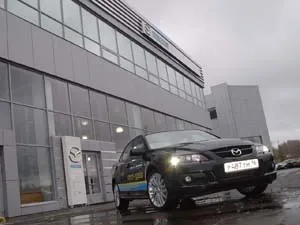
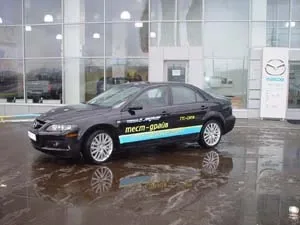
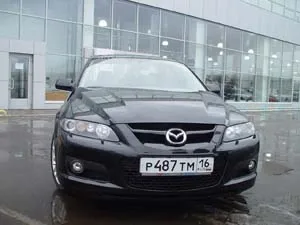
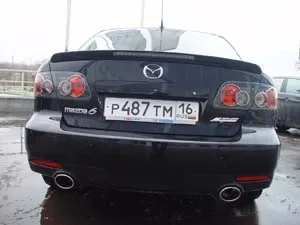
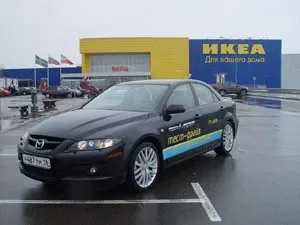
And here Mazda, in my opinion, hit the mark. The Six with the "MPS" badge. Even by its appearance, it is clear — it is better not to compete with it on the road. The high, sculpted hood hides the intercooler of an engine with almost three hundred horsepower, around the perimeter there is an aerodynamic body kit, and at the rear on the sides there are two exhaust pipes.
What I experienced behind the wheel exceeded all my expectations. The noble voice of the engine, the short-throw clutch, which you need to get used to when starting off, and then everything goes like clockwork: the gear lever moves easily — excellent synchronizers make gear changes surprisingly simple, the steering wheel is sharp and clear, the suspension is taut, and now the speedometer needle has passed two hundred!
In short, the Mazda 6 MPS is a car that is suitable both for daily trips to work or to the dacha, and from time to time for "soulful" runs. True, you will have to come to terms with the gluttony of the engine, which requires only 98-octane gasoline.

Alfred, driving experience 11 years.
We have already tested the Mazda 6, but that was the regular version, without the MPS prefix. Since then, a lot of time has passed, but the impressions have not faded at all. I remember the cozy interior, gorgeous design, and, most importantly, the perfect operation of the "automatic." On all cars with automatic transmissions that we have had for tests, we have never encountered such a magnificent gearbox. And what about here, on the MPS? A turbo engine with a displacement of 2.3 liters, with direct injection, producing 260 hp. All-wheel drive with a self-locking differential on the rear axle, which engages the rear when necessary (and, of course, a full set of modern stability systems), six-speed manual. All this filling is packed into the elegant body of the Mazda 6. More precisely, into the body of the Mazda 6 MPS.
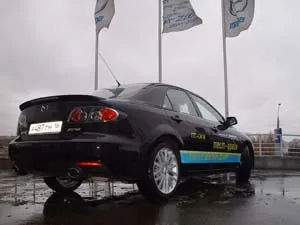
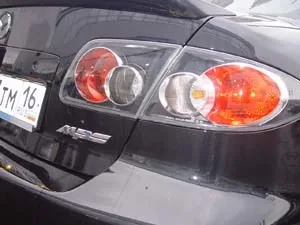
It differs from the regular "Six" in external details. The engineers sought to maintain a 50/50 weight distribution, so they placed the turbo intercooler radiator not in the front overhang, but directly above the engine. Because of this, the hood acquired an additional edge. The Mazda 6 did without a "nostril" on the hood, like the Subaru, and without a "window," like the Lancer Evolution — the hood simply became 35 mm higher. The rear bumper was slightly changed, and the optics were slightly touched. That is on the outside. But inside, everything remained the same, although the character of the car became completely different. True, the interior does not create a sporty mood, which is a pity. The inspection is complete — time to hit the road. This time I am the first to get behind the wheel, look around, and try to pull away. Ignoring the manager's warnings about the short clutch, I stalled. The second attempt — the same result. Apparently, before the trip, I need to read a prayer to the corporate deity Zoom-zoom. Oh, great spirit of Zoom-zoom!
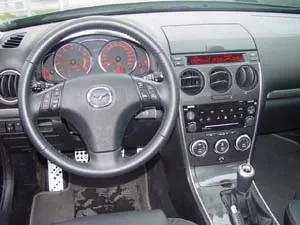
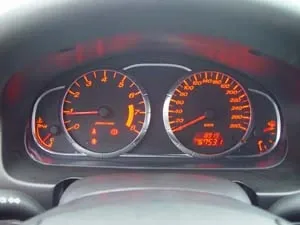
Do not let me stall at a traffic light and save me from wheelspin, breathe an extra half-atmosphere into the turbine, engage the rear drive friction clutches, inject fuel into the combustion chamber, protect me from an accident during acceleration... Ha! It worked!!! It turns out you just need to press the gas more boldly, not be afraid. Spur the car on — and it will respond with joyful, enthusiastic acceleration. It is just that passengers will not appreciate this: their stone faces in the rearview mirror slightly embarrassed me! And speed fascinates, intoxicates, and dulls the sense of danger. Only speed and adrenaline remain (the first is visible on the speedometer, the second you feel with every cell of your body). The turbo kick is felt as a confident jerk forward: without boost, the engine produces 160 hp, and with it — all 260. On a straight road, the car is just a song, and the accelerator pedal becomes the main detail.
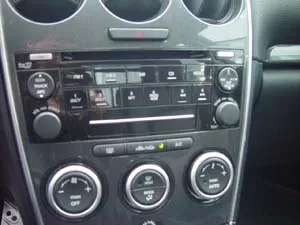
Unfortunately, we never checked how the car handles corners and copes with our road potholes. We did not check — yes, frankly, we were not eager to. It is already clear from the steering that the car handles excellently; it could not be otherwise. The steering feels taut — very responsive and sharp, reacting both to the steering wheel position and the road profile. I mean, if the asphalt has a slight slope, the car involuntarily follows it. At first, I blamed a misaligned wheel alignment, but it turned out to be a feature of the steering. As I said, it is very taut and transmits all the nuances of the surface in a sporty manner, including bumps. The car demands attention, especially at speed, and does not forgive one-handed driving — you need to hold it confidently, with both hands. What did you expect, you have serious machinery in your hands! The gearbox is also tuned for adrenaline-fueled driving: the gears are precise and very short. You hit intuitively where you need to. The first 3-4 shifts make the car visibly jerk, but then, having gotten used to the "length" of the gears and the character of the car, everything falls into place. And now I simply cannot imagine how a gearbox should work otherwise — it should be exactly like this! Driving past a checkpoint at the required 40 km/h, I catch myself thinking that the car is like a sprinter in a low-start position, ready at any moment to dash off so that it will not seem enough. Indescribable sensations!!!
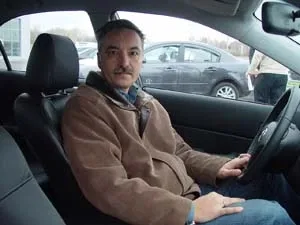
Vadim, driving experience 9 years.
At first glance, the "hot" version is no different from the regular Mazda 6. To spot the differences, I had to ask the manager for help. Mainly, it is the modified radiator grille and rear spoiler. We have already driven the regular restyled Mazda 6 2.0 (see "Autoclub-Kazan" No.), and then the operation of the new 5-speed automatic transmission impressed us the most. So it was all the more interesting to try a car with almost twice the power.
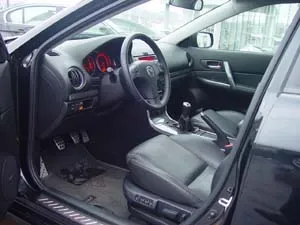
The interior pleasantly surprised: leather seats and steering wheel, high-quality trim, rich equipment. Usually, in the name of "sportiness," the interiors of powerful and inexpensive cars are quite ascetic. This time, I started the test drive in the back seat. What can I say? It is comfortable to sit, soft, plenty of legroom — while the car is stationary or the driver is in a half-asleep state. And everything changes dramatically when the driver remembers the gas pedal! Who would have thought that the seat belts in the back seat are not just an interior detail, but a very necessary thing? And we have not even left the city yet. As the driver "warms up," you can go through two stages: first, it is scary to look forward (such things are happening there!), and then it gets even worse — it is simply impossible to take your eyes off the road. Probably, as an option, there should be a paper towel here, and in especially severe cases, a diaper too.
Well, we took a ride — now it is my turn to get behind the wheel. You immediately notice: the steering wheel is very stiff, it seems that the power steering does not make turning easier, but on the contrary, adds heaviness. In the city, at low speeds, this is rather a minus, but on the highway, it is pure pleasure. The clutch pedal springs under your foot, and its travel is quite short. At first, the engine keeps stalling when starting off, or the car jerks during acceleration. The gear lever moves very precisely, the throws are short, and without getting used to it, it is quite possible to confuse third and fifth. The clutch and gearbox combination is clearly tuned for fast and sharp shifts.
Outside the city, this car literally provokes you into mischief: you slow down to 80, let some car pass ahead, and then overtake it in one burst. And, frankly, I got the feeling that it doesn't matter at all what brand is driving ahead. The turbo is tuned just perfectly: it kicks in at 3500 rpm, but the engine's operation is so smooth that you don't feel any 'turbo lag' when the revs drop below that mark. Honestly, I personally prefer the logic of the Volvo XC90 2.5 Turbo, where the torque peak is at 1500–4500 rpm — that gives both smoothness and reserve for a burst. And the power there is less, only 210 hp, despite the larger displacement, but it's achieved by 5000 rpm. So, the Volvo's thrust is spread evenly across the entire range. But the Mazda is a completely different character — it's driver-oriented, it demands maximum power only at the top end. So, once again, I tip my hat to Mazda's engineers for this gorgeous, almost racing engine. On the highway, I kept lifting off the gas and then trying to accelerate again — sometimes just pressing the pedal, sometimes downshifting. I really liked this responsive acceleration.
Unfortunately, I didn't dare to test the Mazda in corners — it had summer tires with almost worn-out tread, clearly meant for dry asphalt. I must admit, this surprised me: I thought nothing could be worse than the stock Turanza ER30, but it turns out there is. In the city on wet roads, the front wheels keep breaking traction. And the dealership manager strongly advised against driving through puddles at speed. But in normal, standard modes, the handling is just excellent. The rear drive engages automatically when needed. Personally, I like this approach more than permanent all-wheel drive. And it's not even about fuel economy (who cares about that when there are 266 hp under the hood?), but that front-wheel drive is more familiar to me. And if the Mazda does decide it's time to engage the rear axle, then the traction control, ABS, and stability control can all activate simultaneously. Together, they will bring the car back to the correct trajectory — provided, of course, that the tires match the season and the surface.
When we returned to the city, the Mazda pleasantly surprised again. First, lane changes — precise, instant, responsive. Second, acceleration dynamics: if the distance between intersections is short, then approaching the second one, you see that the line of cars has just started moving from the first.
Yes, the car is really good, beyond all praise. But I think the Mazda requires a certain level of experience from the driver. It's very dangerous if it falls into the hands of a young 'racer' who is used to tearing around in a tinted Lada. Usually, their 'skill' is only enough for straight sections of good roads. Overall, though, this Mazda reminds me of a luxurious, spicy dish that you can occasionally treat yourself to.