
Initially, we planned to arrange exclusively a face-to-face meeting of two legends — Mitsubishi Lancer Evolution IX and Subaru Impreza WRX STI of 2006 model year. The first direct duel in Russia of these famous super sedans in their final generations!
However, we decided to expand the circle of participants. Yes, at the first asphalt presentation at the Japanese ring, the Mazda 6 MPS looked deprived of all-wheel drive. But when we brought the production car onto the ice and snow of the Dmitrov test site — and when the Mazda with its simple clutch engaging the rear axle dealt not only with the Volvo S60 AWD, but also with the Subaru Legacy 3.0 Spec B (see AR No. 3, 2006)… It seems a new star has flared up on the horizon of all-wheel-drive turbo cars!
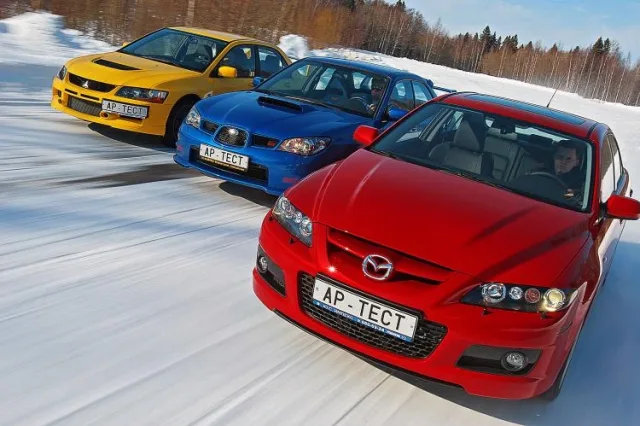
Against the backdrop of two rally monsters, the Mazda still looks like a toy — expensive and cute. The spoiler on the trunk lid is quite small — only chrome trims in the bumper, which merely imitate exhaust pipes, are responsible for the sporty image. Inside — spacious and comfortable “civilian” seats with slippery leather upholstery and a multifunction steering wheel adjustable in two directions. Soft glow of red backlighting, numbers on the on-board computer screen, pleasant music from the Bose audio system... An excellent family sedan. Its “sportiness” is reminded, perhaps, only by the metal pedal covers.
 |  |  |
| Mazda 6 MPS: the most spacious and richly equipped car | Subaru Impreza WRX STI: modest seat, large steering wheel, high gear lever | Mitsubishi Lancer Evolution IX: Spartan trim, excellent Recaro seats, Momo steering wheel |
But the ninth-generation Lancer Evo is an ascetic. A devotee. A fanatic who, for the sake of higher automotive values, gave up simple comfort. There is no audio system, no on-board computer, no... Although wait, the Evo IX finally got climate control — three small knobs hidden at the bottom of the console.
But in the Evo, you least want to think about such mundane things. The carbon plane of the rear wing in the rearview mirror divides the world in two. Recaro seats with leather-suede upholstery securely hold the body. A blackened Momo steering wheel, race-like close to the chest, fits in your hands. Steering column adjustment (as in the Subaru, only by height), engine start — and...
 |  |  |
| The 2.3 DISI engine with direct injection pulls smoothly and powerfully — as if there were no turbo at all — but at the bottom it is sluggish: it wakes up only after 2000 rpm | Beautiful alloy wheels are shod with tires of a rare size 215/45 R18: you will have to suffer with tires | The bezels of the instruments are a slight hint of sport in the “civilian” interior |
But first, let's sit in the Subaru. There is less asceticism here — silver plastic, a standard audio system (though it sounds simpler than in the Mazda), mesmerizing instruments with red needles that make a control sweep when the ignition is turned on. There is something samurai about this — like, roll up your sleeve, swing your arm with a clenched katana. Let's chop the rivals into cabbage! Otherwise, why the plastic intercooler air intake on the hood, why the ornate plastic rear wing on the trunk lid? Why the rally seating position — low seat, steering wheel pushed close, high gear lever?
 |  |  |
| The Bose audio system is not bad, but the climate control does not work perfectly | The short gear lever shifts easily and quite clearly | Through the fake “pipes” you can see ordinary pipes |
It's a pity that the seats here are not as comfortable as in the Evo. But for an extra charge, you can get seats with heating. And a section folds down in the backrest of the rear sofa — only the Impreza of this trio is adapted for transporting long items like skis.
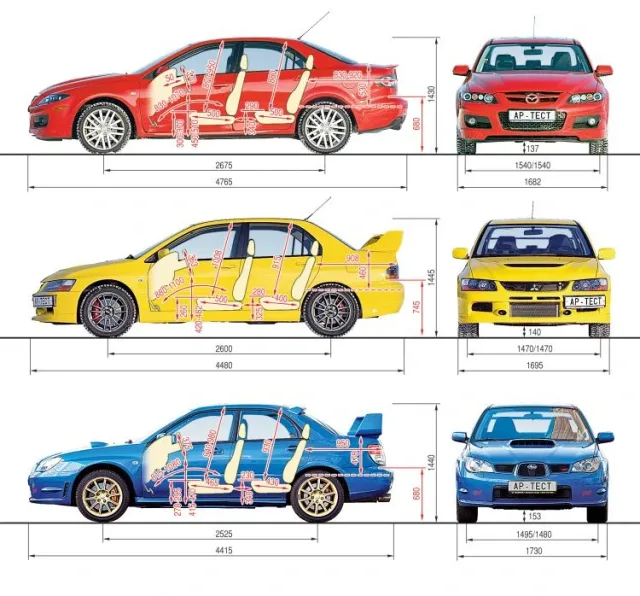
But passengers whom the Subaru owner takes to a ski resort will be the most cramped in the back. Knees press against the hard plastic of the front seat backs, heads — against the low ceiling. And getting in is complicated by the high sill. And the Impreza's trunk is the most modest.
In the Evo IX, there is slightly more space in the back, there are cup holders in the armrest, and the trunk is more spacious. But, of course, neither the Lancer nor the Impreza can compare in passenger and cargo capabilities with a higher-class sedan — the Mazda 6 MPS. If not for the “blind” backrest of the rear sofa, which the Japanese sacrificed for body rigidity...
 |  |
| The seats are not sporty, but with electric drives | To turn on the seat heating in the Mazda, you need to twist your wrist |
 |  |
| The Mazda is more spacious “by definition” — it is class D after all | The trunk is spacious, the lid is upholstered from the inside. But the sofa backrest is “blind” |
But the Evolution and Impreza WRX STI are icons. Those who buy such cars usually don't care about the cramped rear. Or that the trunk closes by the bare metal of the lid. Yes, these are still the same mass-produced Japanese “small cars” — but thanks to FIA homologation, turned into “semi-finished products” for rally monsters. And now on the slippery roads of the test site, we will find out who is worth what! And can the Mazda 6 MPS compete with them?
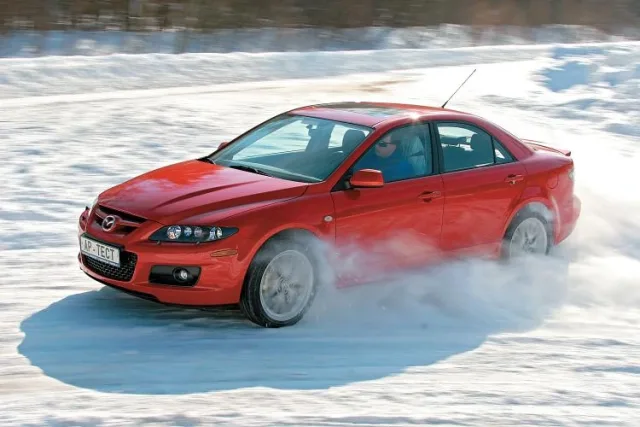
Mazda 6 MPS: an excellent balance of comfort and sport, and with the stability control off on ice — almost ideal behavior of an all-wheel-drive car
In terms of engine displacement, the 2006 Impreza WRX STI confidently leads in this trio: Subaru specialists could not “fit” the familiar two-liter turbo engine into Euro 4 standards and were forced to install a 2.5-liter engine on European Imprezas. But there is no bad without good — who was bothered by the extra half-liter? Theoretically, in elasticity, both the Mazda and Mitsubishi should yield to the Impreza. And in practice? We can only check this when the roads of the test site are completely free of ice. And while the season of instrumental measurements is not open, our professional equipment has not yet come out of winter hibernation — and we can only roughly estimate acceleration. Also because any serious press on the gas immediately causes wheelspin!
The Subaru has the most exciting and dramatic acceleration. The thrust at the bottom is decent but moderate — we expected more from the 2.5 engine. After 2000 rpm, the engine slightly comes to life, and by 3000 rpm it finally “fires” with real turbo thrust. But that's not all — the dynamics increase! The boost peak occurs only at 4000 rpm — it is at these rather high revs that the Subaru engine delivers maximum torque. The effect is intriguing — as if over two thousand rpm on the tachometer, you are increasingly pushed in the back.
And that characteristic “boxer” sound, rich in soft low-frequency vibrations? Yes, the Subaru can be loved for that alone!
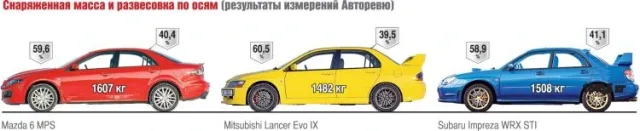
Full throttle on an icy, snowy track is an activity that requires complete concentration, because the Impreza under power stubbornly refuses to hold a straight line. The car constantly tries to break into a slide. This is likely due to the fact that in the all-wheel-drive WRX STI, the torque vector is shifted to the rear axle: the center differential in its standard state sends 59% of the torque to the rear and only 41% to the front. However, in any case, keeping the pedal to the floor is only possible at the cost of continuous and lightning-fast steering work, and you have to turn the wheel not only frequently but also at significant angles. This is despite the fact that the steering on the 2006 WRX STI has become noticeably sharper — the wheel still makes 2.6 turns between the extreme points, like the Mazda. In the Evo IX, this figure is just over two turns.
Of course, the steering response is not just about the steering ratio. For example, the Evo has the worst turning radius — the front wheels cannot turn at a large angle. Subaru, on the other hand, can turn almost on the spot. So if you compare the static steering ratios of the Mitsubishi and Subaru steering mechanisms, the difference will not be fundamental.
Nevertheless, the fact remains: the Impreza responds to steering inputs quickly, but without the lightning-fast sharpness and jewel-like precision that the Evo is famous for. Its reactions are quite "civilian" and well-suited for high-speed highways. Perhaps the relatively soft suspension also plays a role — on asphalt waves, you often notice body roll. But on sharp bumps, the shaking becomes noticeable — this Subaru cannot be called comfortable.
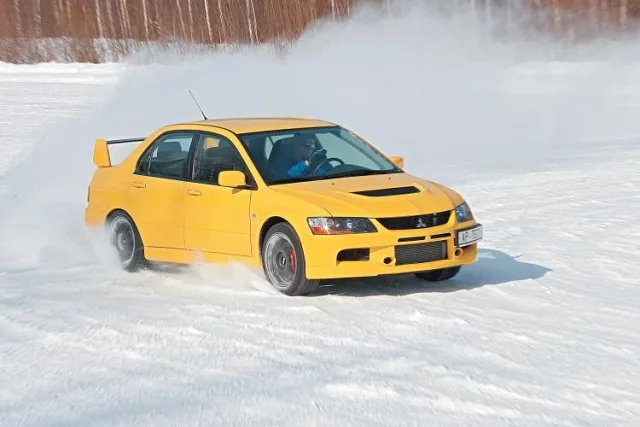
Evo IX — a professionally precise tool for slides. The "smart" all-wheel-drive transmission works perfectly, instantly and adequately responding to driver commands
But the Evolution is the stiffest of the three, even though we have the Ultimate version with "comfortable" Bilstein shock absorbers. It shakes constantly here! But at the same time, the Lancer stands on road waves as if glued — the chassis feels monolithic and solid. Responses to steering inputs are precise, instrumentally calibrated. The engine is simply explosive! Every gear change is a new surge. The turbo kicks in at about 2500 rpm, and moderate acceleration instantly turns into furious! The only disappointment is that on the Evo IX, the engine has become noticeably noisier.
 |  |  |
| The latest generation of the 4G63 turbo engine, thanks to variable intake timing, is "fitted" into Euro 4 norms, but the engine has not lost a bit of the furious, explosive thrust characteristic of the Evo | Mitsubishi's instruments are old-fashioned, the scales are hard to read. But who has been stopped by that when choosing an Evo? | The shift clarity of the Evo IX's six-speed gearbox is better than on pre-production cars. But the "tuning" badge here is unnecessary |
But the new six-speed manual gearbox, although it has lost the feel of a rifle bolt, is the best in our trio in terms of shift precision. In the Subaru, despite a huge step forward (the lever on the 2006 WRX STI has become commendably short-throw and engages positions with a pleasant click of the detents), the selectivity is far from ideal — during fast shifts, you sometimes miss the desired gear.
The Mazda has the most "civilian" gearbox: the short lever seems to slide into the desired slot by itself under the action of the drive springs. And the 2.3 DISI engine is the quietest and most docile. Turbocharging is almost imperceptible here — just around 2000 rpm the engine comes alive and begins to pull powerfully, smoothly, and confidently all the way to the extreme 6000 rpm. But since the main reserve of energy is concentrated in the high-rpm zone, you have to downshift more often than in the "explosive" Mitsubishi and Subaru.
Of course, even on snow, you can feel that the Mazda is slightly slower than the Impreza and Lancer: both the power deficit (260 hp versus 280 for the Evo IX and STI) and the extra 100 kg of curb weight play a role. But this does not mean that the Mazda 6 MPS is "slow." Far from it! On the road, it will allow the driver almost everything! A huge reserve of thrust hurls the heavy sedan forward immediately after pressing the gas. A "sharp" and informative steering wheel, instant and precise reactions... And at the same time — excellent ride smoothness for such a "sporty" character. The suspension perfectly "swallows" small surface defects and confidently dampens waves. Only on potholes with sharp edges does the Mazda shudder unpleasantly with its entire beautiful body.
 |  |
| The emptiness in the console can be filled with a CD receiver "to taste." The small "climate" knobs are inconvenient to operate | The Recaro seats are excellent |
 |  |
| In the back, it's more spacious than in the Subaru, but tighter than in the Mazda | BBS wheels are the prerogative of the expensive Ultimate version |
And yet the main question is: which of the three sedans is the fastest?
Let's not talk about asphalt yet — there's simply none on the test site right now. But on snow and ice... We conducted timed runs on a track laid out along the gentle slopes of the test site. In summer, circuit races sometimes take place here, but now it's slippery. Very slippery. Ideal conditions to reveal all the handling characteristics! Especially since all three cars are placed in equal conditions: all have studded Nokian Hakkapeliitta tires. The only difference is in sizes and that the Subaru had the newest Hakkapeliitta 5 tires, while the Mazda and Lancer had to make do with the well-known fourth generation.
What a nervous Impreza... The whole ride is a constant struggle! Mostly with the car. Approaching a corner, you never know how the Subaru will react to your actions. Sometimes it goes into a long understeer — and there's every chance of leaving a mark with the front end, with its characteristic truncated trapezoid nose, on the outer snow bank. Sometimes it will spin into a desperate oversteer that you might not catch — and then you'll land in a snowdrift rear-first...
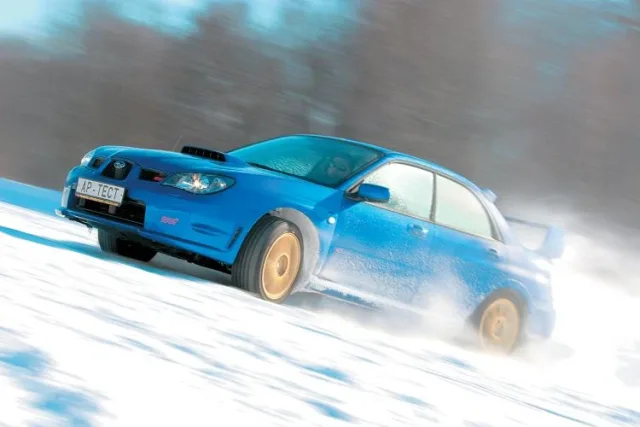
The Subaru's handling is extremely ambiguous: first a deep understeer, then a sharp and equally prolonged oversteer. You need to be very careful with this car — the Impreza does not forgive mistakes
The situation can only be clarified in one way — by first rocking the car with a counter-steer, "setting" it sideways in advance. But there's a catch here too: on the exit of the turn, when you need to press the pedal to the floor for powerful acceleration, the Impreza can suddenly plunge from a steady slide into a very sharp and therefore very deep oversteer. And coping with it without strong course oscillations is extremely difficult — even turning the wheel from lock to lock, you don't have time to catch the right moment! At first, the "STI" seems to ignore the correction, and then it "wags its tail" too sharply.
In short, I had to sweat.
And getting into the Lancer... No, I couldn't cool down. Here too — it's a struggle. But a completely different one: with the track and with yourself. And in this struggle, the Evolution is not a "treacherous traitor" like the Impreza, but a faithful ally.
 |  |
| In addition to the rear wing, the WRX STI version has a spoiler on the trailing edge of the roof | The instruments are excellent; on the tachometer scale, there's a red "hint" lamp for the shift point |
 |  |
| The rear seats of the Impreza are the tightest | The trunk is small, but there's a ski hatch |
Amazing obedience! The initial phase of understeer is short and easily predictable — and it transitions into oversteer, albeit somewhat abruptly, but exactly when you expect it. Reactions to steering input, to lifting off or adding throttle, are sharply fast and, most importantly, unambiguous. You can do anything with this car! Acceleration on a straight line is also more stable than in the Subaru — the Lancer requires only minimal correction.
In the end, averaging all the run times, we determined the winner — on a track that takes two minutes to complete, the Evolution allows you to gain about half a second.
And Mazda? It lagged behind — by a second and a half from the Evo and a second from the Subaru. But driving the Mazda is no less enjoyable than the "Evolution"!
When the clutch engaging the rear axle activates, you barely notice it — you can control the car through the throttle in corners with the same ease and confidence as in the Evo. You approach a bend, brake, lift off the gas to break the rear loose — and then press the pedal to the floor again. The drift angle levels out, and the Mazda, throwing snow from under all four wheels, accelerates confidently in a controlled slide.
 |  |  |
| The seats can't be called comfortable — the backrest presses on the lower back | The climate control is well thought out, the heater works perfectly | The gear lever has a short throw, but the shift precision is lacking |
Moreover, because the Mazda responds more gently to driver inputs, it's even easier to control in drifts than the Evolution! And of course, there's no hint of the stubbornness that characterizes the Subaru.
 |
| The 2.5-liter flat-four in the WRX version produces 230 hp, while the Impreza WRX STI gets 280 hp. The difference lies in higher boost pressure and forged pistons with anti-friction coating. The acceleration dynamics are peculiar: up to 2500 rpm the torque is quite modest, and the turbo kick is stretched to 4000 rpm. The engine sound is also interesting — with signature "flat" notes, but in the Subaru it's not as loud and annoying as in the Evo IX's cabin |
What if we're being subjective? What if something is escaping us? So we invited independent arbiters to the test site — professional instructors from two counter-emergency driving schools, one from Mitsubishi and one from Subaru. But they came to the same conclusions. In timed runs on a winding course marked with cones on a wide snowy area, both Dmitry Bolysov from the Driving Art school and Dmitry Savostin from the Subaru school posted their best times in the Evo. The Mazda, though slower, allowed the instructors to consistently repeat identical laps. But to achieve the second-best result in the Subaru, both had to work hard — their attempts were extremely inconsistent.
The Mazda 6 MPS is simply amazing! It's clear that for rallying it's a bit heavy, the suspension could be stiffer, and the power steering "chokes" during sharp steering inputs... And yes, the all-wheel drive here isn't entirely "honest." On snow, everything is superb. But how will the car behave on gravel? On asphalt? What if the clutch overheats — then the electronics will limit its operation, and the Mazda will essentially become front-wheel drive?
We'll check all this in the near future. But for now, on winter roads, the Mazda 6 MPS has simply captivated us. It offers precise, exemplary, very understandable handling in slides, along with the highest level of safety. After all, only the Mazda among this trio has the DSC stability control system, which works smoothly and unobtrusively. Such a system would be very useful for the Impreza with its treacherous and unpredictable character.
And on top of that, the Mazda 6 MPS is cheaper!
In short, it's almost the perfect car for those who need to drive in the city every day and a couple of times a year head to a closed ice track for training. It's just a pity the rear seat back doesn't fold, the climate control isn't more precise, and the appetite isn't smaller... During the test, the Mazda 6 MPS drained its 60-liter tank no slower than the Evolution and Impreza, which are famous for their gluttony.
So how did their duel end?
It's only in full swing — without the "asphalt" part, it's too early to draw conclusions. But some things can already be said for sure.
The Lancer Evolution IX, like all previous "Evolutions," is an exceptionally precise car to drive. Its behavior in drifts is close to ideal — that's why on ice it turns out to be faster than the Impreza WRX STI. Among racers, there's an opinion that civilian "Evolutions" with the electronically controlled Super AYC rear differential are less predictable than the rally-bred Evo RS with conventional mechanical locks. But our test impressions don't confirm this so far.
However, rallying is a separate universe. Even Group N4 cars, which are closest to road versions, are infinitely far from them. In the eternal Subaru vs. Mitsubishi rivalry, three almost unrelated levels can be distinguished. The tip of the iceberg is the battles of WRC cars. The middle is the fight in Group N4, where cars have completely different gearboxes, suspensions, differentials... And finally, the road-going Lancers and Imprezas are cars for training, "club days," and daily driving with a hefty dose of adrenaline.
For everyday life, the Impreza is still better suited. But in "combat" modes, it loses to the Lancer in handling. Why? Maybe it's due to poorly matched transmission lock characteristics? Or less experience in tuning the electronics that control the center differential in the WRX STI? After all, Subaru started producing electronically controlled DCCD center clutches even earlier than Mitsubishi, but then development slowed — and the Lancer with its "intelligent" all-wheel drive system moved ahead. Now Subaru has to catch up. And although the rivals scored equally in total expert assessments, in our view, the victory in this duel goes to Mitsubishi.
However, there's a positive side to the Subaru's stubborn nature. This car teaches you to always be extremely focused! Relax — and you're in a ditch. Don't feel the moment of losing control — and you're stuck in a snowdrift. Most fast all-wheel-drive cars of the 20th century were like that. Remember the rally monsters of Group B — they refused to turn at all!
So whoever can tame and master the Subaru will have every reason to be proud of themselves.
And what about those who can't? How many side rails and struts have been straightened in dealership and club services? How many turbo-Imprezas have ended their lives with the terrible diagnosis "written off"? So Lenin's behest for Subaru owners sounds more relevant than ever — learn, learn, and learn again! Or start your journey in the world of all-wheel drive with slower, simpler, and more predictable cars. For example, like the Mazda 6 MPS.
| Vehicle equipment | |||
| Make | Mazda | Mitsubishi | Subaru |
| Model | 6 MPS | Lancer Evolution IX | Impreza WRX STI |
| Base version price, $ | 42300 | 46460 | 50910 |
| Front airbags | + | + | + |
| Side airbags | + | – | O |
| Inflatable "curtains" | + | – | – |
| ABS | + | + | + |
| Dynamic stability control | + | – | – |
| Multifunction steering wheel | + | – | – |
| Power-adjustable and heated exterior mirrors | + | + | + |
| Power windows for front and rear doors | + | + | + |
| Power-adjustable front seats | + | – | – |
| Rain sensor | + | – | – |
| Heated front seats | + | – | O |
| Climate control | + | + | + |
| Onboard computer | + | – | – |
| Hatch in rear seat back | – | – | + |
| Cruise control | + | – | – |
| Power sunroof | O | – | – |
| Audio system | + | – | + |
| Leather upholstery | + | – | – |
| Fog lights | + | – | – |
| Xenon headlights | + | – | + |
| Headlight washers | + | – | + |
| Spare wheel | M | R | M |
| Maximum trim price, $ | 43300 | 50790 | 51630 |
| (+) Included in base version | |||
| (-) Not available in base version | |||
| (O) Optional at extra cost | |||
| M — compact spare wheel ("space saver") | |||
| R — repair kit with sealant | |||
Prices and trim levels
Mazda 6 MPS looks the most practical of the three. It offers richer equipment than its competitors and is cheaper — $42,300. For a sunroof, you will have to pay an additional $1,000. The warranty on the car is 3 years or 100,000 km, and maintenance is required every 20,000 km. It is worth noting that all cars from the first batch have already been sold, so a new order (with a $1,000 prepayment) will take about five months.
Purchasing a Mitsubishi Lancer Evolution IX is simpler — the car can be delivered to order in just a couple of weeks. The main sales will be for the Sport version at $46,460, as the more expensive Ultimate trim (which participated in the test) with Bilstein shock absorbers and BBS wheels will cost $50,790. However, it is worth remembering that servicing the Evo is quite troublesome — you need to visit the service every 5,000 km, and the warranty is limited to just one year or 20,000 km.
The Subaru Impreza WRX STI surpasses the Evolution in equipment. The base version costs $50,910, while cars with side airbags, heated seats, and tinted windows cost $51,630. Subaru's main advantage is longer service intervals (once a year or every 15,000 km) and better warranty terms: 2 years or 30,000 km. However, the warranty on suspension parts, including shock absorbers, is limited to 15,000 km. A dealer will deliver an ordered car in three months but will require a 20% prepayment.
For those who do not need such power, it is worth considering the 230-horsepower Impreza WRX — it is about $10,000 cheaper (from $39,860 to $41,710). This version has lower boost pressure, a simpler transmission (the center differential is locked by a viscous coupling), station wagons are available, and the warranty is the same as for regular «civilian» cars — 3 years or 100,000 km.
How the transmissions are designed
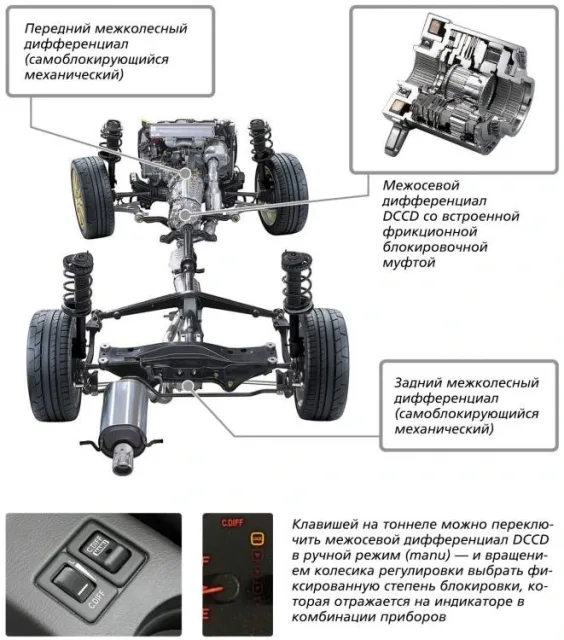
All three cars are equipped with all-wheel drive with electronic control. A special controller analyzes data from steering angle sensors, accelerations, wheel speeds, and even brake light activation to manage the operation of the components.
However, these systems are implemented completely differently.
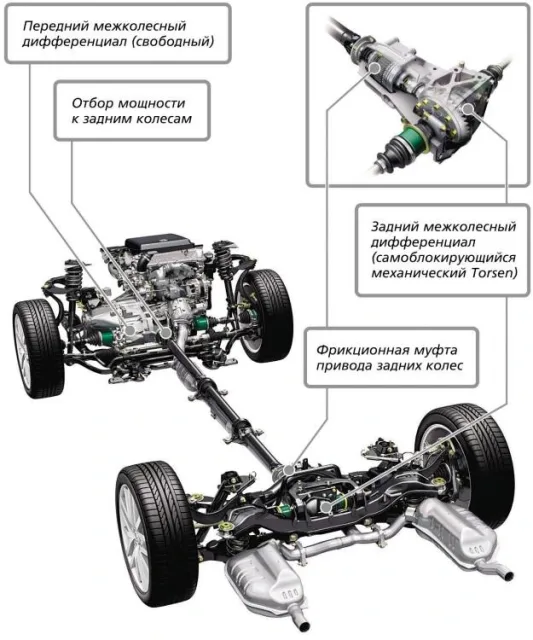
The simplest all-wheel drive is in the Mazda 6 MPS. Essentially, it is a front-wheel-drive car in which the rear wheels are engaged by electronic command. The rear drive coupling is integrated with the rear final drive — the disc pack is compressed by an electromagnet through a ball ramp mechanism. When the discs are released, the Mazda behaves like a regular front-wheel-drive car. As soon as electronics send a signal, the discs compress, and more traction is transferred to the rear axle — up to full locking and a rigid connection of the axles. The driver cannot influence this process — the electronics themselves choose one of three programs: «normal», «sport», or «snow». On asphalt, this works well, but on snow — it is simply excellent.
The transmission design of the Evo and STI has fundamental differences. Both cars have permanent all-wheel drive, but the center differentials are integrated directly into the gearbox housings. In the Evolution, torque is split between the axles in equal proportions — 50:50, while in the WRX STI, the bias is shifted toward the rear axle (41:59). The electronics adjust the degree of center differential locking using friction clutches, but Subaru also gives the driver a manual tool — a DCCD dial on the tunnel that can set the desired locking degree. If the «center» is fully locked, the Impreza accelerates noticeably more confidently, but it responds worse to steering and tends to understeer. In the opposite, most «free» mode — when only a soft mechanical lock inside the DCCD is engaged — the car becomes overly twitchy and even more nervous than in automatic mode. At intermediate dial positions, the car's behavior is as ambiguous as in auto mode.
It seems the manual adjustment is designed to adapt the Subaru's character to a specific track, but only a truly experienced driver can use it effectively.
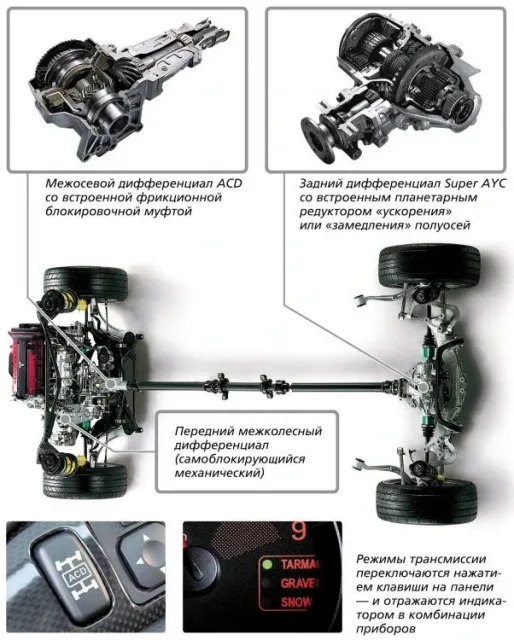
And finally, the Evolution. Its electronic «brain» controls not only the ACD center differential lock but also the exclusive rear Super AYC unit. This system can turn a regular differential into a kind of inter-wheel reduction gear: on electronic command, it can accelerate the rotation of the left or right wheel. The driver can choose one of three modes with the ACD button. On the Evo IX, the transmission remained the same, so the behavior of the «nine» is no different from the familiar Evo VIII. The «asphalt» mode is the most stable, «snow» is maximally agile and prone to slides. «Gravel» is in between — and we considered it optimal for such runs. However, both instructors in their runs preferred «asphalt» — as did the racers we involved in the Evo VIII test earlier. In any of the three modes, the Evolution behaves absolutely predictably.
Mitsubishi Lancer Evolution IX
Mazda 6 MPS
Subaru Impreza WRX STI
Dmitry Bolysov
director of the Driving Art school
 The Mazda 6 MPS left an exceptionally pleasant impression — a benchmark of a fast family sedan with all-wheel drive. True, for active driving, the suspension seems too soft, although it is hardly appropriate to make sporty demands on it. With fast steering, the power steering is clearly overloaded and does not keep up. The clutch also has its own character: the spring servo mechanism pushes the pedal out at the moment of engagement, requiring additional muscle effort from the driver. In city traffic jams, I think this will quickly get tiresome.
The Subaru Impreza pleases with powerful and assertive acceleration, but the «turbo lag» is well felt. A long steering rack in winter is a plus: there is more time to correct mistakes in a turn. And mistakes happen often, because the Impreza behaves unstably: a sudden understeer can turn into oversteer. You have to drive it wide and spectacularly, but it is still slower than the Evo IX. What annoys most is the imprecise gearshift mechanism, which provokes errors during high-speed shifts.
The Evolution IX turned out to be more interesting. Its sharpness and aggressiveness require skill and do not forgive mistakes, but the car allows you to implement completely different driving styles. You can drive with a drift, or you can drive with a smooth roll. In any case, it turns out faster than the Subaru.
Dmitry Savostin
instructor at the Subaru School
 The Impreza WRX STI is a stiff and wayward car, like a spirited horse, that will only obey a brave and skilled rider. The long steering wheel helps beginners avoid mistakes but hinders a prepared driver, and the shift clarity could be higher.
The Evolution — a sharp and informative steering wheel, an explosive engine. A car without a single compromise. If you try to relax — the Lancer will immediately shake you on a bump with its stiff suspension and will not let you forget who is in charge here.
The Mazda 6 MPS is a real surprise! It is docile, nimble, and understandable. Against the background of the Subaru and Mitsubishi, it seems more convenient, comfortable, civilized, and undemanding. But in sporty modes, when the Subaru's waywardness and the Mitsubishi's sharpness become advantages, the Mazda remains a «civilian» car. Here the weaknesses of the power steering, the quirks of the clutch drive, and the features of the all-wheel drive show up — I still feel a delay when the rear axle engages.
It is very difficult to choose between the STI and the Evo: each has its own family flaws and unique advantages. The Mitsubishi has a nicer steering wheel, seats, and gearshift mechanism, while the Subaru responds better to engine control, and the suspension is not as harsh on the spine. But personally, I choose the Mazda. It may not be for professional rallying, but it is comfortable to drive every day. And in amateur rally sprints, it will not yield to more «charged» rivals.
Autoreview readers' forecast
Before this test, we asked visitors of www.autoreview.ru to answer the question: «Which of the cars participating in the next Autoreview test would you choose?» The votes were distributed as follows:
Mazda 6 MPS - 24.4%
Mitsubishi Lancer Evolution IX - 40.3%
Subaru Impreza WRX STI - 35.3%
A total of 12,620 people voted