
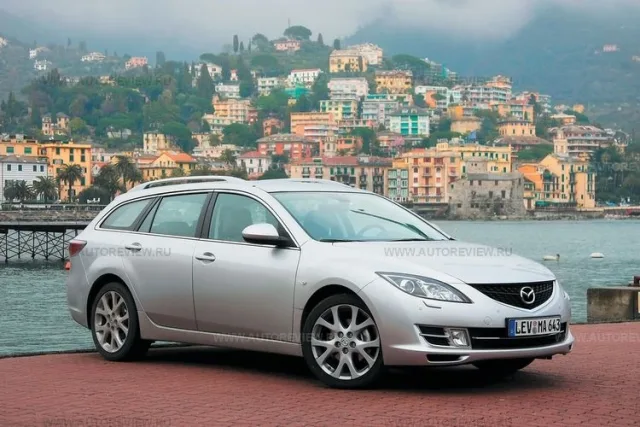
— How many movements do you make to load things into the trunk of a typical station wagon? — asks Riuichi Umeshita, one of the creators of the new Mazda 6. And without waiting for an answer, he starts counting on his fingers. — You open the fifth door — that's one. You lift the shelf — that's two. And only then do you toss the bags inside. With the new Mazda 6 wagon, you'll save one movement!
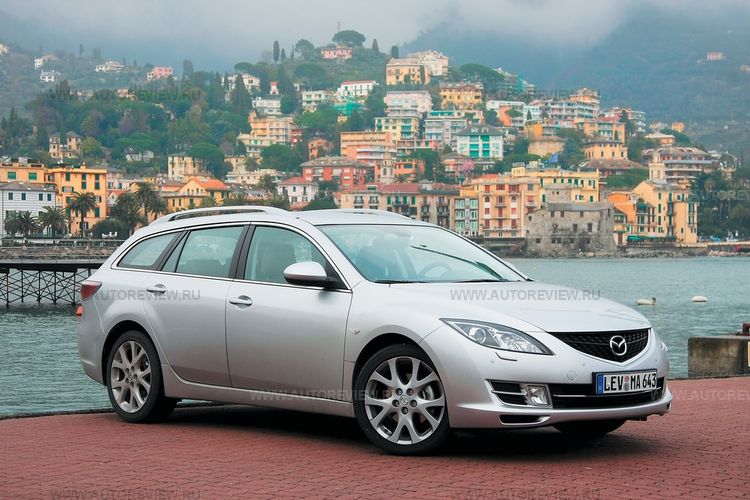
The rigid trunk shelf of the second-generation Mazda 6 wagon has a hidden feature. You open the door — and simultaneously with it, a translucent mesh rises, and the rear edge of the shelf itself starts moving up along the body pillars, folding like an accordion and freeing the opening for loading.
This is karakuri. That's what they called intricate mechanical toys in Japan, crafted on the islands a couple of centuries ago. Karakuri in modern form is the conveniently transformable seat of the Mazda 5 minivan and the previous-generation "six" wagon. And also — the new "mechanized" shelf in the current "six."
The Japanese spent four years creating the karakuri shelf: among ten different mechanism variants, there was, for example, one with an electric drive. However, in the end, they chose more affordable and more reliable mechanics.
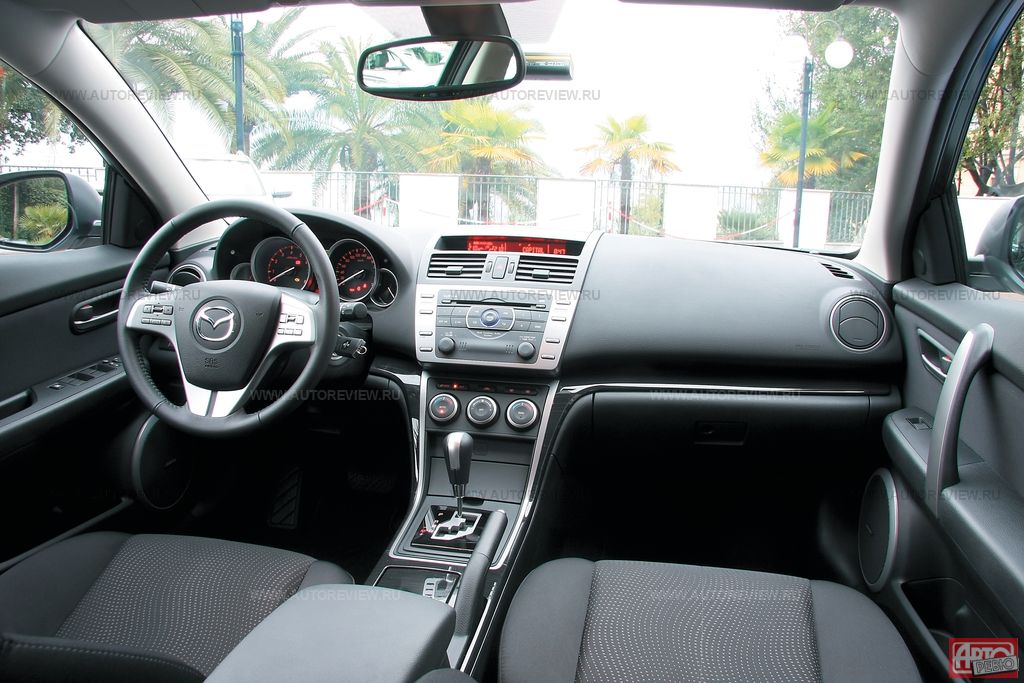 |  |  |
| The interior of the "six" looks solid |
By the way, my first car was also a station wagon — a VAZ "four." With "Russian karakuri": two rubber bands on the inside of the door pulled up a huge shelf made of fleecy plastic. Why make extra movements?
But who would buy a car with "rubber bands" now? It's another matter with karakuri…
In the European D-segment, which has shrunk by 12% over five years, the Mazda 6 is an exception: since 2006, sales of the first "six" have been steadily growing. The new one alone should sell 90,000 units in Europe this year. About 18,500 of them will find owners in Russia. But if three-quarters of all "sixes" here are sedans, the picture in Europe is different. There, 40% of sales are the Mazda 6 wagon. The hatchback is slightly less in demand — 34%, although in Germany its share reaches 86%, and in France — 82%!
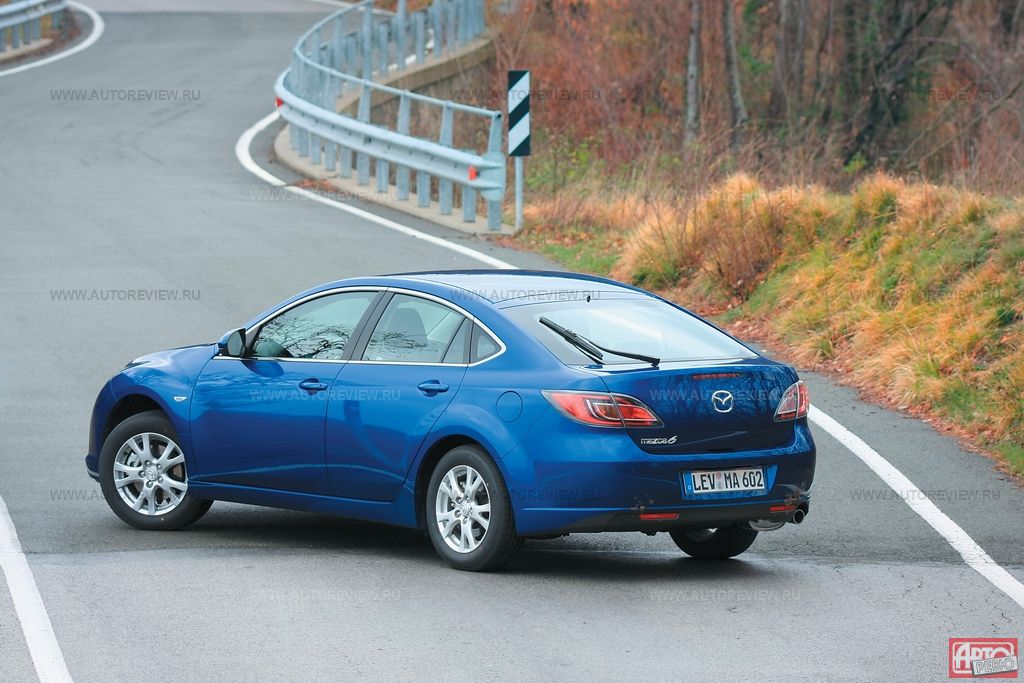
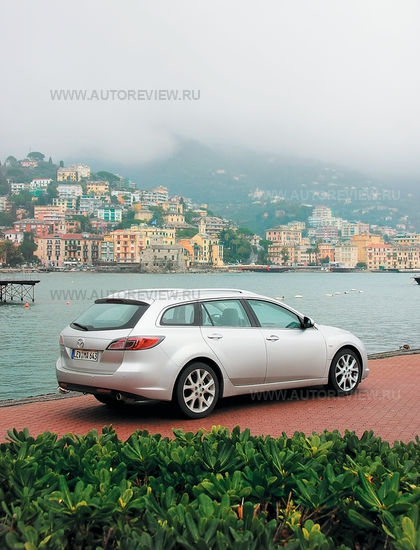
I got acquainted with both five-door "sixes" of the new generation near Genoa, in the town of Rapallo — where the Soviet People's Commissar for Foreign Affairs Chicherin signed the famous Treaty of Rapallo. A place of incredible beauty. And the Mazda 6 wagon is good here: despite being the most bulky in the family (30 mm longer than the sedan). Narrow side windows, rising beltline, sloping roof… It's no wonder that Mazda's chief designer Yoichi Sato considers the "wagon" his main design victory. At the same time, the drag coefficient of the new wagon is 0.28, just one hundredth more than the sedan and hatchback.
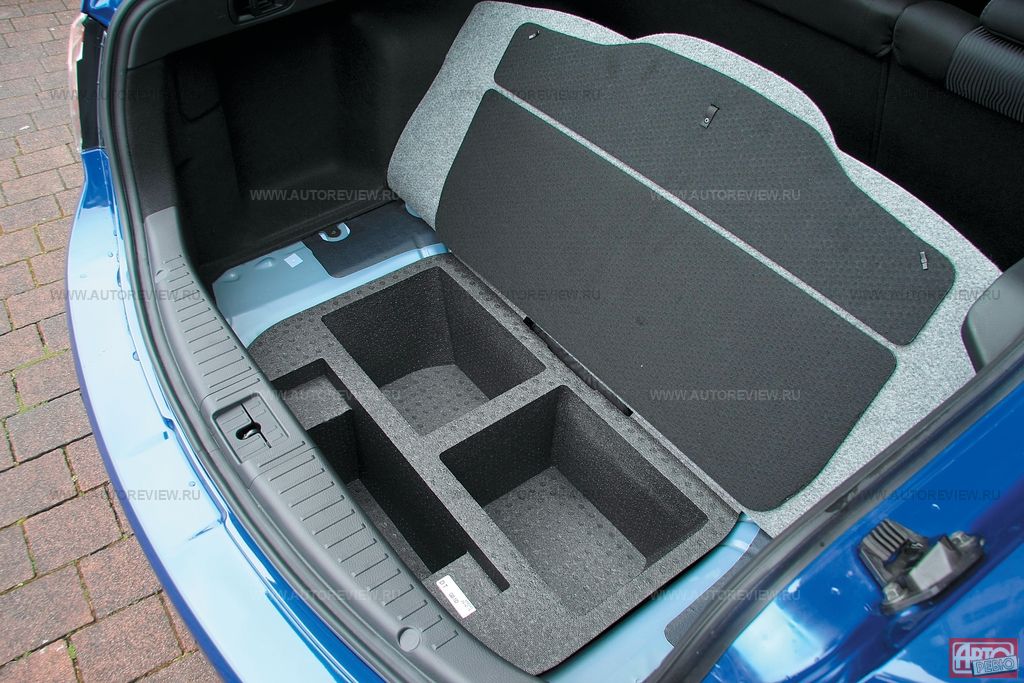 | 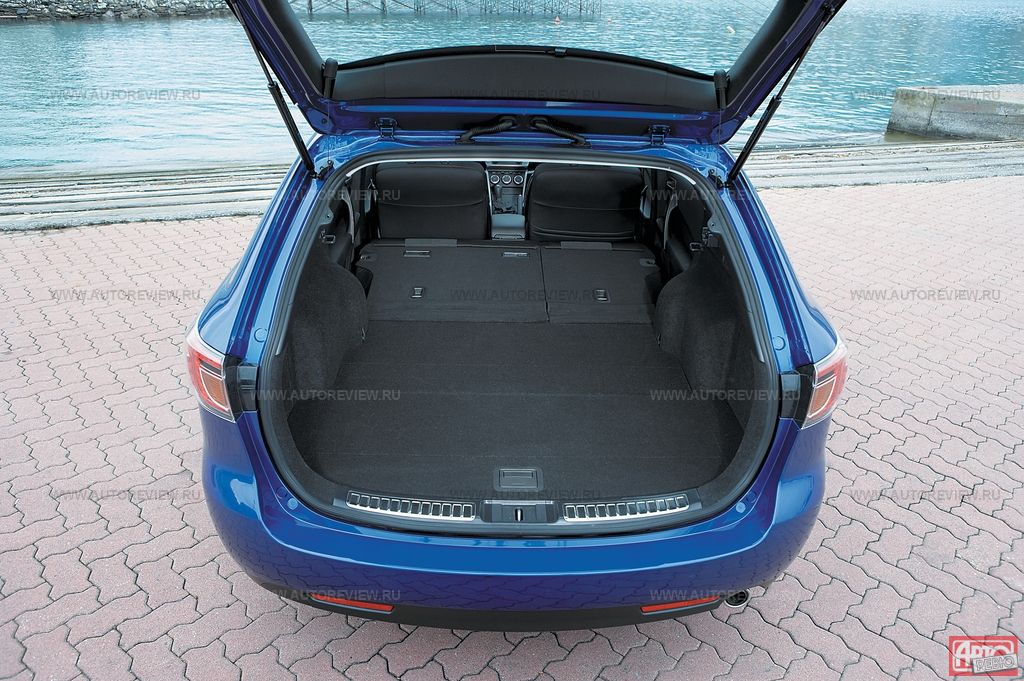 | 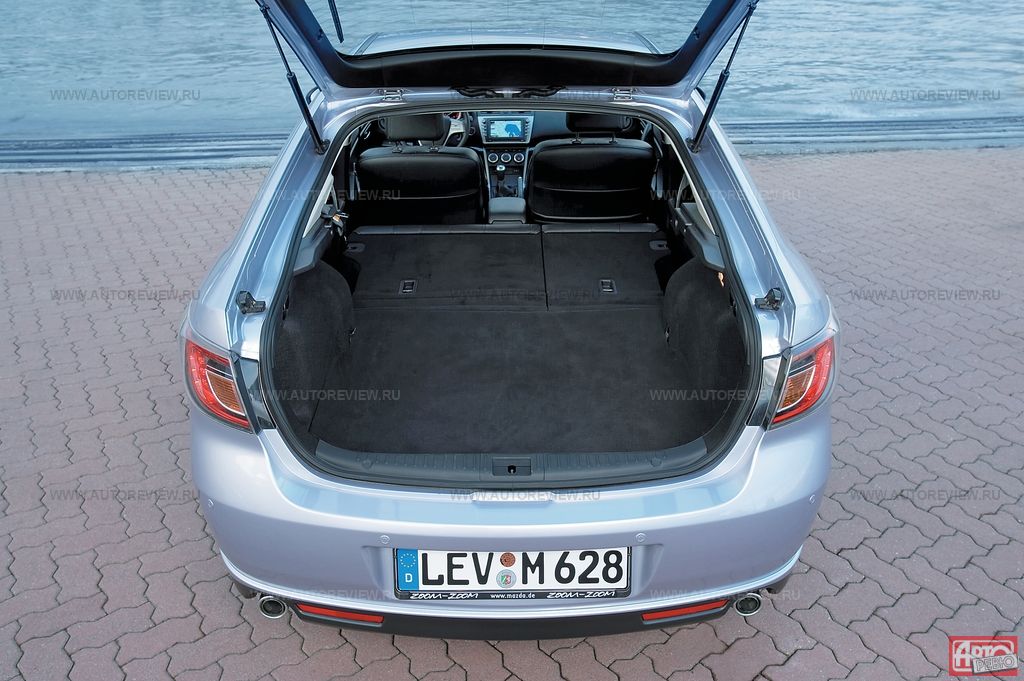 |
| Instead of a spare wheel under the trunk floor — either utility niches or a subwoofer housing | The trunk volume of the wagon "under the shelf" is only 519 liters. Ford Mondeo (542 L) and Volkswagen Passat (603 L) are ahead in this regard, but with the rear seat folded, Mazda wins — 1751 L versus 1733 L for the Mondeo and 1731 L for the Passat | In the usual configuration, the shape of the "hatch" trunk and its useful volume are the same as the wagon's. But due to the sloping roof, the maximum capacity is more modest — 1702 L. By the way, the shelf here is the most ordinary |
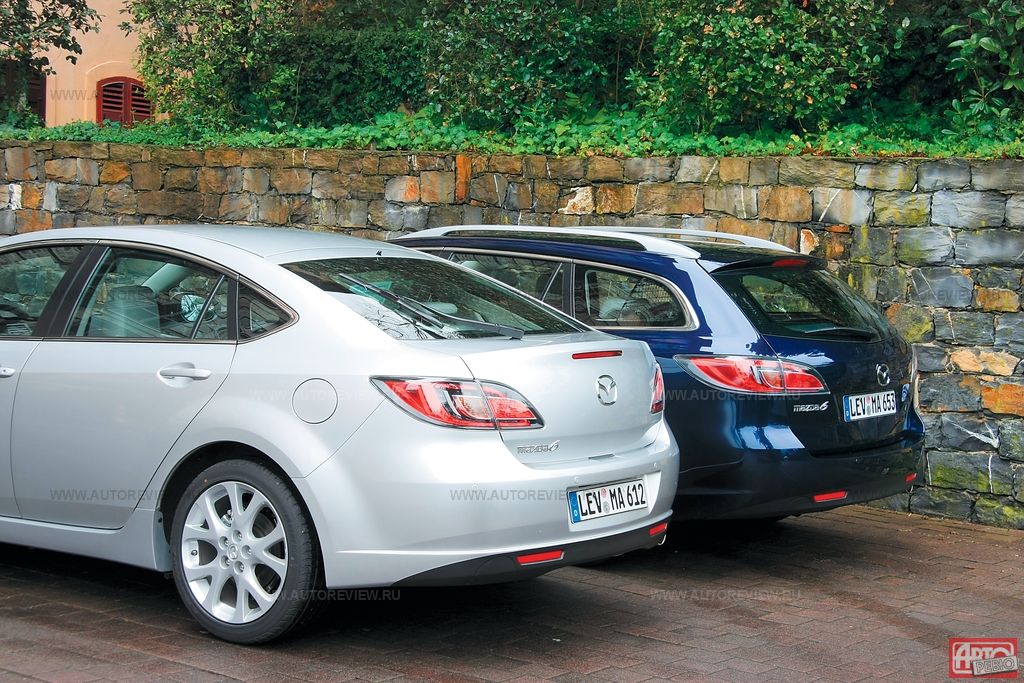
The hatchback in profile is almost an exact copy of the sedan. But due to the presence of a fifth door, it is 40 kg heavier than the four-door version, and the wagon is another 25 kilos more. Compared to its predecessor, the body of the passenger-cargo "six" has become stiffer in bending — by 33%, in torsion — by 25%, but still yields to the sedan in this regard. And the least rigid body is the hatchback with its huge "hole" of the trunk opening.
The sad news is that the European Mazda 6 will no longer have either the MPS turbo version or an all-wheel-drive modification. Over the past two years, only 4,300 "charged" MPS sedans were sold in the entire Old World — buyers switched to the less dynamic but more practical CX-7 crossover, which also closed the niche of a regular all-wheel-drive wagon. Meanwhile, in Japan it's different: the new Mazda Atenza, as the "six" is called there, has a version with a 2.5-liter engine and all-wheel drive.
In Russia, Mazda 6 hatchbacks will be equipped with the same powertrains as the sedans, and wagons — only with 1.8-liter and 2.0-liter engines. I took a ride in a car with a two-liter gasoline engine and a five-speed automatic. A great pair: the 147-horsepower "four" pleases with a lively character, the "automatic" is quite responsive in both normal and manual modes. It's a pity that paddle shifters on the steering wheel spokes are provided only for Japanese "sixes." I also liked the hatchback with the 1.8 engine — with obediently elastic "bottoms" and Mazda-like fighting "tops." Its 120 "horses" and five-speed manual are quite enough in the city, on the highway, and on the sinusoid of Ligurian mountain roads. If only the sound insulation were better and the ride smoothness higher… After all, the Mazda 6 has problems with this, and the wagon and hatchback have even stiffer springs and shock absorbers than the sedan. By the way, in this regard, the Mazda 6 with the 1.8 engine on standard 16-inch wheels (to which the electric power steering is also tuned) pleased me more than the two-liter one.
And in Rapallo, I also managed to drive cars with a modernized two-liter diesel — such an engine is chosen by a third of all European buyers of the "six." The engine is equipped with a second-generation common rail system (working pressure 1800 atm), injecting up to six portions of fuel per working cycle, modified intake and exhaust manifolds, and an optimized exhaust gas recirculation system. Instead of the previous two boost options — one: 140 hp and 330 Nm. Not an engine — a bacchanalia of torque! But you have to operate the lever of the six-speed manual non-stop.
The diesel Mazda 6 won't reach us: there's no point, the share of diesel cars in the D-class is only 0.5%. In the SUV segment — 12%, so in about a year, the Mazda CX-7 crossover with a new 2.2-liter diesel and six-speed manual will start selling in Russia. And for the diesel "six" to interest our buyers, it needs an "automatic" — Mazda doesn't have such a gearbox, and, as Umeshita-san claims, it may only appear in the next-generation "six."
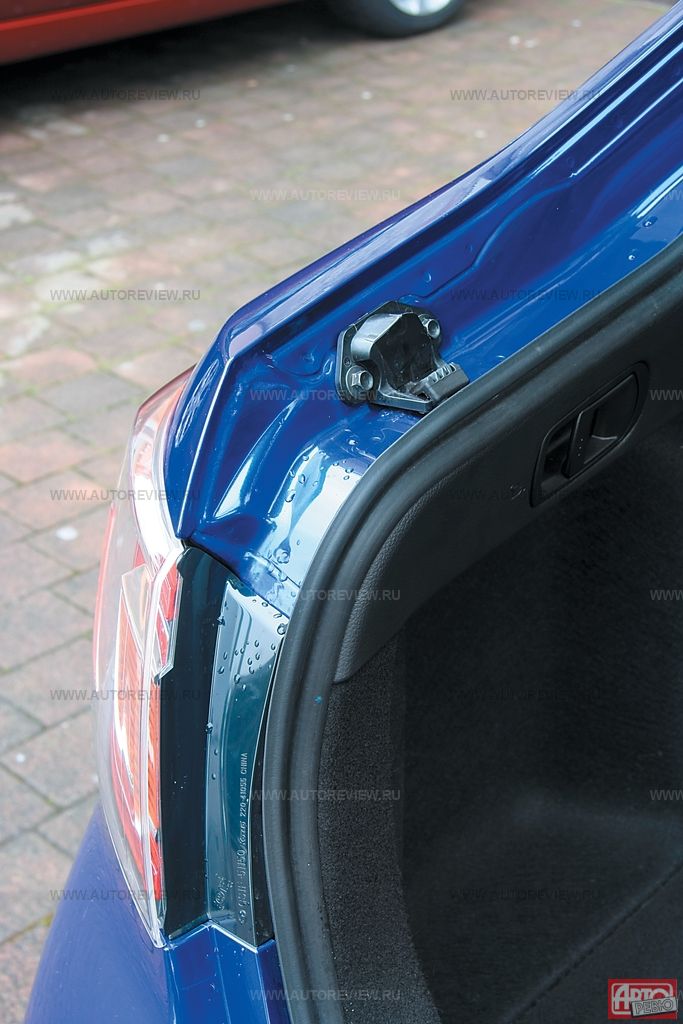 | 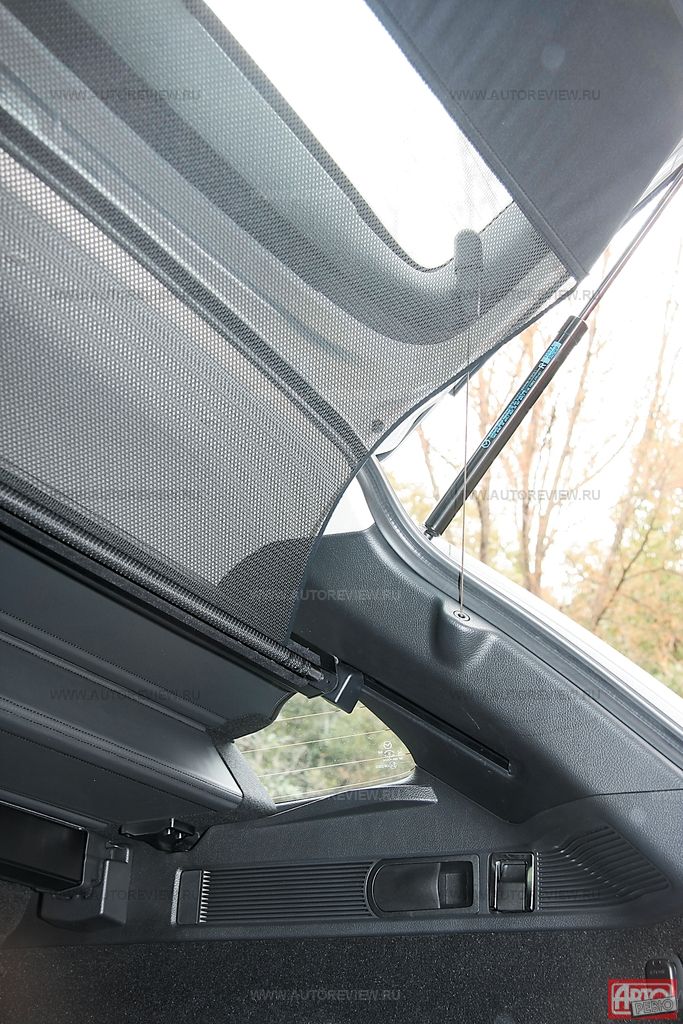 |
| The rear door serves as a stiffener for the hatchback body: to make it "sit" tighter in the opening, additional stops are installed on its side edges, and the lock provides increased locking rigidity. However, this also increased the force needed to close the door, so all hatchbacks are equipped with electric trunk door closers | The karakuri shelf in action — no electric drives: the rear door, rising, pulls on cables attached to its frame, and they in turn pull the end of the shelf up along the guides. If you need to transport large cargo, the shelf can be removed and stowed in the "underground." On the side walls of the trunk there's another karakuri — handles for folding the rear seat: if you pull them, the spring-loaded backrests themselves fall onto the cushion, forming a flat floor of the cargo compartment |
By the way, what will the "third coming" Mazda 6 be like? After all, now in the Ford concern, which includes Mazda, a strange situation has developed. On one hand, the company's head Alan Mulally set a course for global platform unification, and on the other, the almost simultaneously appeared classmates Mazda 6 and Ford Mondeo are built on fundamentally different platforms. Paradox! It turns out that the Ford platform was too big for the new Mazda. However, at the end of this year, a new American Mazda 6 will appear, which, like the Honda Accord for the States, will be noticeably larger (including an extended wheelbase). But even for it, it was decided to take as a basis not the more suitable in size Mondeo, but to rework the current Japanese platform — it turns out, it's cheaper.
In short, it's not yet clear on which platform the "third" Mazda 6 will be built. But definitely on the one that will be more profitable.
In Russia, the fate of the Mazda 6 wagon also depends on money. Orders for the new model are already being accepted, with first deliveries expected in April. The wagon will cost $1,625 more than the sedan: the starting price with the 1.8 engine is $31,000, while the two-liter version with an automatic transmission will set you back $35,000. Interestingly, the share of wagons in orders for the new "six" has already jumped from 4% to 8%. This is not surprising: Ford Mondeo and Opel Vectra in similar trims cost only slightly less, while the Volkswagen Passat is a full $7,000 more expensive. Moreover, none of the competitors have convenient shelves in the trunk, which are called "karakuri" here.
| Specifications | |||
| Parameters | Vehicle | ||
| Mazda 6 | |||
| Modification | 1.8 | 2.0 | 2.5 |
| Body type | 5-door hatchback/5-door wagon* | ||
| Number of seats | 5 | 5 | 5 |
| Dimensions, mm | |||
| length | 4755/4785 | 4755/4785 | 4755/4785 |
| width | 1795 | 1795 | 1795 |
| height | 1440/1490** | 1440/1490 | 1440/1490 |
| wheelbase | 2725 | 2725 | 2725 |
| track front and rear | 1570 | 1570 | 1570 |
| Trunk volume, l | 510—1702***/519—1751*** | 510—1702***/519—1751*** | 510—1702***/519—1751*** |
| Curb weight, kg | 1320/1345 | 1335/1355 (1355/1380)**** | 1355/1380 |
| Gross weight, kg | 1925/1965 | 1950/1970 (1975/2020) | 1970/2010 |
| Engine | petrol, with distributed injection | ||
| Location | front, transverse | front, transverse | front, transverse |
| Number and arrangement of cylinders | 4, in-line | 4, in-line | 4, in-line |
| Displacement, cm³ | 1798 | 1999 | 2488 |
| Cylinder bore/piston stroke, mm | 83.0/83.1 | 87.5/83.1 | 89.0/100.0 |
| Compression ratio | 10.8:1 | 10.0:1 | 9.7:1 |
| Number of valves | 16 | 16 | 16 |
| Max. power, hp/kW/rpm | 120/88/5500 | 147/108/6500 | 170/125/6000 |
| Max. torque, Nm/rpm | 165/4300 | 184/4000 | 226/4000 |
| Gearbox | manual, 5-speed | manual, 6-speed (automatic, 5-speed) | manual, 6-speed |
| Drive | front | front | front |
| Front suspension | independent, coil spring, double wishbone | ||
| Rear suspension | independent, coil spring, multi-link | ||
| Front brakes | disc, ventilated | disc, ventilated | disc, ventilated |
| Rear brakes | disc | disc | disc |
| Tires | 195/65 R16 | 195/65 R16 | 195/65 R16 |
| Maximum speed, km/h | 198/194 | 212/208 (202/198) | 220/217 |
| Acceleration time 0—100 km/h, s | 11.6/11.7 | 10.2/10.3 (11.1/11.2) | 8.3/8.3 |
| Fuel consumption, l/100 km | |||
| urban cycle | 9.6/9.7 | 9.9/10.0 (11.1/11.3) | 11.1/11.2 |
| extra-urban cycle | 5.3/5.4 | 5.5/5.6 (5.7/5.8) | 6.3/6.4 |
| combined cycle | 6.9/7.0 | 7.1/7.2 (7.7/7.8) | 8.1/8.2 |
| CO₂ emissions, g/km | |||
| combined cycle | 162/165 | 168/171 (182/185) | 192/193 |
| Fuel tank capacity, l | 64 | 64 | 64 |
| Fuel | petrol AI-95 | petrol AI-95 | petrol AI-95 |
| * Wagon with 2.5 engine will not be supplied to Russia | |||
| ** Without roof rails/with roof rails | |||
| *** With second-row seats folded | |||
| **** In parentheses — data for modification with automatic transmission | |||