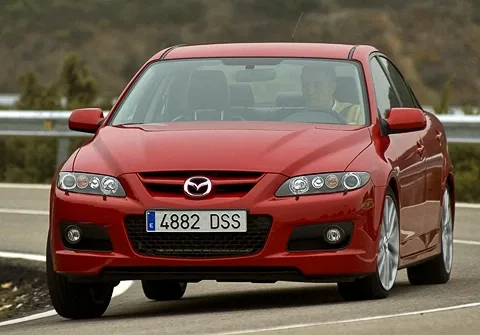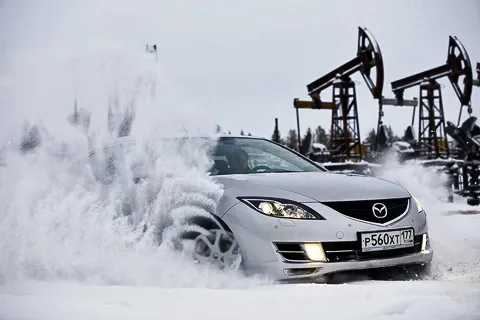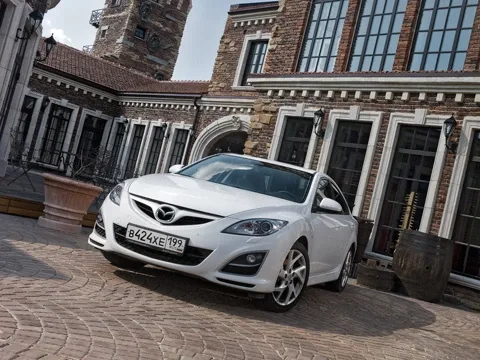
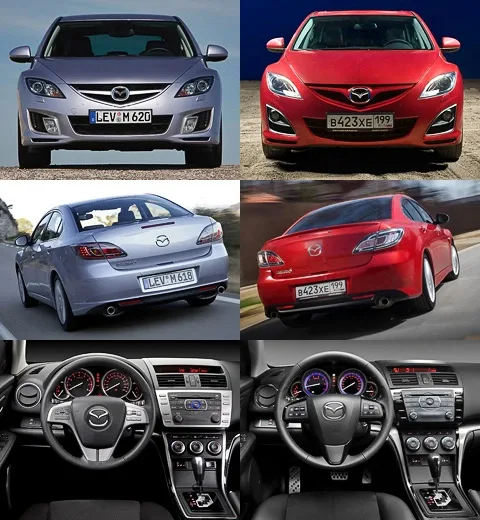
At the front, the updated car is distinguished by round fog lights, and at the rear — a new pattern of diffusers in the taillights. Previously, the "automatic" on the Mazda 6 was installed only with the two-liter engine. And the most powerful version had to be content with a six-speed manual. That, of course, was not proper. Russian brand marketers predict that now the "automatic" Sport 2.5 will account for at least 20% of all "six" sales.
The plastic of the front panel, as before, is soft only on the passenger side, and the central display is still overloaded with information. But the "six" has learned to blink the turn signal three times with a single press of the lever, and during emergency braking it turns on the hazard lights, warning drivers behind. For cheaper "Europeans" this has long been the standard.
The gearbox itself is well known to us: the Mazda6 wagon with the same "automatic" lived in our editorial office for a long time. The same five-speed transmission with manual mode. But paired with the 170-horsepower engine, the car drives as if it has found a second wind. It starts easily, briskly gains speed, and holds the selected gear during overtaking. The latter is especially important on country highways.
Upshifts are smooth, but when shifting down, the gearbox hesitates slightly. If the "automatic" allowed acceleration within one gear, one could turn a blind eye to this. But the slightest press on the gas pedal provokes a downshift. The kickdown is then worked out in two steps: a second after the first shift, another follows. The design does not allow jumping down several gears at once.
The Mazda6 with the 170-horsepower engine and "automatic" loses one and a half seconds to the version with a manual in acceleration to 100 km/h, and the maximum speed is 10 km/h lower — the limit is 210 km/h.
Even such an "automatic" is a serious argument in the market. And in general, the Japanese are being disingenuous when they say that the "six" only needed new cosmetics. They tinkered with the technical part in small ways. And as you know, everything is made up of small things. The update scheme for the "six" resembles the one by which the previous generation "three" underwent a restyling in its time. The emphasis is on ride smoothness and noise insulation.
Even at the presentation in December 2007, I noted the harsh ride of the Mazda as a minus, which lowered the overall rating of the car. The palette of extraneous sounds in the cabin, too rich for the D-class, was also not pleasing. Moreover, from the rear, the "six" seemed noisier and shakier than from the front. Seemed? That's how it really was.
Now the cabin is quieter, although the noise boundary still passes between the front and rear pillars. But at least rear passengers don't have to tense up before every pothole. The suspension of the updated "six" has become softer, and driving the car is noticeably more pleasant. The engineers recalibrated the shock absorbers, installed different compression bumpers at the rear, and new silent blocks with a more compliant stabilizer in the front suspension. As a result, even on 18-inch wheels, the car drives on Rostov roads, far from ideal, significantly better than before — there is more comfort.
The character of the Mazda has become less sharp. The "six" has noticeably gained in ride smoothness, and lost very little in handling. An excellent balance! The small spoiler on the trunk lid and LED taillights are distinctive features of the Sport versions.
At the presentation in Rostov, I only got to drive the "six" with the 2.5 engine and "automatic." Such a car costs 1,108,000 rubles. The more powerful Honda Accord and Ford Mondeo are cheaper by 33 and 60 thousand rubles, respectively (moreover, the Mondeo is sold with spring discounts). But the Toyota Avensis is noticeably more expensive than the Mazda — 1,249,500 rubles for the "Prestige" version.
"But what about the drive?" you might ask. I hasten to reassure: the spark for which we love the "six" has not gone out. It's just that there is less mischief in the car — it has partially converted into control reliability. Body rolls have increased, but driving fast is now easier. Firstly, because you don't need to plot a trajectory with an eye on bumps, as before. On a pothole-ridden turn, the Mazda clings tenaciously to the asphalt.
Secondly, with the increase in rolls, the tendency to skid has decreased, and the slides themselves have become easier to predict. If you will, they have become safer. With the stability control system turned off, the "six" still readily swings the rear, obediently responding to the steering wheel and gas. It's just that with the previous car there was no such mutual understanding.
The steering was also recalibrated. The design has become stiffer thanks to reinforced rack mounts, and the electric power steering program has been optimized. The steering wheel has become more informative — that's for sure. Both in the near-zero zone and when turning the wheel at different angles, the connection with the road remains direct. At the same time, fewer vibrations from the suspension reach the steering wheel than before. It's even a pity that the test didn't include the updated Touring versions — they now have 16-inch wheels instead of 17-inch ones. I recall that the Mazda was especially docile on smaller diameter wheels...
Surfers from all over the country gather in the village of Dolzhanskaya, where the Azov Sea cuts through the Dolgaya Spit. Despite the calm weather, we also caught our wave.
The makeup was applied so subtly that prices for the "six" remained the same. The base Direct trim costs 729 thousand rubles. The revised Touring, which lost the rain sensor and hill-start assist but retained dual-zone climate control and a radio with steering wheel controls, is sold for 769 thousand. For a two-liter car with a six-speed manual, they ask at least 850 thousand. And with 1,108,000 rubles in your pocket, you can buy the 170-horsepower top version with an "automatic." The very one for which, in fact, the restyling was awaited in Russia.
| Mazda6 | 2.5 AT |
|---|---|
| Body | |
| Body type | sedan |
| Number of doors/seats | 4/5 |
| Length, mm | 4755 |
| Width, mm | 1795 |
| Height, mm | 1440 |
| Wheelbase, mm | 2725 |
| Curb weight, kg | 1380 |
| Gross weight, kg | 1970 |
| Trunk volume, l | 519 |
| Engine | |
| Type | petrol |
| Location | front, transverse |
| Number and arrangement of cylinders | 4, in-line |
| Number of valves | 16 |
| Displacement, cm³ | 2488 |
| Max power, hp/rpm | 170/6000 |
| Max torque, N•m/rpm | 226/4000 |
| Transmission | |
| Gearbox | automatic five-speed |
| Drive | front |
| Chassis | |
| Front suspension | independent, spring, double wishbone |
| Rear suspension | independent, spring, multi-link |
| Front brakes | ventilated disc |
| Rear brakes | disc |
| Tires | 225/45R18 |
| Performance characteristics | |
| Maximum speed, km/h | 210 |
| Acceleration time 0-100 km/h, s | 9.5 |
| Fuel consumption, l/100 km | |
| — urban cycle | 11.8 |
| — suburban cycle | 6.4 |
| — combined cycle | 8.4 |
| Toxicity standard | Euro-5 |
| Fuel tank capacity, l | 64 |
| Fuel | AI-95 |
- Front airbags
- Side airbags
- Inflatable "curtains"
- Isofix child seat anchors
- ABS
- Dynamic stability control
- Traction control
- Automatic transmission
- Power steering
- Bi-xenon headlights
- Adaptive headlights
- Fog lights
- Rain sensor
- Tire pressure sensors
- Parking sensors, front and rear
- On-board computer
- Cruise control
- Dual-zone climate control
- Multifunction steering wheel
- Steering column with tilt and reach adjustment
- Heated and power-adjustable exterior mirrors
- Driver's seat height adjustment
- Split second-row seats
- Heated front seats
- CD player with MP3 support
- CD changer
- Sunroof
- Immobilizer
- Leather interior trim
- Alloy wheels
Additional equipment of the test car
- "Metallic" color
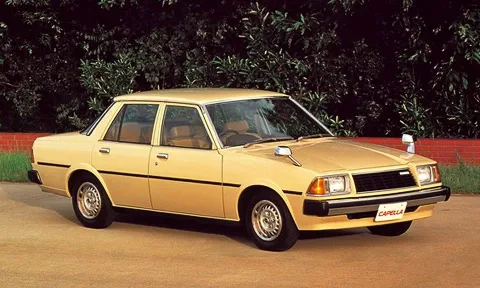
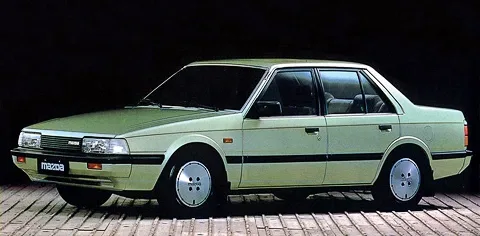
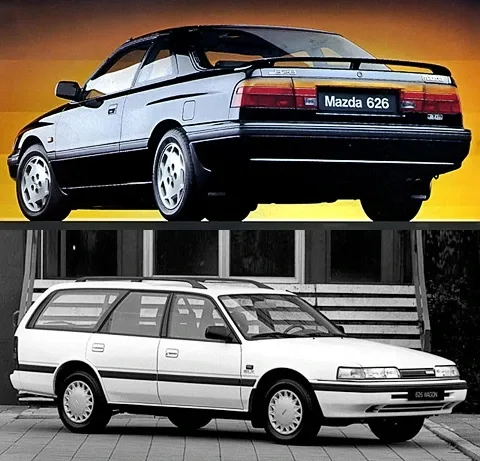

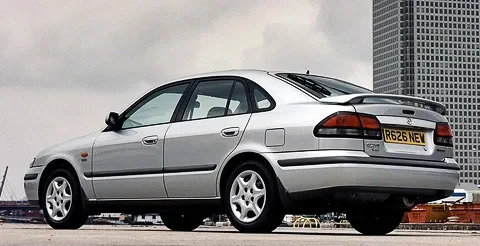
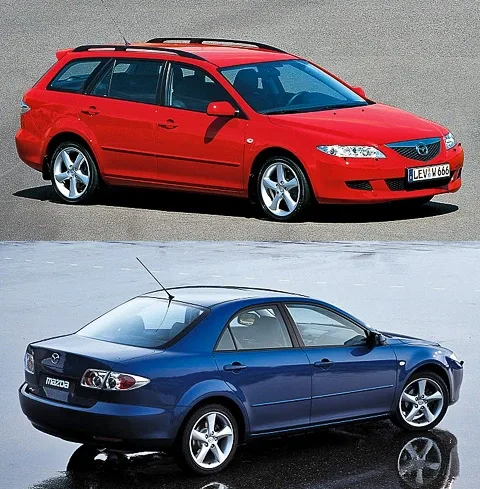
- In 2002, the Mazda6 became the first model to receive its name under the new system. All cars of the brand were renamed in the European manner: the 626 became the "six," the 323 became the "three," and so on. With this model, the Zoom-zoom era began — the marketing concept that became the brand's calling card was timed to its release.
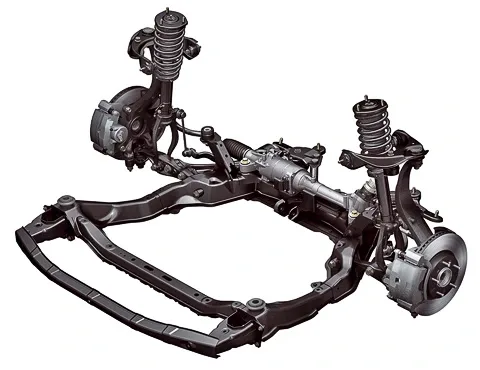
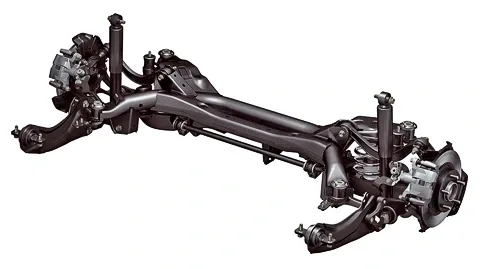
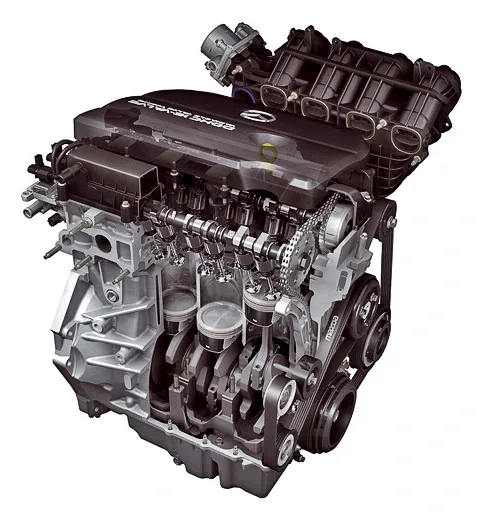
- Despite modest production volumes and pressure from Ford, which then owned a third of the shares, the "six" was built on its own G platform. The chassis received a more compact rear multi-link suspension than the Mondeo of those years, and a front suspension with transverse arms instead of McPherson struts — all for the sake of that very "zoom-zoom." Later, the American Ford Fusion, Mercury Milan, and Lincoln MKZ, as well as the CX-7 crossover, were created on this base.
- In its homeland, the Mazda6 was called Atenza and was produced in three body styles: sedan, hatchback, and station wagon. For Europe, three gasoline "fours" with power from 120 to 166 hp and a two-liter turbodiesel with an output of 121 or 143 hp depending on settings were intended.