
The numbers speak for themselves. It's not that the country is experiencing a real baby boom, but in megacities, demographics seem to have revived. Take Moscow, for example: last year, a third more children were born here than five years ago. And having two or three offspring is almost the norm now. And judging by how sales of exclusively family cars — minivans — are growing, city dwellers can afford not only to pay utility bills and support their kids. In 2003, the Renault Scenic, which then led the compact van segment, found 1,516 buyers. A year later, the new leader, Ford Focus C-Max, managed to sell 2,926 units, and a year after that, the same C-Max was first again — with 4,717 sales. That's a threefold increase in three years! A trend, though…
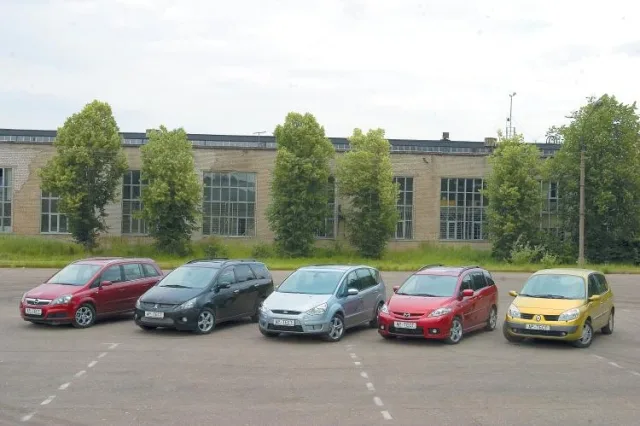
So who will be the next king of the hill? Two bright new models have appeared in the minivan class — the Mazda 5 and Ford S-Max. Let's have a head-to-head not only between them (both, by the way, are on the same platform), but also with the main rivals: Renault Grand Scenic, Opel Zafira, and Mitsubishi Grandis.
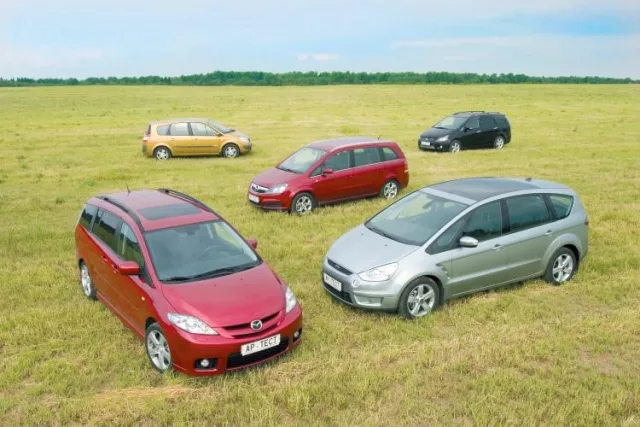
It's clear that a family car must first and foremost appeal to the fairer half. But if that half is so condescending as to consider the opinion of the second, less fair half, then we dare to suggest: men will be eyeing the Ford S-Max. Bulging wheel arches, angular headlights, high-mounted fog lights… And those gills! A real shark! Such gills probably should help the mighty engine breathe, and those in the front bumper — cool the brakes. Let's check… Pure decoration! But it still looks great!
| The gills on the Ford's front fenders are just flashy props |
The Mazda, on the other hand, has no hint of aggression and no tinsel. The elongated silhouette with a small side glass area even seems a bit heavy… But, unlike the Ford, it has sliding doors for rear passengers, which is a plus. The sloping roof and high-mounted rear lights make the Mazda akin to the elegant Mitsubishi Grandis, which replaced the angular Space Wagon in 2003. Perhaps the Grandis looks even more attractive than the Opel Zafira and Renault Grand Scenic.
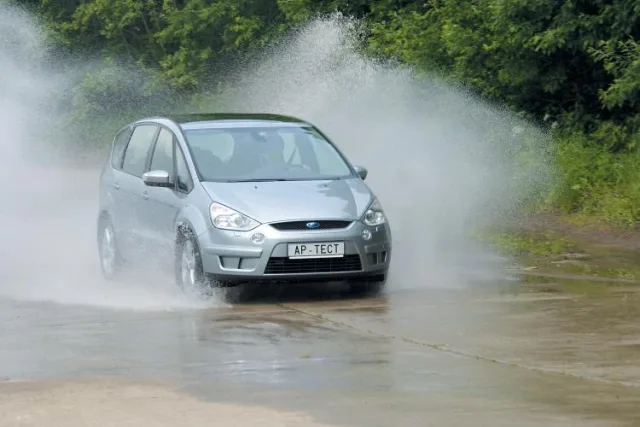
Of course, it's not proper to behave like this behind the wheel of a minivan, but when there are 220 turbo horses under the hood...
 |
 |
 |
| Seats with electric adjustment and ventilation — for an extra charge | Each of the three rear seats has two adjustments | The parking brake handle is original, but you can pinch your finger if you're not used to it |
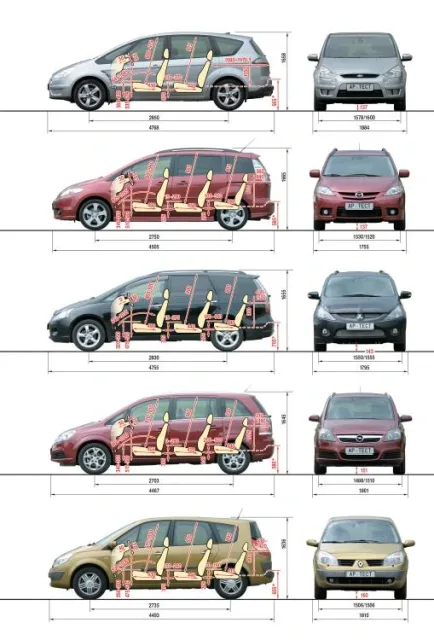
Three of the five cars are equipped with an additional row of seats and are nominally ready to take seven people on board, including the driver. But you won't get far with the whole family of five with kids — if only because there's almost no room left for luggage. In the Mazda, for instance, there are only 112 liters — less than in a Porsche 911! And even without luggage, it's not easy for five on the gallery: the third-row seats are frankly child-sized — even at 175 cm tall, it's cramped there. But if you really want to go with seven, it's better to choose the Opel: the third row is a bit more spacious there.
The Ford has a different demand — it's a five-seater, and the third row is a "deferred" option that wasn't available to order at the time of the test.
 |
 |
 |
| The Ford S-Max pleases with striking trim and rich equipment | On the center console — CD changer and dual-zone climate control | Paired with the turbo engine — six-speed manual gearbox |
 |
 |
 |
| The onboard computer communicates with the driver in Russian | There are hidden compartments under the feet of rear passengers | The underfloor is empty — instead of a spare tire, the S-Max is equipped with a compressor and a can of sealant |
 |
 |
 |
| The main glove box — with cooling… | …and on top — another, additional one | The trunk is one of the most spacious in the class |
The only car in our group with full-fledged (albeit folding) third-row seats is the Mitsubishi Grandis. We got the more expensive six-seat version, and all six passengers can safely set off even on a long journey. The backrests of all seats are adjustable for angle, and on the ceiling there are individual reading lights and air vents. For passengers — the best option!
As for the passenger role of the other cars, it's hard to single out a clear leader. The Mazda's sliding doors simplify entry. The Ford and Renault are better suited for carrying five: in the second row, all seats are separate with individual adjustments, so three passengers enjoy more comfort than in the Mazda. And the Opel lags behind: the middle row is tighter, and passengers have to sit in a line — the bench can move forward and backward, but only as a whole.
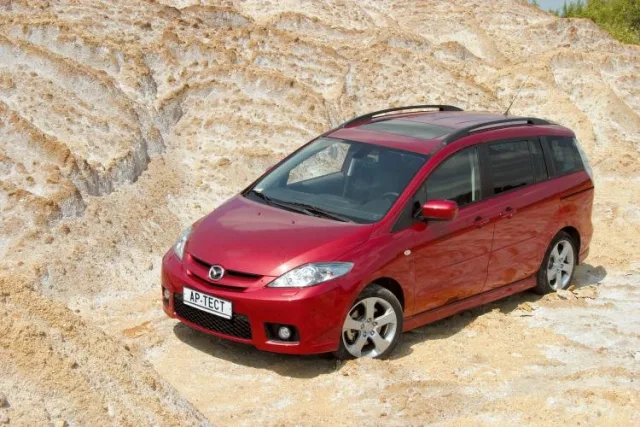
The strongly protruding chin of the front bumper is a dubious decoration
Of course, an extra row of seats is a plus. But it's used much less often than the trunk. So let's look into the cargo compartments with the third-row seats folded. The Grandis has the most space in the trunk, almost as much as the five-seat Ford. Behind them is the Opel, and the third-row seats flattened on the floor barely eat into the useful volume. The Renault is tighter, and the fifth-door opening is a bit narrow. And the most modest trunk is in the Mazda — 426 liters.
 |
 |
 |
| The Mazda's instruments are simple and clear | Two people in the middle row have plenty of room | But on the gallery it's a bit cramped |
 |
 |
 |
| The tiny 112-liter trunk can be enlarged by folding the second and third-row seats | Under the right seat hides a table with cup holders, under the left — a folding footrest for the middle passenger | The Mazda's front seats are equipped with bus-style armrests |
 |
 |
|
| The pocket on the lid is just part of the glove box | The Mazda's rather dull interior is enlivened only by "metal-look" inserts |
What about the spare wheels? We found a full-size spare only in the Opel; three other cars have narrow space-saver spares (not faster than 80 km/h). But if you get a flat tire in the Ford, you can only rely on the repair kit — a compressor and a can of sealant. This will save you from a minor puncture, but in case of more serious damage, you'll have to hitchhike to the nearest tire shop.
But if the wheels are all in perfect order, then... Sit down — and off you go? Not quite. That could be said about any of the five participants in our test, but not about the Ford! First you sit down, then you freeze in surprise, then you exhale — and only then do you drive off. Soft plastic covers not only the upper part of the dashboard but also the lower part, and "aluminum-look" inserts adorn the steering wheel and center console... Rich and tasteful! And at the same time — very comfortable!
 |  |  |
| The gearshift mechanism works flawlessly | Rocking climate control knobs — like on the Mazda 6 | The switchable DSC stability control system is standard on all versions except the base 1.8L engine |
The steering wheel, pedals, and the excellently working gearshift mechanism — everything is top-notch! The seat pleases with power adjustments and a good profile. And when Russian words appeared on the display...
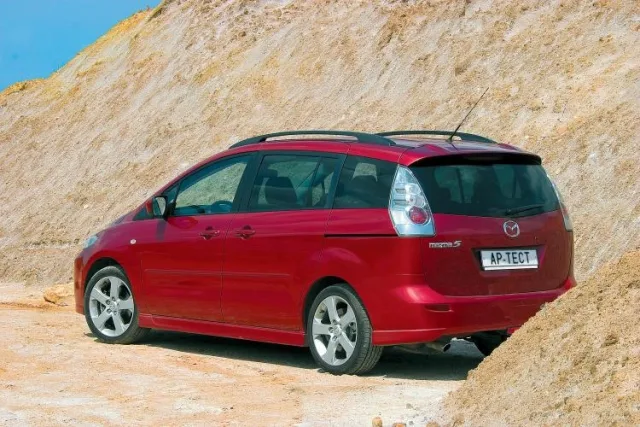
Sliding doors — a gift for rear passengers
The Mazda 5 is more modest: materials are simpler, but you can unlock the doors and start the engine without taking the electronic key card out of your pocket. Otherwise, the Mazda is traditional. If the driver is up to 190 cm tall, then behind the wheel it's comfortable: as if this is not a minivan but a regular Mazda 6 sedan.
The Mitsubishi Grandis has a grand dashboard with a semicircular cliff of the center console. The shapes are a delight, but the materials let it down. Why is the steering wheel rim trimmed in dark wood, while the console and doors are in light? And not wood, but some kind of laminate? The quality of the plastic parts also leaves much to be desired. But the instruments are a beauty: white numbers on blue dials like stars in the night sky. And there's no doubt that you're driving a minivan: high seating position, huge dashboard, and so much space around the seats that you can easily move to any of the passenger seats.
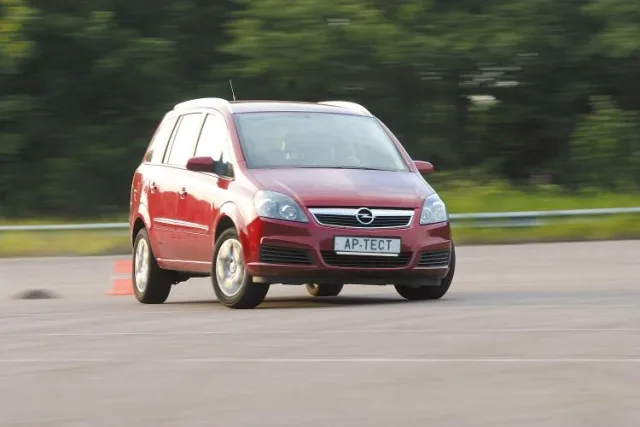
In extreme cornering, the Zafira shows a tendency to oversteer. For a "sportsman" — just what's needed, but for a "family" driver, this could be an unpleasant surprise
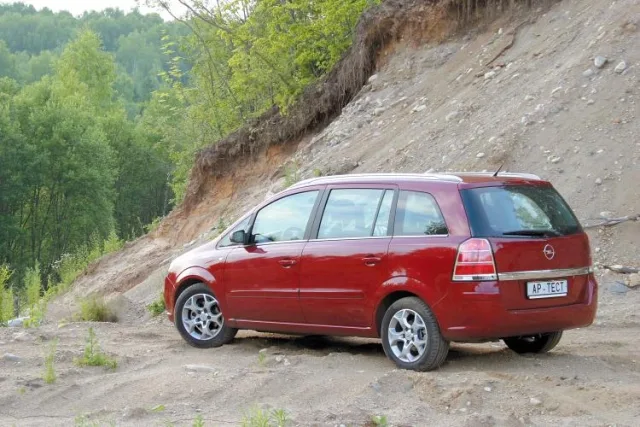
The Opel is tighter; like the Mazda, it resembles a sedan, and a sporty one at that: the seats have the most pronounced lateral support. And the small steering wheel clearly encourages sporty driving. The techno-style dashboard design is an acquired taste. We quickly got used to the handbrake in the form of a bracket, but we never adapted to the steering column-mounted switches with non-latching positions — either "didn't switch" or "over-switched." A stupid solution.
 |  |  |
| Techno design — stylish, but an acquired taste | The Zafira's seats provide the best lateral support | The middle part of the backrest turns into a table with a tiny armrest |
 |  |  |
| The instrument cluster lacks an engine temperature gauge — there's only an overheating indicator | The third-row seats, when folded, lie flat along the floor and are difficult to unfold | Another experiment with the "handbrake"... |
The Renault has another problem — poorly readable instruments. On the narrow display in the center of the dashboard, only the large speed digits are clearly visible, but the rest of the information is shown in such small characters that the driver has to be distracted from the road for a long time. There are also issues with seating: the adjustment ranges of the steering wheel and seat are limited — before buying, you must "try on" the car! And if the "fitting" is successful, the Grand Scenic will delight with a bright, airy cabin, a huge glove box, and plenty of small compartments for little items. And to keep an eye on the kids, there's an additional mirror under the main rearview mirror — it gives a good view of the second-row seats.
The Renault and Mitsubishi are equipped with "automatics," the rest have manual gearboxes. The engines are also different, although the power spread is small — from 136 hp in the Grand Scenic to 165 hp in the Grandis. And only the Ford S-Max stands out — its engine, borrowed from the "hot" Focus ST hatchback, is turbocharged and produces a whopping 220 hp. Out of competition? But when we learned the car's price, our doubts vanished. The base Ford S-Max 2.5 turbo costs $28,140. Meanwhile, the two-liter Mazda 5 (145 hp) costs at least $26,400, and the Renault Grand Scenic (136 hp) — $30,699. Who would refuse a much more powerful engine for the same money? We didn't.
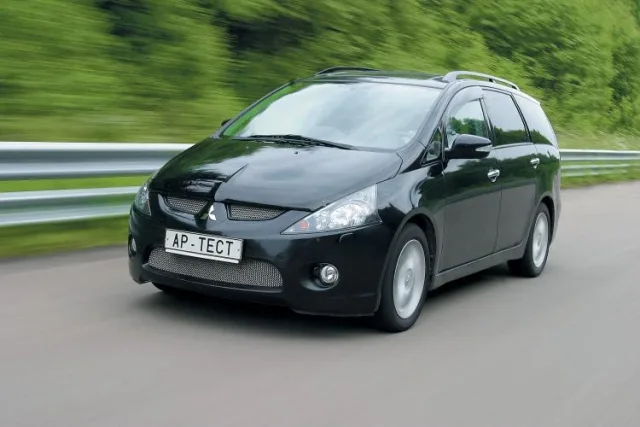
At high speed, the Grandis resembles a good yacht — it glides, gently rocking on the waves
The Ford S-Max accelerates to 100 km/h in 8 seconds and easily reaches 220 km/h. Even for intense overtaking, half the throttle pedal travel is enough, and if you go "full throttle"... This is a sports coupe! And in the city, no problem: the engine behaves excellently at low revs! But for a minivan, the clutch pedal effort is too high.
 |  |
| The Mitsubishi's interior design impresses, but the materials — not so much: the "laminate" on the center console and doors doesn't go well with the wooden steering wheel trim | Soft seats encourage relaxed driving |
 |  |
| The glove box is a bit small | The instruments are a feast for the eyes |
It's clear that no one can keep up with the Ford. But from the standpoint of acceleration control convenience, the Mazda 5 is good. The gearshift mechanism is no worse than the Ford's, the gear ratios are well chosen, and the two-liter engine, willing to rev up to 7200 rpm, provides convincing, assertive acceleration.
 |  |  |
| The large screen is from the optional equipment list | Tables are standard equipment, while the DVD screens built into the headrests are the owner's whim | The Grandis is the most comfortable for passengers |
 |  | |
| And there's plenty of room for luggage | Only the Grandis can offer full-fledged seats in the third row |
Those for whom leading in traffic isn't a priority will gladly trade the Mazda's spirited acceleration for the Grandis's comfortable acceleration with its four-speed "automatic." Of course, the Grandis lags behind both the Mazda and even the Opel. And it's not just the "automatic" to blame: the Grandis is almost 300 kg heavier than the Grand Scenic.
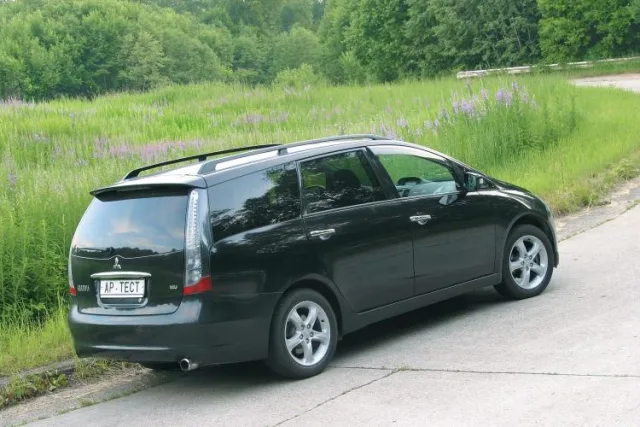
Rear lights — garlands of LEDs
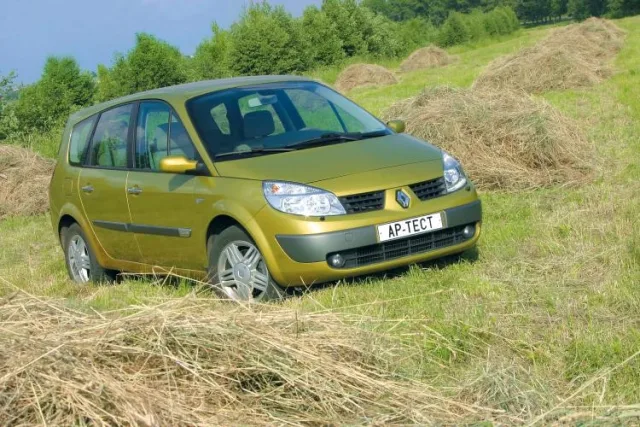
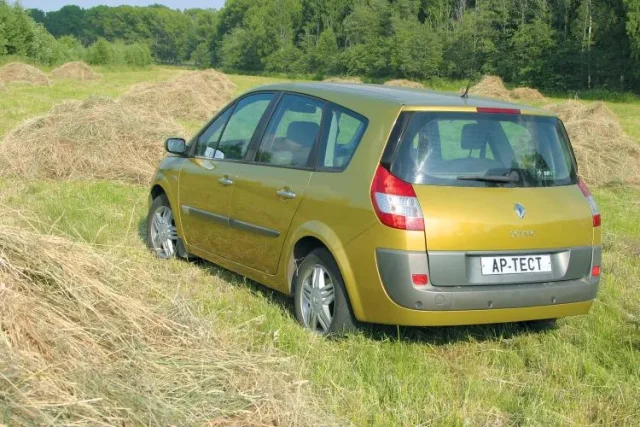
Renault Grand Scenic — a cutie. If you confuse it with someone, it's only with another Renault
 |  | |
| Almost everything is not in its place! And almost everything is quite convenient | The electronic "handbrake" is more convenient than any "bracket" | We didn't like this "automatic" |
 |  | |
| Apart from the speed readings, it's problematic to decipher anything else in the instrument cluster | A large glove box, and even cooled |
 |  |  |
| The tall box between the seats slides back and forth along guides | The middle row seats in the Renault can be folded or removed from the cabin | The folding scheme for the luggage seats is extremely simple |
 |  |  |
| The middle seat easily transforms into a table | The luggage seats are for children | The Scenic offers the largest number of little boxes in the most unexpected places |

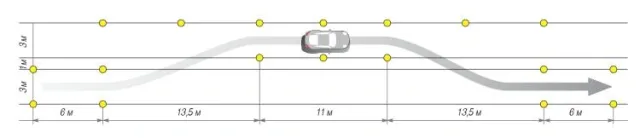
"Moose test"
Simulating an emergency situation involving avoiding a suddenly appearing obstacle (the "moose test"), we try not only to determine the maximum possible speed of the maneuver but also to more fully assess the reliability of the interconnections in the "driver-car-road" chain. Therefore, the maneuver is performed in two stages. First, several drivers (usually five, but in this case four), already accustomed to the cars' reactions in normal modes, make a single run at a speed of 65 km/h. Some manage to perform the maneuver cleanly, while others do not. The ratio of "successful" to "unsuccessful" runs allows us to assess the degree of mutual understanding between the driver and the car in an extreme situation and the likelihood of avoiding an accident. Then a test driver takes the wheel and, using the method of "successive approximations," determines the maximum speed of the maneuver, noting along the way the reasons that prevent the trajectory from being completed even faster.Opel turned out to be the most understandable and nimble in this test. All four participants successfully completed the obstacle avoidance on the first attempt, and the highest recorded speed during the maneuver reached 76.3 km/h. Further acceleration was hindered by a noticeable tendency for the rear axle to slide—to keep the car in the corridor, the driver had to act on the steering wheel with lightning speed.
Next came the Mazda 5 with a result of 75.3 km/h. As with the Opel, there was also a prolonged drift arc here, and very energetic steering was required for stabilization. However, with sharp movements of the wheel, an unpleasant "step" effect on the steering effort occurred—the wheel seemed to momentarily catch. The clear operation of the stability control system, which helped the test driver correct the trajectory, saved the day.
However, only one of the four drivers was able to conquer the Mazda on the first attempt. The others were frightened by the unexpectedly sharp and abrupt reactions of the car to steering inputs.
Behind the wheel of the Ford, two of the four participants managed to avoid a virtual "accident." Interestingly, all four unanimously noted the amazing mutual understanding with the car. The main obstacle was the impressive body dimensions. Thanks to the excellent reactive effort on the steering wheel in any mode, the absence of "biting," and high responsiveness, the expert managed to accelerate to 74.7 km/h, but here too, the same dimensions and slides when returning to the lane prevented going further.
Two drivers coped with the Mitsubishi. The others were hindered by the low informativeness of the steering and delayed interventions of the electronics. These same shortcomings did not allow the test driver to raise the bar above 72 km/h.
Renault became the outsider. The car goes into a deep and prolonged drift, and attempts to extinguish it lead to body sway. The steering wheel requires large turning angles due to low sensitivity, and the informativeness of the drive leaves much to be desired. Nevertheless, two of the four drivers successfully completed the maneuver: that very "cottony" reaction forgave them for their control errors.
| Maximum speed of the "moose test," km/h | |
| Car | Speed |
| Ford S-MAX 2.5 turbo | 74.7 |
| Mazda 5 | 75.3 |
| Mitsubishi Grandis | 72.0 |
| Opel Zafira | 76.3 |
| Renault Grand Scenic | 70.3 |
| "Moose test" on the first attempt at 65 km/h* | |
| Car | Maneuver completed by |
| Ford S-MAX 2.5 turbo | 2 drivers out of 4 |
| Mazda 5 | 1 driver out of 4 |
| Mitsubishi Grandis | 2 drivers out of 4 |
| Opel Zafira | 4 drivers out of 4 |
| Renault Grand Scenic | 2 drivers out of 4 |
| * Four drivers took part in the tests | |
What costs how much?
The base Ford S-MAX 2.0 in the Core version is priced at $24,630. This is a five-seat car equipped with fog lights, front electric windows, ABS, a cassette radio with eight speakers, air conditioning, seven airbags, and central locking. The Trend trim ($25,530) adds rear electric windows, a CD radio, dual-zone climate control, sport front seats, and leather trim on the steering wheel and gear lever. The top Titanium version starts at $27,430. It includes light and rain sensors, heated front seats (driver's with electric adjustments), and alloy wheels. For the seventh seat, you will have to pay an additional $1,000 regardless of the trim, the panoramic roof costs $750, and the leather interior is $2,500. Modifications with the 2.5-liter 220-horsepower engine are $2,600 more expensive and are available only in Trend and Titanium versions. Two turbodiesels are also offered: 1.8 TDCi (125 hp) for $26,000 and 2.0 TDCi (143 hp) for $26,900. Transmissions are exclusively manual, five- or six-speed. The waiting time for an order is from two to four months.
Warranty: 2 years or 100,000 km. The network includes 120 dealers in 76 Russian cities.
The Mazda 5 is produced in four variants. The initial Family version with a 1.8-liter engine (115 hp) and five seats costs $21,900. The seven-seat Touring is $2,000 more expensive. The Touring Plus version with a two-liter 145-horsepower unit is priced at $26,400. Its equipment includes a full electric package, climate control, heated front seats, leather trim on the steering wheel and gear lever, ABS, stability control, six airbags, an immobilizer, and a radio with four speakers. The flagship Active costs $28,700 and adds a rain sensor, xenon headlights, fog lights, alloy wheels, and a CD radio with six speakers. For an options package with a DVD player, multi-channel amplifier, and transponder key card, you need to pay an additional $3,980. The transmission is only a five-speed manual. In Europe, there are versions with a two-liter turbodiesel (110 or 143 hp) and a six-speed manual, but they are not supplied to Russia. The waiting time is 3–5 months.
Warranty: 3 years or 100,000 km. Sales are carried out by 20 dealers in 13 Russian cities.
The Mitsubishi Grandis 2.4 in the base Invite trim with a manual transmission and a seven-seat interior costs $31,090. The Instyle version with a four-speed automatic will cost $2,760 more. It includes six airbags, an electric package, a leather steering wheel, fog lights, ABS, stability control, dual-zone climate control, heated front seats, a CD radio with six speakers, and alloy wheels. The six-seat Grandis in the Intense trim starts at $35,250, and the maximum configuration reaches $39,950—for this money, leather seats with electric drive, two sunroofs, a sport body kit around the perimeter, and roof rails are offered. The engine is the only one—a 165-horsepower "four" with the MIVEC system. The two-liter 136-horsepower turbodiesel is available only to Europeans. The order will have to wait up to four months.
Warranty: 3 years or 100,000 km. Sales are handled by 83 dealers in 60 Russian cities.
The Opel Zafira in the most affordable Essentia version with a 1.6-liter engine (105 hp) and a five-speed manual costs $19,990. The Enjoy version with a 1.8-liter engine (140 hp) is priced at $22,690 and includes four airbags, ABS, a CD radio with six speakers, an immobilizer, front electric windows, and air conditioning. The surcharge for a five-speed automatic is $450, and for a glass roof—$2,000. The top Cosmo version is enriched with climate control, a leather steering wheel, sport front seats, alloy wheels, roof rails, and additional exterior chrome. Such a car with a manual transmission costs $25,000. There are also more powerful options: with a 2.2-liter 150-horsepower engine and a four-speed automatic for $30,000, as well as with a two-liter turbo engine (200 hp) and a six-speed manual for $30,900. Turbodiesel versions with a volume of 1.9 liters (100, 120, and 150 hp) are not brought to Russia. The waiting time for an order is from one to four months.
Warranty: 2 years without mileage limit. Sales are handled by 53 dealers in 28 Russian cities.
The Renault Grand Scenic in the base Expression version with a 1.6-liter engine (115 hp) and a five-speed manual costs $24,700. The minivan with a two-liter 136-horsepower unit and a six-speed manual is available only in the Privilege trim. Equipment includes six airbags, ABS, rain and light sensors, an electric package, a chip card instead of an ignition key, climate control, fog lights, and alloy wheels. The price is $30,700. The surcharge for a four-speed automatic is $1,200, for leather—$1,390, and for a CD radio with four speakers—$390. In Europe, versions with a 1.6-liter engine (98 hp), a two-liter turbo engine (163 hp), and three turbodiesels (86–150 hp) are also sold. The delivery time is 2–4 months.
Warranty: 2 years without mileage limit. Sales are handled by 92 dealers in 54 Russian cities.
Here is the revised test drive text:Family affair: looking for the ideal minivan
What prompted me to take on this test was simple everyday logic: if you have a large family, sooner or later you'll come to the conclusion that a station wagon is a compromise, and an SUV is an excess. What you need is a spacious one-box vehicle. I gathered five of the most interesting representatives of this class to understand which of them truly deserves a place in the garage, and which merely takes up space in the price list. My test subjects were the Ford S-MAX with a 2.5 turbo engine, Mazda 5 with a two-liter engine, Mitsubishi Grandis (2.4 liters), Opel Zafira with a 1.8 engine, and Renault Grand Scenic, equipped with a two-liter unit. All of them are seven-seaters (except the Ford, which doesn't have a third row), all are front-wheel drive. But that's where the similarities end. The most expensive in base trim was the Mitsubishi — they ask $31,090 for it. The most affordable option is the Opel Zafira, priced at $22,690. In between are the Ford at $28,140, Mazda at $26,400, and Renault at $30,699. However, when I started looking into the trim levels, it turned out that the final price tags differ significantly from the starting ones. The test S-MAX with options already came to $36,430, and the Grandis even crossed the $39,750 mark. The Zafira remained the most modest at $25,945, but its equipment is also poorer.Interiors and ergonomics: where is the driver comfortable?
Let me clarify right away: I'm not a fan of dry tables, but we can't do without numbers here. Based on the sum of expert ratings (maximum — 1000 points), the Ford S-MAX leads with a score of 840 points. In second place is the Mitsubishi (830), in third — the Mazda (820). The outsiders are the Opel (790) and Renault (795). The difference between the best and the worst seems small, but in detail it's felt very strongly. In the Ford, I liked the driver's seat. The seat has power adjustments, the steering wheel is leather-wrapped and has multifunction buttons. The tilt and reach of the steering column adjust without issues. What I immediately deducted points for was visibility: the body pillars are a bit wide, and you have to turn your head in corners. But in the Mazda, it's easier: the mirrors are large, and the pillars don't obstruct the view. True, the Japanese car's interior looks simpler than its competitors'. The Mitsubishi Grandis pleased with solid trim and comfortable seats, but the multimedia system with a CD changer seemed anachronistic to me. In the Opel Zafira, the driver's seating is comfortable, but the trim materials evoke boredom: hard plastic, simple solutions. And the Renault Grand Scenic is a different story altogether. It seems everything is thought out, there's even keyless start and power-folding mirrors, but the ergonomics let it down. To find the right function, you have to search for a button on the center console for a long time, and some solutions are frankly confusing. For the driver's workspace, the French car got the lowest scores from me.Driving impressions: who drives, and who crawls?
As for dynamics, there are no surprises here: the Ford S-MAX with the turbo is the king. Its acceleration dynamics earned the maximum 80 points out of 80 possible. The car literally shoots off the traffic lights, and even on the highway, overtaking is easy. The Mazda 5 with the naturally aspirated two-liter engine is noticeably more modest — 65 points, but that's enough for everyday driving. The Mitsubishi and Opel got 60 points each, and the Renault with its two-liter unit — only 55. It tries honestly, but there's not enough torque, especially when fully loaded. Handling is a separate topic. Here I was surprised: the Mazda 5 turned out to be the most spirited in corners. It steers precisely, with minimal body roll, earning 75 points. The Ford S-MAX, despite its powerful engine, is slightly less composed in bends — 70 points. The Opel and Mitsubishi are roughly on the same level (70 and 65 points), but the Renault disappointed again: it's wallowy, with a "dead" steering wheel, scoring only 55 points. It feels like the French engineers tuned the suspension solely for comfort, forgetting about driving pleasure.Comfort and ride smoothness
And here's where the most interesting part happens. If the Ford leads in dynamics, the situation changes in terms of ride smoothness and acoustic comfort. The Renault Grand Scenic, which disappointed me so much on the road, turned out to be the most comfortable. Its suspension softly absorbs joints and potholes, and the sound insulation is the best in the group. For ride comfort, it gets 180 points out of 210 possible, and for ride smoothness — 70. That's higher than all the others. The Ford S-MAX with its driver-oriented character turned out to be the stiffest. On rough roads, it shakes and transmits vibrations to the body. For ride smoothness, it gets only 55 points — the worst result in the test. Acoustic comfort is also unimpressive: at speeds above 100 km/h, the cabin gets noisy. The Mazda 5 is somewhere in between: it's not as stiff as the Ford, but not as smooth as the Renault. The Mitsubishi Grandis is a pleasant compromise: it's more comfortable than the S-MAX and handles better than the Renault. The Opel Zafira is an average performer, with no obvious failures but also no revelations.Practicality: trunk and transformation
In terms of practicality, all five are quite "workhorses." All have rear seats that fold in sections, allowing flexible use of space. But there are nuances. The Mazda 5 and Mitsubishi Grandis have a third row of seats, but the Ford S-MAX lacks it. However, as practice has shown, the third row is more of a "for the future" option: only children can fit there comfortably. The trunk in seven-seat configuration is purely symbolic in all except the Ford. But with the seats folded, the volumes become quite decent. The Mitsubishi Grandis got 60 points for the trunk and the same for transformation — that's a good result. The Ford S-MAX with its 60 points for the trunk and 60 for transformation is also not bad, but the lack of a third row reduces its versatility. The Mazda 5 — 50 points for the trunk (it's the most modest) and 60 for transformation. The Renault Grand Scenic — 55 and 65 points, respectively. And the Opel Zafira — 55 and 55.What's the bottom line?
If we sum it up, the picture is as follows. The Ford S-MAX is a minivan for those who aren't ready to sacrifice dynamics. It's the fastest, the most expensive in equipment, but also the stiffest and noisiest. That's why I gave it 840 points — it's the best, but not perfect. The Mazda 5 is an excellent balance of price and quality: it drives well, handles better than all the others, but it's a bit cramped for seven, and the trunk is small. The result — 820 points. The Mitsubishi Grandis is a solid middle-of-the-road option that's good in many ways: comfort, dynamics, and space. But it also has its weak points. 830 points. The Opel Zafira is the cheapest, but also the simplest. For $25,945, you get a good car without frills, but with mediocre handling and sparse equipment. 790 points. The Renault Grand Scenic is the most comfortable, but also the most "dull." It's ideal for calm driving, but if you want to enjoy driving — this isn't your choice. 795 points. My verdict: if you need the most driver-focused car — take the Ford. If you want practical and affordable — look at the Mazda. And if comfort matters most — the Renault, despite its shortcomings, will be the best companion for a long road. Here's a reworked test-drive text, written in my own words, preserving all facts, figures, and author's assessments. *** In compact vans, you always look for a compromise: either dynamics, or space, or price. I decided to check how these cars can surprise, and took six models for a test: Ford S-MAX in two versions (2.0 and 2.5 turbo), Mazda 5, Mitsubishi Grandis, Opel Zafira, and Renault Grand Scenic. All of them are front-wheel-drive wagons with three rows of seats, but their characters are completely different.Dynamics and engines
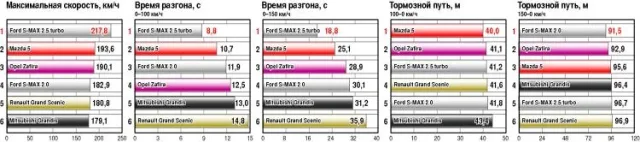
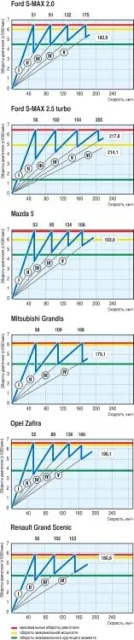
The first thing that catches your eye is the difference in temperaments. The most powerful in the group is the Ford S-MAX with a turbocharged 2.5-liter "five." Its 220 horsepower and 320 Nm of torque are felt immediately. Acceleration to 100 km/h takes just 7.9 seconds according to the specs, and according to my measurements — 8.8 seconds. Turbo boost kicks in from one and a half thousand rpm, so highway overtaking is easy and effortless. The maximum speed I managed to reach was 217.8 km/h, although the factory claims 230. The gearbox is a six-speed manual, working precisely and pleasantly. The naturally aspirated S-MAX with a two-liter engine producing 145 horsepower is a completely different story. It's calmer: acceleration to 100 km/h takes 11.9 seconds. That's enough for everyday driving, but don't expect any excitement. The engine loves high revs, and to keep up with traffic, you have to work the five-speed gearbox lever more often. The Mazda 5 with the same two-liter unit at 145 horsepower seemed even a bit more responsive than its "relative" in the concern: 10.7 seconds to 100 km/h. But it also doesn't claim to be a "hot hatch." The feel from the steering wheel and pedals is light; the car is perceived as a reliable helper, not a toy. The Mitsubishi Grandis with a 2.4-liter engine (165 hp) and a four-speed automatic is about smoothness. Its acceleration to 100 km/h takes 13.0 seconds. The gearbox is a bit sluggish, but if you're not chasing dynamics, it drives fine. On the highway, overtaking is harder, especially if you need to quickly accelerate from 100 to 120 km/h — it takes almost 10 seconds in "D" mode. The Opel Zafira with a 1.8-liter engine at 140 horsepower is a solid middle-of-the-road option. It accelerates to 100 km/h in 12.5 seconds. The engine is torquey, but nothing more. However, it's probably the most economical in the city: the claimed figure is 10.1 liters per 100 km, and in my experience, you can get even lower if you drive calmly. The Renault Grand Scenic with a two-liter engine (136 hp) turned out to be the calmest. Acceleration to 100 km/h took 14.8 seconds, and to 150 — almost 36 seconds. The engine and four-speed automatic work very smoothly, but without any spark. For measured family driving, it's just right, but if you're used to a more lively response to the gas pedal, this car will feel sluggish.Handling and comfort
Here I expected roughly the same from all of them, but I was wrong. The Ford S-MAX pleasantly surprised me. Despite its dimensions, it handles very composedly. The steering is precise, body roll in corners is small, and the car willingly follows the steering wheel. The rear multi-link suspension absorbs impacts, and on bumps the Ford doesn't fall apart. It really feels like a large hatchback, not a dull "wagon". Mazda 5 is also good, but it feels more "car-like". The steering is light, the suspension is slightly more energy-intensive but less composed at speed. During lane changes, it rocks a bit, reminding you of the high center of gravity. But in the city, it's maneuverable and easier to park. Mitsubishi Grandis, on the contrary, felt more wallowy. The suspension is soft, and body roll in corners is more noticeable. This isn't a drawback for a family car, but compared to the Ford, the Grandis clearly loses in driving excitement. However, it's very quiet on the move, which is a big plus. Opel Zafira is a compromise option. It's not as sharp as the S-MAX, but not as wallowy as the Grandis. The rear semi-independent beam makes its behavior predictable, but on large bumps the axle can hop. Overall, it handles honestly and without surprises. Renault Grand Scenic is the "softest" in character. The suspension is tuned for maximum comfort, so on a broken road it floats like a large sedan. But you pay for this with body roll in corners and a less informative steering wheel. For passengers, this is a plus; for the driver, a minus.Brakes and instrument accuracy
All six cars showed decent results when braking from 100 km/h. The best result is from the Mazda 5 — 40.0 meters, the worst from the Mitsubishi Grandis — 43.4 meters. The difference is not critical, but on a wet road it can play a role. All have disc brakes with ventilation at the front. I also want to note the speedometer readings. All cars overstate the real speed. In the Ford S-MAX 2.5 turbo at 100 km/h on the gauge, the real speed is 96 km/h, in the Mazda — 94 km/h, in the Grandis — 95 km/h, in the Zafira — 95 km/h, in the Renault — 96 km/h. So don't be surprised if you're driving slower according to GPS than the needle shows.Practicality
As for capacity, the leaders are obvious. The Ford S-MAX and Zafira offer from 285 to 2000 liters of trunk and 140 to 1820 liters respectively, with seats folded. The Grandis has less volume — from 320 to 1545 liters. The Mazda 5 is the most modest: only 112—969 liters. The Renault Grand Scenic is also good — 200—1920 liters. In the end, if you need driving excitement and handling, take the Ford S-MAX with the turbo engine. If you need a compromise of price and quality — the Mazda 5 or Opel Zafira. If maximum passenger comfort is important — the Renault. And the Mitsubishi Grandis is the choice for those who value calmness and quietness in the cabin.Autoreview readers' forecast
Before conducting this test, we asked visitors of www.autoreview.ru to choose a favorite among the participants of the upcoming comparative test. The votes were distributed as follows:
Ford S-MAX 37.85%
Mazda 5 19.75%
Mitsubishi Grandis 19.48%
Opel Zafira 18.64%
Renault Grand Scenic 4.28%
A total of 6,953 people took part in the survey
Cost of scheduled maintenance
The table below shows prices for routine work, including the cost of consumables and original parts*.
| Cost of scheduled maintenance with consumables and parts* | ||||||
| Scheduled maintenance | Vehicles | |||||
| Ford S-MAX | Mazda 5 | Mitsubishi Grandis | Opel Zafira | Renault Grand Scenic | ||
| Standard hour | 55 | 52 | 57 | 45 | 50 | |
| Mileage, km | 15000 | — | — | 261 | 155 | 139 |
| 20000 | 150** | 210 | — | — | — | |
| 30000 | — | — | 366 | 250 | 229 | |
| 40000 | 150** | 280 | — | — | — | |
| 45000 | — | — | 261 | 155 | 129 | |
| 60000 | 150** | 246 | 598 | 380 | 339 | |
| 70000 | — | — | — | — | — | |
| 75000 | — | — | 250 | 155 | 129 | |
| 80000 | 150** | 306 | — | — | — | |
| 90000 | — | — | 710 | 250 | 289 | |
| Total | 600** | 1042 | 2446 | 1345 | 1254 | |
| * Prices are in US dollars | ||||||
| ** Base cost | ||||||
Prices for original parts at dealers in Moscow
The approximate cost of key components can be estimated from the following table*.
| Approximate prices for original parts at dealers in Moscow* | |||||
| Parts | Vehicles | ||||
| Ford S-MAX | Mazda 5 | Mitsubishi Grandis | Opel Zafira | Renault Grand Scenic | |
| Oil filter | 10 | 8 | 14 | 6 | 9 |
| Fuel filter | 41 | 88 | 270** | 17 | 15 |
| Air filter | 17 | 36 | 80 | 13 | 25 |
| Spark plug | 10 | 27 | 38 | 6 | 7 |
| Front brake pads | 150 | 111 | 186 | 95 | 114 |
| Rear brake pads | 94 | 105 | 203 | 62 | 107 |
| Front shock absorber | 187 | 115 | 265 | 100 | 93 |
| Rear shock absorber | 187 | 112 | 186 | 100 | 123 |
| Front stabilizer link | 86 | 46 | 141 | 27 | 157 |
| Clutch disc | 262 | 205 | 200 | 175 | 373*** |
| Front headlight | 560 | 544 | 717 | 245 | 288 |
| Rear taillight | 150 | 246 | 608 | 115 | 127 |
| Front fender | 224 | 155 | 323 | 146 | 282 |
| Front bumper | 373 | 449 | 643 | 400 | 728 |
| Hood | 448 | 263 | 649 | 345 | 590 |
| Windshield | 373 | 329 | 534 | 250 | 430 |
| * Prices are in US dollars | |||||
| ** Replaced as an assembly with the fuel tank | |||||
| *** Clutch assembly | |||||