
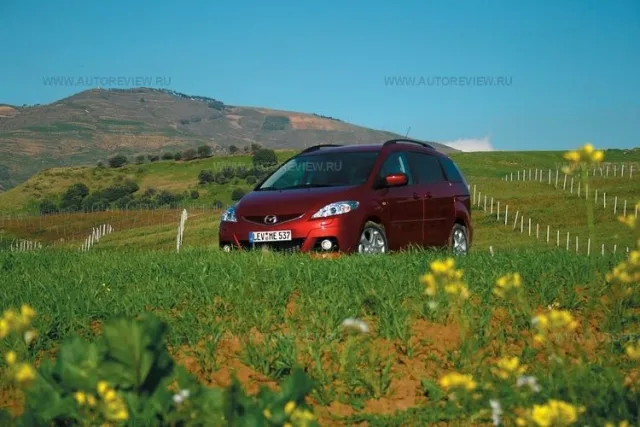
What is hidden under the name Mazda 5? First, it should be clarified: this is not a roadster called Mazda MX5, but a compact MPV. And such a clarification is necessary because the "five" is by no means a sales hit: last year in Russia it took only sixth place among compact one-box vehicles. These 1260 cars are a drop in the ocean, just 2.5 percent of all Mazda cars sold here. Maybe the updated version will change the situation?
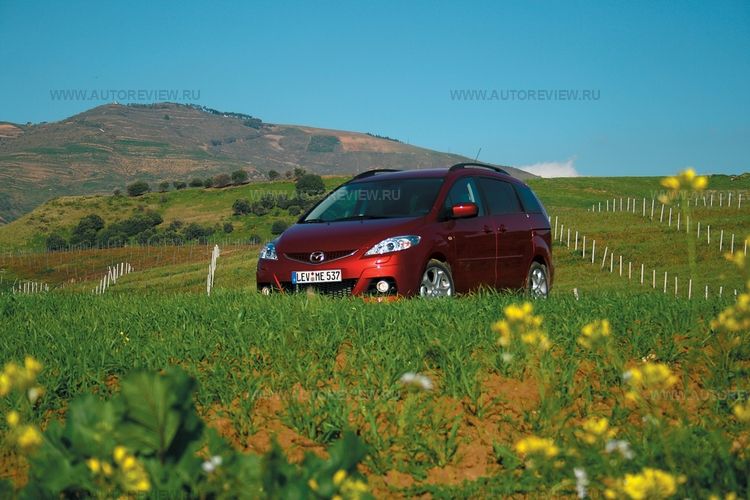
There is no talk of radical modernization, and it would be strange to expect otherwise: only three years have passed since the model's debut. Fresh bumpers, a different grille and optics, new alloy wheels — these are perhaps all the external changes, not a single metal body panel has been touched. You look at the updated version — it seems to please. But as soon as you see a pre-restyling car next to it, you understand: that one is not ugly either. Just pretty, without bright features.
However, there are more significant news. The Mazda 5 has finally acquired an "automatic" that can be ordered with the two-liter engine — previously you had to settle for only a manual gearbox. And for 26 thousand rubles ($1100), an electric drive for the sliding rear doors is available — a convenient thing!
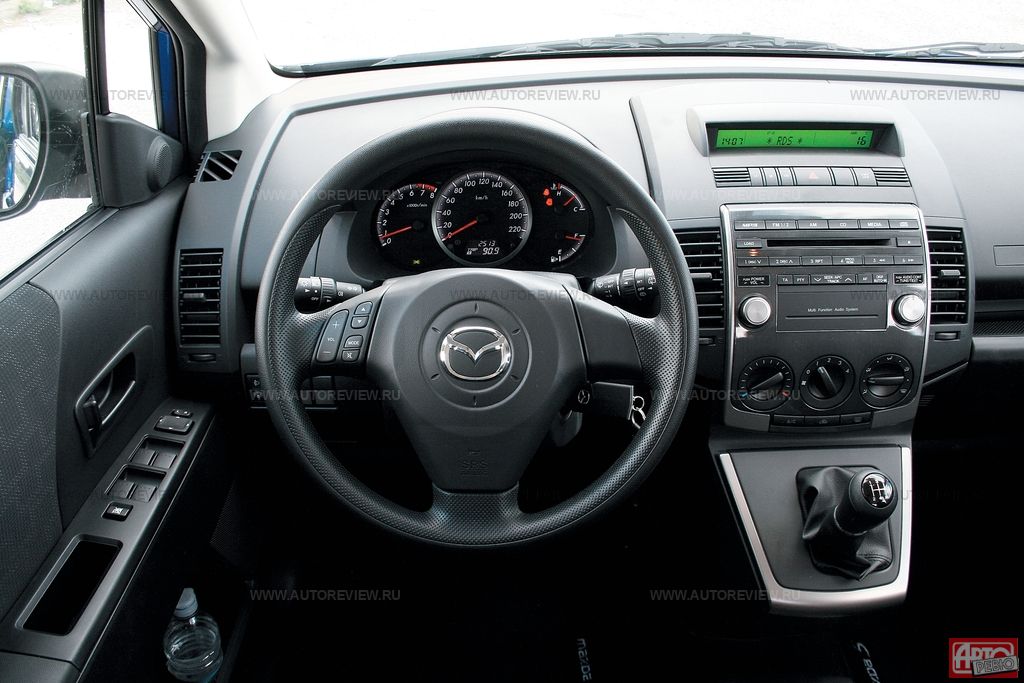 | 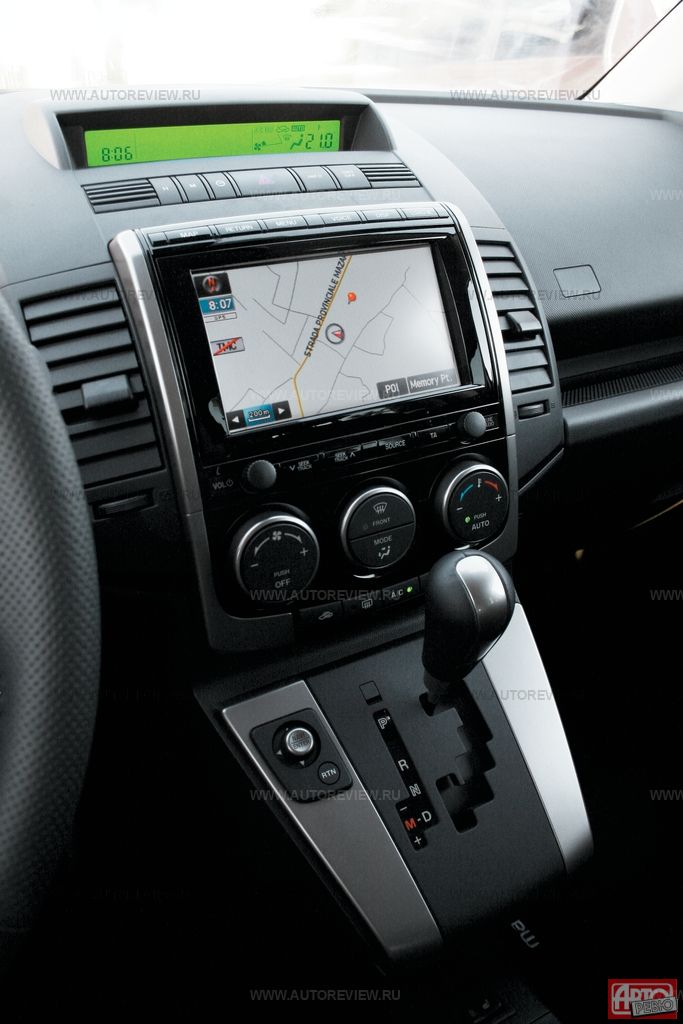 | |
| There are even fewer changes in the cabin than outside: the console is slightly rearranged, the display has become larger and moved higher, and the instruments have received white backlighting instead of green. The five-speed automatic, apart from manual mode, offers no additional algorithms and does not adapt to driving style | ||
Only all these innovations are news only for us: on the Japanese market, the "five" had them from the very beginning. Like the 2.3-liter engine, and even all-wheel drive from the Mazda 6. But although the main market for the compact MPV is Europe, not Japan or the USA, neither all-wheel drive transmission nor a more powerful engine were given to us. For us — either an 1800-cc unit or a two-liter one. The first retained its 115 horsepower, the second was slightly refined: equipped with a variable valve timing system on the intake S-VT and an electronic gas pedal, reduced friction losses. The power, however, remained the same, but the peak torque shifted down by half a thousand revolutions — now it occurs at 4000 rpm. And another important point: the two-liter engine now has a six-speed manual instead of a five-speed.
Next — small things. Sound insulation was slightly improved: several resonator chambers were added to the intake, and a new element for damping vibrations on the roof. And the hum from rolling was reduced by... thicker shelves of wheel disks. The synchronizers of both manual gearboxes were slightly refined, the brake booster was readjusted, and leather upholstery appeared in the options list — again, following Japan and America.
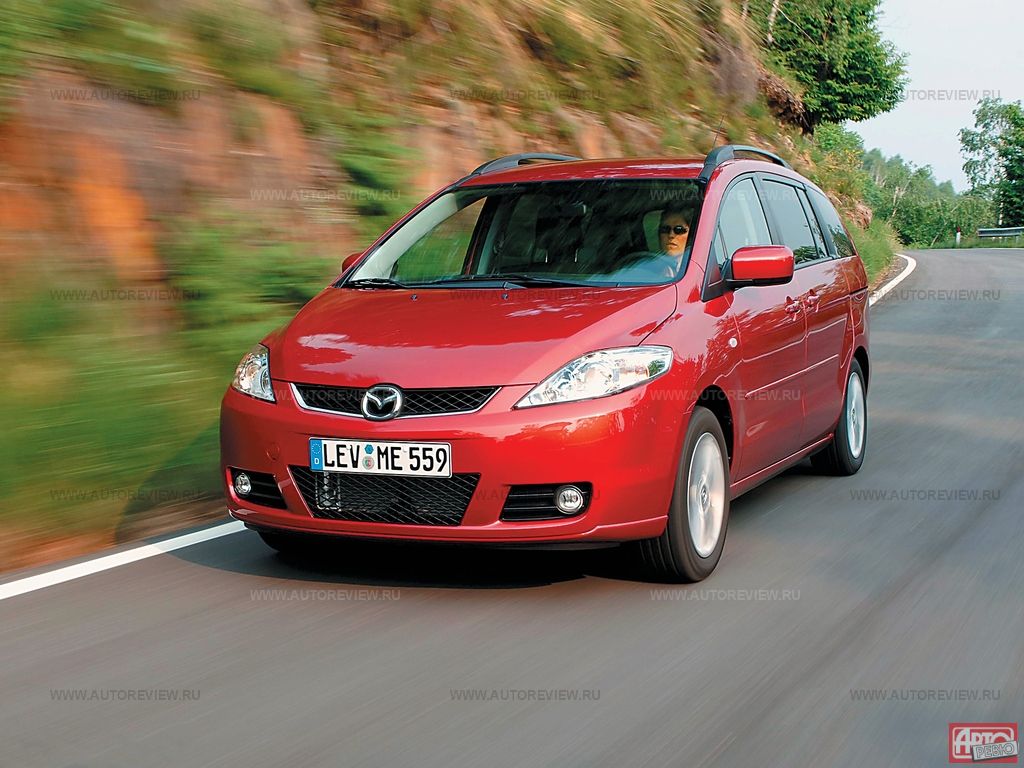 | 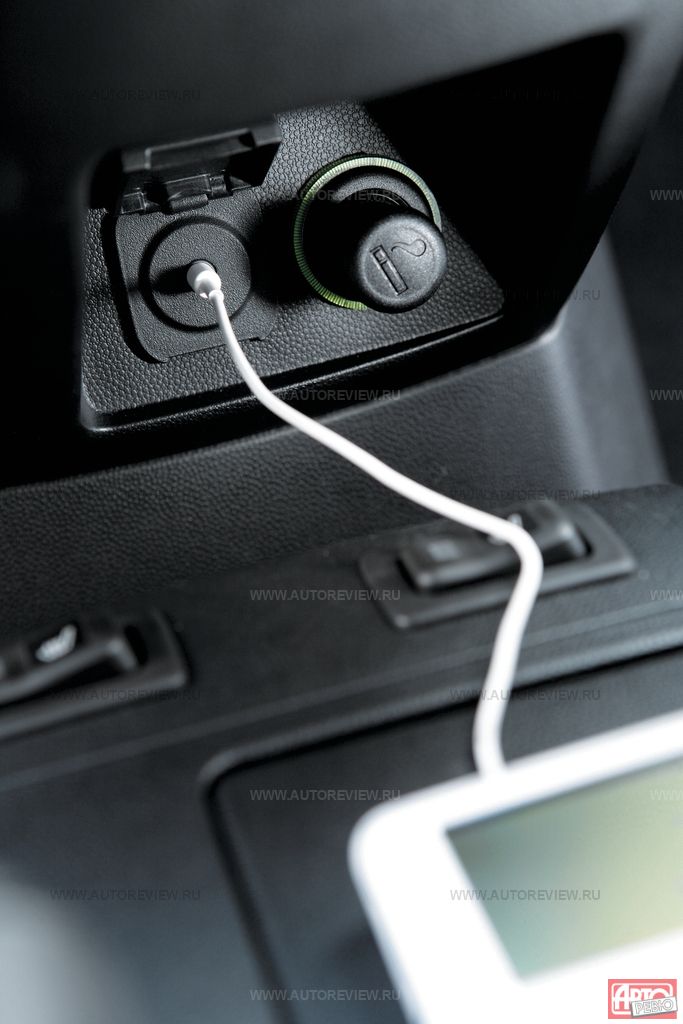 | |
| This is how the Mazda 5 looked before the restyling — can you find three differences? | Among the new options is a connector for an external audio player, hidden under the console, as well as a Bluetooth interface | Gas springs lift the rear door to 1810 mm, after which it can be pushed by hand another 100 mm |
But the changes in the chassis, albeit small, were made specifically and only for Europe. The front shock absorbers were slightly "loosened" for comfort, while the rear ones, on the contrary, were tightened, while increasing the stiffness of the springs and anti-roll bars at the rear. The mounting points of the trailing arms of the rear suspension were also slightly shifted — all this for better stability when fully loaded.
But in the end, the Mazda 5, as it was, remained quite noisy and stiff — at least when there are only two people in the cabin. But it handles easily and enthusiastically, especially on 17-inch wheels: when you release the gas, the car willingly turns into the corner. A lively and understandable chassis! Passengers may get shaken, but they don't get motion sickness.
The new five-speed "automatic" is not a model of perfection. The manual mode here is "honest", but in "drive" the gearbox fusses with extra shifts, and on the highway it is especially noticeable that it cannot adapt to driving style. Just as it cannot start smoothly from a standstill.
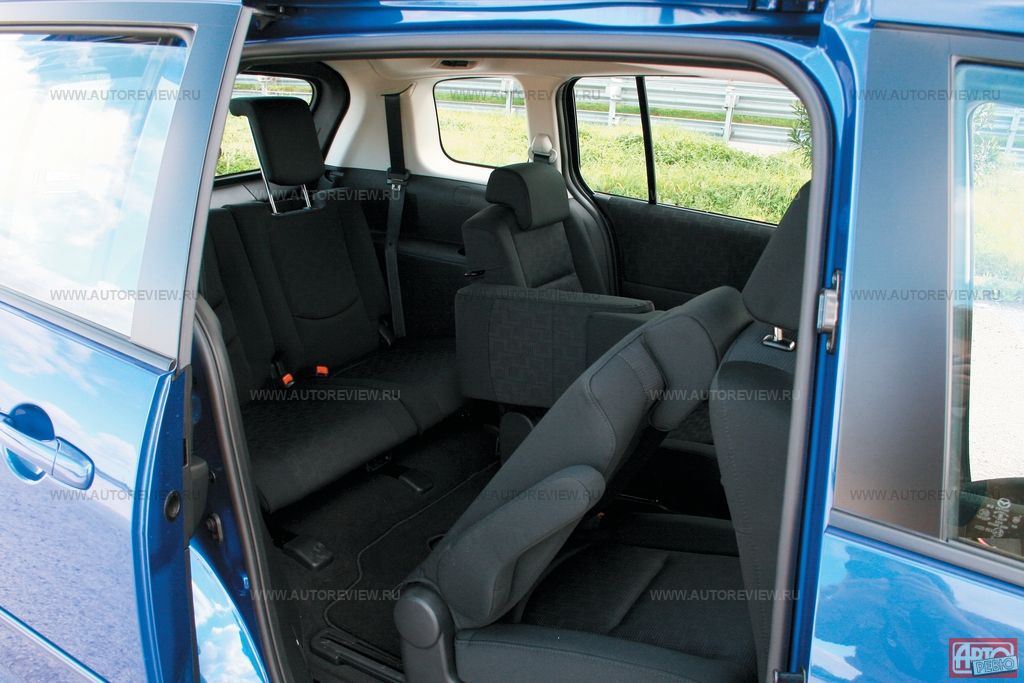 | ||
| Just pull the handle towards you — and the sliding door will move by itself, thanks to the electric drive. The driver can also control it — with buttons on the key fob or on the dashboard. True, if the handbrake is not engaged on a car with a "manual" or the parking mode is not engaged on an "automatic", the doors will have to be moved manually. By the way, each of the sliding doors is 15 kilograms heavier than hinged ones, but the Mazda engineers compensated for this increase by making the fifth door plastic | ||
However, is an "automatic" really necessary here? The segment leader Opel Zafira is sold with an automatic transmission in a third of cases. Ford C-MAX with an "automatic" is chosen even less often — every fifth. Moreover, over the past two years, interest in "automatics" in this class has not increased — their share remains almost unchanged. On the other hand, if the "automatic" can revive demand by a third, then the task of selling 3000 Mazda 5 compact MPVs this year looks quite feasible.
The surcharge for the "automatic" is 39 thousand rubles ($1600), and it can only be ordered with the two-liter engine — the same one that is in the new Mazda 6. The most affordable option with such a gearbox will cost at least 736 thousand rubles ($30200) — this is a seven-seat car in the Touring Plus trim. And the base five-seat version Family 1.8 costs 606 thousand rubles ($24800), which is 11 thousand rubles ($450) more expensive than before the restyling. True, almost all trim levels have become richer. For example, the Mazda 5 Touring 1.8 already has air conditioning, ESP, MP3 radio, and roof rails in the "base". For this pleasure — 699 thousand rubles ($28600). And the Mazda 5 Active with a two-liter engine, Sports Appearance Package body kit, and transparent LED rear lights costs 829 thousand rubles ($33975) with a six-speed manual.
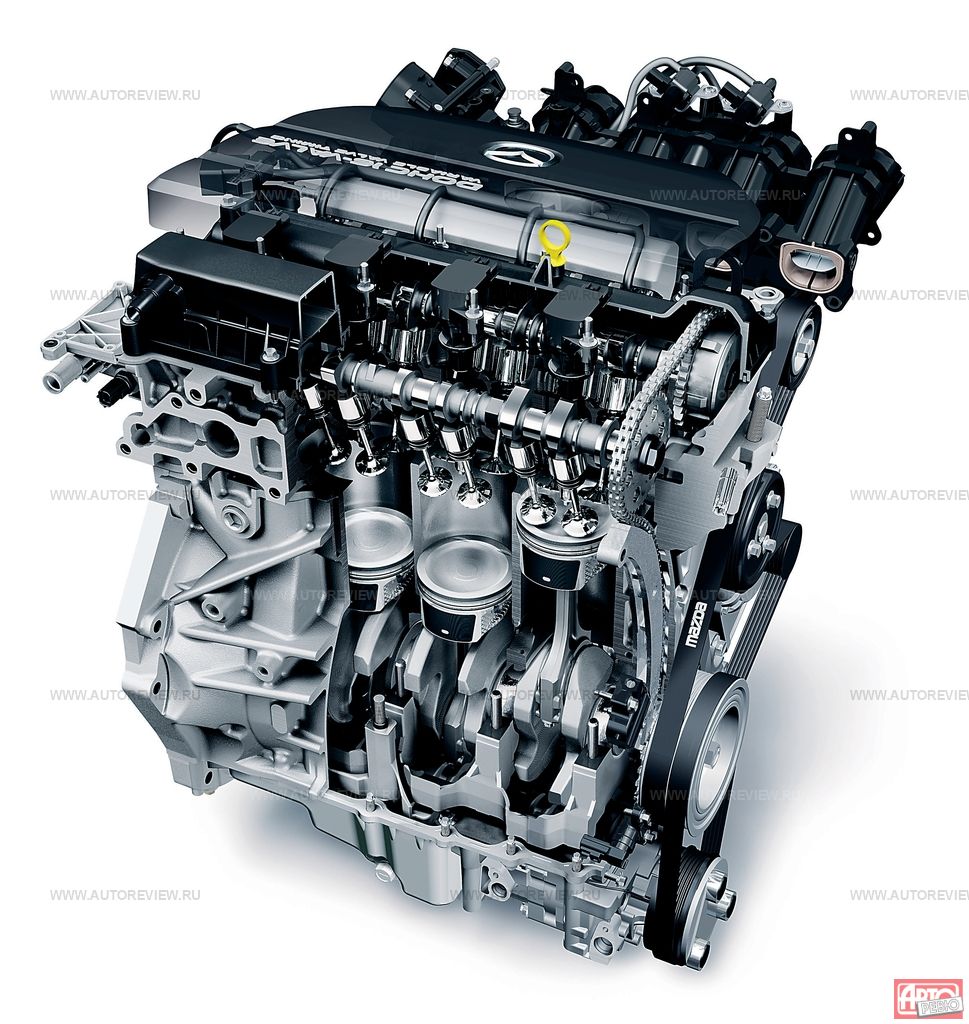 | 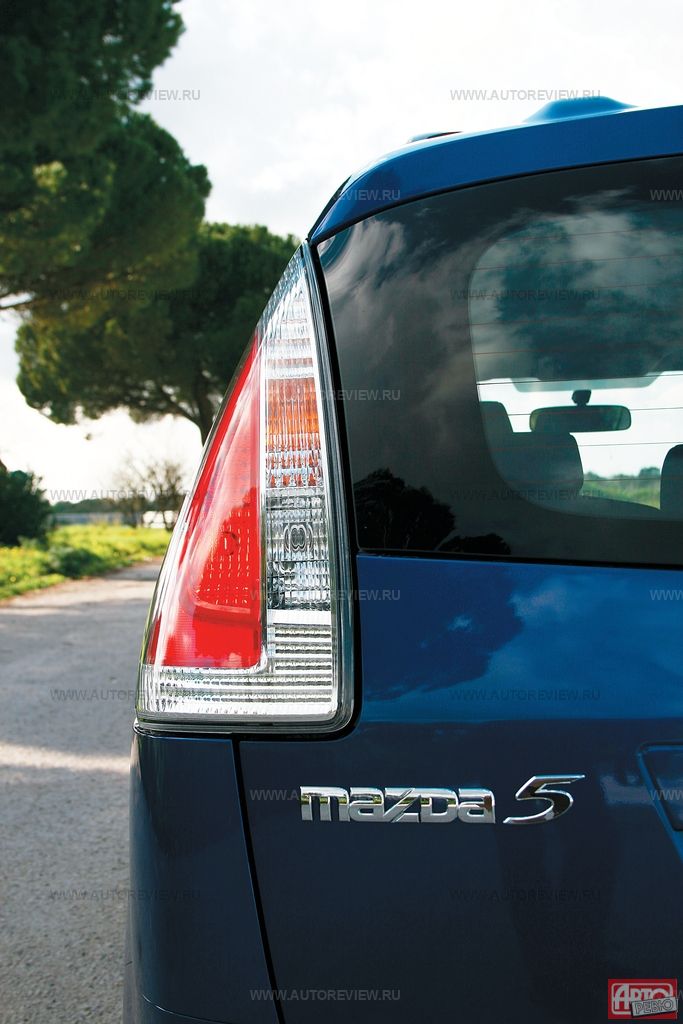 |
| The two-liter engine remained with its 146 horsepower, but acquired a variable valve timing system on the intake S-VT (Sequential Valve Timing) and an electronic throttle | The new rear lights did not require body modifications. On the left photo — Mazda 5 with the Sports Appearance Package body kit, which includes different lights with LEDs |
But if you ask me, this van would benefit from a turbo engine from MPS and a look in the spirit of the RX-8. Or at least a two-liter turbodiesel, which is available in Europe — it is more agile and livelier than the two-liter gasoline one. But they are not available and not expected. It seems I was in vain trying to convince Kenichi Funaga, the project manager of the Mazda 5, to be bolder and make the next "five" more daring. Look, I say, how the Ford S-MAX "shot up"! But the elderly Japanese man only smiled, wrote something in his notebook, and repeated that all Mazdas have a lively spirit and the "five" is no exception.
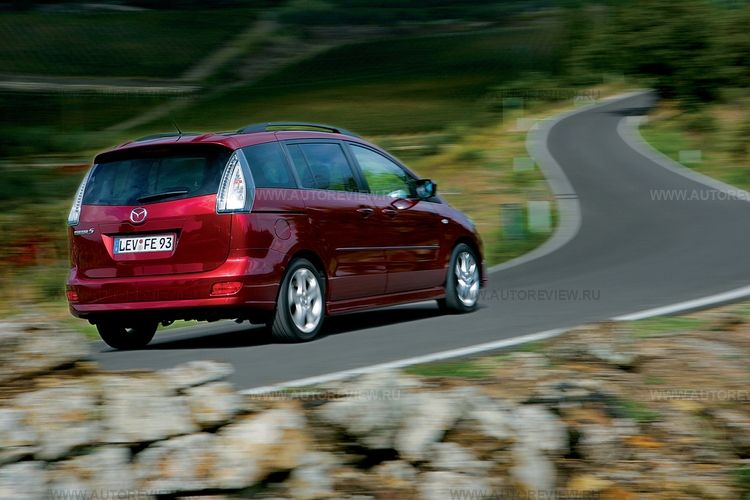
I agree. I am even ready to call it a lively one and put it in the same row as cars like the Mazda 3, Mazda MX5, Mazda CX7, and even the Mazda 6. But let it stand not in the center, but at the edge, closer to the Mazda BT-50 pickup standing aside.
| Specifications | ||
| Parameters | Vehicle | |
| Mazda 5 | ||
| Modification | 1.8 | 2.0 |
| Body type | 5-door wagon | 5-door wagon |
| Number of seats | 5 (7) | 7 |
| Dimensions, mm | ||
| length | 4505 | 4505 (4565)* |
| width | 1755 | 1755 |
| height | 1615 (1665)** | 1615 (1665)** |
| wheelbase | 2750 | 2750 |
| Trunk volume, l | 112—1678 | 112—1566 |
| Curb weight, kg | 1400 | 1410 (1475) |
| Gross weight, kg | 2110 | 2125 (2150) |
| Engine | petrol, with distributed injection | |
| Location | front, transverse | front, transverse |
| Number and arrangement of cylinders | 4, in-line | 4, in-line |
| Displacement, cm3 | 1798 | 1999 |
| Compression ratio | 10.8:1 | 10.0:1 |
| Number of valves | 16 | 16 |
| Max. power, hp/kW/rpm | 115/85/5300 | 146/107/6500 |
| Max. torque, Nm/rpm | 165/4000 | 185/4000 |
| Gearbox | manual, 5-speed | manual, 6-speed (automatic, 5-speed) |
| Drive | front | front |
| Front suspension | independent, coil spring, McPherson, with stabilizer | |
| Rear suspension | independent, coil spring, multi-link, with stabilizer | |
| Front brakes | disc, ventilated | disc, ventilated |
| Rear brakes | disc | disc |
| Tires | 195/65 R15 (205/55 R16) | 195/65 R15 (205/55 R16, 205/50 R17*) |
| Maximum speed, km/h | 182 | 194 (186)*** |
| Acceleration time 0—100 km/h, s | 11.3 | 10.2 (12.4)*** |
| Fuel consumption, l/100 km | ||
| urban cycle | 10.1 | 10.6 (11.3)*** |
| extra-urban cycle | 6.1 | 6.3 (6.4)*** |
| combined cycle | 7.6 | 7.9 (8.3)*** |
| Fuel tank capacity, l | 60 | 60 |
| Fuel | petrol AI-95 | petrol AI-95 |
| * Sports Appearance Package trim | ||
| ** With roof rails | ||
| *** For vehicle with automatic transmission | ||