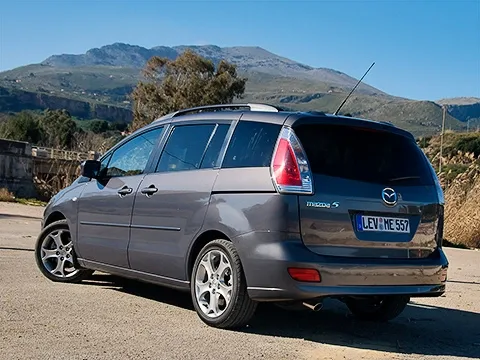
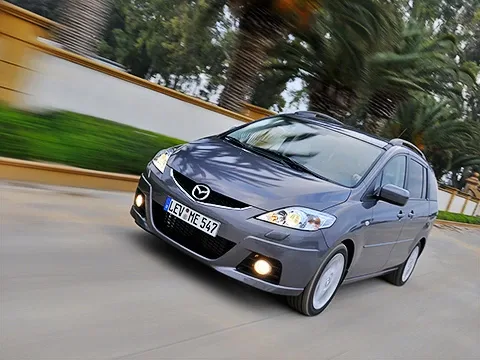
Actually, the 'five' got its update a bit earlier than expected. The model is quite fresh — it debuted only in 2005. And just a couple of years later — bam! — new plastic! Looks strange. But essentially, there aren't many changes. In short — new bumpers, different lights, plus an 'automatic' appeared and some equipment was added. Although, to be honest, I knew the pre-facelift Mazda5 rather superficially. And our last meeting didn't leave a pleasant aftertaste.
Here's how it was. It all happened near Budapest, where the new Mazda6 was premiered. I had to sit on the hard plastic floor of the trunk and race at a decent speed in the 'five'. In one hand — a camera, with the other I desperately clung to the second-row headrest, just to avoid flying out on turns. Time was short — just a few minutes to shoot the new 'six' in motion on the track. And since such shooting is best done from a parallel-moving car, they gave me Ronnie — the head of test drives at that presentation.
The guy is young, always smiling, the spitting image of Richard Hammond, and the only one in the entire Mazda team whose badge didn't have a surname. Everyone just called him Ronnie. He sat behind the wheel of the Mazda5, and I climbed into the trunk with my camera. Another driver took the white 'six', and we set off. For shooting, high speed is usually unnecessary — the motion effect is visible in photos anyway. But Ronnie apparently didn't know that: he flew fast and carved into corners almost with tires squealing! And I was bouncing around in the back, torn between wanting to take shots and trying not to fall out of the open trunk and stay alive.
So at Palermo airport, I started my inspection of the facelifted version with the trunk. And immediately regretted that near Budapest we didn't get such a car: instead of the hard plastic 'mat' (surely practical, but terribly slippery), there was fluffy carpet. The volume, of course, hasn't changed. By eye — about 112 liters with all seats up and 426 with the third row folded. But this time I didn't climb inside — just threw in a suitcase and a case with equipment. They hardly care about the difference in comfort.
In short, acquaintance #2. Yes, the Mazda5 has prettied up — the front is more modern, new wheels clearly suit it, but the rear lights I would perhaps dispute. But I won't. To get me to the hotel, they gave me a car with a 143-horsepower diesel. In Europe, these will sell like hot cakes, but in Russia, diesel Mazdas aren't expected in the coming years. Still, it's interesting to try, right? As it turned out — not very. Cold, doesn't ignite. The pull is smooth, confident, but absolutely emotionless. I didn't complain about lack of power, but I didn't feel thrilled either. Though why am I grumbling like a diesel at idle? It's a compact MPV!
And besides, we won't get it. So the next day I 'wangled' a version with a two-liter gasoline engine and an 'automatic'. Especially since the automatic transmission is the main novelty of the updated Mazda5. Before, only a 'manual' was offered for us.
At dinner, I chatted with Kenichi Fukunaga, the Mazda5 program manager. A man who knows everything about the new 'five' and willingly shares it. For example, he told about the revised suspension: front shock absorbers became softer, geometry slightly changed. Or about the new electronic gas pedal on the two-liter 146-horsepower unit, about variable valve timing S-VT and a new intake system, thanks to which the peak torque is now available at 4000 rpm instead of 4500 as before. Fuel consumption in the combined cycle dropped from 8.2 to 7.9 liters per 'hundred', and it's better for the environment. But the 1.8-liter engine got less engineering attention — they reflashed the control unit and slightly refined the five-speed 'manual'.
On the two-liter engine (and on diesels), the 'stick' is now six-speed, with improved carbon-fiber synchronizers — for greater clarity. I confirm: on the diesel version, the lever 'clicked' perfectly — accurately and with a pleasant effort. But the clutch is set up unusually: a bit stiff, grabs sharply at the very beginning of travel.
As for the 'automatic'? Technically, it's a unit familiar from the 'six'. Five speeds, manual mode — all modern. And here the question arises: why wasn't it there before? After all, in Japan and America, the Mazda5 with automatic transmission was sold from the very beginning. 'It all comes down to European certification,' the Mazda folks explain, 'at that time they thought Europe could do without an automatic, and separately certifying the automatic for Russia would be too costly.'
There aren't many 'fives' in Russia. The close relative and competitor Ford C-Max, built on the same units, sells much better — 6580 cars versus 1258 for Mazda5 in 2007. Why? At first glance, the answer is simple. No matter how they tout handling and design in press releases, no matter how they whisper 'zoom-zoom' in ads, a Mazda is primarily a family car. And what family car is without an 'automatic'? That's just sadistic-Mazda! But now it's there — and that's good.
But it's not so clear-cut. Yes, Mazda marketers plan to sell three thousand cars this year, and many, by their calculations, will be with automatic transmission. That's not the point. Of the same six and a half thousand C-Max sold in 2007, fewer than one and a half thousand went with an 'automatic'. But more on that later. First, let's test the Mazda5 with automatic transmission in action.
Nowhere in Western Europe do I feel as free as in Italy. Yes, it's poorer than Germany or Britain. Yes, there are cigarette butts and trash on the streets, drivers ignore speed limits and don't yield to pedestrians. But that's the whole thrill — here I'm almost at home!
And autonomous Sicily is a whole different song. Everything here is its own: language, cuisine, history, and traditions. And everything is even cooler. Drivers of the sunniest region of Europe spit on priorities and despise 'turn signals'. And almost every other person drives 'tipsy'. And how else? Sicily produces more wine than Austria or Chile — it has to go somewhere! It's in such conditions that the character of the automatic transmission comes in handy: when you release the brake pedal, it instantly, even slightly abruptly, 'creeps'. Once in the city, I stopped to let a girl out of a courtyard, and two more cars shamelessly followed her. Shamelessly, but without Moscow aggression — that's how it's done here. But I pressed the gas in time and didn't let them in — and that's also normal here.
But the gearbox stops pleasing as soon as you leave the narrow streets for open space. It categorically refuses to hold a lower gear: you ease off the gas — it immediately shifts up. Of course, if you drive without driver ambitions, that's normal, and fuel consumption is lower. But there are also problems with downshifts — you press the gas before overtaking, and whether the gearbox will shift or not is a mystery…
Overall, on the highway, the car is good — it confidently holds a straight line and isn't 'woolly'. True, it's quite sensitive to crosswinds, but that's normal for a compact MPV. Another thing is that the cabin is a bit noisy. Moreover, on Italian roads (not the best quality), the 'soloists' are not the Dunlop SP Sport 2050 tires — they're barely audible. It's near the side mirrors that mini-hurricanes rage at speed. Otherwise, driving is pleasant: the seating position is excellent, almost car-like, visibility is wonderful, and the driver's seat armrest is comfortable. In corners, the car behaves superbly — with slight rolls, it accurately and clearly traces the arc, and the steering wheel fills with 'tasty' effort. Both on the long arcs of highways and on narrow mountain roads.
But in the back — it's a completely different matter! Honestly, the rear rows in most compact MPVs usually don't impress me. I can't understand why manufacturers so stubbornly put three separate seats in the back. Of course, it's more convenient for three, and folding them is more interesting. But when one or two people ride in the back (which happens more often), comfort is clearly less: you can't sprawl out properly, and there's usually no central armrest. In the 'Mazda', everything is done the way I like. There's a full-fledged sofa with a proper armrest, the middle of which easily folds down if desired, turning it into two separate seats — just in case. The seats slide back and forth, the backrests recline. Everything is adult-like, and even the third row can be called suitable for people, albeit with a stretch. And getting there is more convenient — the doors are sliding, the opening is wide.
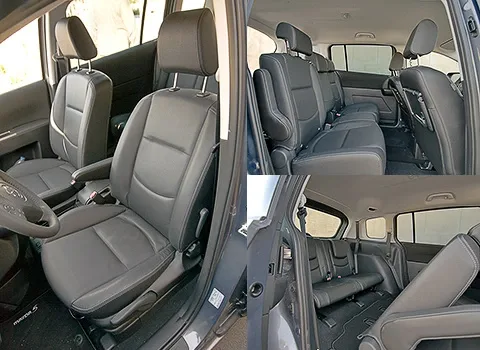
The front seats are decent, and the lack of pronounced lateral support is partly saved by the driver's folding armrest. But in the back — it's just perfect: spacious in all directions, there are folding tables with cup holders, drawers under the seat cushions, and folding armrests. But it's better not to seat too tall passengers in the back seats, although access to them is organized quite conveniently.
But I was worried about the doors. No, not because they'd be hard to open or close. We got a car with electric drive — an option that appeared only after the facelift, but even without it, there would be no problems. Those who've ridden in Russian minibuses would open them with the power of thought! Rather, I was concerned that it would be uncomfortable in the back. The logic is simple: a sliding door has a flat inner panel — no armrests, no pockets. There are indeed no pockets, but the seats have comfortable armrests. So after a couple of hours on the rear sofa, I didn't want to get out of the car at all.
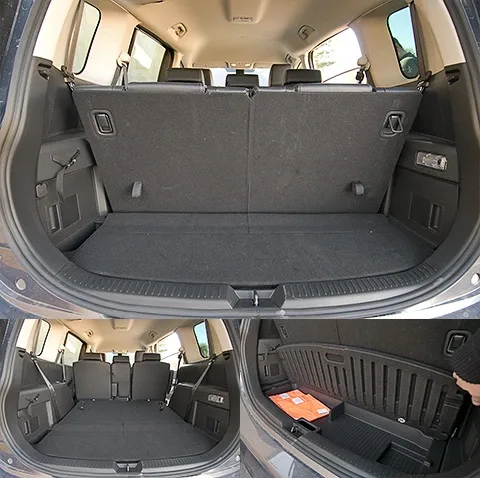
When all seats are up, the trunk is, of course, tiny. But if you fold the third row — there's a lot of space. All transformations are done easily, and the second row folds into a flat floor: however, you first need to flip the cushions and remove the headrests. By the way, the five-seat version of the Mazda5 has a slightly larger trunk 'literage'.
By the way, in Japan, power-operated doors were available from the very start of sales. Why they only reached us now, I didn't bother to ask. Over there, both the 'five' and the 'three' even have all-wheel drive, but we don't have it and it's not expected. They say that outside the city in Japan, there's plenty of snow in winter. I felt like inviting Mr. Fukunaga to Russia for a couple of weeks. Maybe, after driving on our snow, they'd decide to bring all-wheel-drive versions here? But unlikely — European certification, you know...
The Mazda folks have created a distinctive car. Stylish, spacious, with excellent handling and, of course, the main feature — sliding (and truly convenient) rear doors. But with such a sporty chassis, you want a more powerful engine and a more responsive gearbox. After all, there are already plenty of compact MPVs on the market aimed primarily at comfort.
In Europe, the Mazda5 is the third most popular model of the brand after the 'three' and the 'six'. But here, it even trails the large crossover CX-7 and the BT-50 pickup. The thing is, despite an expected sales increase of more than double, it will still be in the role of the chaser. Because many of our compatriots, after looking at the 'five', might decide to pay extra and get the same CX-7. And it's not about the 'automatic' — most compact MPVs are bought with a manual. It's about the price.
Mazda clearly has no intention of cutting prices. The base Family version with the 1.8-liter engine starts at 606,000 rubles. Seems not expensive. But this is an option for the frugal: inside, there's nothing at all! Not only is there no air conditioning or rear power windows, but even ASR and ESP are absent. The mirrors, moldings, and door handles will be black. However, the Touring trim with the same engine already has everything needed — a full set of active safety systems, air conditioning, a CD player (finally with MP3!), and a bunch of other pleasant little things. And then the 'five' can be further equipped with a more powerful engine, an 'automatic', a third row of seats, sliding doors, leather interior, sunroof... But the 'maxed-out' version will already cost 978,000 — almost a million! Quite a lot, you'll agree.
The Mazda folks aren't fools; they understand that few in Russia are ready to marry a compact MPV for love. The Japanese aren't going to fight tooth and nail for top spots in the 'cars for pragmatists' rankings. There are plenty of reasons — the specifics of the 'five' itself, the brand's image, and the not-so-large segment volume. So the Mazda5 is perhaps exactly the case when it's a 'marriage not of convenience'. And for compact MPVs, you'll agree, that's as rare as rain in Sicily.
Technical specifications
| Specifications | 1.8 MZR | 2.0 MZR |
| Body |
| Number of doors/seats | 5/5 (5/7)* | 5/7 |
| Length, mm | 4565 | 4565 |
| Width, mm | 1755 | 1755 |
| Height, mm | 1615 (1665) | 1665 |
| Curb weight, kg | 1475 | 1485 (1550) |
| Gross weight, kg | 2110 | 2125 (2150) |
| Trunk volume, l | 538–1678 (112–1566)* | 112–1566 |
| Engine |
| Type | Petrol, with distributed injection | Petrol, with distributed injection |
| Location | Front, transverse | Front, transverse |
| Number and arrangement of cylinders | 4, in-line | 4, in-line |
| Number of valves | 16 | 16 |
| Displacement, cm3 | 1798 | 1999 |
| Max power, hp/rpm-1 | 115/5300 | 146/6500 |
| Max torque, Nm/rpm-1 | 165/4000 | 185/4000 |
| Transmission |
| Gearbox | Manual, five-speed | Manual, six-speed (automatic, five-speed) |
| Drive | Front | Front |
| Chassis |
| Front suspension | Independent, McPherson | Independent, McPherson |
| Rear suspension | Independent, multi-link | Independent, multi-link |
| Front brakes | Disc, ventilated | Disc, ventilated |
| Rear brakes | Disc | Disc |
| Ground clearance, mm | 140 | 140 |
| Performance characteristics |
| Maximum speed, km/h | 182 | 194 (186) |
| Acceleration time from 0 to 100 km/h, s | 11.3 | 10.2 (12.4) |
| Fuel consumption, l/100 km |
| Urban cycle | 10.1 | 10.6 (11.3) |
| Extra-urban cycle | 6.1 | 6.3 (6.4) |
| Combined cycle | 7.6 | 7.9 (8.3) |
| Emission standard | Euro-4 | Euro-4 |
| Fuel tank capacity, l | 60 | 60 |
| Fuel | AI-95 | AI-95 |
* — for Touring trim; ** — with roof rails
Getting acquainted with the updated Mazda5
When I first saw the updated Mazda5 on the picturesque roads of Sicily, I was curious about how seriously the engineers of the Japanese brand had worked on this minivan. First impression — the car has become noticeably more interesting in appearance, but the main surprises awaited in the details.
Trims and prices
The trim lineup starts with the base Family version, which is equipped with a 1.8-liter engine with a manual gearbox and five seats. It costs 606,000 rubles (about $24,740). A slightly more equipped Touring version with the same engine but already a seven-seat interior will cost 699,000 rubles — $28,530. Interestingly, the base version doesn't offer air conditioning, but in Touring it's already there.
The next step is Touring Plus with a two-liter engine, available with both manual and automatic gearboxes, costing 736 and 775 thousand rubles respectively ($30,040 and $31,630). Here, climate control, traction control system, and dynamic stability system appear. The top Active version with an aerodynamic body kit, xenon headlights, 17-inch alloy wheels, cruise control, and rain sensor is priced at 829 thousand with a manual gearbox and 868 thousand with an automatic — $33,840 and $35,430.
For an additional fee, 'metallic' paint, power-operated rear doors, leather interior, sunroof, and Smart Card access system are offered.
Safety
Although Euro NCAP crash tests were conducted back in 2005 on the pre-facelift version, the results are impressive: five stars for adult occupant protection — that's 33 points. True, in the frontal impact against a deformable barrier at 64 km/h, experts deducted points for potential danger to the driver's legs and knees. But the side impact was passed almost perfectly, earning 18 points. However, child and pedestrian protection is rated more modestly — three and two stars, respectively.
The base equipment includes front and side airbags, curtain airbags, ABS, and EBD. An immobilizer is also present in all versions. But TCS and DSC systems are only available starting with the Touring trim.
Technical features
The Active version differs not only in the body kit but also in LED rear lights, which illuminate faster and consume less energy. However, their main advantage is, of course, the appearance. They give the car a more modern and expressive look.
Driving impressions
The presentation took place in the western part of Sicily, near Palermo. I admit, I really wanted to take a ride to Etna — the highest active volcano in Europe, but the tight test schedule left no time for it on the first, second, or even third day. The consolation was the view of the legendary volcano from the airplane window on the way back — so I can tick the 'seen' box.