
Even when the eighth-generation Honda Civic hatchback is already on the dynamometer road of the Dmitrov test site, we still find it hard to believe that this is an ordinary production car. Aggressive wedge-shaped profile, a "chandelier" of headlights, triangular cutouts for fog lights and exhaust pipes... Against the backdrop of its classmates — the Mazda 3 2.0 Sport and Peugeot 307 2.0 Feline hatchbacks — this Civic looks like a guest from the future!
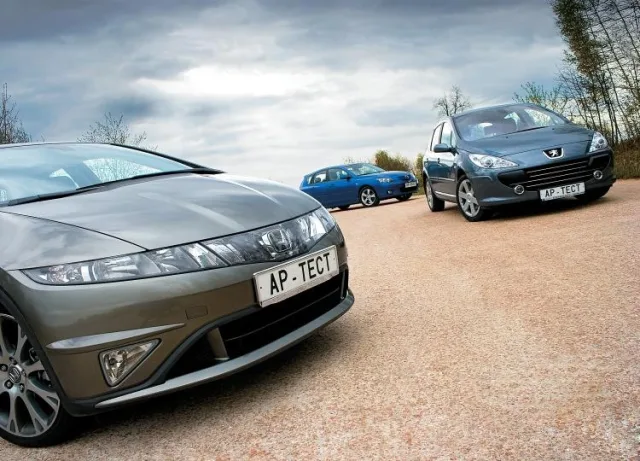
But how much is this bold design backed by real capabilities?
 We didn't choose our rivals by chance — we needed hatchbacks that combine striking looks and good dynamics. Of course, the two-liter Mazda 3, which had already won the "Dynamics" discipline in a comparison with the Volkswagen Golf 2.0 FSI and Ford Focus 2.0 (see AR No. 13-14, 2005), had to be on the list. Who else to take? The flashy Citroen C4 VTS? But we tested it quite recently (see AR No. 10, 2006). So the third participant was the updated Peugeot 307 in its most powerful modification — with a two-liter engine producing 177 hp.
Of course, the odds are not in Honda's favor: the 1.8 i-VTEC engine delivers 140 hp, while Mazda's two-liter "four" produces 150 hp. But unfortunately, there was no choice — the Russian car market is in a fever right now. If the required version isn't in the press fleet, you won't find it at dealers either — everything is swept away by demand. It's good that the 177-horsepower Peugeot remained unsold...
However, the difference in horsepower turned out to be not so decisive.
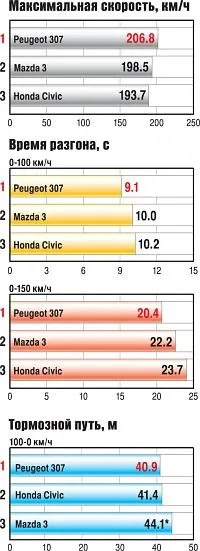
Of course, the Peugeot is faster — it hits 100 km/h 0.9 seconds earlier than the Mazda and a whole second earlier than the Civic. But remember: it was exactly one second in acceleration to 100 that separated the Focus and Mazda 3 with a power difference of only 7 hp. And here the gap is a full 27 hp...
However, peak figures aren't the main thing. What matters is how convenient it is to manage the thrust. And here, the Peugeot is not doing well.
 | 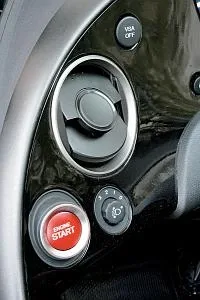 | 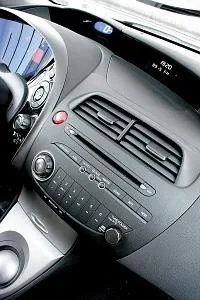 |
| The futuristic dashboard, arranged around the driver, is actually convenient, although the climate control unit is not visible to short drivers | The Start button only starts the engine after turning the ignition key — it's to the right of the steering wheel | This "keyboard" is convenient for switching radio stations or tracks from CD/mp3 discs |
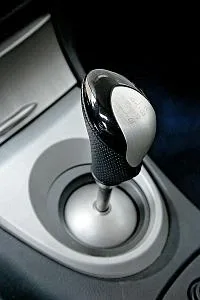 |  |  |
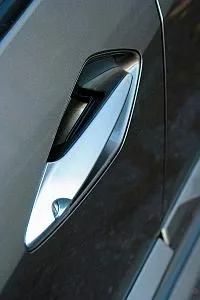
| Shifts are precise, but the lever itself isn't very comfortable | Dynamics and style — in every detail. It's a pity the striking spoiler impairs rear visibility, and in rain, the lack of a "wiper" adds problems | The already flashy Civic can be further enhanced: the bumper "skirt," sill covers, and 18-inch wheels on this car are for an extra charge |
 |  |  |
First, the accelerator pedal is noticeably damped, responses lag. Second, the engine truly comes alive only in the mid-range; revving it above 5500 rpm is pointless. And third, the gearbox ratios are poorly chosen. First gear is too "long": at launch, it feels like you're starting in second — there's not enough torque. You accelerate in second, shift to third — and the engine doesn't "pick up," even though the tachometer seems to show high revs...
 The main instrument is the tachometer. The scales on the sides of the digital speedometer (located a level higher) indicate a shift to economy mode or reaching maximum revs. The speedometer itself responds with noticeable delay |
The Mazda 3 is a completely different story!
If you look only at acceleration figures, the Mazda would remain second. But the first three gears here are the "shortest," engage with sporty precision, and are perfectly matched: there's enough thrust both low and high. The response to the accelerator pedal is exemplary: press it — and it goes. As a result, it's the Mazda that feels the fastest and most driver-oriented!
Yes, the Mazda. Not the Honda.
It's not even about power — the Honda's 10-hp deficit is quite explained by the 200 cc difference in displacement and a couple of tenths of a second to 100. But the Civic unpleasantly surprised with the most "thoughtful" accelerator, against which even the Peugeot seems responsive. You press the gas — silence. And only after a second does the hatchback start to accelerate, as if under the hood there's not a six-speed manual but a lazy "automatic." The previously tested Civic sedan with the same engine and automatic (see AR No. 9, 2006) was much livelier!
And here — neither excitement nor tractability. With "long" gears, the engine doesn't want to "pull" from low revs: accelerating, say, from 60 km/h in fifth is already a problem; you have to downshift.
It's a pity, truly.
The gear shifting itself in the Honda is a pleasure: with the stylish (though not the most comfortable) joystick, you hit the right gear without error. But the clutch lacks informativeness, so when you're not used to it, you start with jerks. It loses to the Mazda in this regard.
Can the Honda make up for it in corners?
The pleasant leather steering wheel with bulges in the grip area and "aluminum-look" inserts does just over two turns from lock to lock, and the high torsional rigidity of the suspension gives the Civic sporty agility. A slight turn of the wheel — and the Honda instantly, almost without body roll, dives to the side. At first, it even seems abrupt. But the reactions of the futuristic hatchback are precise and unambiguous, the steering is informative. And on smooth asphalt, the Civic enters sharp turns so willingly and traces trajectories so accurately that you're amazed. After all, at the rear here, unlike the Civic sedan or Mazda 3, there's not a multi-link but a simple semi-independent beam. But the Japanese tuned it excellently! When lifting off or adding throttle in a limit turn, the Honda simply changes its radius in a four-wheel drift. No understeer, no oversteer!
Unsurprisingly, in the "moose test" (emergency obstacle avoidance with return to the lane), the Civic with its almost neutral handling allowed the experts to achieve the best result — 80.4 km/h. Moreover, the stability control allows slides and intervenes very delicately, without hindering the driver.
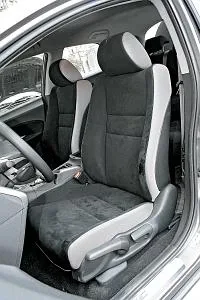 | 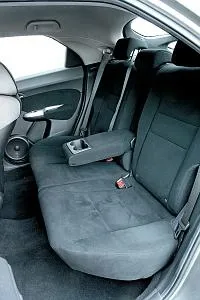 | 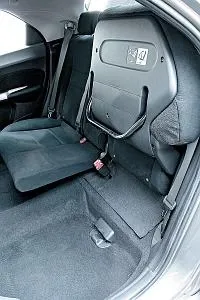 |
| The Honda's comfortable seats lack only lumbar support adjustment | Space in the Honda's rear seat is hindered by the sloping roof and pillars pressing on passengers' heads. But in terms of knee room between the seats and front seatbacks, the Civic is unrivaled | The rear "sofa" cushions are of the lift-up type, like in the younger Jazz model |
 |  |  |
| The "glove box" isn't wide, but it's deep — up to the elbow | The Honda has the most spacious trunk and the most thoughtful transformation | In the "cargo" underfloor, there's a niche |
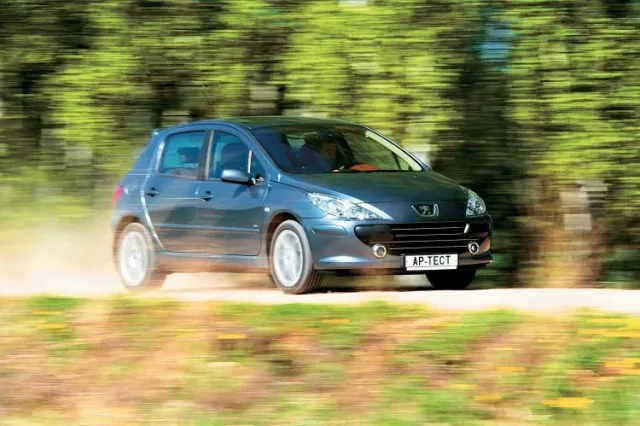 The Peugeot 307 is calmness itself. Moderate response to steering turns, smooth and precise reactions, noticeable body roll, diagonal rocking in corners... None of this is annoying — thanks to clear feedback and predictable behavior. But there's no excitement here. The French car enters sharp corners less eagerly than the Japanese hatches: slightly exceed the speed at the entry — and the car's nose pushes wide. At the limit, the "Frenchman" reacts more strongly to changes in throttle input: lifting off the gas causes a sharper slide, while adding power straightens the path more intensely. But the stability control (which cannot be turned off) is always on guard, so there's nothing to fear.
 |  |
| Peugeot 307: sporty style! But in the red zone of the tachometer, the needle has nothing to do — the engine is truly active in the range from 3200 to 5500 rpm | The interior of the Peugeot 307 in the luxurious Feline trim looks much livelier than the standard one |
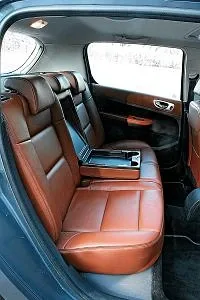 | 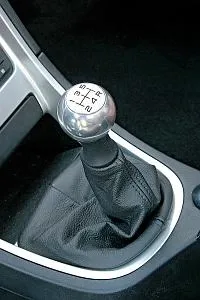 |
| The Peugeot seats pleased us the most. In the back, the Peugeot 307 is the widest, but when seating three, the high floor tunnel gets in the way | The gear selection mechanism — without the slightest hint of sportiness: "sloppy" and imprecise |
 |  | |
| Even after the futuristic interior of the Honda, the Mazda's interior looks very attractive | Racing-style hanging needles and red backlighting create the right mood | Mazda 3 — the ideal balance of exciting and reliable handling |
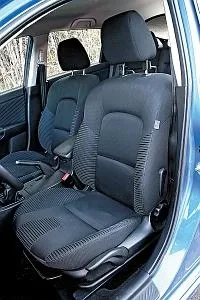 | 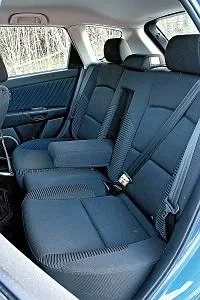 | 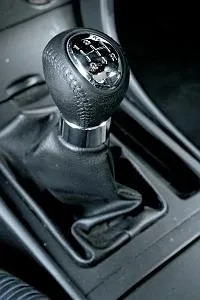 |
| The Mazda seats please with a wide range of adjustments and "grippy" contouring | Rear space — at the level of the Peugeot, but the "sofa" here is the most comfortable | Gears shift precisely — with well-measured throws and efforts |
 So, what do we have in the end?
The most powerful Peugeot 307 is good because it is... the most powerful. But there's no hint of sportiness here. Instead, there's cabin comfort. The interior in the luxurious Feline version is adorned with orange-brown shades of natural leather and silver "aluminum" inserts, the steering wheel has a deliberately chunky rim, and the leather "buckets" please with their "anatomical" shape. Plus dual-zone climate control.
But is that enough to justify the price tag of $32,760? Hardly.
The Mazda 3 2.0 is an energy drink! A tool for daily training of the driver's spirit. And this training takes place in very comfortable conditions. The interior is cozy: striking instrument lighting, blinking LEDs on the panel of the standard audio system, and "hospitable" seats with blue inserts matching the body color. The ride comfort is good. In the back — the most comfortable seat, where three can easily fit. The engine, though, is a bit loud, but overall, in terms of noise, all three cars are roughly at the same level.
Moreover, the Mazda 3 with the two-liter engine is the most affordable of the trio: prices start from $22,300!
Finally, the new Honda Civic hatchback.
The design is fantastic! A spaceship cockpit with a futuristic two-tier front panel, an openwork steering wheel, unusual "split" instruments... Moreover, the aesthetics almost don't conflict with functionality. Rear visibility is, of course, limited — the rear window is crossed horizontally by an effective spoiler and also lacks a "wiper." By the way, in bad weather, the "split" wipers leave wide uncleaned zones at the windshield pillars of the Honda (as well as on the Peugeot 307). But the Civic has large exterior mirrors — unlike the Peugeot.
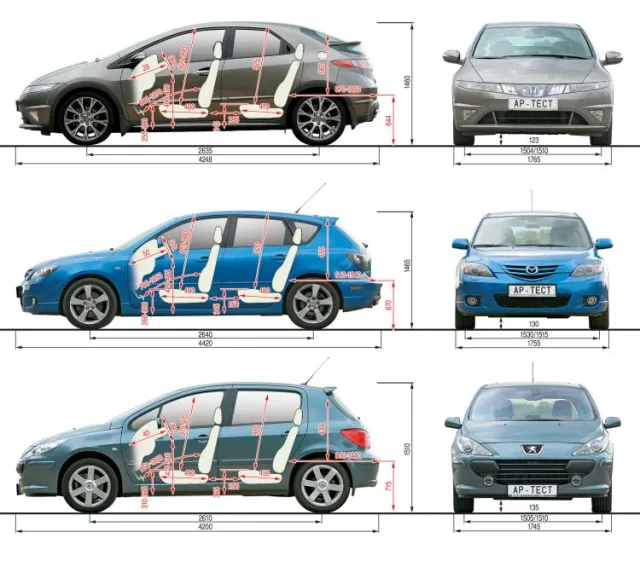
Due to the low roofline, the Honda yields to both rivals in ease of entry and exit, but inside it turns out to be quite spacious: if in the Mazda and Peugeot the knees of rear passengers slightly touch the front seatbacks, then in the Civic there remains a gap in front of them. However, the outer passengers of the Honda are "pressed" by closely positioned pillars with the roof, which also interfere with a "wide-angle" view of the surroundings.
But the Civic is the best transformer! The rear seat here, like in its younger sister Jazz, can be folded in one motion in parts and almost flush with the floor (the backrest folds onto the cushion that moves forward and down), or you can raise and fix only the cushion. Moreover, as in the Mazda, the front seats of the Honda can be pushed all the way back regardless of the position of the rear seat parts. A very valuable quality!
And the Honda's trunk is the most spacious.
Add here the exciting chassis — and we get... But first, from this cocktail of merits, we need to subtract the "thoughtful" accelerator. Who tuned the throttle drive on the Honda hatchback? Surely someone previously responsible for the brakes! Because of this, the entire sporty image collapses. And the mediocre ride comfort of the sportily tuned suspension — remains...
So, what do we have in the end?
The most powerful Peugeot 307 is good because it is... the most powerful. But there's no hint of sportiness here. Instead, there's cabin comfort. The interior in the luxurious Feline version is adorned with orange-brown shades of natural leather and silver "aluminum" inserts, the steering wheel has a deliberately chunky rim, and the leather "buckets" please with their "anatomical" shape. Plus dual-zone climate control.
But is that enough to justify the price tag of $32,760? Hardly.
The Mazda 3 2.0 is an energy drink! A tool for daily training of the driver's spirit. And this training takes place in very comfortable conditions. The interior is cozy: striking instrument lighting, blinking LEDs on the panel of the standard audio system, and "hospitable" seats with blue inserts matching the body color. The ride comfort is good. In the back — the most comfortable seat, where three can easily fit. The engine, though, is a bit loud, but overall, in terms of noise, all three cars are roughly at the same level.
Moreover, the Mazda 3 with the two-liter engine is the most affordable of the trio: prices start from $22,300!
Finally, the new Honda Civic hatchback.
The design is fantastic! A spaceship cockpit with a futuristic two-tier front panel, an openwork steering wheel, unusual "split" instruments... Moreover, the aesthetics almost don't conflict with functionality. Rear visibility is, of course, limited — the rear window is crossed horizontally by an effective spoiler and also lacks a "wiper." By the way, in bad weather, the "split" wipers leave wide uncleaned zones at the windshield pillars of the Honda (as well as on the Peugeot 307). But the Civic has large exterior mirrors — unlike the Peugeot.
Due to the low roofline, the Honda yields to both rivals in ease of entry and exit, but inside it turns out to be quite spacious: if in the Mazda and Peugeot the knees of rear passengers slightly touch the front seatbacks, then in the Civic there remains a gap in front of them. However, the outer passengers of the Honda are "pressed" by closely positioned pillars with the roof, which also interfere with a "wide-angle" view of the surroundings.
But the Civic is the best transformer! The rear seat here, like in its younger sister Jazz, can be folded in one motion in parts and almost flush with the floor (the backrest folds onto the cushion that moves forward and down), or you can raise and fix only the cushion. Moreover, as in the Mazda, the front seats of the Honda can be pushed all the way back regardless of the position of the rear seat parts. A very valuable quality!
And the Honda's trunk is the most spacious.
Add here the exciting chassis — and we get... But first, from this cocktail of merits, we need to subtract the "thoughtful" accelerator. Who tuned the throttle drive on the Honda hatchback? Surely someone previously responsible for the brakes! Because of this, the entire sporty image collapses. And the mediocre ride comfort of the sportily tuned suspension — remains...
P.S.
The story about the Honda accelerator pedal responsiveness had a sequel. Right after the test, one of the article's authors flew to France — to the Michelin Challenge Bibendum eco-friendly car competition (more on that in upcoming AR issues). Among the other contestants there was a Civic Hybrid. And when Honda representatives learned our impressions of the tested hatchback in conversation, they were quite surprised. — That shouldn't be! It happens that buyers of new hatchbacks complain about the not-so-responsive robotic gearbox. But the accelerator... We need to look into it! Calls followed immediately — first to England, and from England to the Russian Honda office. And just a few hours before this article went to print, another Civic pulled up to the editorial office — they said, take a ride and see for yourself...We managed to drive this car, and it turned out: the gas pedal is tuned absolutely adequately! But the clutch, on the contrary, is completely uninformative — the moment when the discs start to engage has to be literally guessed, which leads to discomfort and jerks. Considering that on the Honda Civic sedan we tested earlier (AR No. 9, 2006), the throttle response also caused no complaints, we decided to revise our expert scores for acceleration dynamics and awarded Honda an additional five points. Thus, the Civic managed to catch up with the Mazda, but still couldn't overtake it. However, if we were assessing the consistency of quality and settings, the Civic would again be only second.
Acceleration graphs
 Honda Civic |
 Mazda 3 |
 Peugeot 307 |
What costs how much?
The Honda Civic 1.8 Sport hatchback on our market is available only with one engine (140 hp) and in two trim levels: with a six-speed manual gearbox (we tested exactly such a car — from $24,900) or with its "robotic" counterpart ($25,900). Even the base trim includes stability control, six airbags, climate control, electric windows, fog lights, and a CD/MP3 stereo. For an extra $1,400, the version with the "robot" can be fitted with a glass roof. True, you can't buy the striking Civic right now — delivery times will be known only after its Russian debut, scheduled for July 1.
Honda sales and service are handled by 24 dealerships in 14 Russian cities.
Warranty — 3 years or 100,000 kilometers.
The Mazda 3 2.0 hatchback in the base Touring version costs from $22,300 — the package includes alloy wheels, fog lights, climate control, stability control, and a leather steering wheel. Sedans are $200 cheaper. The top Sport version at $23,600 features 17-inch wheels, xenon headlights, and a rain sensor. Unfortunately, there's no automatic gearbox — it's only available for cars with the 105-hp 1.6 engine (from $17,200).
The queue for the Mazda 3 is currently stretched to six months — by that time, customers will receive already updated cars with minor cosmetic changes to the exterior. And in winter, the Mazda 3 MPS with a 250-hp turbo engine will appear in Russia.
Mazda sales and service are handled by 16 dealerships in 10 Russian cities.
Warranty — 3 years or 100,000 kilometers.
The Peugeot 307 2.0 Feline is the most expensive ($32,760), but also the most luxurious and powerful (177 hp) hatchback in our test. Leather interior, dual-zone climate control, xenon headlights, stability control, ABS, and a full set of airbags, including inflatable "curtains"... But there's also a more affordable dynamic "307th" — with a 143-hp two-liter engine (from $22,400), whose equipment is close to the top version. Both two-liter hatchbacks come standard with a manual gearbox, but for the less powerful one, you can order a Tiptronic automatic (+$1,400). And the cheapest Peugeot 307 is a three-door with a 90-hp 1.4 engine (from $16,500). You'll have to wait from a week to two and a half months for the ordered car.
Peugeot sales and service are handled by 30 dealerships in 16 Russian cities.
Warranty — 2 years without mileage limit.
Autoreview readers' forecast
Before this test, we asked visitors to the website www.autoreview.ru: "Which of the cars participating in the next Autoreview test would you prefer?" The votes were distributed as follows:
Honda Civic 1.8 Sport - 68.3%
Mazda 3 2.0 Sport - 25.2%
Peugeot 307 2.0 Feline - 6.5%
13,423 people voted
Some Autoreview measurement results
| Car | Honda Civic | Mazda 3 | Peugeot 307 |
| Max speed, km/h | 193.7 | 198.5 | 206.8 |
| Acceleration time, s | |||
| 0—50 km/h | 3.4 | 3.9 | 3.4 |
| 0—100 km/h | 10.2 | 10 | 9.1 |
| 0—150 km/h | 23.7 | 22.2 | 20.4 |
| 0—200 km/h | — | — | 56.2 |
| over 400 m | 17.3 | 17.2 | 16.7 |
| over 1000 m | 31.6 | 31.2 | 30.4 |
| 60—100 km/h (III) | 7.9 | 6.1 | 6.4 |
| 60—100 km/h (IV) | 10.7 | 10.1 | 8.9 |
| 80—120 km/h (V) | 15.6 | 14.5 | 12.6 |
| 80—120 km/h (VI) | 20.1 | — | — |
| Coast-down, m | |||
| from 50 km/h | 464 | 596 | 595 |
| 130—80 km/h | 867 | 956 | 925 |
| 160—80 km/h | 1333 | 1445 | 1393 |
| Braking distance | |||
| from 100 km/h, m | 41.4 | 44.1* | 40.9 |
| Deceleration, m/s² | 9.3 | 8.7* | 9.4 |
Max speed of the |
80.4 | 80.2 | 79.5 |
| * With different tires installed on the front and rear axles | |||
Speedometer accuracy
| Speedometer reading, km/h | 40 | 60 | 80 | 100 | 120 | 140 | 160 | 180 | 200 |
| True speed, km/h | |||||||||
| Honda Civic | 36 | 56 | 75 | 94 | 114 | 133 | 153 | 172 | 192 |
| Mazda 3 | 37 | 56 | 76 | 94 | 114 | 133 | 152 | 172 | 190 |
| Peugeot 307 | 39 | 59 | 78 | 98 | 118 | 138 | 158 | 178 | 198 |
Autoreview expert assessments
| Max score | Honda Civic | Mazda 3 | Peugeot 307 | |
| Design | 160 | 145 | 130 | 130 |
| Exterior | 80 | 75 | 65 | 65 |
| Interior | 80 | 70 | 65 | 65 |
| Ergonomics | 160 | 120 | 130 | 135 |
| Driver's workspace | 80 | 65 | 70 | 70 |
| Visibility | 80 | 55 | 60 | 65 |
| Dynamics | 280 | 220/225* | 235 | 225 |
| Acceleration dynamics | 90 | 60/65* | 70 | 65 |
| Braking dynamics | 100 | 85 | 85 | 85 |
| Handling | 90 | 75 | 80 | 75 |
| Ride comfort | 200 | 145 | 150 | 150 |
| Ride smoothness, vibration protection | 80 | 55 | 60 | 55 |
| Acoustic comfort | 60 | 45 | 45 | 45 |
| Climate control | 60 | 45 | 45 | 50 |
| Cabin comfort | 200 | 170 | 160 | 155 |
| Passenger seats | 70 | 50 | 55 | 55 |
| Trunk | 70 | 65 | 60 | 55 |
| Cabin transformation | 60 | 55 | 45 | 45 |
| Total score | 1000 | 800/805* | 805 | 795 |
| * Including additional tests (see P.S.) | ||||
Equipment of cars tested
Honda Civic 1.8, Mazda 3 2.0, Peugeot 307 2.0: comparison of “hot” hatchbacks
When it comes to compact hatchbacks with character, three names come to mind: Honda Civic, Mazda 3, and Peugeot 307. All three are five-door, all with petrol engines and front-wheel drive, but that's where the similarity ends. We took them in top trim levels to understand which one truly delights the driver, and which one just tries to seem sporty.
Let me clarify right away: the cars were tested with manual transmissions. The Honda has a six-speed manual, while the Mazda and Peugeot have five-speed ones. But if for the Japanese the manual is a classic, for the French it raises questions: the gears are long, the lever moves with great effort, and sometimes it seems the engine lacks “shortness” for active driving. The Honda, on the contrary, pleases with a precise and short lever throw, and the sixth gear allows you to keep the engine in a comfortable zone on the highway.
Let me start with the Honda Civic. This car has a distinctive appearance: sharp edges, a “double” rear window that seems strange at first, but then you realize it provides excellent visibility. The interior is a separate story: a two-tier instrument panel where the speedometer is on the upper level and the tachometer on the lower. You get used to it in a couple of minutes, but then you understand it's not just a designer trick—it's actually more convenient to read information. The seats are firm, with good lateral support, but heated seats are absent even in the top version—this will be noticeable in winter.
The Honda's engine is 1.8 liters, 140 horsepower. It revs willingly, but peak power comes at high RPMs, so for active driving you have to constantly keep the tachometer needle in the upper zone. Acceleration to 100 km/h is 8.9 seconds, which is decent for this class but not outstanding. However, fuel consumption is pleasing: 6.6 liters in combined cycle, and only 5.5 on the highway. This is the best figure in the trio.
But the Honda's suspension is stiff, and it's felt on every bump. On smooth asphalt, the car stands as if glued, but on broken roads it starts to shake. Handling is excellent: the steering is sharp, with good effort, and the car willingly turns where you ask it. But for daily driving on our roads, such stiffness can be tiring.
The Mazda 3 is a completely different story. It looks more aggressive: a “angry” headlight gaze, stampings on the hood, plastic body kit all around. The interior is simpler than the Honda's, but the materials are pleasant, and the seats are comfortable. However, rear passengers are more cramped here: the trunk is only 300 liters, and with folded seats—635. This is the most modest figure in the comparison.
Under the hood is a 2.0-liter engine with 150 horsepower. It sounds sporty, but the dynamics don't impress: 9 seconds to 100 km/h. Fuel consumption is higher than the Honda's: 8.2 liters in combined cycle. But the Mazda has xenon headlights, headlight washers, and a light sensor—small things, but pleasant. However, there's no cruise control even in top trim, and for many that's critical.
The Mazda's driving characteristics are a compromise. The suspension is slightly softer than the Honda's, but still composed. The steering is informative but not as sharp as the Civic's. On the highway, the Mazda confidently holds a straight line and doesn't require constant correction. In the city it's also good, but at speeds above 140 km/h, you feel that the rear suspension is multi-link but not ideally tuned for our roads. Overall, the Mazda is a car that is good in everything but outstanding in nothing. It's a “middle ground” with pretensions to sport, but without a spark.
The Peugeot 307 is the most powerful in the trio: 177 horsepower from a 2.0-liter engine. Acceleration to 100 km/h is 8.8 seconds, top speed is 220 km/h. But fuel consumption is the highest: 8.4 liters in combined cycle and 11.8 in the city. The Frenchman is clearly not for economy.
The Peugeot's interior is the most luxurious: leather upholstery on seats and dashboard, heated front seats, dual-zone climate control. Even a power sunroof is present. But ergonomics let it down: the steering wheel is multifunctional, but the buttons on it are uncomfortable, and the instrument panel is overloaded with information. Moreover, the seats are soft but without pronounced lateral support—in corners you have to hold onto the wheel.
The Peugeot's driving behavior is specific. The suspension is soft, but at high speeds this leads to rocking. The steering is light but uninformative, and the car doesn't willingly enter corners. However, on the highway the 307 feels confident: the engine is elastic, and at 200 km/h it still pulls. But due to the soft suspension, the car starts to “float” on uneven surfaces, and this is tiring on a long trip.
What's the result? The Honda Civic is for those who love driving and are ready to put up with a stiff suspension and lack of heated seats. The Mazda 3 is a versatile option for city and highway, but without a spark. The Peugeot 307 is the most comfortable and powerful, but with caveats on handling and fuel consumption. The choice is yours, but if you ask me, I'd take the Honda: it's the most honest in the trio. Even despite the fact that it costs more than all—$29,250 in the tested trim. Although, if the budget is limited, the Mazda at $23,600 is also a good option. And the Peugeot at $33,900 is already a question not of rationality, but of love for French charm.