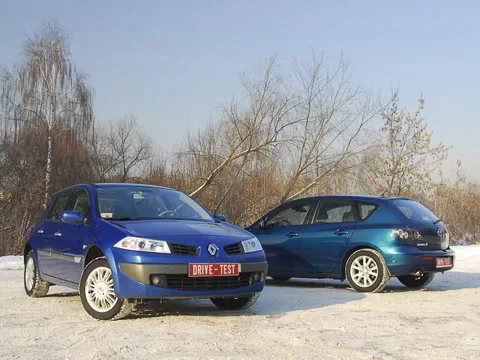
So, we have two almost identical cars in front of us. Mazda3 and Renault Megane — both are five-door hatchbacks, equipped with two-liter engines and six-speed manuals. Even the price tags are comparable: for the test Mazda3, dealers ask for $24,140, while the Renault Megane will cost 27,857 conventional units. So which one is good, and which one is frankly bad?
Let's try on the roles of owners. Suppose I am a driver who prefers measured driving and comfort. I agree, it's hard to believe, but it's worth a try. But Vadim Gagarin (no introduction needed here) is a real racer, for whom every horsepower and every hundredth of a second to sixty matter. He's the type who considers idling at three thousand RPM normal, and a drive without a handbrake yank in a corner — unsuccessful. So, we have money, and we go to choose cars.
Vadim, as a fervent Formula-1 fan and Schumacher devotee, dreams of a Ferrari, but the budget doesn't allow. His gaze falls on Renault — since they've taken championship titles twice in a row, their cars must be fine too. However, "hot" Renault hatchbacks aren't delivered to Russia, and they'd cost a pretty penny anyway. What's "spicier" here? Aha, the two-liter Megane! We'll take it!
I, as already mentioned, prefer calm driving. I'm eyeing the Mazda3. A Japanese brand, should be practical and reliable. I'll take the two-liter version to overtake more confidently on the highway, and with the manual, fuel consumption will be lower. Price-wise, it seems acceptable. I consulted friends and read forums — they approved the choice, saying it's a good car. The only thing — it's a bit noisy. But probably that's an exaggeration; it can't be that noisy.
Decided! The cars are bought and paid for. Let's go pick them up!
Vadim, seeing the Megane, again caught himself thinking that such avant-garde design isn't quite his taste. Funny, of course, but not very sporty. However, no big deal. The main thing is how it drives; looks don't matter. Let's check it out now!
But what's going on? Why does the two-liter engine with 135 horses respond so sluggishly to the gas pedal? Why is the steering so uninformative, the steering effort unnatural, and the brakes overly sensitive? Where do such body rolls and pitching on waves come from? No drive at all! You don't even want to maneuver in traffic. Eh, I should have not watched the ads but taken a test drive first! What a machine!
Meanwhile, I decided to take my new Mazda out of town. And I was grumbling the whole way too. Although at first, everything was fine. The engine is sufficient, even with reserve. But in ruts, the car behaves nervously. The plastic in the cabin is hard and cheap. And that's just the beginning of the flaws.
The interior looks nice but is completely ill-conceived. The display on the center panel is no good, ergonomics leave much to be desired. And why such a sharp throttle response, "sharp" steering, and stiff suspension? Am I going rallying? And my friends from the forums were right. The Mazda3 is indeed noisy, even despite the facelift that added a few kilograms of sound insulation. That was the last straw. "What a piece of junk!" — I couldn't hold back. And in the evening, it turned out the headlights shine poorly — I already took that for granted.
I couldn't stand it. I go to the car market to sell my recently purchased car, and there's Vadim already, looking for a buyer for his Megane. "Why is he selling such a beauty? — I think. — Probably found a higher-class car, show-off."
"Why are you selling such a car? How does it 'haul'?" — Vadim asks me. "Oh, it sure does! — I reply. — Yesterday at a traffic light, I overtook some guy in a blue Renault." "And how's the suspension? Doesn't it roll in corners?" — he continues. I answer: "Almost no roll, though it does shake..." A spark lit up in Gagarin's eyes.
"And why are you selling your Renault? Is it a bad car?" — I ask. "Well, how to put it, — Vadim replies. — It's comfortable, soft, with a quality interior and glass roof, but..." "And how much are you selling it for?" — I interrupt him.
We both left the car market in new (almost) cars. Vadim — in the two-liter Mazda3, and I — in the Renault Megane. The financial issue was resolved by exchange — the new cars cost almost the same.
We drove out of the gates simultaneously, but Vadim immediately "disappeared into the distance," in seventh heaven. "Wow, what a great engine! And the suspension! And the connection with the car!" — flashed through his mind as he sped in the left lane of Mkadburgring past slowpokes. And he probably also thought: "What a fool this Klepach is, giving me his 'swallow' in exchange for that 'bucket.' Well, better for me!"
"He's the fool! — I thought, as I lounged in the seat, calmly driving home. — He gave me such a great car. Comfortable, quiet, with a calm and economical engine. To drive it, you don't need to precisely work the gas, shift gears, or grip the wheel tightly on the highway. Everything comes easily and effortlessly. The steering wheel, pedals — everything is light but precise enough and completely unobtrusive. Except the brakes are overly sensitive. But over time, you understand there's a point to it. And you want to listen to some calm, acoustic music. Truly, the Renault Megane is a car that doesn't stress you out. I have enough worries as it is.
And on the highway, the car behaves excellently. It barely wanders in ruts, sound insulation is quite decent for its class, and it rides smoothly and confidently. I covered three or four hundred kilometers and didn't get tired. The engine is quite enough for overtaking, and the suspension handles our roads well. Let it pitch on waves; the main thing for me is that it doesn't bottom out. And the design is great — truly original and modern. Again, the interior. Quality soft plastic, upholstery pleasant to look at and touch. And when I get home, I'll show my family the glass roof — they'll be blown away.
And we lived happily ever after, and sold our cars on the same day. A complete happy ending, in general. And the cars are actually good. Both. But for different people. For those who love active driving and are ready to forgive a stiff suspension and cheap interior trim for good handling and dynamics, the Mazda3 is perfect. People without racing ambitions, who value comfort and thoughtfulness in every detail, will definitely not be disappointed in the Renault Megane. What's good for one is bad for another. People are different, and so are cars.
And the concept of "good" is a very dubious characteristic. After all, in any car, no matter how much it costs, you can find a thousand flaws if you want (and some — even two thousand). Because flaws are a continuation of virtues. But it's not even about that — some will be annoyed by these shortcomings, while others won't even notice them, just driving and enjoying. Whether it's the thrill or the comfort — to each their own.
Mazda3 vs Renault Megane: a duel of two characters
When the editorial office had the opportunity to simultaneously test two of the most popular golf-class cars with two-liter engines, we didn't hesitate. Mazda3 in Touring trim and Renault Megane Privilege — both with manual transmissions and gasoline engines. It would seem, what could be simpler: sit down and compare. But, as it turned out, behind similar figures hide completely different cars.
First impressions
From the outside, the Mazda3 looks more aggressive and dynamic, its lines seem carved by the wind. The Megane, on the contrary, seems calmer and even more conservative, although its silhouette is not without elegance. Inside, the differences are felt immediately. In the Mazda, you sit as if in a sports car cockpit: dense seats with good lateral support, an informative instrument cluster with red needles. The Megane's interior is softer and more comfortable, but also a bit more spacious — especially noticeable in the back row, where the French car has more legroom and headroom.
Ergonomics in both cars are top-notch. In the Mazda, the steering wheel adjusts both for height and reach, as does the Megane. Heated seats are a nice bonus on a cool morning. But the French car has something the Japanese one lacks: parking sensors, rain sensor, auto-dimming mirror, and folding mirrors. Trifles, it seems, but they make life easier.
On the move
The engines in both are two-liter naturally aspirated units, but tuned differently. The Mazda produces 150 horsepower at 6500 RPM, and you can feel it: the engine loves to rev, responds eagerly to the throttle, and pulls almost to the redline. The Megane with its 136 horsepower at 5500 RPM seems calmer and lazier, but it's enough in city traffic. Acceleration to sixty is almost the same — 9.1 and 9.2 seconds respectively. But the sensations are completely different.
The Mazda3 is about drive. The six-speed manual with precise and short throws, a firm suspension that holds the body in corners without excessive roll. But you pay for it: on rough roads, the Japanese car shakes noticeably, transmitting all the joints and cracks in the asphalt to your backside. But the steering is exemplary: sharp, informative, with pleasant weighting. You want to find winding roads and test what the car can do.
The Megane has a different character. Its suspension is softer and more energy-intensive, swallowing potholes and rails without discomfort. The steering is lighter but also less informative — the French car handles more calmly, without excitement. On the highway, the Megane feels confident, but during sharp lane changes, noticeable body roll appears. But it's more comfortable for daily driving: you get less tired, don't fear bad roads.
Practicality and equipment
The trunks in both are roughly the same — sufficient for everyday needs. But the Megane in Privilege trim is richer: here you have leatherette-fabric seat upholstery, cruise control already in the base, and parking sensors. The Mazda in Touring is also well-equipped — there's climate control, heated seats, stability control, xenon. But for cruise control, you need to pay extra. At the same time, the base price of the Mazda is lower — $23,300 versus $26,249 for the Megane. However, if you equip the Mazda with cruise control and paint it metallic, the gap narrows: $24,140 versus $27,857.
As for safety, both cars are fully equipped: ABS, EBD, stability control, front and side airbags, and curtain airbags. But the Megane also has an emergency braking assist system — the French took care of this as standard, while Mazda does not offer this option even for an extra charge.
Verdict
The choice between these cars is a choice between emotions and reason. The Mazda3 is for those who love driving, who are willing to put up with a stiff suspension for sharp handling. The Megane is for those who value comfort and practicality, who prefer a calm pace of life and do not want to feel every bump. Both are good in their own way, and each will find its buyer. But if you ask me which car I would spend my money on, I would choose the Mazda — simply because behind its wheel I enjoy every trip.
Cars for the test were provided by JSC "Avtoframos" and the official representative of LLC "Mazda Motor Rus".