
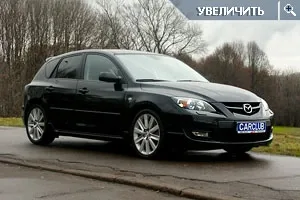
Creating materials like this one is not a very rewarding task. If you are already the owner of a Mazda3 MPS, our opinion is unlikely to interest you: most likely, you have long abandoned your computer and spend all your free time behind the wheel. But this applies only to those 150 lucky ones who were fortunate enough to buy (or are about to buy) this spirited hatchback under the quota. No more of these cars will be brought to Russia this year. For those who did not manage to place an order for the Mazda3 MPS, reading this text is probably also not worth it — just like visiting Mazda dealers, so as not to get upset once again. And yet, while the first owners are waiting for deliveries, rare "matryoshkas" in the MPS version are already managing to cause a stir on the roads. And here's why.
Moonlight
 It is no secret that competing with a deliberately stronger opponent is pointless. Even Michael Schumacher understands this, which is why he chooses Ferrari. A driver always feels calmer when the power of the engine is visible from afar: fellow road users are filled with respect and do not cut in front of you. So, through the night Moscow, a "very powerful" "nine" rushes by with a howl, followed by an equally powerful "eight" (Zhiguli, of course), then a "ten" with a spoiler, and after that a "twelfth" with a huge rear wing and an exhaust pipe the size of a locomotive's. Senseless and merciless, they prove to everyone who is in charge and embody the international idea of tuning as understood by speed enthusiasts all over the world: overtake everyone and everything.
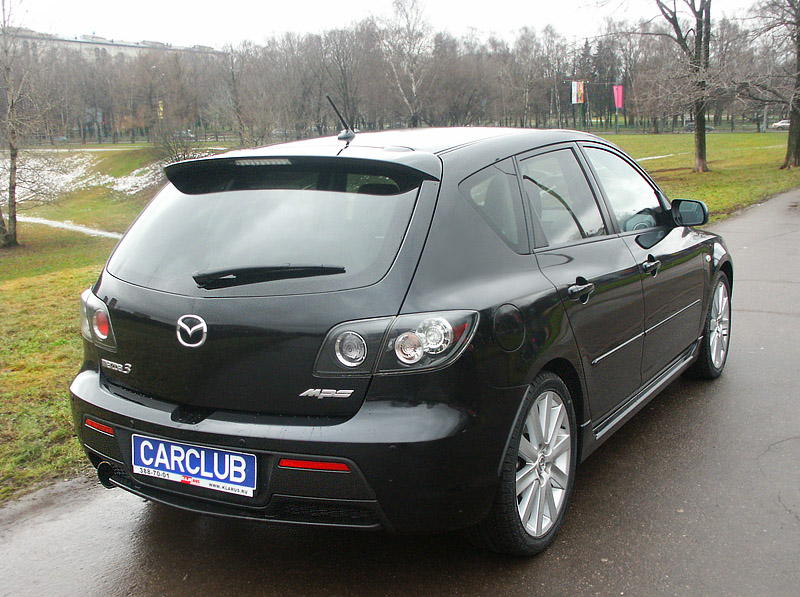
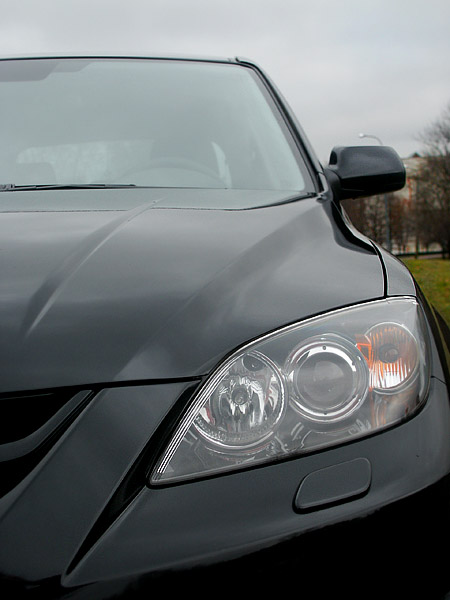
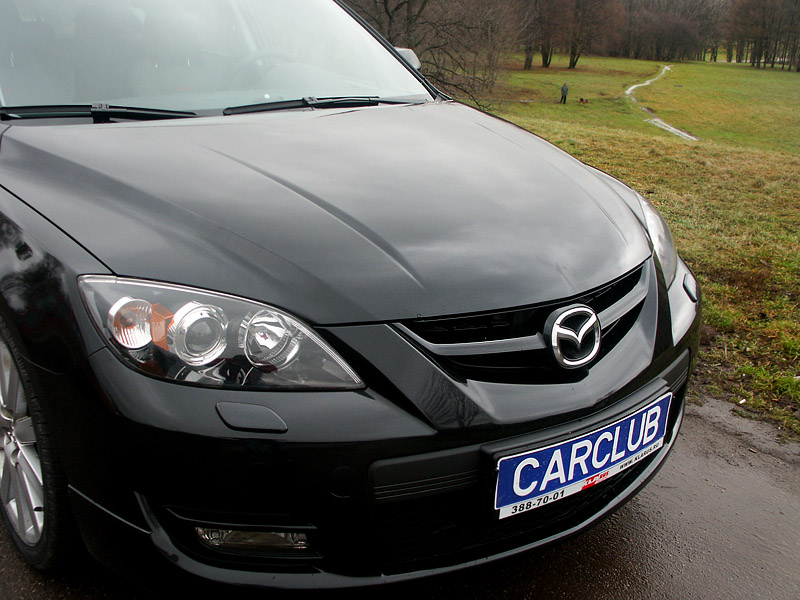
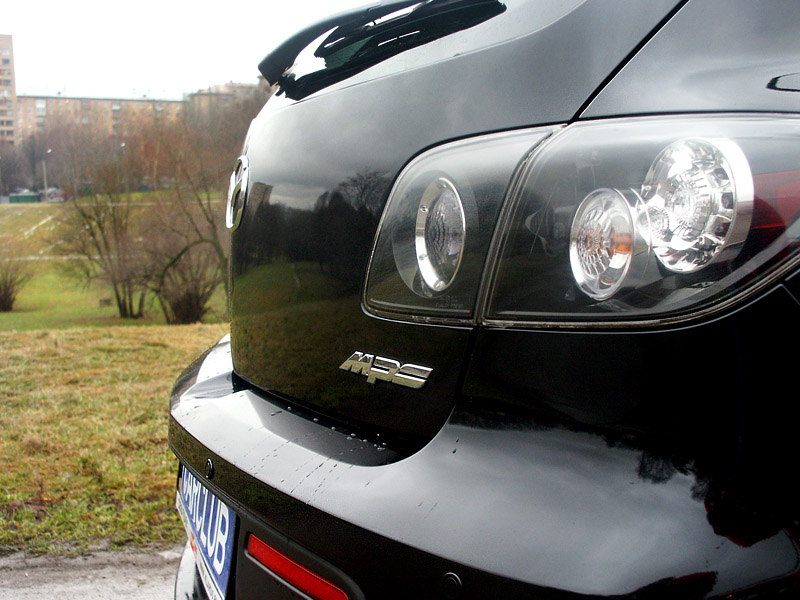
 That winter evening, when the roads were dry and only decorated fir trees reminded of winter, not a single oncoming or passing "tuner" could resist the temptation to compete with the Mazda3 MPS. The outcome was predictable — but only not for them. After all, tuning without "tuning" is not tuning at all. And what the Mazda3 MPS offers as factory tuning does not look like tuning at all. Just think, 18-inch wheels, a slightly higher hood line (under which, by the way, hides a hefty intercooler — a charge air cooler), a small visor spoiler. Well, and the letters MPS on the fifth door. Such attributes can be attached to the rear by anyone, even the owner of a regular "three" with a 1.6-liter engine and an automatic transmission. And the exhaust system remained completely standard — the Japanese left room for modifications, and noise regulations for production cars in Europe are quite strict. So what's the result? The modest Japanese did not even come up with a signature color for their fastest and most charged model — even the owner of the rotary beauty Mazda RX-8 rests on the roadside and nervously smokes: his spectacular two-section rotary at 8500 rpm produces a measly 231 hp, while under the hood of the "turbo-three" hides a herd of 260 "horses".
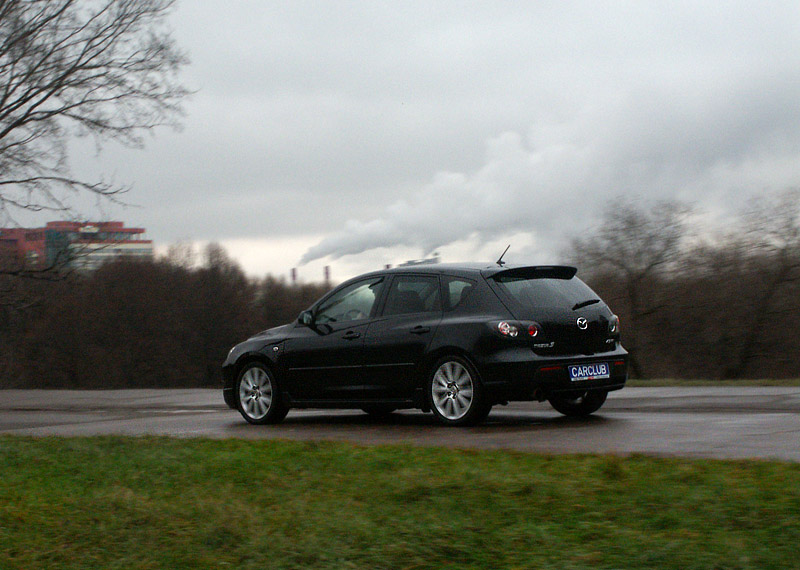 That is why the MPS is so difficult to single out from the general flow and immediately appreciate its potential. An attentive eye will notice the enlarged air intake in the front bumper, but the black grille on a black car is not visible immediately, and few manage to see the front bumper of the MPS on the road. So for the uninitiated, only those same barely noticeable three letters — MPS remain for identification, which stand for Mazda Performance Series, or "a very fast car of the Mazda brand". It has been noticed: since it appeared on the city streets, the average speed of ordinary Mazda cars has increased by 20–30 km/h. Those who managed to see it in traffic, sitting behind the wheel of their Mazdas, sincerely believe that they can also drive just as fast. But it all comes down to visual acuity. Those with poor eyesight and hearing will long keep pushing the tachometer needles into the red zone, vainly trying to keep up with the MPS. Where everything ends for them (at 170–180 km/h), for the "turbo-three" it is just beginning. Those whose eyesight and hearing are in order will hasten to get out of the left lane and give way to a quite budget hatchback with a 260-horsepower turbo engine (the turbo kicks in already at 2000 rpm) and an MPS badge. And they will be right.
Not for the faint of heart
 Because behind the wheel, you get the feeling that you are controlling a personal ballistic missile to which some craftsman has attached a five-seat cabin and a small trunk. At a speed of 100 km/h, the speedometer needle is in the lower sector — where "normal" cars have leisurely twos, threes, and fours with a zero. By the way, the MPS reaches the first "hundred" in just 6.1 seconds — only 1.4 seconds slower than the BMW M5. But this, as already mentioned, is only the beginning: vertically at the top point of the speedometer, the alluring figure of 260 km/h glows, and to the right of it, as if in mockery, — 280 km/h. Beyond 260, the needle of the stock MPS speedometer cannot be pushed — the limiter kicks in. And that's for the better: it's unlikely a civilian car should accelerate faster...
If, by turning off the stability control, you rev the engine to 3000 rpm, when the torque reaches its maximum of 390 Nm, and sharply release the clutch pedal, an unprepared passenger will first cry out, and the wheels, after spinning a couple of times, will firmly grip the asphalt. In less than half a minute, when in fourth gear the car accelerates to 200 km/h at full throttle, the passenger will begin to noticeably turn pale, and another 20 seconds later, when the speedometer needle stands vertically and you exceed all conceivable limits, the passenger will take offense, call you selfish, and ask to be let out of the car. Of course, after you, with unvarying pleasure, under the furious roar of the engine, click down all six gears, and the speedometer needle returns from the 250 km/h mark to zero.
 It is impossible to find fault with the handling of this "matryoshka" in principle. Whatever comes into the driver's head, the MPS will not let him down — perfectly informative brake pedal feel, well-calibrated steering effort with excellent feedback. When deviating from a straight line, it becomes clear that the Mazda is prone to slight understeer, but this is easily corrected, for example, by lifting off the throttle at the corner entry. The impression of driving is not spoiled even by the stiff gearbox linkage. The suspension's angular stiffness compared to the regular "three" is increased by 60%, additional struts have appeared on the body, so body roll during lane changes and cornering of any steepness is absent as a class. And only the driver's back and neck can feel heavy. Perfect, unstrained handling and excellent directional stability captivate, but our Mazda, shod with winter non-studded Pirelli tires of size 225/40 R18, was wary of ruts, requiring minimal corrective steering. However, on a more or less even road, it seems you can safely let go of the steering wheel, take out your phone, laptop, and get down to work. Right behind the wheel!
The only thing to be wary of is the police, both lying and standing. On the former, you can break the suspension — the reduced ground clearance for stability and aerodynamics forced the free wheel travel to be limited; the latter are not averse to profiting from documents or, in extreme cases, money. At first, they often do not believe the readings of their own radar, time-tested and more than once paid for itself, but after taking the registration certificate and looking at the line "engine power", they are filled with respect, but, alas, do not give discounts, even New Year's ones.
But not everything is so rosy
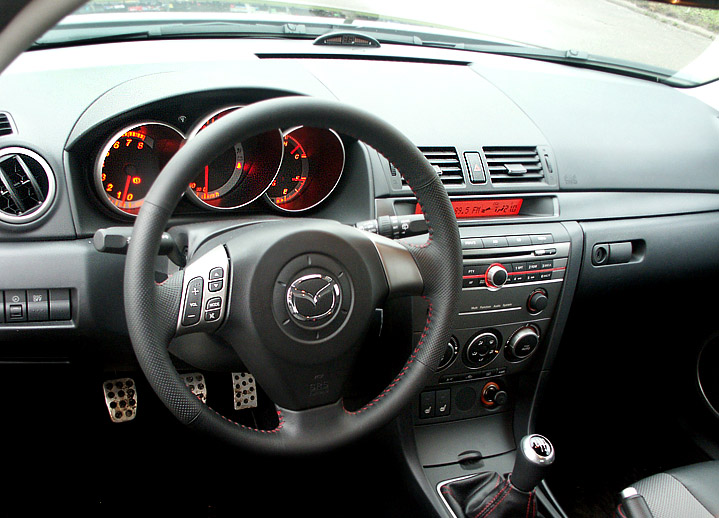
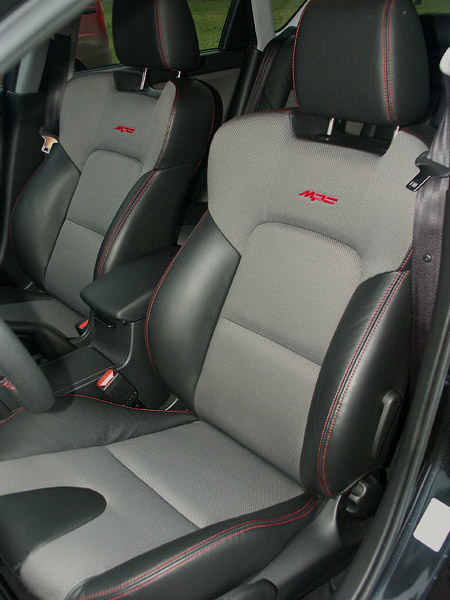
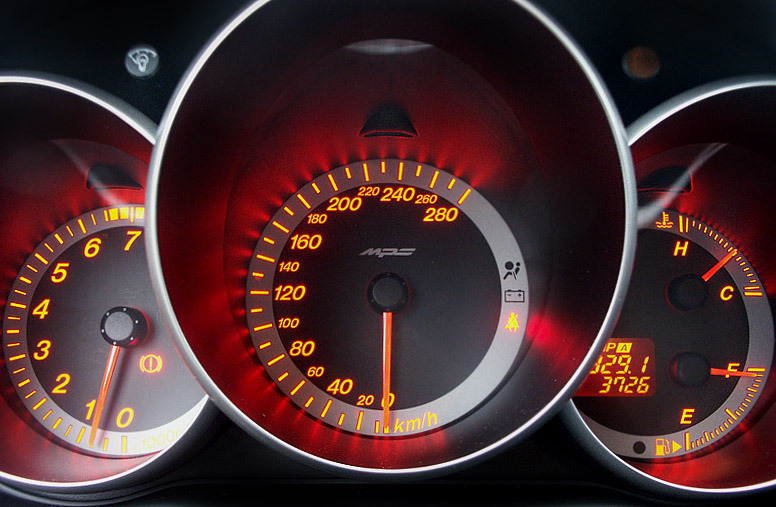 However, there is a fly in the ointment, and in this, I confess, lies my professional duty. The first thing that confuses is the price: 31,800 dollars for a car that is essentially a collectible example in maximum trim, almost a supercar, — is suspiciously cheap and unrealistic. The second is the interior: apart from a couple of MPS emblems, we have an ordinary civilian car with a very spacious cabin and even an armrest on the rear sofa. Rigid and comfortable sport front seats, as well as a speedometer with a scale up to 280 km/h — that, perhaps, is all that gives away the "charged" version. It's even a bit sad. Where are the carbon fiber inserts, where is the roll cage? Six airbags are, of course, good, but, you must agree, not at all sporty. And one more annoying point: this athlete persistently demands that everyone in the car fasten their seat belts and emits an annoying beep if someone does not do so. I understand that safety comes first, but why shout like that, I heard everything perfectly the first time. And, perhaps, the main drawback: unlike its main competitors — the Opel Astra OPC and Ford Focus ST — this turbo beast under the hood is recommended to be fed only with gasoline with an octane rating of no less than 98. But even this inconvenience pales in comparison to how powerful and superior to competitors the Mazda 3 MPS engine is.
Alexey Sharapov