
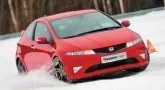
In winter, in our latitudes, motorists have a hard time — the cold lasts for half a year, and cars are operated in the harshest conditions. That's why we decided to launch a series of winter tests at the Dmitrov test track, and the first to hit the ice and snow were the hot hatches Mazda3 MPS, Skoda Octavia RS, and Honda Civic Type-R.
It must be said that our winter is not what drivers in warm countries are used to. To understand what cars are capable of in the cold and on slippery surfaces, we organized these tests.
Mazda3 MPS
The Mazda3 MPS is a kind of stealth racer. Externally, the "three" is hard to distinguish from the regular version, and only its quickly receding silhouette reveals its character. But the main thing about it is a turbocharged 2.3-liter engine producing 260 hp.
Skoda Octavia RS
The Skoda Octavia RS is like a diligent student that has absorbed the best from its older siblings in the concern — Volkswagen and Audi. And this has benefited it. The result is an excellent family car with a sporty character: comfortable for passengers and fast for the driver. Everyone will enjoy the ride.
Before moving on to the results, let me explain the test methodology. As in summer, the key exercises are the double lane change and the slalom. But in winter, the distances between the cones have changed: in the lane change, they are approximately doubled. The distance between the first gates is 21 m, between the second — 33 m. Moreover, there are no fixed exit gates: it is important that the car returns to its lane within those 33 m. In the slalom, the cones are spaced at 36 m intervals instead of the previous 18.
The approach to measuring acceleration and braking has also changed. Now the conditions are closer to urban ones: braking from 60 km/h and acceleration in first gear, with the maximum speed also recorded in that gear. The tests are conducted both on a flat area and on an incline with an 8% gradient.
Since all participants are sports cars, a separate event was a sprint track of 800 m. It is divided into three sections: the first has turns of varying sharpness, the second has acceleration and braking on mixed surfaces (packed snow and ice), and the third has a turn during emergency braking.
All exercises are performed with the stability control system enabled. But it's worth starting with the steering — in winter, when traction leaves much to be desired, steering feedback is critically important. All three cars have progressive steering: as speed increases, the wheel noticeably becomes heavier.
The heaviest steering is in the Mazda3 MPS, and that's not surprising: the front of the car is overloaded because under the hood is a 2.5-liter engine. The Honda Civic Type-R, on the contrary, has sharp, even slightly nervous steering. The Skoda Octavia RS turned out to be the calmest, although at high speeds it also maintains excellent road feedback.
Each car goes through the tests in its own way, and the key role here is played by suspension settings and the operation of the stability control. In the Mazda, this is compounded by an excess of power at 260 hp, which is not always beneficial. In the slalom, the wheels slip, the stability control doesn't always manage to cope with the torque, and understeer occurs. The limited-slip differential in such a situation doesn't have time to engage because one of the wheels isn't sufficiently unloaded. As a result, in the slalom, the Mazda is only second.
But in corners — in the lane change and sprint — the power reserve and the differential do their job. Here, the Mazda confidently leads. The stiff suspension doesn't allow the rear axle to slide, and the wheels turned inward help maintain the trajectory. But there's a downside: the short-travel suspension often bottoms out on bumps, leading to "bulges" on the tires.
The Honda Civic Type-R has the same short-travel suspension, but it's harder to bottom out thanks to its high energy capacity. True, you have to pay for this with nervousness: the car requires a firm grip with both hands, and all joints and bumps are felt throughout the cabin. You get tired from such driving, but you feel like a real athlete. There are no body rolls in the Type-R at all. The balance of power and weight of the naturally aspirated engine is excellently maintained, but the weight distribution across the axles is far from ideal — most of the mass falls on the front. The rear axle is overly unloaded, and with a maximally stiff suspension, any mistake leads to a sharp breakaway of the front axle. It's very difficult to "set up" the Civic, so sharp corners are best taken with lifted throttle and active braking. Ideal conditions for the Type-R are high-speed winding sections where it feels like a fish in water. This is clearly visible in the slalom and sprint: maximum speed is achieved while maintaining the correct trajectory and almost without sliding. But as soon as understeer begins, the stability control reacts sharply and harshly, as if someone is pulling a cable, returning the car to its course. At high speeds, this is ideal, but at low speeds, the system tries to almost completely stop the car. That's why the exit speed in the double lane change for the Honda turned out to be the lowest.
The Skoda Octavia RS differs from its rivals primarily in body shape — this hatchback is more like a sedan. But its weight is no more than the Mazda's. The weight distribution across the axles is close to ideal — 60 to 40. In the tests, the "Czech" had the hardest time: under the hood is the least powerful turbocharged two-liter engine with 200 hp, and the tires were non-studded.
However, the Skoda didn't lose too much to its rivals. The four-second gap on the track is explained solely by the tires — they play a key role, especially during acceleration on the uneven asphalt of the second section (Fig. 2). But in the other exercises, the Czech hatchback showed decent results, largely thanks to its softer suspension. True, this had to be paid for with body rolls. They are especially noticeable on flat surfaces where traction is at least somewhat decent. Comfort demands sacrifices, but contact with the asphalt and steering responsiveness don't disappear, and that's important. The Skoda is the most "alive" of the trio. Throwing it into a controlled drift is as easy as pie, and even the enabled stability control doesn't prevent this. As a result — an excellent result in the slalom. Constantly sliding in a drift, you can quickly navigate the "snake," but straightening the trajectory requires full concentration.
Power is far from the main factor. Much more important are the suspension settings, and in winter — also the algorithms of the stability control system. Each car's electronics work differently, so you need to get used to them in any case. Disabling the stability control on all three cars didn't improve either times or speeds. Or rather, speed increased, but it immediately turned into rapidly growing oscillation of the drift. Therefore, the optimal modes for completing the figures ultimately turned out to be close to those achieved with the electronics on. But the chances of losing the car on a slippery surface without it are much greater.
Our verdict
The results of the winter test were a surprise. It wasn't possible to identify a clear winner — each took its own in a separate discipline. First of all, the cars differ in behavior on snowy roads. The Honda Civic Type-R is an uncompromising athlete living by the principle "fast, hard, precise." The Mazda3 MPS doesn't look like an aggressor externally, but when the opportunity arises, it can wipe the nose of anyone. True, even the lightning-fast stability control doesn't always cope with its excess power, so caution never hurts. The Skoda Octavia RS is a fast car with a comfortable suspension and pleasant handling that doesn't force you to choose between speed and convenience.