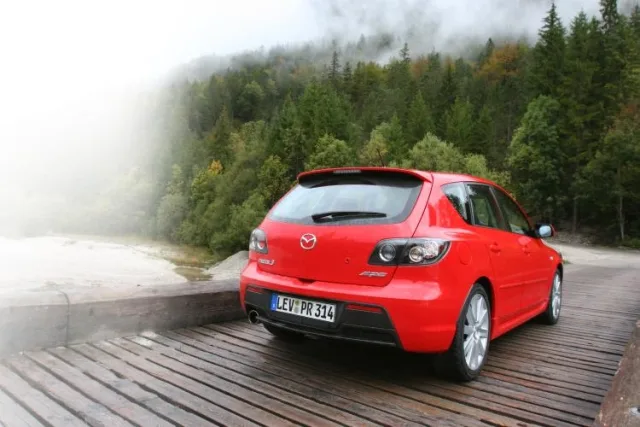
It smells like trouble.
I caught this scent just a couple of kilometers behind the wheel of the "hot" Mazda 3 MPS hatchback. No, it's not the clutch, although with 380 newton-meters of torque, burning it is a piece of cake. It smelled of red-hot competition in the "hot" hatchback segment of the golf class, where the new Mazda can give any rival a run for its money. And it's not just about the "relative" on the platform — the Ford Focus ST…
Don't you think "hot" hatchbacks are gradually running out of steam? In the old days, the creators of the Volkswagen Golf GTI were burning with sporting passion — each new model had to be more powerful, angrier, and more temperamental than its predecessor. Now, the engineering fervor seems to have faded. Modern models certainly outpace their ancestors in dynamics, but they have noticeably fewer emotions. Safety, comfort, marketing…
And then the Mazda 3 MPS steps onto the stage.
The MPS abbreviation stands for Mazda Performance Series — that's what Europeans call the factory "tuning" program. Under the hood hides a 260-horsepower turbo engine, familiar to us from the Mazda 6 MPS sedan. According to factory data, it's this unit that made the "three" the fastest front-wheel-drive hatchback on the planet! At least, until the Dodge Caliber SRT4 with its 300 hp showed up.
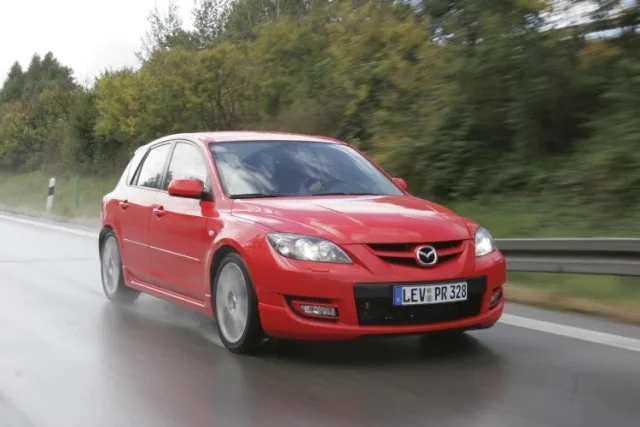
No need to explain with what mood I settled into the seat of the Japanese hatch. After all, 260 "horses" — and it's pouring rain outside!
I press the gas — and a short but furious wheelspin with harsh jolts in the transmission. And this repeats on first, second, and even third gears! And this is despite the electronics trying to "rein in": on the first two gears, the system closes the throttle and vents excess pressure through the turbo's wastegate. It seems the Japanese engineers deliberately left the driver the right to feel out the edge of what's allowed — just ease off the pedal a bit, and you balance on it without much effort.
 | From the front, the Mazda 3 MPS is revealed by a different bumper with a wide "mouth" of the air intake, a hood with a couple of extra stampings (the seam line with the bumper is now higher), and widened fenders |
The engine is a true predator. At low revs, the pull is quite decent; after 2500 rpm, the turbo smoothly kicks in, and the engine confidently revs up to 5500 rpm. Above that, up to the limit of 7000 rpm, the unit spins without enthusiasm, so you have to shift often. The three-shaft gearbox (manual, of course — also from the Mazda 6 MPS) selects gears well, but my right elbow kept hitting the seat's side bolster, causing me to accidentally engage fourth instead of sixth a couple of times. But when I hit the target precisely, the acceleration was exactly as desired. Sometimes the speedometer needle crawled up to 250 km/h! True, the last few kilometers to that mark are hard for the car.
The chassis is dense, monolithic. The Mazda 3 MPS has stiffer springs and dampers, and the anti-roll bars "thickened" by 5 mm — in total, this gave a 60% increase in suspension roll stiffness. The body was also reinforced with local stiffeners. The transmission features a limited-slip differential: when the unloaded wheel spins in a corner, it transfers up to 66% of the torque to the loaded "outer" wheel. Its work is especially visible with the stability system on: instead of the usual understeer under power for front-wheel-drive cars, the Mazda seems to hold an arc, as if pulled by an invisible tugboat.
 |  |  |
| The body is reinforced in three points: a strut brace at the front, an insert on the central tunnel, and pads in the rear wheel arches | ||
Finding a "self-locking" differential on a production front-wheel-drive car is a rarity. Among current "hot" hatches, only the top version of the Megane Renaultsport F1 Team R 26 and optionally the new Mini can boast it. Engineers usually fear vibrations in the steering under power and a sharp increase in "return" effort. But the Mazda 3 MPS is almost free from this effect (torque steering) — it mainly makes itself known with the stability control off. However, there's not much point in turning off this "electronic collar": without it, it's easier than ever to break the front end into understeer with excessive power. And if that happens, the informative steering helps — the MPS uses a regular hydraulic power steering instead of an electro-hydraulic one.
 |  |  |
| The gearbox is six-speed, three-shaft, with a self-locking differential (right in the diagram). Mazda abandoned all-wheel drive to avoid inflating the price | The limited-slip differential can deliver up to 66% of the torque to the wheel with better grip. The lock is provided by conical rings (highlighted in red in the diagram) | Under the hood is the turbo engine from the Mazda 6 MPS sedan: direct injection, 2.3 L displacement, output 260 hp, 380 Nm, the intercooler radiator is placed above the engine |
And what about ride comfort? Stiff. On bumps, the Mazda wanders slightly and transmits vibration to the steering wheel, but it doesn't dart sideways, unlike the Focus ST. But sound insulation is a problem. Not only is it weak in the "three" even in standard versions — you can hear the tires humming and sand grains "drumming" on the arches — but the main muffler was deliberately reduced: they say, enjoy the engine's voice. And that voice isn't pleasing — not a roar, but a scream.
But what's most important in "hot" hatchbacks? Definitely not comfort, right? Emotions. And with those, the Mazda is in perfect order — you can fall in love with this car! I fell in love. And that's despite the pouring rain.
 |  |
| The standard red instrument lighting rhymes perfectly with the red stitching of the upholstery and aluminum pedal covers | The seats aren't ideal, but they match the car's spirit |
 |  |
| The stability system turns off completely | The speedometer scale is optimistically marked up to 280 km/h. The instruments have two backlight modes — daytime bright red (in the photo) and nighttime with a purple tint |
Now it remains to find out how the Mazda 3 MPS will perform on our roads. Let's wait for December. Dealers, by the way, say the queue for this "three" is booked six months in advance! In the rich base trim, which differs from the top only in the absence of a CD changer and cruise control, the Mazda 3 MPS is priced at $31,800 — $450 more than the five-door Focus ST, on par with the three-door Opel Astra OPC, and more than $1,500 cheaper than the five-door Volkswagen Golf GTI and Skoda Octavia RS. Moreover, Mazda's main trump card is not just "raw power," but also the self-locking differential. On slippery roads, this is... However, let's not speculate. We'll compare — and tell you.
| Specifications | |
| Model | Mazda 3 MPS |
| Body | five-door hatchback |
| Aerodynamics (Cx/frontal area), m² | 0.31/2.19 |
| Seats | 5 |
| Dimensions (L/W/H), mm | 4435/1765/1465 |
| Wheelbase, mm | 2640 |
| Track front/rear, mm | 1535/1525 |
| Ground clearance, mm | 160 |
| Trunk, l | 290—1229* |
| Curb weight, kg | 1485 |
| Maximum weight, kg | 1910 |
| Engine | petrol, turbo, direct injection |
| Location | front, transverse |
| Cylinders | 4, inline |
| Displacement, cm³ | 2261 |
| Cylinder bore/piston stroke, mm | 87.5/94.0 |
| Compression ratio | 9.5:1 |
| Valves | 16 |
| Max power, hp/kW/rpm | 260/191/5500 |
| Max torque, Nm/rpm | 380/3000 |
| Transmission | manual, 6 speeds |
| Gear ratios | |
| I | 3.54 |
| II | 2.24 |
| III | 1.54 |
| IV | 1.17 |
| V | 1.09 |
| VI | 0.85 |
| reverse | 3.83 |
| final drive | 3.94/3.35** |
| Drive | front |
| Front suspension | independent, McPherson, springs, twin-tube shock absorbers |
| Rear suspension | independent, multi-link, springs, monotube shock absorbers |
| Front brakes | disc, ventilated, 320 mm |
| Rear brakes | disc, 280 mm |
| Tires | Bridgestone Potenza 215/45 R18 93Y |
| Maximum speed, km/h | 250*** |
| Acceleration 0—100 km/h, s | 6.1 |
| Fuel consumption, l/100 km | |
| city | 13.5 |
| highway | 7.5 |
| combined | 9.7 |
| Tank, l | 55 |
| Fuel | AI-98 |
| * With rear seats folded | |
| ** For I–IV/V–VI gears | |
| *** Electronic limiter | |