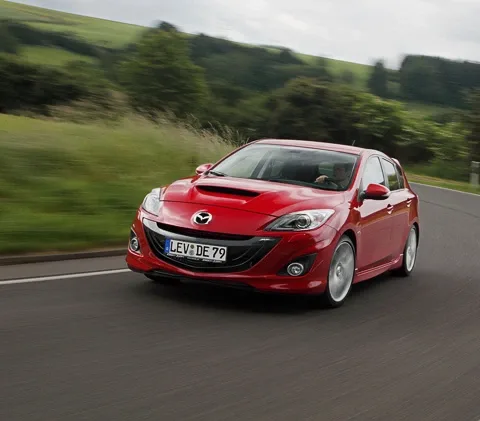
The turbo whistles, the white needle on the speedometer briskly ticks off even values: 120, 160, 180, 200, 220... I grip the thin leather rim, passengers freeze in anticipation: will it reach 250? "It did," I exhale with relief, watching the hood with the air intake bounce.
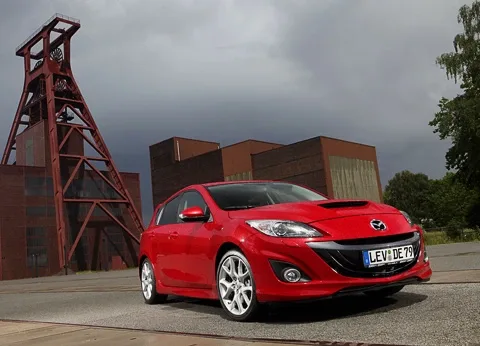
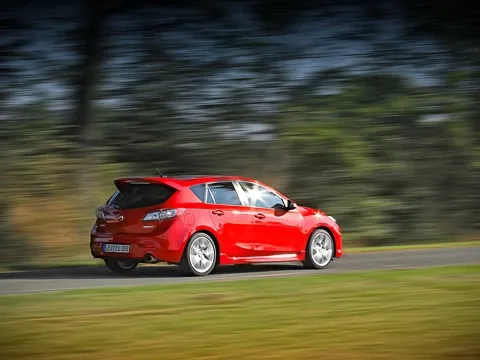
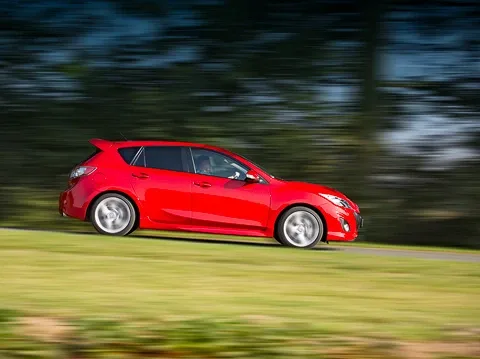
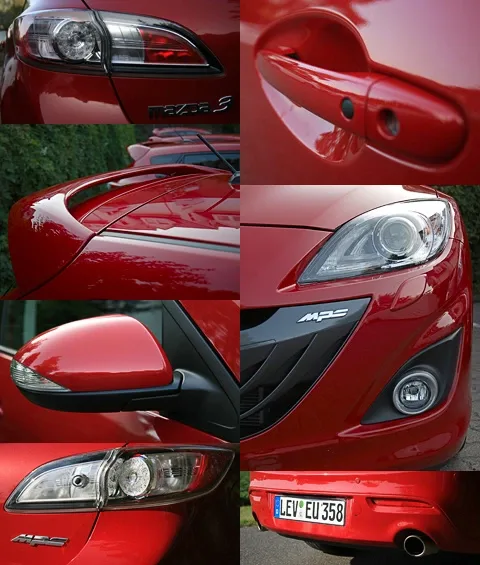
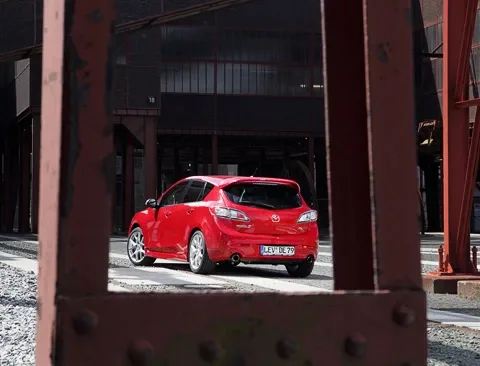
The exterior now screams hot hatch without words: the owner no longer needs to explain how his "three-door" MPS differs from the regular ones. And the "nostril" on the hood is no longer the privilege of Subaru and some other performance cars.
At the presentation of the updated Mazda3 MPS, the main entertainment was the high-speed highways. Where there are no limits, the car feels like a queen, but on the streets of Hamburg and narrow country roads, where two cars barely pass each other, the "em-pe-es-ka" struggles. The suburban corners are all blind: you enter the bend, and a diesel Passat with an elderly driver is already rattling towards you. Nobody drives as aggressively as Mazda can in this German city — everyone here is unhurried, even the owners of countless Porsche 911s, which seem to be parked in every yard.
A short and sharp turn of the steering wheel — and the car, almost without leaning, instantly returns to its lane. The effort on the wheel builds smoothly and linearly, not confusing the driver. Under load, the assistance of the upgraded limited-slip differential is felt. The stability reserve is enormous: to make the Dunlop tires squeal, you first need to disable the stability control not on the panel, but in your own head.
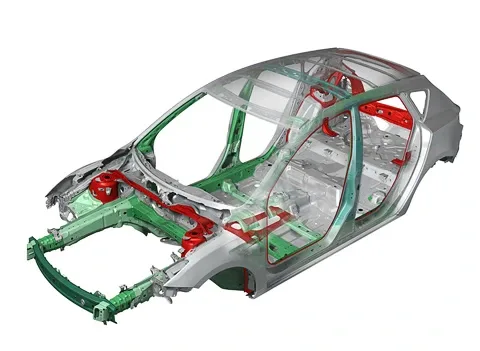
Is sport a priority? Chief engineer Kenichiro Saruwatari set the accents exactly that way. The body of the new MPS has become stiffer: the share of high-strength steels has grown by 17%. The curb weight of the hatchback has decreased by 25 kg compared to the first "em-pe-es-ka". However, of the engineering tricks, I can feel on my own skin only the refined aerodynamics, created to increase downforce. At maximum speed, the car literally sticks to the road and no longer requires steering corrections — the predecessor was more capricious on a straight line.
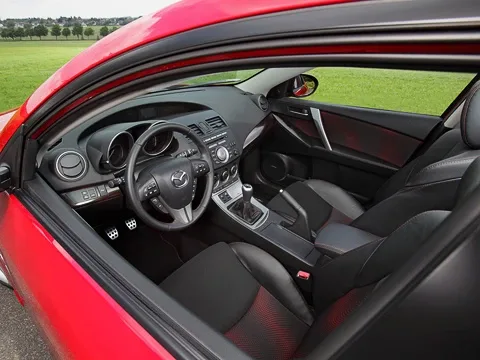
The interior designers have not changed their love for red: backlighting, stitching on the leather, seat fabric, and shimmering inserts on the dashboard.
The upgraded brakes are definitely no worse than before. Dropping speed from 200 to 70 km/h to avoid hitting a Seat that unexpectedly changed lanes is about two-thirds of the pedal travel. I would like the Mazda to bite a bit earlier. But emergency braking happens without yawing or nerves. True, in normal mode, modulating deceleration is not as convenient: the transition between the free and working pedal travel is a bit abrupt.
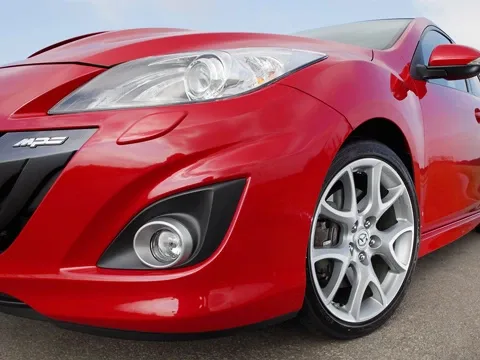
The brake discs remain the same: front ventilated — 320 mm, rear — 280 mm. The master cylinder diameter is 25.4 mm.
The front seats hug firmly, they are delightfully stiff, as if stuffed with sand. The instruments resemble fighter jet nozzles on afterburner. In the efforts of the short-throw six-speed manual lever, there is a sporting steel feel. The stabilizers are thicker, the suspension elements are reinforced... But all these fragments of the statue of Hector after bleaching come together as a girl with an oar. A sporty girl.
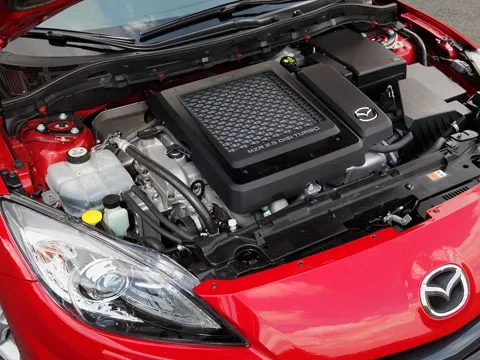
Bursts along the autobahns, attacks on unsuspecting pensioners at Lake Hemmelsdorfer... After a series of such antisocial acts, I come to the conclusion: the Mazda3 MPS has not become fundamentally better in martial arts, but it has gained additional arguments as a daily car. And the main argument is the good old "turbo-four" 2.3 DISI.
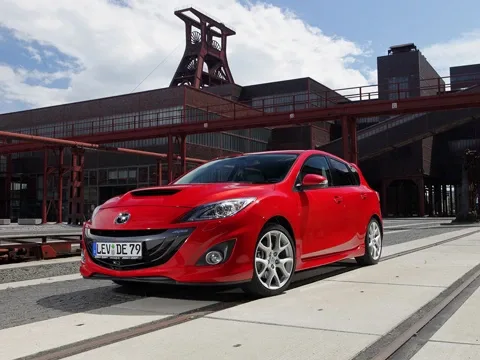
Previously, the "three-door" MPS was shod only in Bridgestone Potenza, now — strictly Dunlop SP Sport 2050. The instructors of the Russian Mazda Sport Academy school praise them for grip, ride smoothness, and acoustic comfort.
The engine still accelerates the hatchback to 100 km/h in 6.1 seconds — an excellent workout for the neck, especially after 3500 rpm. The output has not changed: 260 horsepower and 380 newton-meters. The engine, as before, at full throttle during overtaking tries to weave a braid out of the driver's hands. But now it is almost inaudible: the "vacuum cleaner" hum appears only after 5000 rpm. There is a lack of the serpentine hiss of the exhaust, and on first and second gears, the transmission jolts are less noticeable.
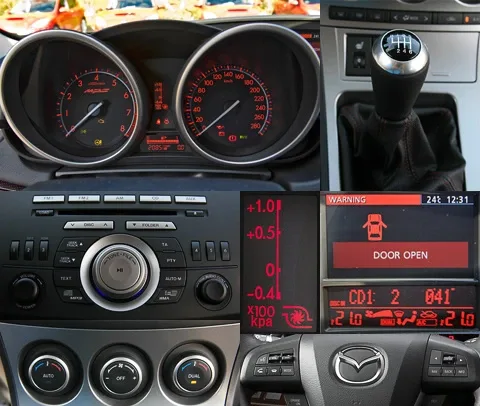
- Don't be scared of the buttons on the steering wheel: you get used to them in an hour. The audio system and climate control are easy to operate.
- The motorcycle-style instruments are modest but perfectly readable. On the tiny display between the speedometer and tachometer — the boost pressure indicator. After 3000 rpm, the red column rushes to the ceiling.
- The central multimedia screen is perfectly visible to the driver, although it is set back under the windshield. The navigation is clear and convenient, but it "lags".
In total — it doesn't excite. But the cabin offers a lot of new pleasant sensations not related to sport. For example, the pleasure of increased quality. The voluminous center console with a claim to solidity. Inserts of pliable plastic. Thick door panels, improved sound insulation of the arches and floor. The suspension? It remains extremely stiff and not very energy-intensive, but it works more nobly and quietly.
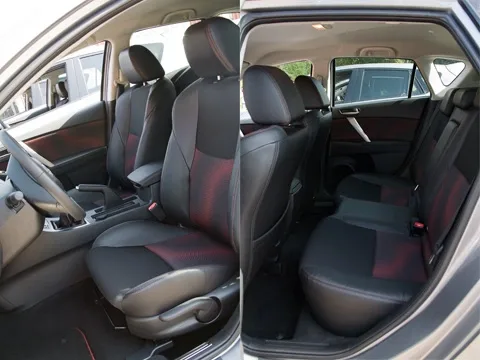
Sitting "behind yourself" in the "three-door" MPS is hard: knees press against the thick backs of the front seats, and the head is hindered by the side pillar.
Finally, the equipment. What instincts do the bi-xenon swivel headlights, the multimedia system with navigation, or the Bose audio system with ten speakers appeal to? Will keyless entry attract the animal in you? No, but Homo sapiens will be overcome by sweet consumer languor.

The trunk is more comfortable than the rear passengers: it has flat walls and 340 liters when loaded "under the shelf".
And this languor will not dissipate when you are told that the price has increased by more than 150 thousand rubles. Oh no! For the considerable price is justified... by the price. Calculate how much a fully equipped Ford Focus ST would cost? A five-door with a leather interior in "metallic" costs over 1,220,000 rubles. Moreover, the ST is already a pensioner: it is slower and worse equipped.
The Mazda buyer won't even remember the 200-horsepower Golf GTI, whose prices start at 1,127,347 rubles. Instead, he will maniacally choose between two trims of the "three-door" — the base one for 1,216,750 rubles and the top one for 1,288,250. The latter differs precisely by the presence of bi-xenon, navigation, and advanced "music". The predecessor, I remind you, cost from 1,062,000 to 1,101,000 rubles.
I suspect that the MPS will remain the only "three-door" of the second generation that will sell as briskly as before. The car has matured, and its potential buyer has remained the same. Here, our designer Boris Ulzibat, who has been driving the MPS hard for several years, is eyeing photos of the new hatch. The fresh image will also attract newcomers to Mazda. But it's easier for me to imagine the future owner of the "three-door" MPS with a calculator in hand than with a stopwatch.
Technical specifications
Tech
Under the hood is the same unit: the inline "four" MZR DISI with a displacement of 2.3 liters, turbocharged and with direct injection. The output has not changed: 260 horsepower and 380 newton-meters. However, the Japanese have recalibrated the electronics of the throttle and intake tract, making the boost pressure rise smoother. Combined with the stretched gear ratios of the manual, this gave a slight efficiency gain: in the combined cycle, appetite decreased by 0.1 liters (to 9.6 liters per 100 km), and CO₂ emissions dropped by 7 grams per kilometer — now they amount to 224 g/km. Part of the credit goes to the new catalytic converter, which was created using nanotechnology. Thanks to it, the content of precious metals in this element was reduced by 90%. Such a solution is used in mass production for the first time.
The body has become noticeably stiffer than before. The share of high-strength steels in the structure has grown by 17%, the central tunnel has received an increased cross-section, and the pillars at the front and rear have been reinforced with more massive reinforcements. As a result, engineers recorded an increase in torsional rigidity, and the rigidity of the fifth-door opening grew by 41%.
History
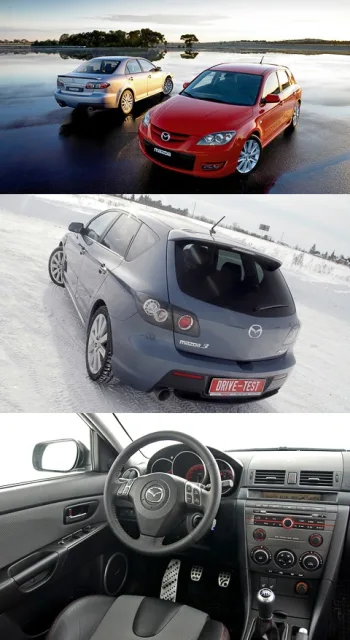
The Mazda Performance Series division has few models in its portfolio. The Mazda6 MPS sedan, which debuted in 2005, was equipped with a 260-horsepower DISI 2.3 turbo engine and all-wheel drive — the car turned out successful and was warmly received by the public. A year later, the Mazda3 MPS hot hatch hit the market: the same engine and six-speed manual gearbox, but with front-wheel drive only. Torque was managed by a self-locking differential, assisted by a clever traction control that intervened in the turbo operation. The most powerful car in the golf class reached 100 km/h in 6.1 seconds and topped out at 250 km/h. In combined cycle, it consumed 9.7 liters per 100 kilometers. The powerful, fast, and generously equipped hatch cost less than most competitors, which made it a sales leader in its segment on our market.
Behind the scenes
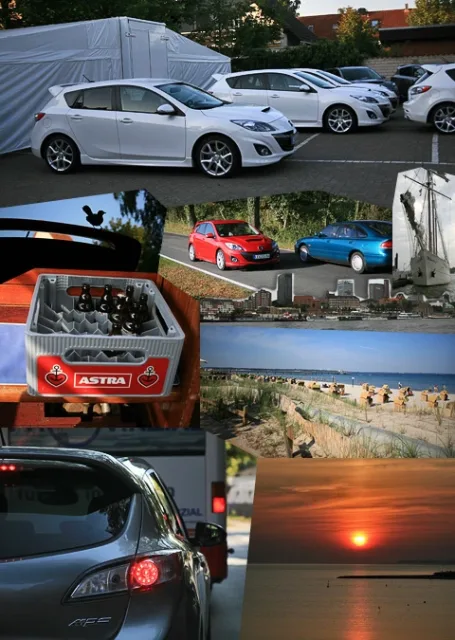
More than thirty Russian journalists came to the presentation of the new model. Among them was a daredevil who decided to take a swim in the cool Baltic on the very first day. Since the sea is nearby — why not take a dip? Funny. But on the way back home, looking at the clouds from the airplane window, I suddenly caught myself thinking that I envied that person. And I realized I should have followed his example: the beach near the hotel was deserted and perfectly clean. As it usually happens.