
Mazda3 Evolution
The presentation of the new generation Mazda3 took place in Portugal, on the Atlantic coast. We went for a test drive, fully understanding how important this model is for our market — in recent years, the "three" has accounted for more than half of all sales of the Russian office of Mazda.
lighter, stiffer, and more modern,
but has remained true to itself
By the way, for the third Mazda, Russia is also in first place. Our car buyers purchase more "threes" than residents of any other European country. Even the Germans and the British, who also have steady demand for this car, are left behind.
Unification
The Mazda3 is built on the global C1 platform, owned by Ford. The Ford Focus and Volvo S40 are also based on this architecture. The same chassis was used in the creation of the second-generation Mazda5 compact MPV, which went on sale in 2005. |

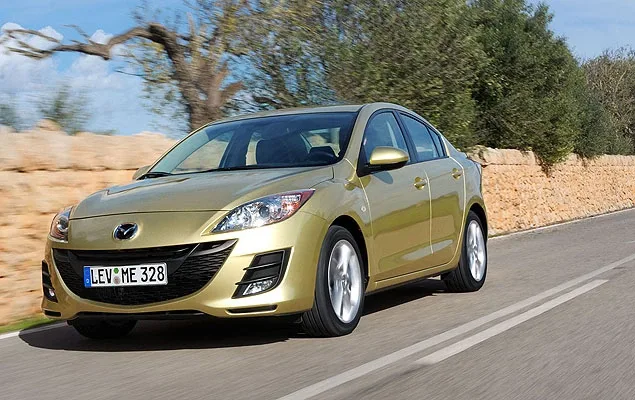
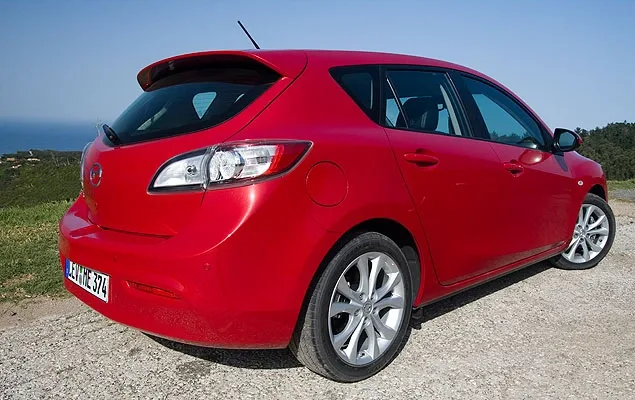
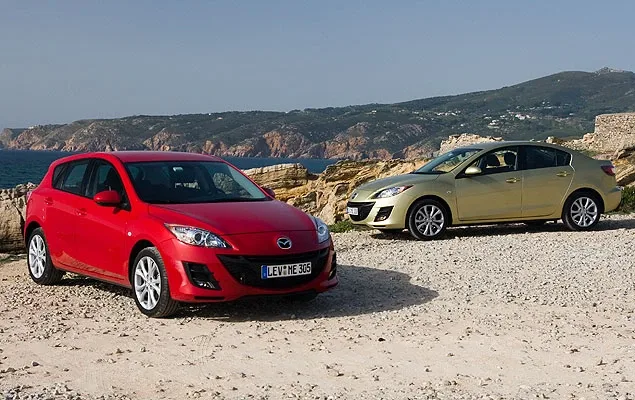
Upon personal acquaintance with the updated "MaTryoshka", it turned out that all the photos viewed before the trip slightly distorted reality due to their "flatness". In a two-dimensional image, the front of the car with a large hood and the absence of the usual radiator grille, replaced by a wide air intake in the bumper, seems somewhat simple. However, in three-dimensional reality, the new shapes look much more interesting and quite original.
And I think future owners won't need much time to get used to the fresh look of the Mazda3. Especially since the exterior is very modern — convex wheel arches, expressive ribs, intricate stamping of body panels.
Quality Control
After the March snowfalls in Moscow, the Portuguese spring seems like paradise: +27 on the thermometer, palm trees around, and a fresh ocean breeze. But there's no time to enjoy the southern nature — I want to get behind the wheel as soon as possible and... check the promised soft plastic in the cabin by the "Mazda folks" and evaluate the new front panel.
Regarding the new, more expensive and higher-quality materials, the "PR people" didn't deceive us: the interior of the new "three" has become noticeably more solid. The upper part of the front panel is almost entirely covered with soft plastic with a pleasant texture, and the console curved like a swan's neck, with round climate control knobs built into it, is adorned with a glossy "aluminum-look" trim. For a Japanese C-class car, the Mazda3's interior is almost unforgivable luxury, but such care for the tastes of European buyers warms the soul.
However, the layout of the front panel at first glance seems complex and bulky. The instrument panel without a common visor in the new "three" is complemented by two displays right at the windshield. They show information from the onboard computer, audio system, and navigation, if included in the trim. And the "wells" themselves, where the speedometer and tachometer are hidden, look unusual.
Interior
|
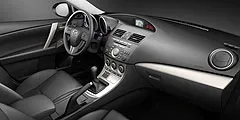

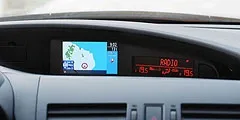
True, you quickly get used to the complex geometry of the space in front of the driver, and all the dials and displays turn out to be quite readable — at least, it's very convenient to follow the road on the navigation screen. However, the driver will also have to figure out the many different-sized buttons, small buttons, and knobs on the front console, which are scattered across the plastic with some unearthly logic. Most likely, everything is simple there... if you thoroughly study the owner's manual.
Working on Mistakes
What did all journalists and even some owners usually criticize the previous version of the Mazda3 for? That's right — for poor sound insulation. The sound of the engine, the noise from tires rolling on the road, and the whistle of the wind all penetrated the cabin. However, owners of the new third Mazda are unlikely to complain about this drawback — after driving more than 200 kilometers across the Iberian Peninsula, my colleagues and I were convinced that the new "three" has become much quieter.
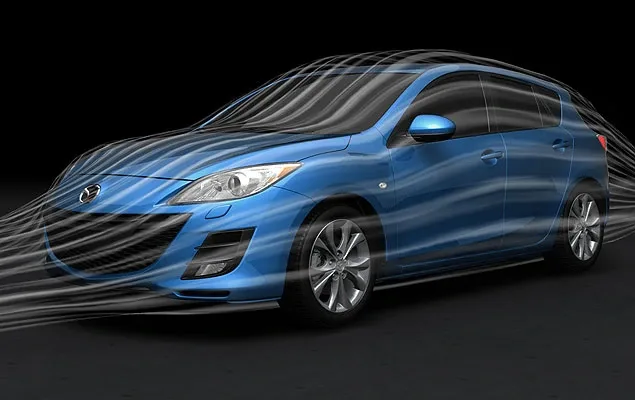
According to official data, the cabin of the new "MaTryoshka" has become 6-11 percent quieter. To achieve this effect, engineers, firstly, laid the "sound insulation" in the body panels in a new way, and secondly, thoroughly refined the aerodynamics of the body.
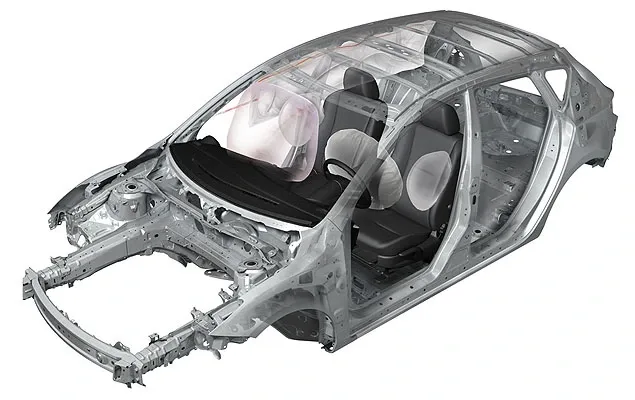
A certain role in reducing the noise level was also played by the overall increase in body stiffness. The designers not only increased the number of welding points and welds in the most loaded places but also added new reinforcing elements. Both the hatchback and the sedan have an additional beam under the roof that connects the middle pillars, and the frame formed in the hatchback by the rear pillars and the reinforcing bar passing under the roof is now not welded but stamped as a single profile.
In addition, the new Mazda3 has strengthened the suspension inherited from the first generation — MacPherson struts in the front and a multi-link in the rear. The arms and the front subframe made of stamped steel have become more powerful, the mounting points of the front and rear anti-roll bars are arranged differently, and a strut brace between the front suspension struts has appeared.
Bon Voyage
However, "strengthening" the suspension does not mean that the new Mazda3 has become stiffer than its predecessor. On the contrary, due to increased angular and longitudinal stiffness, the chassis on second-generation cars has become more energy-intensive and much better "digests" bumps. Although, honestly, there were few potholes and holes on the roads around the resort of Cascais, where the test drive was held. But there are plenty of serpentines winding along the rocky Atlantic coast and hills around Sintra — the ancient residence of Portuguese kings. On them, we were able to check whether the famous handling of the third Mazda suffered as a result of the modernization.
After the very first series of several scenic turns, it became clear that even if the suspension of the "three" has lost some of its "sporty" settings, it is only a very small part. The car still goes through corners very flat, and at the same time gives the driver a feeling of complete control over the car, which quickly turns into excitement. Yes, the suspension has become a little softer, the rolls have become, perhaps, a little larger. However, due to the increased rigidity of the chassis, the new Mazda3 feels more "composed" on the move.
The steering, as it seemed to me, has become a little more comfortable — the reaction to steering wheel turns is no longer as lightning-fast as before. And this is more of an advantage than a disadvantage: the previous Mazda3 seemed overly sharp in this regard to many drivers, especially older ones. The steering wheel itself has also become lighter — this was achieved by increasing the volume of the hydraulic cylinder of the electro-hydraulic power steering. In addition, the steering gear is now attached to the subframe at three points instead of two, which made it possible to install softer bushings and significantly reduce vibrations on the steering wheel from road irregularities.
Familiar engines, new approach
On Portuguese roads, we managed to try both petrol engines that the new Mazda3 will receive in Europe. We are talking about refined versions of the already known four-cylinder MZR units with a displacement of 1.6 and 2.0 liters. The power remained the same — 105 and 150 horsepower, respectively, but the engines now comply with the Euro-5 standard. In addition, the two-liter unit has acquired a direct fuel injection system.
However, these engines will not reach our market: Mazda marketers decided that Euro-4 standards are sufficient for Russia, which the previous generation of engines, familiar to us from the first Mazda3, meets. In addition, we will again be left without diesel versions! Russian diesel fuel, as before, is contraindicated for the Japanese diesel.
Although the diesels, it must be admitted, are excellent! Especially the new MZR-CD with a displacement of 2.2 liters. It exists in two versions — boosted and regular, which differ mainly in the size of the turbocharger. The "charged" version develops 185 horsepower and 400 Newton-meters of torque, while the "civilian" version — 150 "horses" and 360 Newton-meters. Moreover, both modifications reach peak torque already at 1800 rpm.
But we were not deprived of the new five-speed automatic transmission, which will be installed on two-liter petrol versions. The old four-speed "automatic" will remain only on cars with the 1.6 engine.
Looking to the future
After the trip to Portugal, only positive emotions remained from the car. But for some reason, the feeling did not leave that we were shown not quite a new car. Rather, it is a deep "facelift" combined with careful work on the mistakes made during the creation of the first generation Mazda3. In principle, six months ago this would have been enough for potential buyers to besiege Russian Mazda dealerships.
Alternative
|
However, now, in times of crisis, even the "hottest" new products do not cause a stir — few can afford a new car. In such a situation, the success of the new Japanese "golf class" will depend only on whether Mazda can maintain the "price/quality" ratio at an acceptable level, which made the "three" one of the bestsellers of the Russian market.
For now, the intrigue remains — prices for the new third "Mazda" have not been announced. And although the second generation Mazda3 will appear in Russian showrooms already in August, no one undertakes to predict its cost.
Technical characteristics of the Mazda3 2.0 AT sedan
| Length, mm | 4580 |
| Width, mm | 1755 |
| Height, mm | 1470 |
| Wheelbase, mm | 2640 |
| Curb weight, kg | 1335 |
| Engine displacement, cm3 | 1999 |
| Power, hp/rpm | 150/6500 |
| Torque, Nm/rpm | 187/4000 |
| Acceleration time from 0 to 100 km/h, s | 10.6 |
| Maximum speed, km/h | 210 |
| Fuel consumption in combined cycle, l/100 km | 7.6 |