
Mazda3 is the bestseller of the Japanese brand: over two million such hatchbacks and sedans have been sold worldwide. And at the same time, it is one of the most driver-oriented models: even the modest version with a 1.6-liter engine, despite all its flaws, delivered plenty of driving pleasure. That is probably why the arrival of the next-generation car was met with heated discussions, sighs, and doubts — is this the Mazda we fell in love with? With the "six," I recall, no such conversations arose.
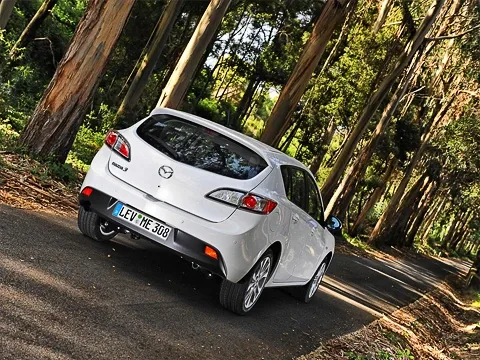
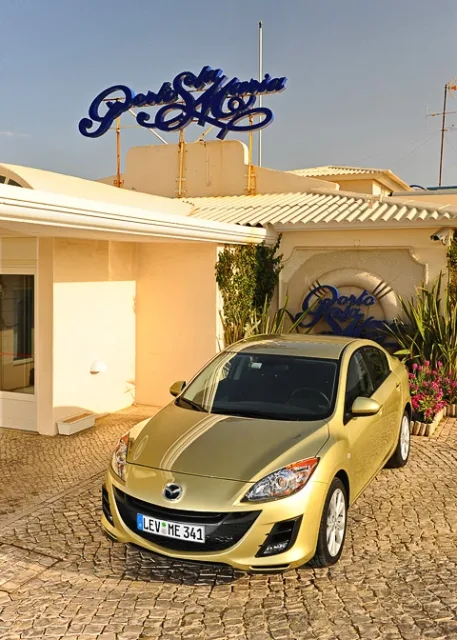
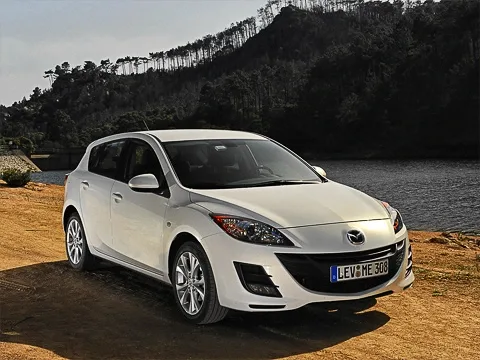
I spent quite a long time pondering whether I like the exterior of the new "three." If Spielberg were making an automotive "Jaws," the role of the bloodthirsty shark would go to the Mazda3. And the Cheshire Cat, switching to a car, would choose the "three." Who sacrificed the original radiator grille to this very "shark"? No, I won't claim it turned out ugly. But something bothers me.
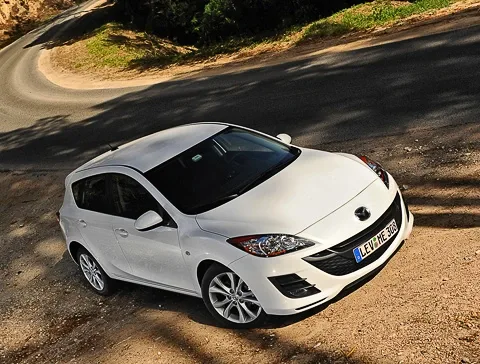
The hatchback has grown 45 mm in length, but the wheelbase remains unchanged at 2640 mm.
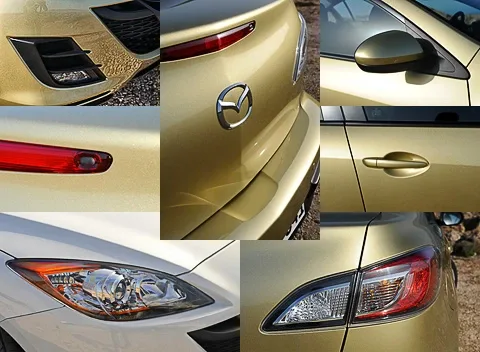
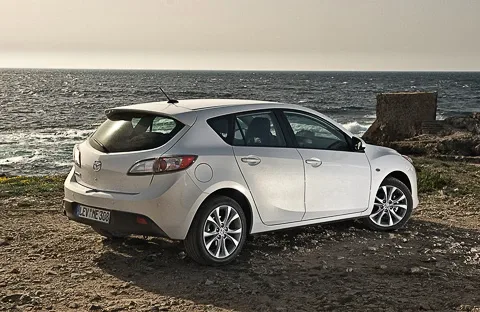
The partitions on the rear side windows and the tail lights also bother me. Whether the Mazda3 is beautiful and whether it has surpassed its predecessor in design can be debated endlessly. But one cannot help noticing: the stylists have caught the current trend, and Mazda, along with Renault, has ridden the new "smiley" wave. Apparently, it is no coincidence that Mazda's former chief designer will now command Renault's artists. It seems both companies share a similar outlook on life. It doesn't matter whether it's beautiful or not. The main thing is that it's fashionable!
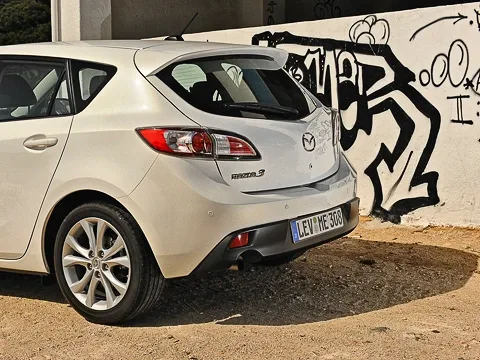
What matters even more is recognizability. Even if the Mazda's face bore an Audi shield, it would still remain a Mazda 3. The secret lies in the proportions. One can criticize the Golf endlessly for conservatism, but the Germans don't change its appearance due to creative stagnation. It would be a sin to touch the proportions by which you recognize a car from five kilometers away. The Astra, for instance, is a completely different car in each generation. But Mazda has remained the same familiar "three." In short, I say "yes" to the design.
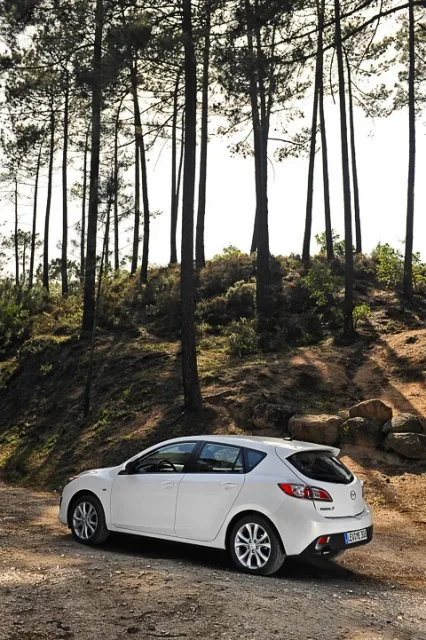
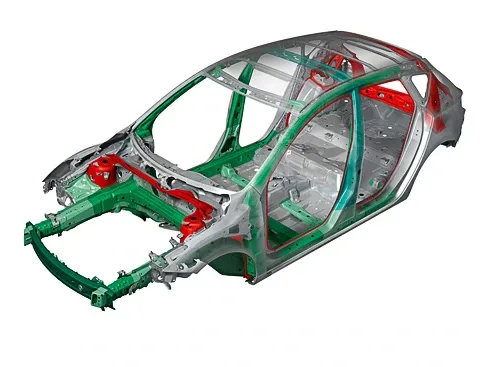
Although for preserving the proportions, thanks should go not to the designers but to the accountants who did not allow building the new model from scratch. The platform remains the same. Consequently, the body's load-bearing structure has not fundamentally changed, nor has torsional rigidity, although there are plenty of point reinforcements. At the same time, the curb weight was slightly reduced — by about 15 kg. That is, the base "three" with the 1.6 engine weighs 1245 kg.
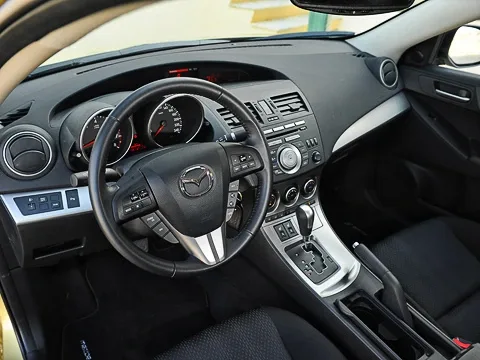
The buttons in the cabin are like those on the remote of a high-end hi-fi amplifier. Here, as in the Mazda 6, there is the CF-Net interface: from the steering wheel, you can control anything — from navigation to climate control. True, you'll have to get used to the controller.
The interior draws the fewest complaints. To those who criticized the cheap, rattling plastic of the dashboard, Mazda offered a soft (but not "expensive") one. For most, that will be more than enough. The new architecture in the spirit of the Honda Civic, rich equipment: swivel bi-xenon, dual-zone climate control, smart key, blind-spot monitoring system (will not appear in Russia). There is even a heated windshield — a signature Ford feature. Oh yes, Ford is supposedly no longer involved.
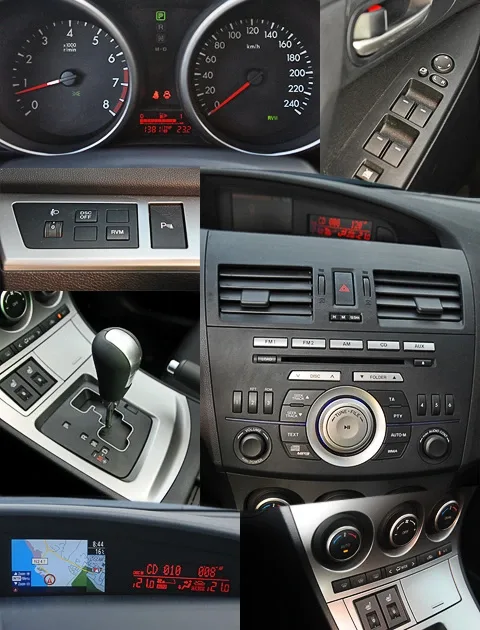
- The base instruments have drawn scales. More expensive versions get optitronic ones with blue-red backlighting. The needles in the zero position no longer hang strictly downward: a symbolic moment for the "discharged" Mazda. The new instruments are easier to read.
- You don't need to get used to controlling the audio system and climate control, but the two different-sized screens in the center of the dashboard are a strange solution.
- The color display of the navigation system is quite small, but conveniently located: you take your eyes off the road for only a moment. In simpler versions, it is replaced by a monochrome screen.
The doors are still centrally locked and unlocked not by pressing a separate button, but by turning the "flag" on the driver's door handle. At least thanks for no longer needing to press a button with the mysterious abbreviation AMB to find out the outside temperature. I am not one of those who immediately guessed that the Japanese meant ambient — the surrounding environment.
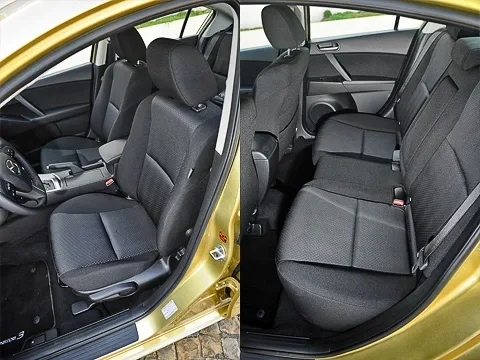
- The driving position is quite low and comfortable, with plenty of adjustments for both the seat and the steering column. The handbrake, in Japanese style, is located on the right side, as in its predecessor.
- The front seats on base versions are flat, but better than before. For an extra charge, the driver's seat will be equipped with electric adjustments with memory. In the rear, unfortunately, there is no more space.
The navigation screen should be equipped with a glycerin lens — like the ancient Soviet TV set KVN. Otherwise, it's hard to see anything. You can only control the navigation from the steering wheel — inconvenient. But it will be available in Russia: firstly, at a reasonable price, and secondly, Russified. But why is this traditional red information display in the center of the dashboard? The company clings to it as if its creator saved the life of Mazda's current president. But in terms of seating position, seat shape (they have become slightly more contoured), or the clarity of the gearshift mechanism — no problems at all.
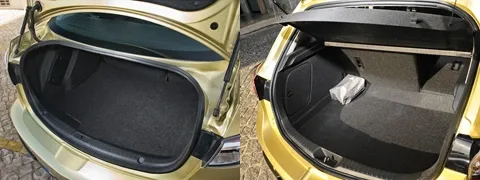
The trunks are normal for their class: moderately spacious, with a wide opening and convenient transformation, both for the sedan (430 L) and the hatchback (340 L).
In general, the interior has certainly become better, but exactly enough to remain Japanese, Mazda-like. There was no breakthrough; a precisely dosed evolution occurred. Owners of previous "threes" will be satisfied, but the Golf remains out of reach (including in price!). Although it was one of the main reference cars during development. At least in terms of driving qualities.
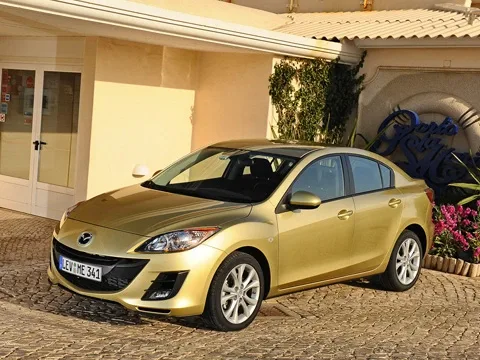
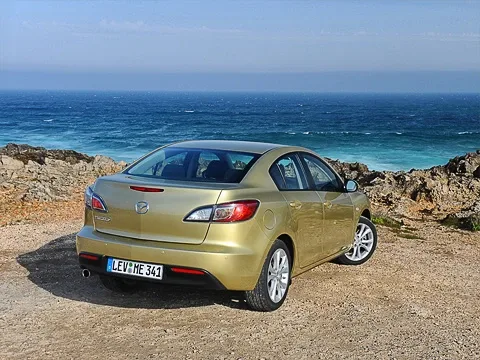
The sedan is not as harmonious as the hatchback. Although the bridge allowing the rear window to lower completely looks natural here.
It's not noticeable at first glance. The clutch, heavy and sharp, exactly like old-school garage rock, as before, engages at the very beginning of the pedal travel. I almost stall. Not an optimal algorithm for the 1.6 engine, but we're used to it. If I can recognize any Mercedes-Benz with my eyes closed by the smell of the cabin, then I recognize Mazda by the clutch, the short-throw and somewhat stiff gear lever, and the sharp throttle responses.
Although the first impression was rather negative. It doesn't go! We seem to know gasoline engines from the cradle. But here's a surprise! The combination of the 105-horsepower 1.6 engine and the five-speed manual used to work smoothly, but now you have to rev the engine, rev, rev... The eco-norms made it lazy, exactly like an Italian on Monday — the engines now meet Euro-5 requirements. However, Russia will get "dirtier" and "livelier" Euro-3 engines. The main thing is that the two-liter engine now works with a five-speed automatic instead of a four-speed one. The same one used in the Mazda 6. A normal gearbox: nothing to criticize. Though nothing to praise either.
But the essence of the changes that happened to the "three" is not in the design or the powertrains — it's in something else. For instance, a couple of months ago, I gave a ride to an owner of a late-80s Porsche 911 in the latest Carrera 4 model. Here it is, the quintessence of progress. 0-100 in 4.9 seconds versus his six, 345 horsepower, a rapid-fire "robot" killer. And the owner of the old "rocket" only muttered: "Somehow, there's too little emotion."
The same story with Mazda. Where did the vibrations go? Where are the noises? Of course, try to reproach Mazda's engineers for this — and they'll call the medics on you. But it was precisely these flaws that organically complemented the previous image of the Mazda 3 — the image of a cheap sports car. The new "three" is smoother and quieter, but that, in my opinion, has made it less emotional.
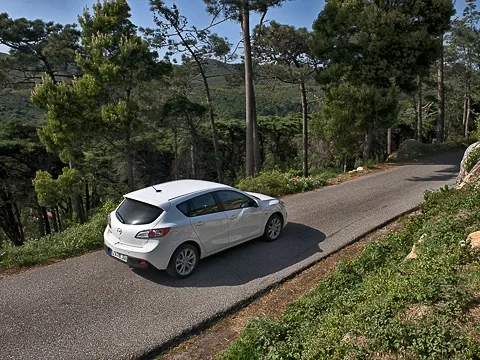
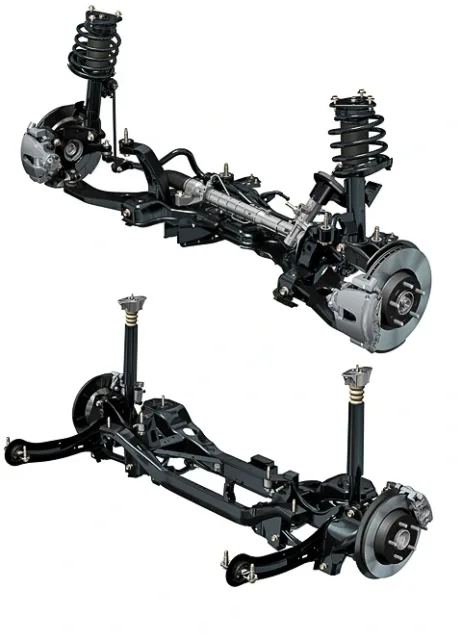
The same goes for handling. It's hard to find fault with the behavior of the new car. Mazda gets a pass automatically, especially since the suspension layouts haven't changed. But now Mazda responds to the driver's commands differently — more sensibly, if you will. How can I explain this? Previously, the "three" only needed a direction to be indicated — and it would throw itself into the corner. But now it waits for me to show it the entire path from start to finish with the steering wheel. It's all academic and precise, and it's more convenient for daily driving. "This is what European customers wanted," Yoshiyuki Maeda, the Mazda 3 program chief, tells me, "while Americans, for example, wanted a sharper car — and we made it for them." It's been a long time since we had a reason to envy the Yankees.
In Europe, the two-liter engines of the "three" will be equipped with direct injection; in our market — with conventional port injection, like in the previous generation cars.
If we rely on forecasts according to which Germany will still overtake Russia in Mazda sales volume, then the pro-German approach has its merits. In the old "three," I would hardly have dared to set off for five hundred kilometers, but here — easily. And this despite the fact that the suspension hasn't softened at all — it has even become stiffer! The new "three" handles minor road surface defects better, but on serious bumps it rocks no less. However, once you switch to the old car, you get the feeling that you've accidentally ended up on a vibration stand. Not surprising: engineer Maeda started at Mazda precisely as a specialist in noise and vibration insulation. While working on the "three," he obviously remembered his youth!
An interesting picture emerges. Previously, we journalists praised the old Mazda 3 for its sportiness and at the same time criticized it for weak noise insulation and vibration comfort. We cursed its onboard computer and climate control, but forgave all the flaws for its vibrant character in motion. Now we have a car that doesn't require forgiveness for anything. The comments have been heard: much has been reworked and improved. And now we complain that they didn't deliver where we didn't even complain. Is that fair?
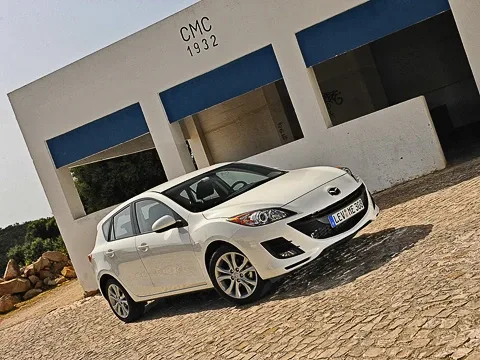
In Russia, the new Mazda3 will appear only in August. Due to new regulations, the car won't have time to pass certification earlier.
The average buyer of the "three" (especially if it's a female buyer) actually needs a better interior, fresh design, comfort, and practicality. All of this is present in the new car. Even handling remains at a high level. But emotionality is a parameter that isn't measured in SI units. And "zoom-zoom" sounds to most like something from the world of photography. If we draw analogies, the old car seemed more alive, but it was rock recorded not in a modern studio, but in a garage.
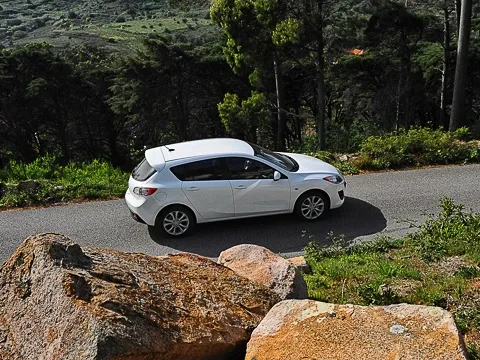
The new Mazda3 is no longer a daring debutant, but a star with multi-platinum sales. It easily shakes hands with the "fifth" Golf, which sold only half a million units more. In Russia, it's in the top ten, while the Golf isn't. Mazda has re-qualified from rockers to pop performers, but the world around has also changed: Lancer, Civic — they've also become completely different. You have to adapt, find a new sound, compose more relevant hits. But one thing remains unchanged — the music of the Mazda 3 is still alive.
Technical specifications
| Model | Mazda3 1.6 | Mazda3 2.0 |
|---|---|---|
| Body | ||
| Number of doors/seats | 5/5 (4/5) | 5/5 (4/5) |
| Length, mm | 4460 (4580) | 4460 (4580) |
| Width, mm | 1755 | 1755 |
| Height, mm | 1470 | 1470 |
| Wheelbase, mm | 2640 | 2640 |
| Track front/rear, mm | 1530/1515 | 1530/1515 |
| Curb weight, kg | 1255 (1245) | 1340 (1335) |
| Gross weight, kg | 1770 (1745) | 1835 (1820) |
| Trunk volume, l | 340–1360 (430) | 340–1360 (430) |
| Engine | ||
| Type | petrol, with port injection | petrol, with port injection |
| Location | front, transverse | front, transverse |
| Number and arrangement of cylinders | 4, in-line | 4, in-line |
| Number of valves | 16 | 16 |
| Displacement, cm3 | 1598 | 1999 |
| Max power, hp/rpm | 105/6000 | 150/6500 |
| Max torque, Nm/rpm | 145/4000 | 187/4000 |
| Transmission | ||
| Gearbox | manual, five-speed | automatic, five-speed |
| Drive | front | front |
| Chassis | ||
| Front suspension | independent, coil spring, McPherson | independent, coil spring, McPherson |
| Rear suspension | independent, coil spring | independent, coil spring |
| Front brakes | disc, ventilated | disc, ventilated |
| Rear brakes | disc | disc |
| Performance characteristics | ||
| Maximum speed, km/h | 188 | 210 |
| Acceleration time from 0 to 100 km/h | 12.2 | 10.6 |
| Fuel consumption, l/100 km | ||
| — urban cycle | 8.3 | 10.6 |
| — extra-urban cycle | 5.2 | 5.8 |
| — combined cycle | 6.3 | 7.6 |
| Fuel tank capacity, l | 55 | 55 |
| Fuel | AI-95 | AI-95 |
Technology 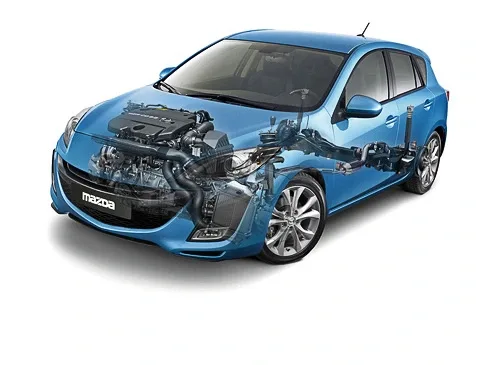
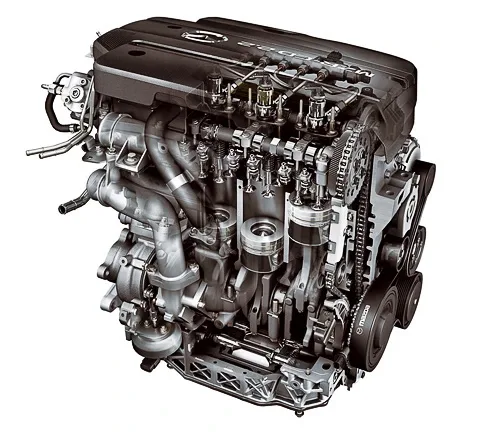
The newest 2.2 turbodiesel is produced in two tuning variants — 150 hp or 185. All engines now comply with Euro-5 standards. Nothing is yet known about the Russian prospects of the diesel "three."
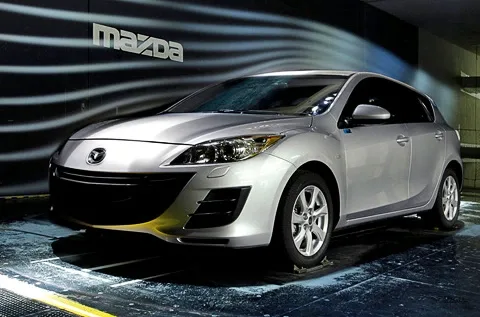
The aerodynamic drag coefficient Cx for the hatchback was reduced from 0.32 to 0.3. For the sedan, it remained unchanged — 0.28.
Design 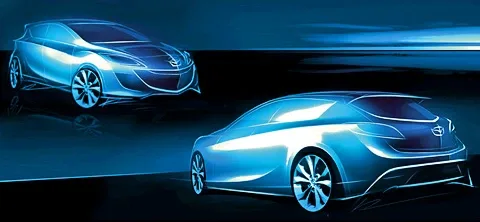
The Mazda3 is Laurens van den Acker's first work as Mazda's chief designer. The project designer is Kunihiko Kurisu, whose previous work was the Mazda2. Van den Acker himself, by the way, recently left the company for a similar position at Renault.
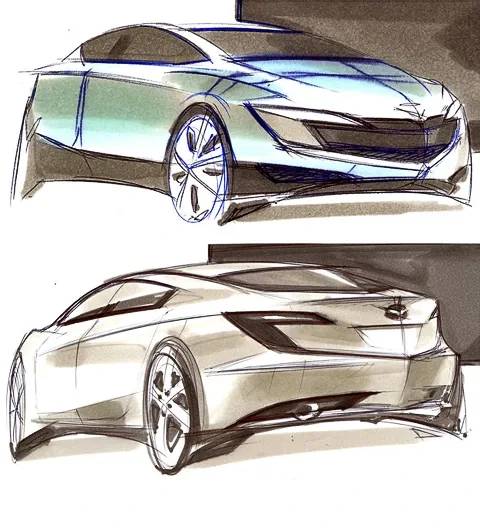
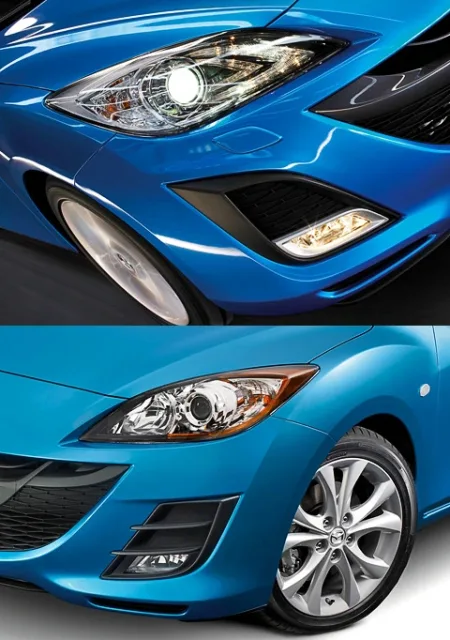
The styling package SAP (Sport Appearance Package, top) differs primarily in the front optics: here are different fog lights, and the headlights have "checkmarks" of the parking lights. Also included is a rear spoiler from the MPS version, other bumpers and wheels.
Behind the scenes 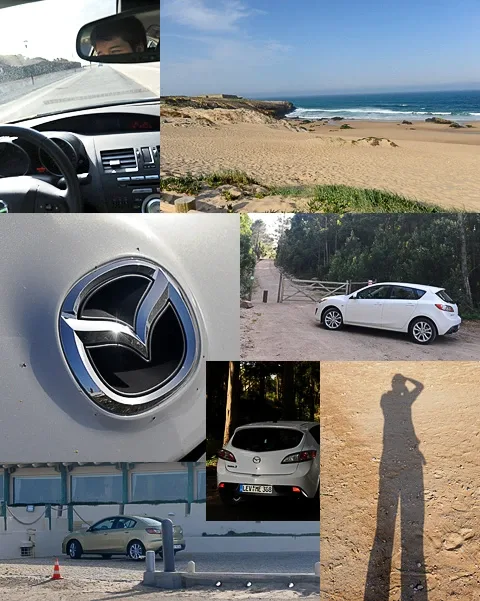
It's warm in Lisbon — around +25 Celsius. I spent less than a day in this wonderful place and really regretted that among the test cars there was no two-liter version with a manual transmission. Engineer Maeda assured that its settings are significantly "hotter" than those of the base versions and two-liter ones with automatics.