The Bologna Motor Show is a surprisingly calm place: the public leisurely strolls between the stands, and even loud premieres take place in the spirit of a chess club. However, the appearance of the new Mazda 3 brought liveliness to this quiet haven: stilt walkers, acrobatic acts, and the overall atmosphere suddenly reminded us of the usual Russian shows.
In Italy, we were only allowed to inspect the car and listen to long stories about its philosophy. The real acquaintance with the driving qualities was scheduled for Mallorca, where we were met by a piercing winter wind. There were plenty of technical presentations there too: we were shown models of trees and ships that one of the engineers assembles, while we impatiently glanced at the cars parked nearby.
Finally, we were given the keys. For the test, we took the potentially most in-demand version — with a 1.6-liter engine and a five-speed manual gearbox. To complete the picture, we also chose the base trim, which can be distinguished from more expensive versions by the absence of fog lights and some decorative elements.
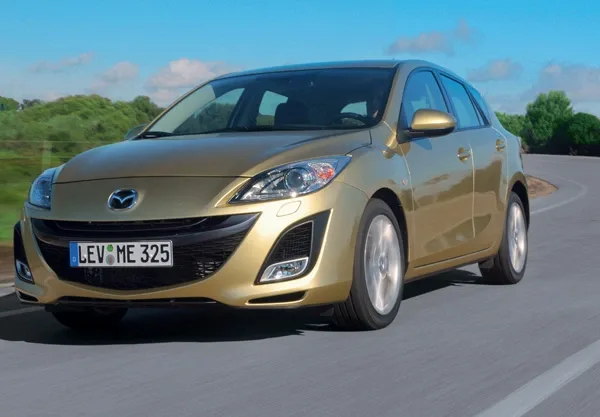
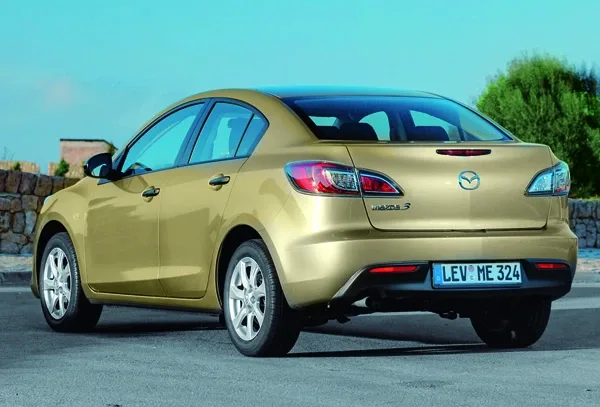
DIFFERENT EYES
The rear lights of the hatchback and sedan are different. On the five-door, they look noticeably more interesting and richer.
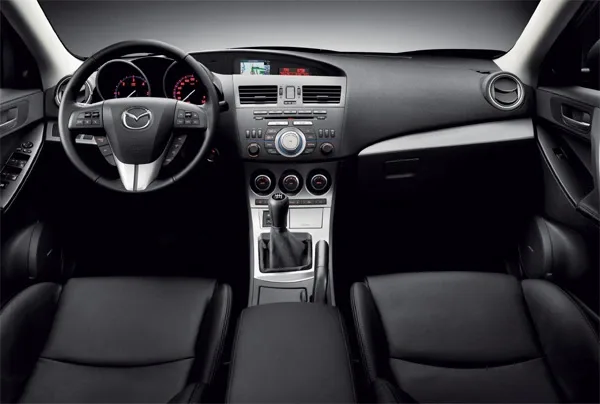
Admittedly, the interior of the base version without light inserts on the dashboard looks gloomy. Everything is in its place, assembled solidly, even the hard plastic raises no doubts, but the atmosphere is dreary. The instrument clusters with monochrome backlighting also lose to their "painted" counterparts from higher trims. True, this problem can be fixed with an extra payment, but replacing the boring monochrome display of the trip computer with something more colorful is no longer possible: the only alternative is the navigation screen, which is not supplied to Russia. Because of this, some of the buttons on the steering wheel will disappear from Russian cars, although the remaining buttons will still be enough to train your fingers.
Otherwise — fresh, Mazda-like original. The only thing that upset me was the small range of longitudinal adjustment of the front seat: tall drivers will feel cramped. We were given little time and space for "zoom-zoom," but we still learned something about the new "three."
First — the cabin has become quieter. The Japanese claim a reduction in noise by an average of 9%, and one wants to believe them, although these percentages cannot be verified by ear. Second — even heterogeneous plastics do not creak.
The engine with 109 hp is a lively one, although at the bottom it lacks punch. Nevertheless, it is enough for both the city and the highway, where it accelerates the car to 188 km/h. The gears in the five-speed manual are well chosen, the lever pleases with clarity. Little has changed in the character of the car, and even with the suspension recalibration, it has not become softer. The Mazda people themselves do not hide this: they say their suspensions are tuned for handling, and if the car starts to rock on waves, then it is no longer "zoom-zoom," but, as they put it, cold tea with sour milk.
I really wanted to describe the delights of the excellent 180 hp diesel — with the world's first particulate filter on nanoparticles and truly fantastic traction. To tell that with such an engine, no MPS is needed. But... Please do not wait, do not hope, and do not rely on the global financial crisis, which theoretically could open the doors for our market. Japanese steadfastness in this matter is worthy of respect, as is the persistence of our oil workers, who for years have been trying to reach at least Euro 0 standards.
Sedans and hatchbacks with gasoline engines will go to Russia. The younger one, with a volume of 1.6 liters, produces 105 hp, and the older one, two-liter, produces 150 hp. The latter works in tandem with a five-speed automatic, which shifts quite briskly, and can accelerate the Mazda3 to 210 km/h. Fuel consumption promises to be moderate — about 11 liters in the urban cycle.
Maxim Rakitin
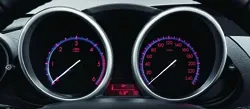 | COLOR MUSIC
The "colorful" dials are a privilege of expensive versions. But even the standard ones, devoid of such a variety of colors, are perfectly readable at any time of day, largely thanks to the deep "wells" |
| OH, HOW MANY OF YOU!
There are indeed too many numbers. Perception is complicated not only by
different colors of the screens, but also by the completely inconsistent graphics of the information windows. | 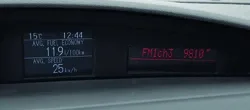 |
 | |
Manufacturer's data
■ ENGINE
1560 cm3 petrol, 4 cylinders
109 hp at 4000 rpm,
240 Nm at 1750 rpm
■ TRANSMISSION
Manual, 5 gears front-wheel drive
■ DYNAMICS
max speed – 188 km/h
acceleration time 0-100 km/h – 12.2 s
■ DIMENSIONS (mm)
length – 4460
width – 1755
height – 1470
■ ECONOMY
average consumption – 8.3 l/100 km